
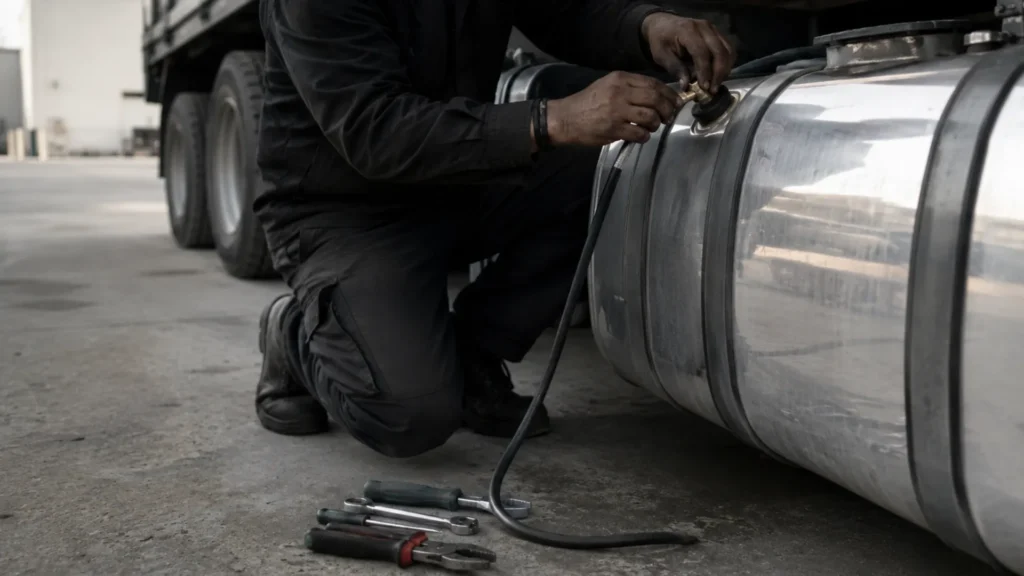
Fuel sensor accuracy is the first question most South African fleet operators ask about truck fuel monitoring, and it deserves a more honest answer than the industry usually gives.
Here is the honest answer. A sensor in a diesel tank does not measure litres. It measures a level, and a level only becomes a volume once somebody has taught the system what that particular tank looks like on the inside.
Skip that step and the reports still arrive, still look confident, and still disagree with the pump slip. Therefore the manager stops trusting the system, the alerts get ignored, and an expensive installation quietly becomes wallpaper.
The difference between a fuel monitoring system that works and one that annoys people is rarely the hardware. It is almost always the calibration.
Direct Answer: What Determines Fuel Sensor Accuracy?
Fuel sensor accuracy depends on three things: the quality of the sensor itself, the calibration that maps sensor readings to actual litres in that specific tank, and the conditions under which the reading is taken. Of the three, calibration matters most, because an uncalibrated sensor produces consistent readings that mean nothing.
Consistency and accuracy are not the same property. A sensor can repeat the same wrong number all day. In practice, fleets discover this at month end, when a reliable-looking report refuses to reconcile with what the fuel supplier invoiced.
DigitFMS installs and calibrates truck fuel monitoring systems per vehicle rather than per fleet, because two trucks of the same model can carry different tanks after a repair or a replacement.
Fuel Sensor Accuracy Versus the Dashboard Gauge
A truck’s factory fuel gauge exists to stop a driver running dry. It was never built to support an audit.
Manufacturers deliberately damp that gauge so the needle does not swing every time the vehicle brakes or climbs a hill. They also flatten its response near full and near empty, which is why a tank seems to sit on full for the first hour and then drop quickly. As a result, the dash reading tells a driver roughly what he needs and tells an operations manager almost nothing.
Some fleets try to solve this by pulling fuel data off the vehicle’s CAN bus instead. That approach inherits the same damping, because the CAN value often originates from the same sender the dash uses. Consequently a dedicated in-tank sensor, calibrated to the tank, gives a fleet something the vehicle itself never offered.
The Conditions That Undermine Fuel Sensor Accuracy
A diesel tank is a hostile place to take a measurement.
Fuel moves constantly while a truck drives, and the surface the sensor reads tilts with every corner, gradient and braking event. Meanwhile the tank itself is rarely a neat cylinder. Saddle tanks curve, baffles divide the space, and the last hundred millimetres of depth almost never holds the same volume as the first hundred.
What distorts fuel sensor accuracy
Above all, none of these are faults. They are physics that calibration has to account for.
- Gradient — a truck parked nose-down reads differently from one on level ground
- Slosh — fuel in motion never presents a flat surface to measure
- Tank geometry — curved and baffled tanks hold uneven volume per centimetre of depth
- Temperature — diesel expands when warm, so the same mass occupies more space
- Return-line heating — fuel returning from the engine warms the tank during a shift
- Twin tanks — linked tanks equalise slowly and unevenly after a fill
- Vibration — engine and road noise ride on top of every raw reading
Good systems handle these by filtering the raw signal and by treating readings taken while stationary as the reliable ones. Even so, a fleet that expects an exact litre figure at any moment on any gradient is expecting something no tank sensor can deliver.
Check what your current readings are worth
A DigitFMS technician can verify whether your existing fuel data is calibrated to each tank or merely consistent.
Book a Fuel Monitoring Assessment →How Does Tank Calibration Create Fuel Sensor Accuracy?
Calibration builds a map between what the sensor sees and what the tank holds.
A technician drains the tank, then fills it in measured increments, recording the sensor value at each step. Because the tank is not a uniform shape, those pairs form a curve rather than a straight line. The platform stores that curve against the vehicle, and every later reading passes through it before anybody sees a litre figure.
Consider a truck with twin tanks, one replaced after an accident with a unit from a different supplier. The two tanks now hold different volumes at the same depth. A fleet-wide calibration profile would report that vehicle wrongly every day of its working life, which is exactly why the work happens per vehicle.
The Digit D-Fuel sensor is calibrated this way at installation. DigitFMS handles the work through a national branch network, so recalibration after a tank change does not require a truck to travel to another province.
The Pump Is Legally Verified. Your Tank Is Not.
South African fuel dispensers are regulated measuring instruments. Truck tanks are not.
Legal metrology in South Africa falls to the National Regulator for Compulsory Specifications, which administers the Legal Metrology Act and the verification of trade measuring instruments, fuel pumps among them. A forecourt pump therefore carries a legal claim about the litres it delivers.
Your tank sensor carries no such claim, and it does not need to. It exists to answer a different question — not “how much did I buy” but “how much arrived, and did any of it leave again”. Consequently the two figures are complementary rather than competing, and a well-run fleet compares them deliberately.
That comparison is where calibration earns its money. Without it, every gap between slip and sensor looks like a possible theft, and investigating each one burns credibility until nobody investigates any.
Which Fleets Suffer Most From Poor Fuel Sensor Accuracy?
Poor fuel sensor accuracy hurts most where the terrain moves, the tanks vary and the margins are thin.
The operations that feel it soonest include:
- Mining and quarry fleets working permanent gradients
- Agricultural operations parking on uneven ground overnight
- Long-haul operators running twin or linked tanks
- Mixed fleets assembled from several manufacturers
- Construction fleets with vehicles repaired and re-tanked over time
- Any operator running a formal fuel reconciliation each month
- Fleets building a disciplinary case on fuel data
By contrast, a small delivery fleet on flat urban routes with identical vehicles will tolerate a rough calibration for a long time. Fleet size, therefore, is not the variable. Variety is.
Building a Fuel Measurement Strategy You Can Defend
Fuel data becomes useful at the point somebody is willing to act on it.
That threshold is higher than most fleets expect, because acting on fuel data means confronting a driver, disputing a supplier invoice or defending a figure to a client. Each of those conversations tests the calibration behind the number. Fleets that also monitor storage tanks find the same principle applies there, as our piece on bulk fuel management systems in South Africa sets out.
What a defensible setup looks like
In short, treat calibration as maintenance rather than as a once-off installation task.
- A calibration record held per vehicle, not per fleet
- Recalibration whenever a tank is replaced, repaired or moved
- Alert thresholds set as a rate of drop, not an absolute level
- Refuel events compared against the slip within days, not at month end
- A tolerance band agreed with the team before anyone is questioned
- Readings taken stationary treated as the reference values
- An annual spot check on a sample of vehicles
Revisit the tolerance band as the fleet ages. Older tanks, new routes and different load patterns all shift what normal looks like, and a threshold set three years ago will either flood the office with noise or miss the losses entirely.
Conclusion
Every supplier will tell you their sensor is accurate. Few will explain that accuracy is not a property of the sensor at all.
A sensor reports a level. Calibration turns that level into litres for one specific tank, and the conditions of the reading decide how much to trust it in the moment. Get all three right and fuel data becomes something a manager will act on. Get calibration wrong and the system produces confident numbers that nobody believes.
So the question to ask a supplier is not how accurate the sensor is. Ask how they calibrate it, per vehicle, and who recalibrates it after a tank change.
An uncalibrated fuel sensor is not inaccurate. It is simply not yet measuring anything.
Frequently Asked Questions
How closely a reported litre figure matches the diesel physically in the tank. That depends on the sensor, on the calibration mapping sensor values to that tank’s shape, and on the conditions when the reading is taken. Consistency alone does not make a reading accurate.
Several ordinary reasons before theft: an uncalibrated tank profile, a vehicle parked on a slope, warm diesel occupying more space than cool diesel, or twin tanks still equalising. Rule those out first, then treat the remaining gap as worth investigating.
A technician empties the tank and refills it in measured increments, recording the sensor value at each stage. Those readings form a curve stored against that specific vehicle, so every later reading converts through the real shape of the real tank.
The factory gauge exists to warn a driver, not to support an audit. Manufacturers damp it heavily and flatten its response near full and empty. CAN bus values often come from the same sender, so they inherit the same limitations.
After any tank replacement, repair or removal, after a sensor is refitted, and whenever a vehicle changes hands within a mixed fleet. An annual spot check across a sample of vehicles catches drift that nobody reported at the time.
On a long, shallow tank it changes the level at the sensor position noticeably, which is why parked readings on level ground make the best reference points. Systems that filter for movement and gradient give far steadier figures than raw output does.