
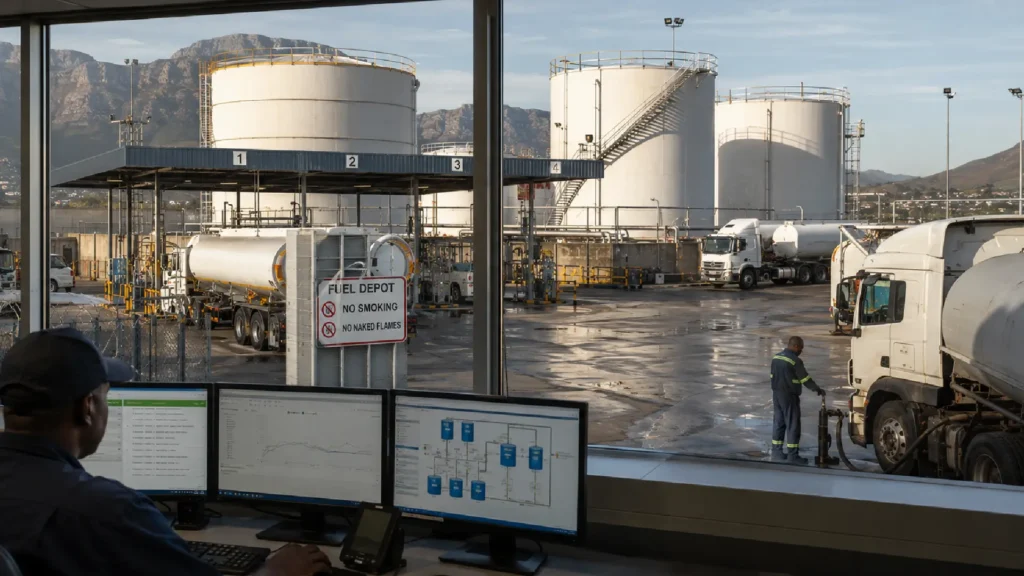
Fuel Storage Monitoring has become one of the most important yet overlooked aspects of operational cost control. Across South Africa, businesses invest heavily in managing vehicle fuel consumption, driver behaviour and route optimisation. However, many organisations pay far less attention to where fuel losses often begin — inside the storage tank itself.
Fuel remains one of the largest operating expenses for transport fleets, mining operations, agricultural businesses, construction companies and industrial facilities. Consequently, even small discrepancies can have a significant impact on profitability over time.
While organisations often focus on monitoring fuel after it enters a vehicle, substantial losses can occur long before that point. Furthermore, many businesses struggle to identify exactly where fuel losses occur because they lack visibility into storage, dispensing and reconciliation processes.
Therefore, modern fuel management strategies increasingly begin at the source. Understanding what happens to every litre after delivery has become essential for organisations seeking stronger accountability, improved reporting and reduced losses.
Direct Answer: Why Fuel Storage Monitoring Matters
Fuel Storage Monitoring provides visibility into fuel deliveries, tank levels, dispensing activity and reconciliation processes. Rather than focusing only on fuel consumption inside vehicles, businesses can monitor what happens to fuel from the moment it is delivered until it is dispensed and consumed.
Consequently, organisations gain better control over fuel usage, identify discrepancies earlier and reduce the risk of theft, losses and reporting inaccuracies.
DigitFMS helps businesses improve fuel accountability through D-Bulk, an intelligent bulk fuel bowser management solution that provides real-time visibility across storage, dispensing and reporting environments.
Why Fleet Operators Focus on the Wrong Fuel Risk
When fuel costs increase, many organisations immediately focus on vehicle-related factors. These may include driver behaviour, idling, route planning and vehicle efficiency.
Additionally, telematics systems have made it easier than ever to monitor fuel consumption once fuel enters a vehicle. As a result, businesses often assume that vehicle monitoring alone is sufficient.
However, this approach overlooks a critical question:
What happens before fuel reaches the vehicle?
In many organisations, fuel is delivered to a storage tank, transferred to bowsers or dispensing points and distributed across multiple vehicles, machines or assets. Meanwhile, visibility often decreases significantly at each stage of the process.
Consequently, businesses may have excellent visibility into fuel consumption while having limited visibility into fuel storage and dispensing activity.
Furthermore, this lack of visibility can create opportunities for losses that remain undetected for extended periods.
What Happens After Fuel Is Delivered?
Fuel management does not begin when a vehicle arrives for refuelling. Instead, it begins the moment fuel is delivered to a facility.
A typical fuel journey may look like this:
- Fuel supplier delivery
- Bulk storage tank
- Fuel bowser or dispensing point
- Vehicle, equipment or machinery
- Operational consumption
- Reporting and reconciliation
At each stage, opportunities exist for losses, inaccuracies or unauthorised activity. Additionally, organisations relying on manual monitoring processes often struggle to maintain accurate records throughout the entire fuel lifecycle.
Therefore, businesses should evaluate how much visibility they currently have into every stage of fuel movement.
The Fuel Visibility Problem
One of the most common challenges in fuel management is the visibility gap between delivery and dispensing.
Many organisations know how much fuel was purchased. Likewise, they know how much fuel should theoretically have been dispensed. However, they often lack accurate, real-time visibility into what actually occurred.
As a result, discrepancies may only become apparent during monthly audits, stock counts or financial reviews.
Additionally, identifying the root cause of fuel losses can become extremely difficult when historical data is incomplete or inconsistent.
Common visibility challenges include:
- Unknown fuel stock levels
- Delayed reporting
- Unauthorised dispensing
- Manual record keeping
- Inaccurate reconciliations
- Fuel theft concerns
- Multi-site management challenges
- Limited operational oversight
Consequently, organisations often make decisions using incomplete information. Furthermore, unresolved discrepancies can accumulate into significant financial losses over time.
Modern fuel storage monitoring addresses these challenges by providing accurate, real-time visibility into fuel inventory, movement and dispensing activity.
The Hidden Cost of Unmonitored Fuel Storage
Fuel losses are not always dramatic or immediately obvious. In many cases, losses occur gradually over time, making them difficult to identify until significant financial damage has already occurred.
Furthermore, organisations often assume that fuel theft is the primary cause of discrepancies. While theft remains a concern, several other factors can contribute to losses.
Common causes of fuel discrepancies include:
- Unauthorised dispensing
- Fuel theft
- Recording errors
- Manual data entry mistakes
- Unverified deliveries
- Inaccurate stock measurements
- Poor reconciliation processes
- Operational inefficiencies
Consequently, businesses may experience ongoing fuel losses without clearly understanding where the problem originates.
Additionally, even relatively small discrepancies can accumulate into substantial costs when large fuel volumes are involved. Therefore, visibility and accountability become essential components of fuel management.
Why Manual Fuel Logs No Longer Work
Many organisations still rely on manual fuel logs, paper-based registers or spreadsheet reporting systems. While these methods may have been effective in the past, modern operations often require greater accuracy and visibility.
Additionally, manual processes introduce opportunities for human error and delayed reporting.
Common challenges associated with manual fuel management include:
- Incomplete records
- Delayed updates
- Human error
- Missing information
- Lack of accountability
- Limited audit trails
- Time-consuming reconciliations
- Difficulty managing multiple sites
Furthermore, paper-based systems often provide only historical information. Consequently, businesses may only discover discrepancies days or weeks after they occur.
Modern fuel storage monitoring systems provide real-time visibility, helping organisations identify issues sooner and respond more effectively.
How Fuel Storage Monitoring Improves Visibility
Fuel Storage Monitoring provides organisations with continuous insight into fuel levels, movement and dispensing activity.
Rather than relying on manual checks and delayed reporting, businesses can access accurate operational data as events occur.
Additionally, fuel storage monitoring helps answer critical operational questions:
- How much fuel is currently available?
- When was fuel delivered?
- How much fuel was dispensed?
- Who accessed the fuel system?
- Which vehicles or assets received fuel?
- Are stock levels accurate?
- Are reconciliations balanced?
- Are unusual patterns emerging?
Consequently, organisations gain greater operational confidence and stronger accountability throughout the fuel lifecycle.
Furthermore, visibility helps managers make better decisions regarding procurement, replenishment schedules and operational planning.
The Role of Fuel Reconciliation
Fuel reconciliation is one of the most important aspects of effective fuel management. Simply purchasing fuel and dispensing it is not enough. Businesses must be able to verify that reported volumes align with actual stock movement.
Additionally, accurate reconciliation helps organisations identify discrepancies before they become significant losses.
A robust reconciliation process should account for:
- Opening stock levels
- Fuel deliveries
- Dispensing activity
- Closing stock levels
- Operational consumption
- Site transfers
- Exceptions and variances
Consequently, businesses gain greater confidence in the integrity of their fuel reporting and inventory management processes.
Industries Most at Risk
Although every organisation that stores fuel can benefit from improved visibility, some industries face significantly greater exposure due to high fuel consumption volumes.
Industries that commonly benefit from Fuel Storage Monitoring include:
- Transport and logistics
- Mining operations
- Construction companies
- Agricultural businesses
- Fleet operators
- Municipal fleets
- Fuel distributors
- Industrial facilities
- Plant hire companies
- Manufacturing operations
Furthermore, organisations operating multiple depots, remote sites or large vehicle fleets often experience the greatest benefits from centralised monitoring and reporting.
The South African Fuel Risk Environment
South African businesses continue to operate in an environment where fuel costs have a direct impact on profitability and operational performance.
Additionally, organisations face increasing pressure to improve efficiency, reduce waste and strengthen accountability across fuel-intensive operations.
For many businesses, fuel represents one of the largest controllable operating expenses. Consequently, even small improvements in visibility and accountability can produce meaningful financial benefits.
Furthermore, businesses managing large fuel inventories require stronger operational controls to ensure every litre can be accounted for accurately.
As a result, Fuel Storage Monitoring is increasingly becoming a strategic operational tool rather than simply a reporting solution.
Building a Complete Fuel Accountability Strategy
Fuel accountability extends far beyond measuring how much fuel a vehicle consumes. Modern organisations require visibility across the entire fuel lifecycle, from delivery and storage through to dispensing and operational consumption.
Furthermore, the most effective fuel management programmes combine multiple technologies and processes to create a complete operational picture.
A comprehensive fuel accountability strategy may include:
- Fuel Storage Monitoring
- Bulk fuel bowser management
- Fuel dispensing controls
- Access management
- Vehicle tracking systems
- Fuel consumption monitoring
- Driver accountability
- Automated reconciliation
- Operational reporting
- Exception management
Consequently, businesses gain complete visibility into fuel movement, helping ensure every litre is accounted for accurately.
Additionally, organisations can identify unusual activity earlier, improve reporting accuracy and strengthen operational controls across multiple sites.
How D-Bulk Supports Fuel Storage Monitoring
DigitFMS D-Bulk was designed to help organisations improve visibility across bulk fuel storage and dispensing environments.
Rather than relying on manual processes and delayed reporting, D-Bulk provides real-time operational insight into fuel inventory, dispensing activity and reconciliation processes.
Additionally, businesses can gain greater confidence in their fuel reporting by improving visibility across multiple stages of the fuel lifecycle.
D-Bulk supports operational objectives such as:
- Fuel inventory visibility
- Dispensing accountability
- Site monitoring
- Fuel reconciliation
- Multi-site management
- Operational reporting
- Fuel usage analysis
- Exception identification
Consequently, organisations can move from reactive investigations to proactive fuel management.
Furthermore, D-Bulk helps create a stronger foundation for long-term fuel accountability and operational efficiency.
Questions Every Business Should Ask
Before investing in additional fuel infrastructure or attempting to reduce fuel costs, organisations should evaluate how much visibility they currently have into fuel storage and dispensing operations.
Key questions include:
- Can we verify every fuel delivery accurately?
- Do we know our real-time tank levels?
- Can we account for every litre dispensed?
- How quickly can we identify discrepancies?
- Are our reconciliation processes accurate?
- Who has access to fuel dispensing infrastructure?
- Can we monitor multiple sites centrally?
- How much visibility do we have into fuel movement?
- Are manual processes creating risk?
- Can we confidently explain every variance?
Consequently, these questions often reveal operational blind spots that traditional fuel management processes fail to identify.
Furthermore, organisations that answer these questions honestly are typically better positioned to improve accountability and reduce fuel-related losses.
Conclusion
Fuel Storage Monitoring is no longer a luxury reserved for large fuel-intensive operations. It has become an essential component of modern operational control, accountability and risk management.
While many organisations focus heavily on vehicle fuel consumption, significant losses can occur before fuel ever reaches a vehicle. Consequently, businesses that fail to monitor storage and dispensing activity may overlook one of their largest operational risks.
Furthermore, manual processes, delayed reporting and limited visibility make it increasingly difficult to identify discrepancies before they impact profitability.
By implementing Fuel Storage Monitoring, organisations can gain real-time visibility into deliveries, inventory levels, dispensing activity and reconciliation processes. As a result, they can strengthen accountability, improve reporting accuracy and make better operational decisions.
Ultimately, you cannot effectively manage fuel if you cannot accurately see what is happening between delivery and consumption. That is where many fuel losses begin — and where stronger visibility delivers the greatest value.
Frequently Asked Questions
Fuel Storage Monitoring provides real-time visibility into fuel deliveries, tank levels, dispensing activity and reconciliation processes, helping businesses improve accountability and reduce losses.
By providing accurate visibility into inventory levels, fuel movement and dispensing activity, businesses can identify discrepancies earlier and investigate potential losses more effectively.
Yes. Modern systems can provide visibility into dispensing events, helping organisations improve accountability and strengthen fuel management processes.
Transport, logistics, mining, construction, agriculture, municipal fleets, manufacturing and industrial operations often benefit significantly due to their high fuel consumption volumes.
Fuel reconciliation helps verify that deliveries, stock levels and dispensing activity align accurately, allowing businesses to identify discrepancies and improve accountability.