
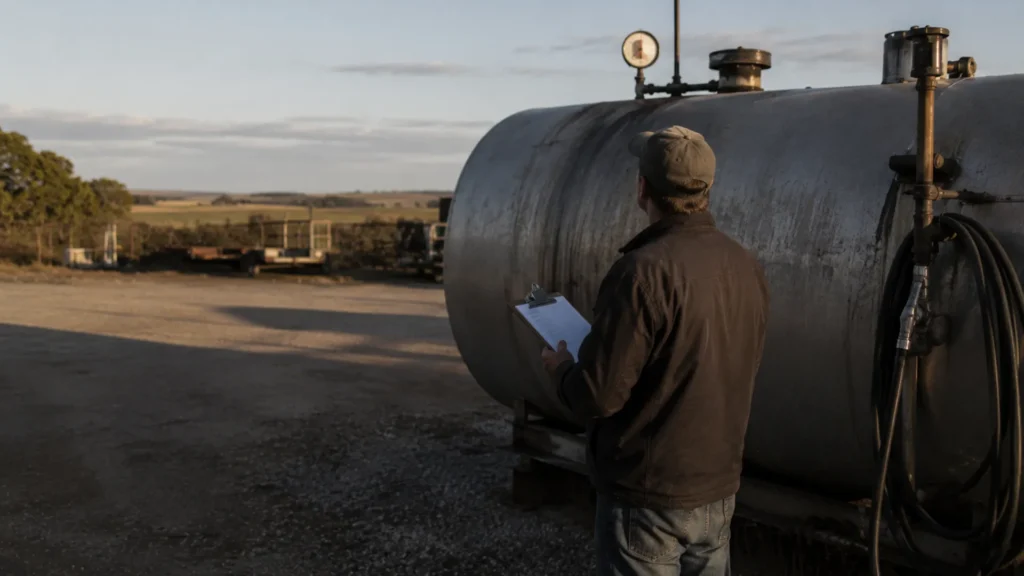
Fuel stock reconciliation is where operations and finance discover they have been describing the same diesel in two incompatible ways.
Operations knows the tank was full on Monday and low on Friday. Finance knows what the supplier invoiced. Between those two facts sits a variance nobody can explain, and month end arrives whether or not anyone has explained it.
Most South African sites close that gap by agreeing on a number. Somebody dips the tank, somebody adjusts the sheet, and the ledger balances because a person made it balance.
That works until an auditor asks how the figure was arrived at. Then the absence of a record stops being an administrative shortcut and becomes a finding.
Direct Answer: What Is Fuel Stock Reconciliation?
Fuel stock reconciliation is the process of proving that opening stock, plus deliveries received, minus fuel dispensed, equals closing stock in a bulk diesel tank. Where those figures disagree, the variance points to a measurement error, a recording error, or a loss — and only a dated record identifies which.
The arithmetic is trivial. The difficulty is that four separate figures come from four separate places, and on most sites at least two of them originate as somebody’s handwriting on a clipboard.
DigitFMS addresses this through bulk fuel bowser management, which timestamps every delivery and every draw so the reconciliation assembles itself rather than waiting for month end.
Why Fuel Stock Reconciliation Fails at Month End
A month-end reconciliation asks people to remember a month.
By the time finance requests the figures, the delivery happened three weeks ago, the operator who signed for it has taken leave, and the dispensing book has a gap on the days it rained. Therefore the reconciliation becomes an exercise in reconstruction rather than verification.
More importantly, a variance discovered a month late is almost never actionable. Nobody can investigate a missing quantity when the only certainty is that it went missing sometime in June.
The Four Numbers That Never Agree
Every reconciliation rests on four figures, and each one enters the process by a different route.
The delivery figure comes from the supplier. The dispensing figure comes from a meter or a book. The stock figures come from a dip or a gauge. Consequently they are not four measurements of one thing — they are four different instruments, read by different people, at different moments.
What breaks fuel stock reconciliation
Above all, most variance is not theft. It is arithmetic done on unreliable inputs.
- Dip readings taken by different people with different technique
- Deliveries signed for without anyone verifying the quantity received
- Dispensing logged after the fact, or not at all on busy days
- Temperature moving the volume between delivery and count
- Transfers between tanks recorded on one side only
- Contractors drawing fuel against a verbal arrangement
- Cut-off dates that differ between the site book and the ledger
Each of these produces a variance indistinguishable from a loss. As a result, real losses hide comfortably inside the noise, and honest operators spend their time defending figures that were never solid.
See what your last month would look like reconciled
A DigitFMS specialist will walk your site and show you which of the four figures you can currently evidence.
Book a Bulk Fuel Control Assessment →How Does Automated Fuel Stock Reconciliation Work?
Automation does not calculate the reconciliation faster. It captures the inputs at the moment they happen.
A tank sensor records the level continuously, so a delivery appears as a measured rise against the supplier’s stated quantity. An authorised dispensing point records every draw with a time, a volume and an identity. Because both events land in the same platform as they occur, the closing balance is not a figure somebody produces at month end — it exists already.
The Digit D-Bulk system works this way across tanks from small site bowsers up to large depot installations, and reports across multiple sites from one dashboard. Meanwhile the variance calculation runs daily rather than monthly, which is the difference between an investigation and an autopsy.
Getting Fuel Data Into Sage, SAP or Pastel
Diesel held on site is stock, and stock eventually has to appear in a financial system.
On most sites that journey runs through a spreadsheet somebody rebuilds every month. The site sends a figure, finance retypes it, and the audit trail ends at an email. By contrast, exporting measured data directly into Sage, SAP or Pastel removes the retyping step and, with it, the most common source of unexplained difference between the yard and the ledger.
This matters beyond tidiness. Finance can only cost fuel to a department, a site or a job if the underlying record carries that detail. Once it does, diesel stops being a single monthly expense line and becomes a cost anyone can question.
Operators claiming under the SARS diesel refund scheme face a stricter version of the same problem. Professional advisers report that SARS has intensified its auditing of diesel refund claims, with claims disallowed where logbooks could not evidence a complete trail from delivery through to qualifying use, and with records expected to be retained for five years.
Which Operations Need Fuel Stock Reconciliation Most?
Fuel stock reconciliation matters most where diesel is large enough to notice and dispersed enough to lose track of.
The operations that feel it hardest include:
- Mining and quarry operations running tanks at several pits
- Agricultural businesses claiming a diesel refund
- Construction firms moving bowsers between sites mid-contract
- Logistics depots refuelling both own and contracted vehicles
- Fuel resellers and depots carrying diesel as trading stock
- Any operation costing fuel to individual jobs or clients
- Businesses whose auditors have already raised a fuel finding
By contrast, a single tank on one site with one authorised user reconciles fine on paper. Volume, therefore, is not the only trigger. Dispersion is.
DigitFMS installs and supports these systems through a national branch network, which matters when tanks sit at pits and farms rather than at head office.
Building a Fuel Stock Reconciliation You Can Audit
An auditable reconciliation is one a stranger can follow without asking anybody a question.
That standard sounds severe until you consider the alternative, which is a figure defensible only for as long as the person who produced it still works there. Sites that have already tightened their loss controls, as our piece on fuel theft and fleet risk management describes, often find the reconciliation is the part still held together by memory.
What an auditable fuel record contains
In short, every litre needs a date, a direction and a name attached to it.
- Opening and closing balances captured on fixed dates
- Deliveries recorded as measured volume, not only as invoiced volume
- Every draw carrying a time, a quantity and an authorised identity
- Tank-to-tank transfers logged on both sides
- A tolerance band agreed with finance before the first variance
- Exceptions investigated within days, with the outcome written down
- Site cut-off dates matched to the accounting period
Note that measurement itself is a regulated discipline in South Africa. The National Regulator for Compulsory Specifications oversees legal metrology and the verification of trade measuring instruments, so the quantity a supplier bills you comes from an instrument held to a standard. Your tank gauge is not, which is precisely why the comparison between the two is worth recording.
Conclusion
Most sites treat fuel stock reconciliation as a monthly chore that finance imposes on operations. It is better understood as the only mechanism that turns diesel from an assumption into an asset.
The variance is not the enemy. A variance you can explain is a working control. A variance nobody can explain is a control that has already failed, whatever the spreadsheet says at the bottom.
So the useful question is not how much diesel went missing last month. Ask instead how quickly your site could show a stranger where every litre came from and where it went.
A reconciliation that balances because somebody made it balance is not a reconciliation. It is a rounding decision with a signature on it.
Frequently Asked Questions
Proving that opening stock plus deliveries received, minus fuel dispensed, equals closing stock in a bulk tank. Where the figures disagree, the variance identifies a measurement problem, a recording problem or a loss, provided the underlying records carry dates.
Monthly reconciliation satisfies the ledger but rarely produces anything actionable, because the trail has gone cold. Daily variance checking against a measured baseline lets somebody investigate while the delivery note, the operator and the vehicle are all still available.
Temperature changes diesel volume between the depot and your tank, tank gauges are not verified trade instruments, and a partly filled tank settles unevenly after a fill. Small differences are normal, which is why an agreed tolerance band matters more than an exact match.
Yes. Measured stock and dispensing data can export into Sage, SAP, Pastel and comparable systems, removing the manual retyping step between the site and the ledger. That step is where most unexplained differences between yard and finance originate.
Claims rest on a complete trail from delivery through storage to qualifying use, with quantities, dates, sources and the activity each litre served. Requirements change, so confirm the current position with SARS or a tax adviser before relying on any summary.
No, and treating it that way destroys trust quickly. Most variance comes from inconsistent dip technique, unlogged transfers, temperature effects or late paperwork. Removing those causes first is what makes the remaining variance worth investigating.