
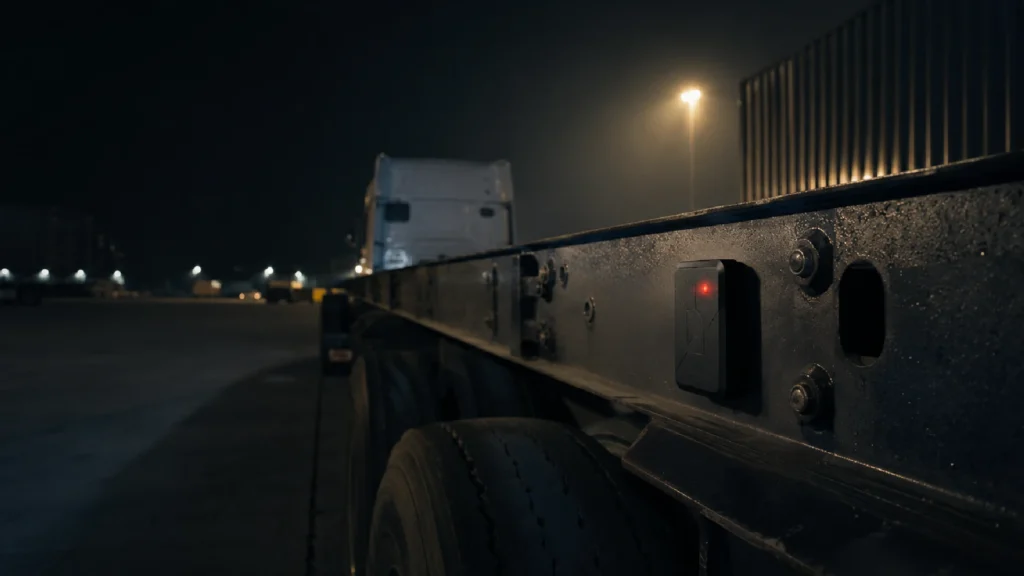
Non-powered asset tracking solves a problem most South African operations only discover after something is gone: the trailer, generator or container had no power source, so it never carried a tracker, so nobody knows where it went. Conventional tracking assumes a vehicle — an ignition, wiring, a battery to draw from. A large share of what a business owns meets none of those conditions.
The exposure is rarely dramatic. A trailer sits on a temporary contract. A compressor spends a month on an unfenced site. A container passes through three sets of hands between depot and delivery. Each of these is normal operations — and each is invisible to the systems watching the fleet.
That invisibility has a price. When an untracked asset moves without authorisation, there is no alert, no location and usually no recovery. As a result, the business writes off the loss, the insurance premium adjusts, and the gap stays open for the next incident.
This article explains how tracking works when there is nothing to wire a device to, what that changes about recovery, and which operations carry the most exposure.
Direct Answer: How Does Non-Powered Asset Tracking Work?
Non-powered asset tracking uses self-contained, battery-powered GPS devices that attach directly to trailers, containers, generators, equipment or cargo. The device needs no vehicle power, wiring or installation, reports its position over the mobile network, and enables covert monitoring and recovery of assets that conventional vehicle tracking systems cannot reach.
In practice, the device is the easy part. What matters is deployment speed — protection that goes onto the asset in seconds rather than by installation appointment — and a monitoring layer that turns a position report into a recovery.
DigitFMS delivers non-powered asset tracking through the DigitFMS Specialised Range, including the magnetic Digit D-Pod for long-term use and the disposable Digit D-Sticker for temporary consignments.
Why Conventional Tracking Ends at the Vehicle
A fitted tracking unit draws power from the vehicle it protects. That design works precisely because trucks, bakkies and cars carry their own batteries and wiring looms. Remove the power source, however, and the entire model collapses — there is nothing to install into and nothing to draw from.
The result, therefore, is a hard boundary around most tracking programmes. Everything on the vehicle side of the boundary is visible; everything on the other side is not. The assets outside that boundary typically include:
- Trailers and interlinks between contracts
- Shipping containers in transit or storage
- Generators, compressors and welding plant
- Tools and small equipment on open sites
- High-value cargo consignments
- Rental and loan assets in other people’s care
- Personal assets such as bicycles and motorbikes
By contrast, criminals draw no such boundary. An asset with resale value is a target whether or not it has an ignition. Which is why the losses in an otherwise well-secured operation tend to cluster on exactly these items.
What Does It Cost When a Trailer Simply Vanishes?
An untracked asset that disappears rarely comes back. Big Box Containers, a South African site-storage provider, estimates construction site theft costs South Africa in the region of R1 billion each year, with only about 6% of stolen construction equipment ever recovered. Those figures describe one sector; the pattern repeats wherever valuable, unpowered assets sit unwatched.
The invoice for a single loss also runs well past the replacement price. The full cost usually includes:
- Replacement of the asset itself
- Hire charges for a substitute
- Project or delivery downtime
- Insurance excess and premium loading
- Investigation and administrative time
- Repeat targeting once a site is known to be soft
More importantly, an unrecovered loss teaches the operation nothing. Without a device on the asset, there is no route, no destination and no pattern to act on — only a write-off and a suspicion.
Close Your Non-Powered Asset Tracking Gap
Tell a DigitFMS specialist which assets sit outside your tracking today, and get the right devices matched and deployed while the risk is still current.
Speak To A Specialist →A Generator, a Long Weekend and an Empty Site
Consider a typical loss. A contractor’s generator powers a site through Friday afternoon. The crew locks the gate and leaves for a long weekend. Some time between Saturday night and Monday morning, a bakkie arrives, two people load the generator, and the site is empty again in under ten minutes.
The discovery comes on Tuesday. Consequently, the crew reports the theft with a three-day window, no direction of travel and no description of a vehicle. By the time SAPS opens a case and the insurer logs the claim, the generator is already in another province or across a border.
Now replay the same weekend with a covert device magnetised to the generator’s frame. The asset moves outside its geofence on Saturday night, an alert fires, and a live position guides the response while the asset is still moving. The difference between the two outcomes is not the fence, the gate or the site — it is whether anyone could see the asset once it left.
How Non-Powered Asset Tracking Changes the Recovery Equation
A recovery needs two things: early notice that an asset is moving, and a live position while it moves. Non-powered asset tracking supplies both, and it does so covertly — the device is small, silent and placed where nobody looks, with no wiring to trace.
Accordingly, the DigitFMS Specialised Range splits the job across two deployment styles. The Digit D-Pod is a self-contained magnetic tracker built for long-term use on assets that move unpredictably, while the Digit D-Sticker is disposable — deployed onto a single consignment or handover in seconds, and not expected back.
The approach holds up beyond simple theft. In one case cited by Corporate Asset Protection Services (C.A.P.S.), Digit D-Sticker tracking and coordinated intelligence supported the disruption of a multi-million Rand fraud operation within weeks — visibility applied to assets that no fitted system could have reached.
Who Needs Non-Powered Asset Tracking Most?
Non-powered asset tracking earns its keep wherever valuable things move, change hands or sit beyond the reach of fitted systems. Scale is not a requirement — a single high-value consignment justifies a single device. The operations with the most exposure include:
- Logistics and distribution fleets with trailers and interlinks
- Construction and civils contractors with plant on open sites
- Mining and industrial operations with remote equipment
- Agricultural businesses with implements and generators
- Plant, tool and trailer hire companies
- Businesses moving high-value or temporary consignments
- Operations handling frequent handovers and transfers
- Sites without power, network or fencing infrastructure
In other words, the market is not defined by industry but by a condition: an asset worth stealing that cannot carry a conventional tracker.
Does Non-Powered Asset Tracking Survive South African Conditions?
South Africa is a demanding operating environment for any device: dust, heat, rain, corrugated farm roads and long stretches of patchy network coverage. However, battery-powered trackers take these constraints as their design brief — sealed housings, and reporting profiles that trade frequency for endurance where coverage is thin.
Independence from infrastructure also matters more here than in most markets. A device that carries its own power keeps working through load-shedding, on unpowered sites and at premises where the mains supply is itself a theft target.
The principle mirrors what DigitFMS applies to stationary stock: losses cluster where nobody is watching, which is the same conclusion that drives fuel storage monitoring on bulk diesel tanks. Non-powered asset tracking extends that watchfulness to everything that moves without its own power.
Building a Smarter Non-Powered Asset Tracking Strategy
The devices are not a replacement for fitted vehicle tracking — they complete it. The fleet keeps its installed systems; the trailers, cargo, equipment and temporary movements that fall outside those systems get their own layer.
A practical strategy starts with an honest inventory: list every asset worth more than its tracking cost that currently has no device on it, then rank the list by how often each item moves, changes hands or sits unattended. The top of that list is where the next loss is most likely to come from — and where the first devices should go.
From there, deployment is deliberately simple. Long-term assets get magnetic units; temporary movements get disposable ones; and every device reports into the same monitoring environment as the rest of the operation, so the control room handles an alert on a trailer with the same discipline as an alert on a truck.
Conclusion
Every operation draws a line around what it can see. Fitted tracking draws that line at the vehicle, and for years operations simply accepted the assets beyond it — trailers, containers, generators, cargo — as unprotectable.
That acceptance is no longer necessary. Self-contained, battery-powered devices put recoverable visibility on anything worth protecting, deploy in seconds, and cost a fraction of the losses they prevent.
The decision, therefore, is not whether the technology exists. It is whether the operation acts before or after the next asset disappears.
Non-powered asset tracking puts a live, recoverable position on the assets conventional systems were never built to reach — an asset does not need a power source to be tracked, it only needs a device on it before it moves.
Frequently Asked Questions
Self-contained, battery-powered GPS devices attach directly to assets with no power source of their own — trailers, containers, generators, equipment or cargo — and report position over the mobile network. Because they need no wiring or installation, the devices suit covert deployment and rapid recovery.
A magnetic battery-powered device such as the Digit D-Pod fixes to the trailer chassis and reports independently of any towing vehicle. As a result, the trailer stays visible whether coupled, parked, out on a contract or standing in someone else’s yard.
Battery life depends on the device type and how often it reports — frequent live reporting drains a battery faster than periodic check-ins. In practice, disposable devices carry enough power for a single deployment, while magnetic units run for the long term.
The Digit D-Pod is a self-contained magnetic tracker for long-term, repeated use on assets that move unpredictably. By contrast, the Digit D-Sticker is disposable — deployed onto a single consignment, handover or short-term risk, and not expected back.
Device type, reporting frequency and monitoring level drive the cost. A disposable unit protecting one consignment costs far less than a fitted system, while continuously monitored magnetic devices sit higher. Most operations therefore deploy per asset or per risk rather than across everything at once.
Covert placement is the point of the design. The devices are small and silent, they sit where nobody looks, and unlike a fitted tracker there is no wiring to trace. Detection is never impossible; however, the practical odds strongly favour the asset owner.