
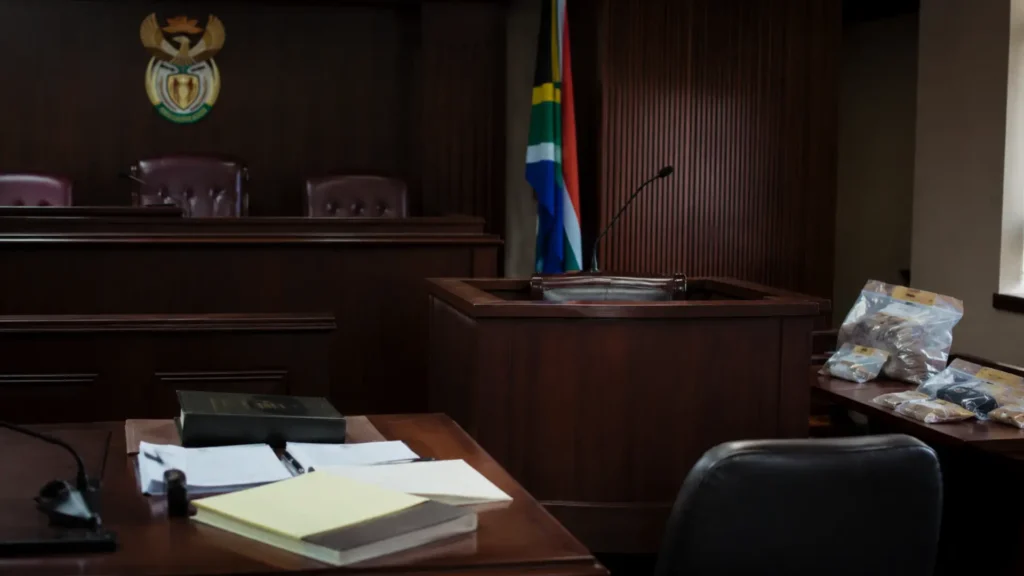
The Madlanga Commission fleet security implications reached a new depth this week — and the word that captures it best is “chaos.” Yesterday, Colonel Gavin Jacob testified that a suspect came forward in February 2026 with details about the R200 million cocaine stolen from Hawks offices in Port Shepstone — the first break in the case since the November 2021 theft. On Monday, Warrant Officer Karl Sander told the commission he physically moved guns in a police armoury to make room for drug seizures at the Isipingo depot — the same facility linked to the cocaine theft. Sander described police drug storage as “chaos” and revealed the Hawks transferred him from the Narcotics Unit for “stepping on the toes” of officials linked to drug dealing. KZN Hawks head Major-General Senona testifies Friday about why he took personal control of cocaine storage keys and refused a polygraph test.
For fleet operators, every one of these revelations strikes at the same institution responsible for investigating hijackings, cargo theft, and organised fleet crime.
This is the second report in our Madlanga Commission fleet security series. Our 14 May analysis documented how drug cartels exploit the same truck infrastructure fleet operators use. Today’s article examines the three witnesses who testified this week, why their evidence proves the SAPS fleet crime investigation apparatus is compromised at the command level, and what the Beitbridge-versus-Port Shepstone contrast reveals about where fleet security actually works.
Witness 1: The Whistleblower — How the Madlanga Commission Fleet Security Picture Changed Yesterday
Specifically, Colonel Jacob told the commission on Wednesday 3 June that during late January 2026, his office conducted investigations into “certain drug-related killings and feuds in the Durban and surrounding area.” Those investigations led to a person coming forward in early February, claiming to have been involved in the original cocaine theft from Port Shepstone.
What the whistleblower means for Madlanga Commission fleet security findings
Importantly, the whistleblower’s emergence is significant for two reasons. First, it confirms that the cocaine theft was an inside job — the person came forward claiming direct involvement, not secondhand knowledge. Second, it suggests the stolen cocaine fuelled subsequent violence: Jacob’s office was investigating “drug-related killings and feuds” when the informant appeared. Crucially, the commission is now examining Jacob’s own role in the initial June 2021 seizure, meaning even the investigating officer is under scrutiny. For fleet operators, this layered compromise within the Hawks carries a direct implication. Hijacking and cargo crime cases submitted to the same unit may have received the same institutional dysfunction.
Jacob’s testimony connects drug-related killings to fleet corridor violence
Furthermore, the “drug-related killings and feuds” Jacob investigated concentrate in Durban and the surrounding area — precisely the region where the N3 freight corridor terminates and where truck drivers blockaded the N3 last Saturday. Additionally, the stolen cocaine — worth R200 million at wholesale — would have been distributed through networks that use the same road infrastructure fleet operators depend on. The commission is documenting that drug trafficking, police corruption, and fleet corridor violence are not separate problems. They share the same roads, the same institutional failures, and the same compromised leadership.
Witness 2: The Veteran — Karl Sander Reveals the Madlanga Commission Fleet Security Reality Inside SAPS
Sander, a 40-year police veteran, delivered testimony on Monday and Tuesday that painted the most detailed picture yet of institutional dysfunction within the narcotics investigation apparatus.
“It’s chaos”: drug storage failures that undermine fleet evidence security
EWN reports that Sander described the Pretoria Forensic Science Laboratory vault — meant to be South Africa’s most secure evidence facility — with a single word: “chaos.” He testified that there are “very few police storage sites where seized illicit substances can be safely secured.” Importantly, the Isipingo police station refused to accept the 541kg cocaine consignment due to space constraints. Officials then physically moved guns in the armoury to make room for a separate 547kg mandrax seizure. Officials transferred the cocaine to Port Shepstone Hawks offices — a facility with no CCTV and a broken alarm — where thieves stole the entire consignment through the windows.
Punished for doing his job: Madlanga Commission reveals what happens to honest fleet crime investigators
IOL reports that Sander made several major drug busts at Durban harbour, intercepting cocaine shipments from South America. His reward: transfer from the Narcotics Unit to Support Services. The reason given was that he was “stepping on the toes” of officials linked to drug dealing. Subsequently, investigators treated Sander as a suspect in the cocaine theft investigation and subjected to a polygraph test — despite being on leave when the theft occurred. Reviewers later found the polygraph examiner’s report contained “serious errors.” For fleet operators, the implication is devastating: the officer who actively caught drug shipments at Durban harbour cocaine moved through Scania truck containers — lost his position and faced criminal suspicion for doing his job effectively.
Witness 3 on Friday: What Senona’s Testimony Could Reveal About Madlanga Commission Fleet Security Failures
Looking ahead, Major-General Lesetja Senona — the suspended KZN Hawks head — testifies on Friday 6 June. His testimony is the most consequential for fleet security of any witness this week.
The questions Senona must answer about fleet crime investigation capacity
Crucially, Major-General Hendrik Flynn previously testified that Senona personally assumed control of the storage keys when the cocaine was booked in as exhibits — a move Flynn described as “inconsistent with standard procedures.” Senona attended the booking-in but subsequently refused to take a polygraph test about the theft. Furthermore, multiple officers underwent polygraphs but Senona — the most senior officer with physical access — did not. The commission will ask why. His answers will determine whether the KZN Hawks’ failure to investigate fleet crime effectively resulted from resource constraints or command-level corruption.
Senona oversaw the fleet crime investigation apparatus on the N3 corridor
Critically, as KZN Hawks head, Senona’s unit was responsible for investigating hijacking syndicates, cargo theft networks, and organised crime along the N3 — South Africa’s most critical freight corridor. The same corridor where SAPS allegedly fired live rounds at trucks last Saturday and where 50 vehicles were stranded during the ATDF-ASA shutdown. Fleet operators who reported hijackings to the Hawks in KZN were submitting cases to a unit whose head allegedly took personal control of cocaine storage keys and refused a polygraph about the resulting theft. Consequently, the quality of fleet crime investigation in KZN over the past five years must now be re-evaluated in light of Senona’s alleged conduct.
Beitbridge Versus Port Shepstone: The Madlanga Commission Fleet Security Contrast That Defines the Choice
Our Beitbridge article documented how intelligence-led technology caught R1 billion in drugs. The Madlanga testimony documents how institutional corruption allowed R200 million to vanish. The contrast defines the fleet security choice every operator faces.
Beitbridge: technology and integrity produced fleet-relevant results
First, at Beitbridge, intelligence tracked a truck’s route from Malawi. A cargo scanner detected concealed material. Officials spent eight hours dismantling the vehicle. Three arrests followed. R1 billion stayed out of the country. Minister Schreiber described it as “a new organisational culture.” The system worked because every component — monitoring, detection, investigation, prosecution — functioned as designed. Notably, the BMA operates independently of the SAPS command structure that the Madlanga Commission is examining.
Port Shepstone: corruption defeated the entire fleet security chain
In contrast, at Port Shepstone, 541kg of cocaine arrived at a facility with no CCTV and a broken alarm. The provincial Hawks head personally took the storage keys. A veteran narcotics officer who intercepted drugs effectively lost his position for “stepping on toes.” Polygraph tests contained “serious errors.” The cocaine disappeared through the windows. R200 million vanished. No convictions followed for over four years — until a whistleblower came forward this February. The system failed because corruption compromised the people operating it at the command level.
The fleet operator’s lesson: invest in what you control
Accordingly, the Beitbridge-Port Shepstone contrast delivers a single, clear lesson for fleet operators. Technology works when people of integrity operate it. Technology fails when compromised individuals control it. Fleet operators cannot control SAPS integrity. They cannot ensure the Hawks investigate their hijacking cases effectively. They cannot guarantee that evidence submitted to police will not disappear — as the cocaine did. However, fleet operators CAN control their own technology: GPS tracking that monitors vehicles independently of SAPS, dashcams that capture evidence regardless of police response, fuel monitoring that detects theft without relying on police investigation, and SVR with private armed response that recovers vehicles without waiting for compromised officers.
What the “Chaos” Means: How the Madlanga Commission Fleet Security Evidence Affects Everyday Operations
Undeniably, the word “chaos” — used by a 40-year police veteran describing South Africa’s most secure evidence facilities — has specific operational implications for fleet operators.
Recovered vehicle evidence may not survive SAPS custody
For example, when a hijacked fleet vehicle is recovered, evidence — fingerprints, DNA, dashcam footage from the vehicle, cargo manifests — enters the SAPS evidence chain. If drug evidence worth R200 million can disappear from a Hawks facility, fleet crime evidence can disappear from any police station. Similarly, fleet operators who rely solely on police-held evidence for insurance claims and prosecution face the risk that the evidence chain breaks inside the institution that Sander describes as chaos. Self-generated, cloud-stored evidence from fleet technology platforms provides a parallel evidence chain that operates entirely outside the SAPS custody system.
Fleet hijacking investigations may have been deprioritised
Similarly, if the KZN Hawks head focused on controlling cocaine storage keys rather than directing investigations, fleet crime cases in the province may have received inadequate attention. The Q4 crime statistics showed KZN recording 32 truck hijackings in the quarter. Each case required Hawks investigation. Each case competed for attention with an institutional leadership allegedly focused on managing drug corruption rather than solving fleet crime. Fleet operators with unresolved hijacking or cargo theft cases in KZN should reassess whether those cases received adequate investigation.
The 30 June security vacuum deepens the Madlanga Commission fleet security crisis
The 30 June shutdown threat requires an effective SAPS response to contain. The Madlanga testimony documents that the institution tasked with that response has compromised leadership, chaotic evidence management, and officers punished for doing their jobs. Fleet operators preparing for 30 June should factor in that the SAPS response capacity documented by Sander and Jacob this week is the same capacity that will deploy on 30 June — weakened, compromised, and in Sander’s assessment, characterised by chaos.
Five Actions for Fleet Operators After This Week’s Madlanga Commission Fleet Security Revelations
Build your fleet security around private technology, not SAPS dependence. The Madlanga testimony documents that the institution responsible for fleet crime investigation has compromised leadership, stolen evidence, and punished investigators. GPS tracking with SVR provides vehicle recovery through private armed response. AI dashcams capture evidence stored in the cloud — outside the SAPS evidence chain. Fuel monitoring detects theft without requiring police involvement. Every capability that reduces dependence on SAPS reduces exposure to the institutional dysfunction the commission has documented.
Next, ensure all fleet evidence uploads to the cloud automatically. Dashcam footage, GPS route data, fuel consumption records, and driver identification logs should all upload continuously to a cloud platform the fleet operator controls. If a hijacking occurs and the case enters the SAPS system, the fleet operator retains a complete parallel evidence set that supports insurance claims, private prosecution, and CCMA processes regardless of what happens inside the police evidence chain.
Furthermore, review any unresolved fleet crime cases in KwaZulu-Natal. If your fleet has open hijacking, cargo theft, or fuel crime cases that were submitted to the KZN Hawks during Senona’s tenure, consider requesting a status update from the investigating officer. The Madlanga evidence suggests that cases may not have received the command-level attention they required. Private investigation firms can supplement SAPS investigations where the fleet operator suspects inadequate progress.
Prepare for Friday’s Senona testimony and the 30 June convergence
Monitor Senona’s testimony on Friday 6 June. His answers about the storage keys and the polygraph refusal will determine whether the KZN Hawks’ failures were systemic or individual. If the commission finds systemic corruption, the implications for fleet security in KZN extend beyond Senona’s personal conduct — affecting every case the unit handled during his tenure.
Finally, accelerate your 30 June contingency plan. The SAPS response capacity available on 30 June is the same institution the Madlanga Commission spent this week documenting as chaotic, compromised, and internally conflicted. Fleet operators who rely on SAPS to contain the 30 June shutdown are relying on the same organisation that lost R200 million in cocaine through a window, punished its own narcotics officer for catching drugs, and is now hearing from a whistleblower who claims direct involvement in the theft. Private technology, private armed response, and self-generated evidence are the fleet operator’s defence — not the institution the commission describes.
Who Provides Fleet Security That Operates Independently of the Compromised SAPS System
In essence, the Madlanga testimony makes the case for private fleet security technology in terms no marketing material ever could.
DigitFMS integrates GPS tracking with SVR and armed response coordination, AI dashcams with cloud upload, D-Fuel litre-level monitoring, wireless driver identification, and geofencing on a single dashboard. Every capability operates independently of SAPS. Vehicle recovery coordinates through private armed response — not the suspended Hawks officers the commission is examining. Evidence uploads to the cloud — not the chaotic police evidence facilities Sander described. Fuel theft detection triggers fleet manager investigation — not a police case that enters an institution where narcotics officers are transferred for doing their jobs effectively. The company’s 100+ franchise branches include KZN operators who work the N3 corridor daily.
Equally, Cartrack’s 88.3% recovery rate operates through its own recovery network. Tracker’s SVR delivered 3,671 recoveries with 146 arrests in H1 2025 — using private resources that function regardless of Hawks leadership. Netstar, Ctrack, and MiX by Powerfleet all provide fleet security platforms built on private capability rather than SAPS dependence. The Madlanga Commission has spent this week explaining why that independence matters. Fleet operators who listened are already protected. Fleet operators who still rely on SAPS as their primary security mechanism should read the testimony and reconsider.
Outlook: The Madlanga Commission Fleet Security Crisis Will Deepen Before It Resolves
In summary, this week delivered a whistleblower, a veteran’s account of chaos, and the promise of Senona’s testimony on Friday. The commission’s second interim report — due to President Ramaphosa — will synthesise these findings into recommendations. However, even the most decisive recommendations take months or years to implement. New leadership appointments require vetting. Institutional culture changes require sustained pressure. Evidence systems require investment.
Meanwhile, in the meantime, fleet operators face the 30 June shutdown with a policing institution documented this week as chaotic and compromised. The SARB hiked rates with two more warned. The diesel levy returned yesterday with the full R3.93 arriving 1 July. The impeachment committee has begun proceedings. Every external pressure on fleet budgets is intensifying while the internal security apparatus is weakening.
Ultimately, the Madlanga Commission fleet security testimony this week answered a question fleet operators have asked since the Khan and Kadwa arrests in May: how deep does the institutional failure go? The answer, delivered by a 40-year veteran of the narcotics unit, is one word: chaos. Fleet operators who accept that answer and build their security around private technology, private response, and privately generated evidence will navigate whatever comes — the 30 June shutdown, the July levy, and the ongoing institutional decay at SAPS. Fleet operators who continue relying on the same organisation that stored cocaine in a building with no CCTV and a broken alarm will eventually discover what fleet managers in KZN have learned: when the institution fails, only the technology you own and the evidence you generate yourself stand between your fleet and total loss.
Frequently Asked Questions
Who is the whistleblower in the Madlanga Commission?
Colonel Gavin Jacob testified on 3 June that a suspect came forward in February 2026 with details about the R200M cocaine stolen from Port Shepstone. The person claimed direct involvement in the theft. Jacob’s own role in the initial seizure is also under scrutiny. The whistleblower’s emergence links the stolen cocaine to subsequent drug-related killings in Durban.
What did Sander reveal about SAPS drug storage and fleet evidence?
Sander described police drug storage as “chaos.” Guns were moved in an armoury to make room for mandrax seizures. The Port Shepstone facility had no CCTV and a broken alarm. The Hawks transferred Sander from Narcotics for “stepping on toes” of officials linked to drug dealing. Investigators then treated him as a suspect despite being on leave during the theft.
Why did Senona refuse the polygraph about fleet-impacting cocaine theft?
Senona personally took control of storage keys when cocaine was booked in — described as “inconsistent with standard procedures.” Other officers took polygraphs; Senona did not. He testifies Friday 6 June. His answers will determine whether the KZN Hawks’ failure to investigate fleet crime was resource-driven or corruption-driven.
How does the Madlanga Commission testimony affect fleet security?
Senona headed the unit investigating truck hijackings and cargo theft on the N3. If drug corruption compromised him, it undermined fleet crime investigation in KZN at command level. Fleet operators submitted cases to a unit whose leader allegedly controlled cocaine keys. Evidence submitted to SAPS enters the same “chaotic” system Sander described.
How does Port Shepstone compare to Beitbridge?
Beitbridge: technology + integrity = R1B caught. Port Shepstone: corruption + chaos = R200M stolen through a window. Same drugs-in-trucks threat, opposite outcomes. The BMA operates independently of the compromised SAPS command. Fleet operators who invest in private technology mirror the Beitbridge model. Those relying on SAPS mirror the Port Shepstone outcome.
What happened to the officer who investigated drugs effectively?
Sander made major busts at Durban harbour intercepting cocaine from South America. The Hawks transferred him from Narcotics to Support Services for “stepping on toes.” Then treated as a suspect in the theft investigation. Subjected to a flawed polygraph despite being on leave during the theft. The message: doing your job in a compromised unit carries career consequences.
What should fleet operators do after this testimony?
Build security around private technology not SAPS dependence. Upload all evidence to the cloud automatically. Review unresolved KZN fleet crime cases. Monitor Senona’s Friday testimony. Accelerate the 30 June contingency plan — the SAPS response capacity is the same institution documented this week as chaotic and compromised.
Sources
Daily Maverick — “Whistleblower suspect broke silence on R200m Port Shepstone cocaine theft”, 3 June 2026; Colonel Gavin Jacob testimony, February 2026 informant, drug-related killings · News24 — “Guns moved in armoury to make room for drugs at depot linked to R250m cocaine theft”, 1 June 2026; Warrant Officer Karl Sander, 547kg mandrax, Isipingo depot · The Citizen — “I was on leave: Hawks officer recounts polygraph over R200m cocaine theft”, 2 June 2026; Sander treated as suspect, polygraph errors, Senona refused test
IOL — “Madlanga Commission: Undercover officer exposes police trust crisis in drug investigations”, 3 June 2026; Sander transferred for “stepping on toes,” Senona testifies Friday · EWN — “It’s chaos: Madlanga Commission hears of critical failures in SAPS drug storage facilities”, 1 June 2026; Pretoria vault chaos, Port Shepstone no CCTV, broken alarm · Sowetan — “Drugs worth R200m moved under false police entry, commission hears”, 2 June 2026; false register entry, Senona key control · The Citizen — “Extremely strange: Madlanga commission hears details on R200m cocaine theft”, 5 May 2026; Major-General Flynn testimony, inconsistent procedures
DigitFMS — Drug cartel fleet infrastructure analysis (14 May), SAPS corruption fleet security (12 May), border security fleet technology (1 June), N3 shutdown aftermath (31 May), 30 June shutdown contingency (28 May), Q4 crime statistics (25 May)
© 2026 DigitFMS. All rights reserved.