
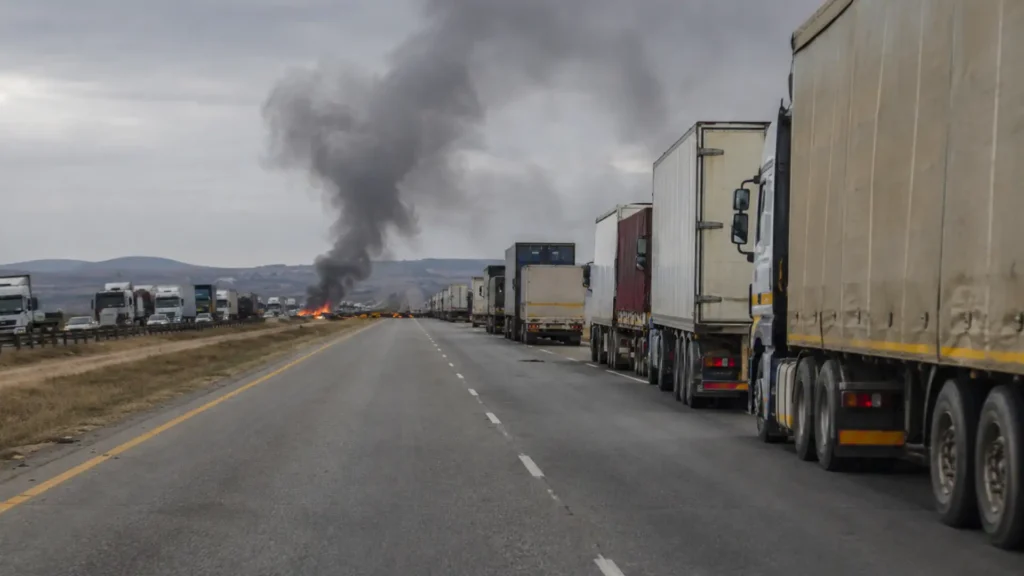
The June 30 shutdown fleet logistics threat is now the most serious operational risk on South Africa’s transport calendar. March and March founder Jacinta Ngobese-Zuma issued a national shutdown ultimatum on Monday night: all undocumented foreign nationals must leave South Africa by 30 June, or the movement will “shut down” the country. In response, the government convened an emergency meeting at the Union Buildings on 26 May. Although Defence Minister Motshekga told the public not to panic, March and March walked out saying the government presented no clear action plan. Meanwhile, Al Jazeera is covering the crisis globally. GroundUp has also warned of “fears of a repeat of the July 2021 riots.” That unrest cost the logistics sector an estimated R50 billion. Therefore, fleet operators have just 34 days to prepare.
This is the third report in our xenophobia fleet logistics disruption series. Previously, our 8 May analysis documented the initial operational impact. Then, our 20 May update covered the Human Rights Watch condemnation. Today’s article addresses the specific 30 June deadline, what the July 2021 precedent tells fleet operators about shutdown disruption, and the 34-day contingency plan every fleet manager should activate this week.
What Happened This Week: The June 30 Shutdown Fleet Logistics Threat Escalates
Specifically, three developments in 48 hours transformed the March and March campaign from an ongoing protest movement into a scheduled, date-specific shutdown threat with national security implications.
Ngobese-Zuma’s press conference sets the deadline
Speaking at a press conference in Umhlanga on Monday evening, Ngobese-Zuma laid out the demands. First, she called on government to “declare a state of emergency for illegal immigration.” She then demanded a moratorium on all refugee applications. In addition, she announced that the movement has begun pressuring Checkers Sixty60, Mr D, and McDonald’s to disclose how many foreign nationals they employ and what permits they hold. “Our people want to take to the streets on the 30th of June 2026 if this issue is not addressed correctly,” she stated. Furthermore, she warned that the movement intends mobilising participants from “various sectors of society” — signalling a broader shutdown beyond street marches.
The Union Buildings emergency meeting
The government’s justice, crime prevention and security cluster convened an urgent high-level meeting at the Union Buildings on 26 May. During the meeting, Defence Minister Angie Motshekga assured the public that “there is no reason for panic” and that “anyone breaking the law will face the consequences.” However, GroundUp reports that March and March leader Sandile Dube emerged from the meeting saying he had “little confidence in its outcome” and that “no clear action plan had been presented.” Consequently, Dube confirmed that the 30 June shutdown remains active.
Deputy Home Affairs Minister inflames rather than calms
Notably, Deputy Home Affairs Minister Njabulo Nzuza told the meeting that other countries must deal with their own issues so that migrants are not “forced upon South Africans.” He also stated: “A person must not leave their country because they say I am hungry, I need to get a job elsewhere.” As a result, this language — from a cabinet minister at a de-escalation meeting — signals that elements within government share aspects of March and March’s framing. For fleet operators, this suggests the government response may remain fragmented rather than unified, reducing the likelihood of effective intervention before 30 June.
The July 2021 Precedent: What a National Shutdown Actually Does to Fleet Logistics
Clearly, fleet operators who experienced the July 2021 unrest need no reminder. However, those who did not must understand what a national shutdown physically does to logistics infrastructure.
R50 billion in logistics damage: the shutdown fleet precedent
To understand the scale, the July 2021 unrest — triggered by the arrest of former President Zuma — lasted approximately 10 days and caused an estimated R50 billion or more in economic damage. During that period, looters destroyed over 200 shopping centres and malls. At the same time, arsonists set trucks alight on the N3 between Durban and Johannesburg — South Africa’s most critical freight corridor. Insurance claims exceeded R30 billion. In many cases, some businesses never reopened. Ultimately, the logistics sector took months to recover supply chain continuity.
What a shutdown threat does to fleet logistics physically
Crucially, the July 2021 disruption affected every layer of fleet operations simultaneously. Road blockades halted vehicle movement. Meanwhile, burning trucks blocked highway lanes for days. Fuel stations in affected areas closed or ran dry. In addition, depots and warehouses faced direct looting. Cold chain operations collapsed as refrigerated goods could not reach their destinations. As conditions worsened, drivers refused to enter affected areas, and many were physically attacked. Cell tower damage disrupted GPS tracking connectivity. Power outages also disabled depot security systems. Therefore, the cascade from initial protest to full logistics collapse took less than 72 hours in KwaZulu-Natal.
Why the current shutdown fleet logistics threat is credible
EWN reports that foreign nationals are already living in fear of the 30 June deadline. In addition, HSRC data shows anti-immigrant sentiment is structurally higher now than in 2021 — with 42% wanting no immigrants nationally and 60% in KwaZulu-Natal. The movement has also demonstrated the ability to organise marches across multiple cities simultaneously. Meanwhile, political parties including the Patriotic Alliance, ActionSA, and MK Party have adopted anti-immigrant rhetoric. Additionally, the SAPS leadership is weaker than in 2021. With 18 officers suspended from the Madlanga Commission, the security apparatus available to contain a shutdown has degraded since the last crisis.
The Timing Collision: June 30 Shutdown Fleet Logistics Threat Meets July 1 Diesel Levy
Critically, the shutdown threat does not exist in isolation. Instead, it collides with the most significant fleet cost event of the year.
On 30 June, March and March threatens to shut down the country. Then, on 1 July, the full R3.93 diesel levy returns — pushing diesel toward R35 per litre permanently. As a result, fleet operators face the possibility of a national logistics disruption and a R3.93 per litre cost increase in the same week. If the shutdown disrupts fuel supply chains on 30 June — emptying fuel stations, blocking tanker deliveries, and closing depots — the levy increase on 1 July would compound the pressure immediately.
Furthermore, the confirmed end of fuel levy relief means there is no government safety net. Treasury has closed the door on further intervention. Meanwhile, the SARB announces its rate decision today, 28 May, with no expectation of a cut. Therefore, fleet operators enter the 30 June period with the highest fuel costs in South African history, the weakest police leadership since democratisation, and a scheduled national shutdown — all converging in the same week.
Which Areas Face the Highest June 30 Shutdown Fleet Logistics Risk
Based on available data, the July 2021 pattern and current March and March activity identify several high-risk corridors.
KwaZulu-Natal: epicentre of the shutdown fleet logistics threat
First, March and March originated in KZN. Ngobese-Zuma also held her press conference in Umhlanga. In addition, HSRC data shows that 60% of KZN residents want no immigrants — the strongest anti-immigrant sentiment of any province. In July 2021, KZN suffered the worst destruction. The N3 between Durban and Johannesburg remains the country’s primary freight corridor. Therefore, fleet operators with vehicles on the N3 corridor, within Durban metro, or serving KZN distribution centres face the highest exposure.
Gauteng: fleet logistics hub at risk from shutdown
Second, Johannesburg CBD, Alexandra, Hillbrow, Tshwane, and industrial areas including Aeroton and Isando concentrate both fleet logistics infrastructure and foreign-owned businesses. In addition, the Q4 crime data shows that 21 of the top 30 carjacking precincts sit inside Gauteng. Consequently, a shutdown in Gauteng would disrupt the national distribution hub that feeds supply chains to every other province.
Major fleet logistics corridors facing shutdown disruption
Third, the N3, N1, N2, and N12 all pass through areas with active March and March presence. In July 2021, burning trucks blocked the N3 for days. These blockades created physical barriers that required heavy equipment and several days to clear. Therefore, fleet operators running any of these corridors should have alternative routing pre-programmed and ready to activate within hours of any shutdown announcement.
The 34-Day Contingency Plan: How Fleet Operators Should Prepare for the June 30 Shutdown Fleet Logistics Threat
Accordingly, fleet operators have 34 days from today. Here is the week-by-week preparation plan.
Phase 1 (28 May – 3 June): Assess and plan
Map your exposure. Identify every route, depot, warehouse, and client location that sits within a high-risk area. Then, mark those locations on your fleet tracking platform. Next, calculate the revenue at risk if each location becomes inaccessible for 3, 7, and 14 days. This exposure map becomes the basis for every subsequent decision.
Additionally, verify insurance coverage for civil unrest. Contact your broker this week and confirm that your fleet policy covers vehicle damage, cargo loss, business interruption, and driver injury arising from civil unrest, protests, and riots. Some policies exclude these scenarios unless specific endorsements are in place. For that reason, get written confirmation of coverage before 30 June — not after an incident occurs.
Phase 2 (4-10 June): Technology and routes
Activate geofencing around every high-risk area. Create geofences along the N3 corridor, around Durban metro, Johannesburg CBD, Alexandra, Hillbrow, Tshwane, Khayelitsha, and every location where March and March has staged demonstrations. Once a vehicle approaches a geofenced zone, both the driver and control room should receive an automated alert — before the vehicle enters the danger zone, not after.
Furthermore, pre-programme alternative routes for every affected corridor. For the N3, identify the N11 through Newcastle or the R34 via Vryheid as alternatives. For the N1 through Gauteng, the N14 or R21 may bypass the worst areas. Importantly, share alternative routes with drivers now — not when a burning truck blocks the highway at midnight.
By mid-June (11-17 June): Supplies and stockpiling
Stockpile fuel before 28 June. The June diesel price dip creates a double incentive: fuel is cheaper in June than it will be in July, and fuel supply chains may face disruption if the shutdown materialises. Therefore, fill every bulk tank and every vehicle tank by Friday 27 June. A fleet caught with empty tanks on 30 June faces both price escalation and supply disruption simultaneously.
Simultaneously, stockpile critical vehicle parts and supplies. In July 2021, parts supply chains collapsed for weeks. Suppliers could not deliver tyres, brake pads, filters, and lubricants to affected areas. As a result, fleet operators with critical maintenance scheduled for early July should bring parts forward and complete maintenance before 28 June.
Final fortnight (18-24 June): Drivers and decisions
Brief every driver on shutdown protocols. Do not attempt to drive through a blockade. Do not engage with protesters. Instead, contact the control room immediately if you feel unsafe. If roads ahead are blocked, pull over safely and wait for instructions. Drivers should also carry emergency supplies, including water, food, a first aid kit, reflective triangles, and a fully charged phone with the control room number saved. In addition, foreign drivers should carry valid documentation and understand their rights.
Additionally, decide which vehicles to pull from high-risk areas. In July 2021, operators who withdrew vehicles from exposed areas 48 hours before the worst violence preserved their assets. By contrast, operators who left vehicles in affected areas lost them to arson, looting, and blockade damage. Therefore, make the withdrawal decision by 25 June — not on 30 June when roads may already be blocked.
Countdown days (25-30 June): Execute
Activate the contingency plan by 28 June. Move high-value vehicles to secure locations. Complete all fuel purchases. Confirm that all dashcams upload to the cloud. Also confirm that all tracking units transmit continuously. Then, brief the control room team on escalation procedures. Establish direct communication with local SAPS station commanders and private armed response teams. Finally, monitor social media and news for real-time developments. Do not send vehicles into affected areas after 28 June without confirmed safe passage.
Technology That Protects Fleet Operations During the June 30 Shutdown Fleet Logistics Threat
Notably, the same integrated platform that protects against hijacking and fuel theft serves a critical role during civil unrest. Therefore, the 30 June threat makes deployment more urgent than ever.
DigitFMS integrates GPS tracking with geofencing, AI dashcams with cloud upload, wireless driver identification, panic button activation, and autonomous vehicle defence on a single dashboard. When a vehicle approaches a geofenced protest zone, both driver and control room receive instant alerts. If an incident occurs, dashcam footage uploads in real time — surviving even if the vehicle is damaged or destroyed. Driver ID also confirms who is in each vehicle at all times. In addition, the company’s 100+ franchise branches include operators in KwaZulu-Natal and Gauteng — the two provinces most likely to face disruption — providing local intelligence and response coordination from people who know the ground.
Cartrack, Tracker, Netstar, Ctrack, and MiX by Powerfleet all offer real-time tracking and geofencing. However, the critical requirement during a shutdown is cloud-based dashcam storage, geofencing with automated alerts, and rapid response coordination that operates independently of SAPS. This matters because the 18 suspended officers mean police response capacity is already degraded before any shutdown begins.
Outlook: The June 30 Shutdown Fleet Logistics Threat May Define the Rest of 2026
Admittedly, the shutdown may not happen. Motshekga says there is no reason for panic. Government engagement may still de-escalate the deadline. Moreover, March and March’s organisational capacity for a sustained national shutdown remains untested. However, the July 2021 unrest also came with warnings that many dismissed — and the cost of being unprepared was R50 billion.
Nevertheless, for fleet operators, the prudent approach is to prepare as if the shutdown will happen and welcome the relief if it does not. The cost of preparation — geofencing, driver briefings, fuel stockpiling, insurance verification, and alternative routing — is measured in hours of planning time and modest operational adjustments. By contrast, the cost of being unprepared — burned trucks, looted depots, stranded drivers, collapsed supply chains, and disputed insurance claims — is measured in millions of rand and months of recovery.
Ultimately, the June 30 shutdown fleet logistics threat arrives at the worst possible moment in the worst possible environment. Diesel may reach R35 from July. There is no government fuel relief. SAPS leadership is in crisis. The Phala Phala impeachment process is creating political uncertainty. CPI sits at 4%. Now, a scheduled national shutdown threat has emerged from a movement that has demonstrated the ability to mobilise across provinces, backed by sentiment data showing that 42% of South Africans want no immigrants and 60% in KZN. Therefore, fleet operators who use the next 34 days to prepare will navigate whatever comes. Those who dismiss the threat because the government says not to panic may be the first to call their insurer on 1 July — and discover whether their policy covers what just happened to their fleet.