
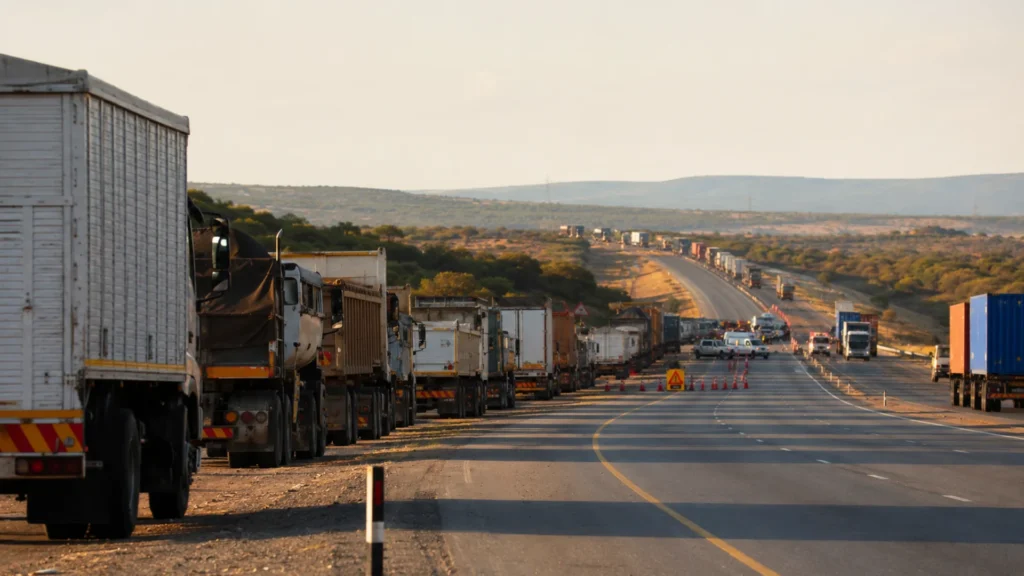
Fleet logistics disruption protests are causing the most significant operational challenge South African transport operators have faced since the July 2021 unrest. At least 100 Zambian truck drivers have lost their jobs after cross-border transport companies closed operations amid escalating anti-immigrant protests. Businesses across Johannesburg, Durban, Cape Town, and KwaZulu-Natal have shut down. Road blockades have disrupted delivery schedules. Nigeria has arranged repatriation flights for 130 citizens. Ghana has petitioned the African Union. For fleet operators, the crisis is not a news story to follow. It is an operational reality requiring immediate action.
This analysis examines the fleet logistics disruption protests are causing across South Africa’s transport sector, the specific routes and areas affected, the diplomatic fallout threatening SA companies operating across Africa, and the practical steps fleet operators should take to protect drivers, vehicles, and supply chains while the situation remains volatile.
The Operational Impact: How Fleet Logistics Disruption Protests Affect Transport
Specifically, the anti-immigrant protests — led primarily by the March and March movement and Operation Dudula — have spread across multiple provinces since late April 2026. Daily Maverick reports that marches have occurred in Tshwane, Johannesburg, Durban, and Cape Town. However, the impact extends far beyond the protest routes themselves. For fleet operators, the disruption manifests in five specific ways.
Cross-border transport shutdown
First, cross-border transport operators have closed operations rather than risk driver safety. Freight News confirmed that at least 100 Zambian truck drivers lost employment as a direct result. Cross-border public transport operators in Bulawayo reported business “taking a serious knock,” with some cancelling trips entirely. Fewer people and goods are moving between South Africa and its neighbours — Mozambique, Zimbabwe, Zambia, Malawi, and Botswana — precisely when diesel cost pressures already strain cross-border freight economics.
Retail delivery disruption
Vanguard reports that migrants in Johannesburg, Durban, and KwaZulu-Natal have closed businesses and avoided public gatherings. Additionally, foreign-owned spaza shops — which account for a significant portion of township retail — have shut down in affected areas. Consequently, delivery fleets serving these outlets face cancelled routes, rejected deliveries, and goods returned to depot. Cold chain and perishable goods operators face increased spoilage risk when deliveries cannot be completed on schedule.
Road blockades and route disruption
Meanwhile, protest marches and road blockades have disrupted traffic in multiple urban areas. Moneyweb reported that a countrywide shutdown was planned for 4 May, with organisers calling for “all businesses, work places, schools” to close. While the shutdown did not materialise at full scale, localised blockades have affected routes in Tshwane, Hillbrow, Chatsworth, and Khayelitsha. Fleet vehicles caught in these disruptions face delays measured in hours, not minutes — with corresponding fuel waste, missed delivery windows, and driver safety concerns.
Workforce disruption at depots and warehouses
In addition, fleet depots and warehouses that employ foreign nationals face staff shortages as workers stay home for safety. Loaders, packers, drivers, and warehouse operatives from Zimbabwe, Mozambique, Malawi, and other countries represent a significant proportion of the logistics workforce in Gauteng and KwaZulu-Natal. When these workers do not report, loading schedules slip, vehicles depart late, and the ripple effect extends to every delivery on the day’s manifest.
Driver safety in high-tension areas
Human Rights Watch has documented a long pattern of attacks on foreign truck drivers in South Africa. In the current crisis, the risk has intensified. Protesters have reportedly stopped people outside hospitals and schools demanding identification papers. Fleet operators employing non-South African drivers face a direct safety responsibility. A driver who cannot produce acceptable documentation — or who is perceived as foreign — faces real personal risk in certain areas.
The Diplomatic Fallout: Why Fleet Logistics Disruption Protests Threaten SA Companies Across Africa
The fleet logistics disruption protests are not contained within South Africa’s borders. The diplomatic response from the continent threatens retaliatory action against South African businesses operating elsewhere in Africa.
Government responses accelerating
Already, Nigeria has summoned South Africa’s acting High Commissioner and warned that violence against its citizens puts lives and bilateral relations at risk. Two Nigerians died in separate incidents involving local security personnel. Ghana petitioned the African Union to intervene. Zimbabwe, Malawi, Lesotho, and Kenya issued safety advisories to their citizens. Mozambique’s president met Ramaphosa and called for calm. The African Commission on Human and Peoples’ Rights issued a formal statement calling South Africa’s response inadequate.
Retaliation risk for SA companies
Consequently, South African businesses with large operations across the continent face direct exposure. MTN, Standard Bank, Shoprite, and other major SA brands operate in multiple African countries. TimesLive notes that African counterparts are threatening economic retaliation. South African artists have already had concerts cancelled in Zimbabwe and London. For fleet operators and logistics companies with cross-border operations, the risk includes regulatory obstacles, hostile operating conditions, and potential boycotts in countries where anti-SA sentiment is growing rapidly.
The election accelerant
HSRC data published in The Conversation shows anti-immigrant sentiment has surged: the proportion of South Africans who would welcome “no immigrants” rose from 30% in 2021 to 42% in 2025. KwaZulu-Natal shows the most dramatic shift — from 23% in 2021 to 60% in 2025. South Africa holds local government elections on 4 November 2026. Importantly, researchers warn that political parties may exploit this sentiment for electoral advantage, potentially sustaining or escalating protests through the election period. Fleet operators should plan for intermittent disruption over the coming months rather than assuming a quick resolution.
Which Routes and Areas Face the Greatest Fleet Logistics Disruption Protests Risk
Crucially, the disruption is not uniform. Fleet operators can reduce exposure by understanding which areas carry the highest risk.
Gauteng: epicentre of protest activity
In particular, Johannesburg CBD, Hillbrow, Alexandra, Tshwane, and surrounding areas have seen the most intense protest activity. The Johannesburg-Pretoria corridor faces the highest risk of road blockades and disrupted business areas. Fleet operators with delivery routes through the inner city should identify alternative routes that avoid known protest gathering points, particularly Mary Fitzgerald Square (used for the 29 April march) and the Union Buildings precinct.
KwaZulu-Natal: history of escalation
Similarly, Durban, Chatsworth, and surrounding areas carry elevated risk. KwaZulu-Natal has the strongest anti-immigrant sentiment in the country (60% wanting no immigrants, per HSRC data) and a documented history of xenophobic violence dating to 2008. The July 2021 unrest caused catastrophic logistics disruption in the province. Fleet operators in KZN should monitor conditions daily and have contingency routing prepared.
Western Cape: isolated but active
Likewise, Khayelitsha, Delft, and parts of central Cape Town have seen protest activity. The N2 corridor through Khayelitsha — already identified as a hijacking hotspot — faces compounded risk during protest periods. Fleet operators running the N2 “hell run” should factor protest activity into their existing risk assessment for this corridor.
Cross-border corridors
Furthermore, the Beitbridge border post (Zimbabwe), Lebombo/Ressano Garcia (Mozambique), and Maseru Bridge (Lesotho) face elevated tension. Border areas are natural flashpoints because they concentrate both foreign nationals and vehicles with foreign plates. Fleet operators running cross-border freight should brief drivers on border conditions, ensure tracking is active through border zones, and confirm that insurance covers civil unrest scenarios.
How Fleet Operators Should Respond to the Logistics Disruption
Clearly, the situation demands immediate operational adjustments. Here are the specific actions fleet managers should take this week.
Activate real-time vehicle monitoring
Essentially, ensure GPS tracking is active on every vehicle, with live monitoring during operating hours. Control room operators should watch for vehicles that stop unexpectedly in known protest areas. Geofence high-risk zones — Hillbrow, Alexandra, Chatsworth, Khayelitsha — and set alerts for any fleet vehicle that enters these areas. The tracking platform becomes a safety tool, not just a fleet management tool, during civil unrest.
Ensure AI dashcams capture everything
Equally, if a vehicle is attacked or a driver is harassed, time-stamped dashcam footage provides critical evidence for insurance claims, criminal complaints, and legal proceedings. Confirm that all AI dashcams are recording and uploading footage to the cloud in real time. Footage stored only on local SD cards may be lost if the camera or vehicle is damaged or stolen during an incident.
Brief drivers on avoidance and response protocols
Above all, drivers must know which areas to avoid, what to do if they encounter a road blockade, and how to communicate with the control room if they feel unsafe. Establish clear protocols: do not attempt to drive through a blockade, do not engage with protesters, immediately contact the control room and await instructions. For foreign drivers, ensure they carry valid documentation and understand their rights. Additionally, consider temporarily reassigning foreign drivers away from high-risk urban routes to less exposed areas.
Plan alternative routes now
Accordingly, for every delivery route that passes through or near a protest hotspot, identify an alternative that avoids the area entirely. Pre-programme these alternatives into the fleet tracking system as secondary routes. When a geofence alert triggers — indicating protest activity in a planned route area — the driver can switch to the alternative immediately. This is standard contingency planning that every fleet should have regardless of the current situation.
Review insurance coverage for civil unrest
In parallel, confirm that your fleet insurance policy covers damage arising from civil unrest, protests, and riots. Some policies exclude these scenarios unless specific endorsements are in place. Furthermore, verify that your tracking and dashcam systems meet insurer requirements for claims related to civil unrest — insurers may require verified GPS data and video evidence to process a claim arising from a protest-related incident.
Assess cross-border exposure
Additionally, fleet operators with vehicles crossing into Zimbabwe, Mozambique, Zambia, or other countries should assess whether anti-SA sentiment in those countries creates risk for SA-plated vehicles or SA-branded fleet livery. In some previous episodes of xenophobic violence, retaliatory action targeted South African businesses and vehicles in neighbouring countries. Monitor conditions at border posts and in destination cities. If risk levels rise, consider delaying non-essential cross-border movements until conditions stabilise.
Technology That Helps Fleet Operators Navigate Logistics Disruption During Protests
Notably, the technology already deployed for hijacking prevention and fuel monitoring serves a dual purpose during civil unrest.
GPS tracking with geofencing provides real-time visibility of every vehicle’s position. Geofences around protest hotspots alert the fleet manager before a vehicle enters a danger zone — not after. Combined with route management, this enables dynamic rerouting that keeps drivers away from disruption without halting operations entirely.
AI dashcams with cloud upload capture evidence of any incident in real time. If a vehicle is stopped, damaged, or a driver is threatened, the footage uploads to the cloud immediately — ensuring it survives even if the camera is destroyed. This protects the fleet operator’s insurance claim and supports any subsequent legal action.
Driver identification confirms which driver is in each vehicle at all times. During a crisis where specific individuals may be at risk based on perceived nationality, knowing exactly who is driving each vehicle enables targeted safety interventions — reassigning vulnerable drivers before they enter high-risk areas.
Leading providers including Cartrack, Tracker, Netstar, Ctrack, and DigitFMS all offer these capabilities. DigitFMS integrates GPS tracking, AI dashcams, driver identification, and geofencing on a single dashboard accessible across its 100+ franchise branches — providing both centralised monitoring and local response coordination in the areas where disruption occurs.
Outlook: Fleet Logistics Disruption Protests May Persist Through 2026
Overall, the HSRC data points to a structural shift in public sentiment, not a temporary flare-up. Anti-immigrant sentiment has grown steadily since 2021. The November 2026 local government elections create a political incentive for organisations like March and March and Operation Dudula to maintain visibility and pressure. Meanwhile, the underlying drivers — unemployment, service delivery failures, housing shortages — remain unresolved.
Nevertheless, Cabinet Minister Khumbudzo Ntshavheni stated on 7 May that “there are no xenophobic attacks in SA,” while simultaneously acknowledging that fake videos are circulating and Ghana has written to the AU. This gap between official messaging and ground-level reality creates uncertainty for fleet operators who need accurate situational awareness to make routing decisions.
Ultimately, fleet operators cannot control the political situation. They can control their preparedness. The fleets that activate tracking, geofence protest zones, brief drivers, plan alternative routes, and verify insurance coverage will navigate the disruption with minimal operational loss. The fleets that treat the protests as someone else’s problem will discover — when a vehicle is blocked on the N2 or a driver is threatened in Hillbrow — that fleet logistics disruption protests become everyone’s problem the moment a vehicle enters the wrong area at the wrong time.
Frequently Asked Questions
How are protests affecting fleet logistics?
Over 100 Zambian truck drivers lost jobs as cross-border operators shut down. Businesses in Joburg, Durban, and Cape Town closed, cancelling delivery routes. Road blockades delay schedules in affected areas. Warehouse staff shortages occur when foreign workers stay home. Cold chain operators face spoilage risk from delayed deliveries.
Which routes are most affected?
The Johannesburg-Harare corridor faces the most disruption. The Durban-Maputo corridor is affected. Inner-city Johannesburg, Tshwane, Chatsworth, and Khayelitsha carry the highest urban risk. The N2 through Khayelitsha compounds protest disruption with existing hijacking risk. Border posts at Beitbridge, Lebombo, and Maseru Bridge face elevated tension.
Are foreign truck drivers at risk?
Human Rights Watch has documented attacks on foreign truck drivers in SA. Zambian drivers have lost jobs as companies close operations. Multiple countries issued safety advisories. Fleet operators employing non-SA drivers must assess route-specific risk, provide communication capability, and prepare contingency plans for driver extraction.
How does the diplomatic crisis affect SA fleet operators in Africa?
Nigeria summoned SA’s High Commissioner. Ghana petitioned the AU. The African Commission issued a formal statement. SA companies with African operations face boycotts and regulatory obstacles. Fleet operators with cross-border operations risk hostile conditions in countries where anti-SA sentiment grows. SA-plated vehicles may face targeting in some areas.
What should fleet operators do to protect drivers?
Activate real-time GPS tracking and geofence protest zones. Ensure AI dashcams upload to the cloud for evidence. Brief drivers on avoidance routes and blockade response protocols. Consider reassigning foreign drivers from high-risk urban routes. Establish direct communication channels beyond cellular. Do not send vehicles into areas where blockades are confirmed.
How long could the disruption last?
The timeline is uncertain. HSRC data shows anti-immigrant sentiment rising structurally — from 30% wanting no immigrants in 2021 to 42% in 2025. Local elections on 4 November 2026 may sustain protests as parties exploit sentiment. Plan for intermittent disruption over months rather than assuming quick resolution.
What supply chain disruptions are fleet operators reporting?
Cross-border companies closing operations. Retail delivery routes cancelled to shuttered foreign-owned shops. Road blockades delaying scheduled deliveries. Depot staff shortages from foreign workers staying home. Cold chain spoilage from timing disruption. Last-mile courier drivers refusing high-tension areas.
Sources
Freight News — “Logistics companies latest victims in xenophobic violence”, 100 Zambian drivers affected · Daily Maverick — “Xenophobic marches gather pace as UN warns South Africa”, 29 April 2026 · Moneyweb — “Send the foreigners home: countrywide shutdown planned for 4 May”, April 2026 · TimesLive — “Poll: Are anti-illegal migrant protests in SA xenophobic?”, 7 May 2026 · OkayAfrica — “Nigeria plans repatriation flights as SA tensions rise”, 4 May 2026; “African states turn up pressure on South Africa”, 7 May 2026 · Vanguard Nigeria — “Experts urge action to stop South Africa xenophobia”, 5 May 2026 · The Conversation — “South Africans far less tolerant of migrants”, HSRC data, 7 May 2026 · African Commission on Human and Peoples’ Rights — “Statement on xenophobic attacks in South Africa”, 27 April 2026 · Human Rights Watch — “South Africa: Deadly Attacks on Foreign Truck Drivers”, 2019 · IOL — “Xenophobia in South Africa: A crisis of governance and unemployment”, 8 May 2026 · BBC — “South Africa condemns fake videos of alleged xenophobic attacks”, 7 May 2026 · Cabinet — Minister Ntshavheni statement on foreign nationals, 7 May 2026 · Caracal Reports — “A Fractured Freedom: Xenophobia and the Unraveling of South Africa”, 3 May 2026
© 2026 DigitFMS. All rights reserved.