
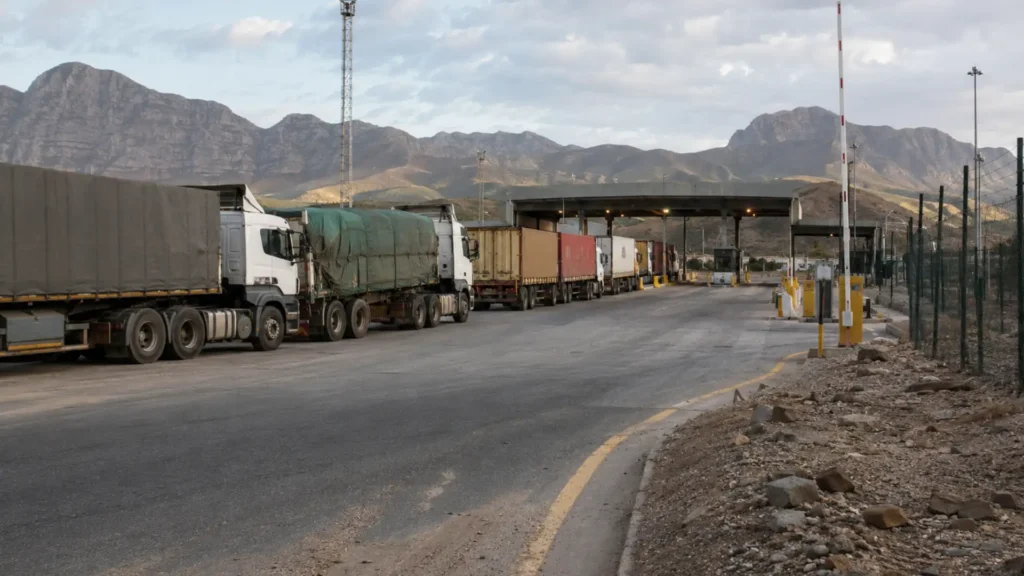
The xenophobia fleet logistics disruption that began in April has now drawn formal international condemnation — and entered its second month with no end in sight. Human Rights Watch published a major report today documenting violent attacks on African and Asian foreign nationals across South Africa, finding that police “failed to protect foreign nationals or, worse, aided the attackers.” A Malawian man died after police beat, tortured, and placed him in the trunk of a car. Five Ethiopian migrants were killed in Johannesburg on 3 May. A Cameroonian shop owner in Durban was attacked by ten men who broke down his door. Over 200 foreign truck drivers have died in xenophobic attacks since 2018. Cross-border transport operators continue to report reduced volumes and driver safety fears. This is no longer a protest. It is a structural disruption to South Africa’s logistics infrastructure.
This is the second report in our coverage of the xenophobia fleet logistics disruption. Our 8 May analysis covered the initial operational impact. Today’s article examines what the HRW report means for fleet operators as the crisis deepens, why the data shows the anti-foreign-driver narrative is factually wrong, and what the escalating international response means for SA companies operating cross-border fleet operations.
The HRW Findings: What Today’s Report Reveals About Xenophobia Fleet Logistics Disruption
Specifically, Human Rights Watch researcher Nomathamsanqa Masiko-Mpaka stated: “South Africa’s constitution and international human rights law protects the right to protest, but that does not include permission to commit violence. The authorities should not allow vigilante groups to violently target foreign nationals and instead need to protect them and bring those who harm them to justice.”
Documented attacks on foreign nationals
In detail, the HRW report documents multiple incidents from April and May 2026. A 43-year-old Cameroonian shop owner in Durban — who has lived in South Africa for nearly 20 years and holds lawful residence — closed his shop during protests, locked the doors, and turned off the lights. Approximately ten men broke down his door and attacked him using a derogatory term. He has not opened an assault case because he does not trust the criminal justice system. Separately, HRW documented an episode in which police beat, tortured, and placed a Malawian national in the trunk of a car after he could not produce documentation. The man subsequently died from his injuries.
Police failure — and complicity
Crucially, HRW found that police officers failed to protect foreign nationals during the attacks — consistent with a pattern documented since 2008. In some cases, officers actively aided attackers. The report notes that despite 18 years of documented xenophobic violence, “remarkably few arrests and even fewer convictions” have resulted. For fleet operators, this finding carries direct implications: foreign drivers who encounter violence on SA roads cannot rely on SAPS for immediate protection. The SAPS leadership crisis — with 18 officers suspended from the Madlanga Commission — compounds this vulnerability.
The scale of violence against foreign truck drivers
HRW’s previous reporting documented that over 200 foreign truck drivers died in xenophobic attacks between March 2018 and September 2019 alone. During a three-week period in May 2019, attackers hit over 60 trucks with Molotov cocktails — predominantly on the N3 between Durban and Johannesburg, South Africa’s busiest freight corridor. The current crisis follows the same geographic pattern: March and March demonstrations have concentrated in Johannesburg, Tshwane, Durban, and Cape Town — precisely the cities that anchor SA’s freight network.
The Data That Disproves the Anti-Driver Narrative Behind the Xenophobia Fleet Logistics Disruption
Importantly, the protests target foreign truck drivers based on the claim that they displace South African workers. The data tells a different story.
84.66% of truck drivers are South African
Research published in the National Library of Medicine confirms that the Road Freight Employers Association records show 44,021 registered truck drivers in South Africa. Of these, 84.66% (37,265) are South African citizens. Only 15.34% (6,756) are foreign nationals. The perception that foreign drivers dominate the industry is factually wrong. However, the academic study notes that “influenced by anti-immigrant sentiments, attacks have been specifically targeting foreign drivers and trucks resulting in death, injury, and damage to vehicles and cargo.”
Foreign nationals in the broader workforce
Meanwhile, HRW notes that South Africa’s unemployment rate stands at 43%. CoRMSA activist Mpho Makhubela observed that “vigilante groups feed off the country’s frustrations and socioeconomic rights regression, unemployment, and lack of efforts to address the equity gaps.” Nevertheless, the HSRC data published in The Conversation shows tolerance declining sharply: 73% of South Africans reported not trusting immigrants from Africa “at all” or “not very much.” In KwaZulu-Natal, the proportion wanting no immigrants rose from 23% in 2021 to 60% in 2025. These attitudes drive the disruption — regardless of what the employment data actually shows.
Month Two: How the Xenophobia Fleet Logistics Disruption Has Evolved Since Our Last Report
Our 8 May report documented five categories of fleet disruption. Here is how each has evolved over the past 12 days.
Cross-border transport: still depressed
First, cross-border operators who reduced or suspended services in April have not fully resumed. The Johannesburg-Harare corridor remains affected. Foreign governments continue to advise caution. Freight News confirmed over 100 Zambian drivers lost employment in the initial weeks — and recruitment to replace them has not materialised because the underlying risk remains. Furthermore, the academic literature warns that “for landlocked countries in the region, any instability in South Africa can have a serious impact on the logistics of their trade participation.”
Retail delivery disruption: evolving but persistent
Second, foreign-owned businesses that closed in April have partially reopened in some areas but remain shuttered in others. Delivery fleets report inconsistent route availability — a shop that accepts deliveries on Monday may close again by Wednesday if protest activity resurges in the area. The HRW report documents that attacks continue in Durban, Johannesburg, and Pretoria, meaning fleet operators cannot assume stabilisation in any specific area.
Driver safety: escalated
Third, the HRW finding that a Malawian man died after police torture represents an escalation from the risk level reported on 8 May. Foreign nationals face violence not only from vigilante groups but also from law enforcement officers. For fleet operators employing non-South African drivers, this means the threat comes from two directions simultaneously. Additionally, the HRW report confirms that “no law enforcement officers came to protect” the Cameroonian shop owner during his attack — consistent with the SAPS effectiveness decline documented across our reporting.
International response: now formally hostile
Fourth, the international response has escalated from diplomatic concern to institutional condemnation. The African Commission on Human and Peoples’ Rights called SA’s response inadequate. Nigeria repatriated 150 citizens. Ghana petitioned the African Union. HRW’s report today adds the most influential international human rights organisation to the list of bodies formally condemning South Africa’s handling of the crisis. Consequently, SA companies operating cross-border fleet operations face an environment where their home country is under formal international censure — creating regulatory, reputational, and operational risk in every country where they operate.
What the HRW Report Means for Fleet Operators Navigating the Xenophobia Fleet Logistics Disruption
Clearly, the HRW report changes the context for fleet operators in three specific ways.
International scrutiny increases retaliation risk
To begin with, every HRW report generates global media coverage. SA companies with operations in Nigeria, Ghana, Kenya, Tanzania, and other African countries now operate under heightened scrutiny. MTN, Standard Bank, Shoprite, and other major SA brands face boycott risk. Fleet operators and logistics companies with cross-border operations may encounter regulatory obstacles, hostile customer environments, or targeted disruption of SA-branded vehicles and facilities in countries where anti-SA sentiment is growing.
Insurance implications may crystallise
Equally concerning, insurers monitor civil unrest risk when setting fleet premiums and coverage terms. A sustained xenophobia crisis documented by HRW, the African Commission, and multiple foreign governments may trigger insurers to tighten civil unrest exclusions or increase premiums for fleets operating in affected areas. Fleet operators should proactively verify that their insurance covers damage arising from xenophobic violence — and that GPS tracking and dashcam systems meet insurer requirements for civil unrest claims.
The November election extends the timeline
Most troublingly, HRW notes that xenophobic violence in SA dates to 2008 and has never been adequately addressed. South Africa holds local government elections on 4 November 2026. Political parties may exploit anti-immigrant sentiment for electoral advantage — sustaining or escalating protest activity through the second half of 2026. Fleet operators should plan for intermittent disruption through at least November rather than assuming the crisis will resolve before then.
Updated Fleet Protection Measures for the Ongoing Xenophobia Fleet Logistics Disruption
Accordingly, the measures recommended in our 8 May report remain essential. The HRW findings add urgency to several specific actions.
Upgrade from monitoring to active protection
Fundamentally, GPS tracking alone shows where a vehicle is. Active protection adds geofencing that prevents vehicles from entering danger zones, real-time dashcam upload that captures evidence of any incident, driver identification that links every trip to a named individual, and panic button activation that triggers immediate control room response. In an environment where HRW confirms police may not respond, the fleet operator’s own technology becomes the primary safety system.
Document everything for legal and insurance purposes
Similarly, if a fleet vehicle or driver is attacked, time-stamped dashcam footage, GPS route data, and driver ID records provide the verified evidence that insurance claims, criminal complaints, and potential civil litigation require. HRW’s documentation of police inaction means fleet operators cannot rely on police reports alone. Self-generated, technology-verified evidence fills the gap that police failure creates.
Reassess cross-border fleet livery and branding
In addition, SA-branded fleet vehicles operating in countries where anti-SA sentiment is growing may attract retaliatory attention. Fleet operators with prominent SA branding on vehicles operating in Nigeria, Ghana, Zimbabwe, or Mozambique should assess whether temporary livery modifications reduce the targeting risk. This is a practical measure, not a political one — it protects drivers and vehicles from being identified with a country under international censure.
Brief drivers on the HRW findings
Finally, foreign drivers in your fleet should know that an international human rights organisation has formally documented the violence they face and the police failure to protect them. This is not reassurance — it is situational awareness. Drivers who understand the risk environment make better decisions about route selection, stop management, and when to call for help. Brief every foreign driver this week.
Technology That Protects Fleet Operations During the Xenophobia Fleet Logistics Disruption
Notably, the integrated fleet management platforms that protect against hijacking and fuel theft serve a critical dual purpose during civil unrest — and the HRW report makes their deployment more urgent.
DigitFMS integrates GPS tracking with geofencing, AI dashcams with cloud upload, wireless driver identification, and panic button activation on a single platform. When a vehicle enters a geofenced protest zone, both the driver and the control room receive immediate alerts. If an incident occurs, dashcam footage uploads in real time — surviving even if the camera or vehicle is damaged. Driver ID confirms who was driving, where they were, and what route they took. The company’s 100+ franchise branches include operators in Gauteng, KwaZulu-Natal, and the Western Cape — the three provinces where HRW documents the most concentrated violence.
Cartrack, Tracker, Netstar, Ctrack, and MiX by Powerfleet all offer GPS tracking and geofencing that serve the same protective function. The critical requirement during the xenophobia fleet logistics disruption is that the platform provides real-time position monitoring, geofencing with automated alerts, cloud-based dashcam storage, and rapid response coordination that operates independently of SAPS.
Outlook: The Xenophobia Fleet Logistics Disruption Is Now an International Crisis
Overall, today’s HRW report transforms the xenophobia crisis from a domestic disruption into an international incident with diplomatic, economic, and operational consequences. The pattern is clear: vigilante groups attack foreign nationals, police fail to protect them, government issues statements without effective action, and international organisations escalate condemnation. Meanwhile, fleet operators absorb the operational cost — reduced cross-border volumes, disrupted delivery routes, driver safety risks, and the reputational exposure of operating SA-branded vehicles across a continent that is watching.
Nevertheless, the academic data confirms that 84.66% of truck drivers are South African citizens. The violence targets a narrative, not a reality. However, narratives drive behaviour — and the behaviour disrupts logistics. Fleet operators cannot control the political dynamics driving the crisis. They can control their driver protection systems, their route intelligence, their insurance posture, and their evidence-capture capability.
Ultimately, the xenophobia fleet logistics disruption will persist as long as the underlying conditions — 43% unemployment, institutional police failure, electoral incentives, and international impunity — remain unresolved. HRW’s report documents that these conditions have persisted since 2008 without adequate government response. Fleet operators who build their protection around technology and private response capability — rather than hoping for government intervention that 18 years of evidence shows will not come — will navigate this crisis with their drivers safe, their vehicles tracked, and their evidence preserved.
Frequently Asked Questions
What did Human Rights Watch report today?
On 20 May 2026, HRW documented violent xenophobic attacks in SA during April-May 2026. Police failed to protect foreign nationals or aided attackers. A Malawian man died after police torture. Five Ethiopians were killed in Johannesburg. A Cameroonian shop owner was attacked by ten men in Durban. HRW called on authorities to protect foreign nationals and bring attackers to justice.
How does this affect fleet logistics?
Cross-border operators still report reduced volumes since April. Over 100 Zambian drivers lost jobs. Foreign-owned businesses receiving deliveries remain closed in some areas. Delivery routes are inconsistent — shops reopen then close again with protest activity. The disruption has entered month two with the November 2026 elections likely sustaining it further.
How many foreign truck drivers have been attacked?
Over 200 foreign truck drivers died in xenophobic attacks between March 2018 and September 2019. In one three-week period, attackers hit 60+ trucks with Molotov cocktails on the N3. The current crisis follows the same geographic pattern along SA’s major freight corridors. HRW has documented the pattern since 2008 with “remarkably few arrests and even fewer convictions.”
Are foreign drivers actually taking SA jobs?
No. Road Freight Employers Association data shows 84.66% of truck drivers (37,265 of 44,021) are South African citizens. Only 15.34% are foreign nationals. Academic research confirms attacks target a false narrative rather than actual labour displacement. The violence disrupts logistics for all operators — South African and foreign-owned alike.
What should fleet operators do now?
Activate GPS tracking with geofencing on all vehicles. Ensure AI dashcams upload to the cloud in real time. Brief foreign drivers on avoidance routes and the HRW findings. Consider reassigning foreign drivers from high-risk urban routes. Verify insurance covers civil unrest. Assess cross-border fleet livery for retaliatory targeting risk. Document every incident with technology-verified evidence.
How long will this disruption last?
Through at least November 2026 (local government elections). HSRC data shows anti-immigrant sentiment rising structurally — 42% wanting no immigrants by 2025. HRW notes the pattern dates to 2008 without adequate government response. Political parties may exploit the sentiment for electoral advantage. Plan for intermittent disruption over months, not weeks.
What international response has occurred?
HRW published formal condemnation today (20 May). The African Commission on Human and Peoples’ Rights called SA’s response inadequate. Nigeria repatriated 150 citizens. Ghana petitioned the AU. Zimbabwe, Malawi, Lesotho, and Kenya issued safety advisories. SA companies operating across Africa face boycotts, regulatory obstacles, and hostile conditions in countries where anti-SA sentiment grows.
Sources
Human Rights Watch — “South Africa: New Waves of Xenophobic Attacks”, 20 May 2026; Nomathamsanqa Masiko-Mpaka quotes; Cameroonian shop owner, Malawian national incidents · Human Rights Watch — “South Africa: Punish Xenophobic Violence”, September 2019; 200+ truck driver deaths, 60+ trucks firebombed · Human Rights Watch — “They Have Robbed Me of My Life”, September 2020; systematic documentation of xenophobic violence patterns
African Commission on Human and Peoples’ Rights — Statement deploring xenophobic attacks, 27 April 2026 · National Library of Medicine / PMC — “Attacks on road-freight transporters: a threat to trade participation for landlocked countries in Southern Africa”; 84.66% SA drivers, 15.34% foreign nationals · HSRC / The Conversation — “South Africans far less tolerant of migrants”, 2025; 73% distrust, KZN 60% wanting no immigrants · Freight News — “Logistics companies latest victims”, 100 Zambian drivers · CoRMSA — Mpho Makhubela statements · DigitFMS — “Anti-immigrant protests disrupt cross-border logistics”, 8 May 2026 · DigitFMS — “SAPS corruption fleet security crisis deepens”, 12 May 2026
© 2026 DigitFMS. All rights reserved.