
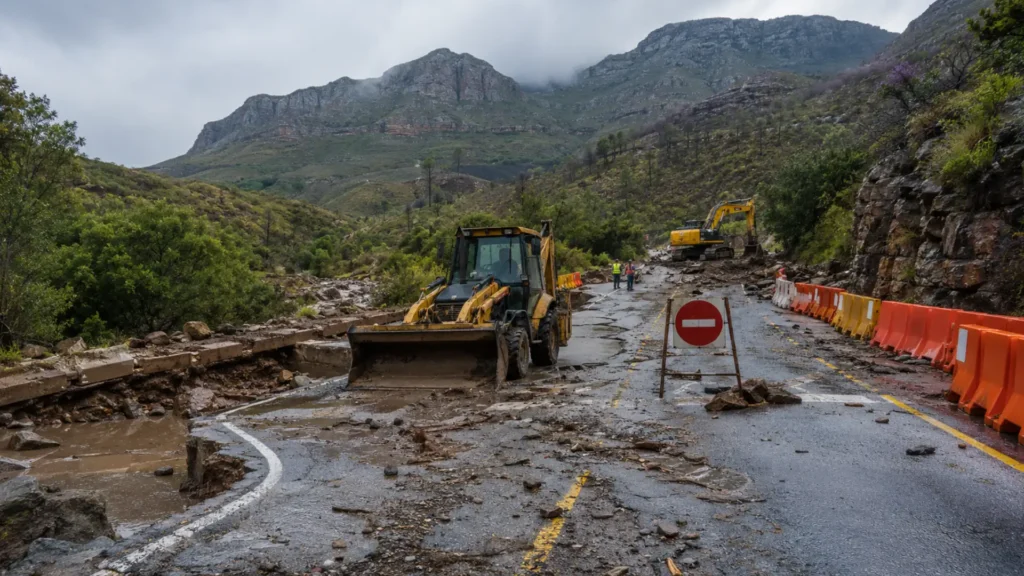
Garden Route road closures fleet recovery has entered its second week — and the picture is both improving and worsening simultaneously. Twelve days after storms dumped 300 mm of rain and triggered a national disaster declaration, the Western Cape Provincial Government reports that 15 roads have reopened but 55 remain closed. Meiringspoort has no estimated reopening date. The N2 at Bitou operates under stop-and-go after SANRAL installed a temporary pipe. Meanwhile, a new threat has emerged: criminals have already stolen more than R100,000 worth of cable from electricity infrastructure that Eskom has not yet re-energised — exploiting the chaos exactly as the copper theft crisis analysis predicted.
This is the follow-up to our 12 May national disaster report. It provides fleet operators with the current road-by-road status, the emerging costs of semi-permanent detours, the criminal activity exploiting the disruption, and the updated timeline for when the Garden Route road closures fleet recovery will actually be complete.
Current Status: What Reopened and What Remains Closed in the Garden Route Road Closures Fleet Recovery
The Garden Route District Municipality Multi-Agency Command Centre (MACC) issued 16 alerts between 4 and 11 May. Here is the consolidated status as of day 12.
Roads that have reopened
Specifically, fifteen roads have reopened across the district. Notably, the N9 between Uniondale and George is open — a critical alternative for fleet vehicles diverted from Meiringspoort. The R62 between Joubertinia and George is open but authorities urge caution on wet surfaces. Robinson Pass between Oudtshoorn and Mossel Bay has reopened. Montagu Pass operates as a single lane. Seven Passes Road and several Knysna-area routes reopened after tree clearance. Huisrivier Pass operates under stop-and-go. Furthermore, the N2 at Bitou reopened under stop-and-go traffic control after SANRAL installed a temporary drainage pipe at the KwaNokuthula turn-off.
Major routes still closed
Meiringspoort (TR33/4) remains closed with no estimated reopening date. The GRDM stated the “estimated time to clear this road is not known because of the extent of the damage.” Cango Caves Road will remain closed “for some time.” Swartberg Pass between Prince Albert and Oudtshoorn remains closed. Seweweekspoort (MR309) remains closed. The R328 near De Kombuys is still blocked by a major landslide and rockfall requiring geological assessment.
District roads: the slow recovery
Meanwhile, across the Oudtshoorn, Kannaland, and Uniondale areas, dozens of district and municipal roads remain closed or severely damaged. In Oudtshoorn, only two of six low-water bridges have reopened — the municipality’s infrastructure department continues assessing the remaining four. The Kammanassie region remains a significant challenge: multiple farms remain cut off, and recovery teams reached seven isolated areas on 10 May to deliver food parcels. In Calitzdorp, roads at Groenfontein, Middelpad, Doornkloof, Vleirivier, Gais, and Jagberg remain closed due to flooding of low-level structures.
Criminals Exploit the Chaos: Cable Theft During the Garden Route Road Closures Fleet Recovery
The GRDM MACC Alert 13 flagged a development that should alarm every fleet operator in the region: criminals have already begun stealing infrastructure during the disaster recovery.
Specifically, the Bitou Municipality reported that vandalism and cable theft are targeting electricity lines that Eskom has not yet re-energised after the storm. The MACC confirmed that more than R100,000 worth of cable has been stolen. Local SAPS members and neighbourhood watches have been requested to remain on high alert and monitor affected areas. This pattern is depressingly familiar — it mirrors precisely the copper theft infrastructure security crisis documented across Eskom, Transnet, and Telkom nationally.
For fleet operators, the implication is direct. Electricity restoration in the Garden Route depends on Eskom repairing damaged lines. If criminals steal the cable before Eskom can reconnect it, the restoration timeline extends further. Power outages at fleet depots, fuel storage facilities, and pump stations in the region continue — and the criminal exploitation of the disaster prolongs every one of them. Consequently, depot security systems in the affected area must operate on independent backup power, because the grid restoration that would reactivate them keeps getting pushed back by the very crime the security systems are meant to prevent.
The Cost of Detours: What the Garden Route Road Closures Fleet Recovery Adds to Operating Budgets
Importantly, the initial emergency is over. The ongoing cost is not. Fleet operators using Garden Route corridors now face semi-permanent detour costs that accumulate daily.
Meiringspoort detour costs
To illustrate, the Meiringspoort detour via R341 through De Rust or N12 via George adds approximately 80 to 120 km to the Beaufort West-Oudtshoorn route depending on the specific origin and destination. At R31 per litre diesel and typical heavy vehicle consumption of 35 to 45 litres per 100 km, each detour trip costs an additional R450 to R680 in fuel alone. Driver hours, tyre wear, and vehicle maintenance add to this figure. For a fleet running this corridor twice daily, the monthly detour cost reaches R27,000 to R41,000 — exclusively from a single road closure.
N2 delay costs
Similarly, the N2 at Bitou operates under stop-and-go traffic control while engineers continue drainage repairs. Fleet vehicles report delays of 20 to 45 minutes at the KwaNokuthula diversion. For a truck idling in a queue, this costs approximately 3 to 7 litres of diesel per wait — R93 to R217 per vehicle per passage. Additionally, perishable cargo in cold chain vehicles faces spoilage risk from extended journey times that push delivery windows beyond acceptable thresholds.
Agricultural corridor disruption
In addition, the Kammanassie, Langkloof, and Oudtshoorn farming areas are the most affected. Multiple farms remain cut off. Agricultural fleet vehicles that normally transport produce from these areas face impassable routes. For farming operations eligible for the SARS 100% diesel refund, the disruption creates a double hit: increased fuel consumption on longer routes and reduced productive activity that diminishes the eligible diesel volume for refund claims.
The Recovery Timeline: How Long the Garden Route Road Closures Fleet Recovery Will Take
Crucially, fleet operators need to distinguish between roads that will recover in days, roads that will take weeks, and roads that will take months.
Days to weeks: district roads and low-water bridges
First, most district roads closed by flooding will reopen as water recedes and road surfaces dry. Low-water bridges require individual structural assessment — two of six in Oudtshoorn have reopened, with assessments continuing on the remaining four. Expect most district roads to reopen progressively through May, with some requiring temporary repairs that reduce load capacity for heavy vehicles.
Weeks to months: N2 Bitou permanent repair
Second, SANRAL installed a temporary pipe to reopen the N2, but permanent repair of the four-metre-deep culvert damage requires full engineering reconstruction. Stop-and-go traffic control will persist until the permanent fix completes. Fleet operators should budget for 20-to-45-minute delays on this section through at least June, potentially into July.
Months: Meiringspoort, R328, and Cango Caves Road
Third, Meiringspoort faces the longest recovery. The pass sustained severe flooding from the Meiringspoort River while the Stompdrift Dam overflowed at 139% capacity. Engineering assessment has not yet determined the scope of reconstruction required. Historical precedent from previous Meiringspoort closures suggests repairs of this scale take three to six months. The R328 landslide requires geological assessment before crews can begin clearing — and landslide sites carry ongoing risk of further collapse. Cango Caves Road will remain closed “for some time” with no specific timeline. Fleet operators should plan these three closures as semi-permanent through at least the end of winter 2026.
How Fleet Technology Supports the Ongoing Garden Route Road Closures Fleet Recovery
Notably, the technology deployed during the initial emergency continues to serve fleet operators during the recovery phase — but the use case shifts from emergency response to cost management.
Dynamic geofencing for evolving closures
Essentially, road closure status changes daily. A road that was closed on Monday may reopen on Wednesday. A road open under stop-and-go may close again after new rain. Fleet operators should update geofences around affected roads at least weekly — removing geofences from reopened routes and adding them around newly affected areas. This ensures drivers receive current alerts rather than outdated warnings that cause unnecessary detours.
Fuel monitoring quantifies detour costs
Equally important, litre-level fuel monitoring shows the exact additional consumption each detour generates. When the fleet manager can see that the Meiringspoort detour costs R680 per trip in fuel, that data supports contract renegotiation with clients, insurance claims for increased operating costs, and management decisions about whether to continue serving affected routes or temporarily withdraw capacity.
Depot security during extended power outages
Accordingly, with cable theft delaying Eskom’s restoration timeline in the Bitou area, fleet depots in the region face extended periods without grid power. Solar-powered CCTV, battery-backed access control, and cellular-connected alarm systems operate independently of the grid — maintaining security through the exact infrastructure gap that criminals exploit. DigitFMS’s integrated platform monitors both depot security systems and vehicle tracking on a single dashboard, ensuring fleet managers maintain visibility across all assets during the disruption.
Five Actions for Fleet Operators Navigating the Ongoing Recovery
Update your detour routing weekly. The GRDM MACC issues regular alerts via the Garden Route District Municipality website. Check each Monday for updated road status. Remove unnecessary detours from reopened roads and programme new alternatives for any fresh closures. Every unnecessary detour kilometre costs money at R31 per litre.
Next, calculate and document your actual detour costs. Use fuel monitoring data to quantify the exact additional consumption per affected route. This documentation supports fuel surcharge negotiations with clients, insurance claims for disaster-related cost increases, and internal budget adjustments that distinguish “normal” fuel consumption from disaster-driven overages.
Additionally, verify depot backup power in the affected region. Cable theft in Bitou means Eskom restoration is delayed beyond the storm damage timeline. If your Garden Route depot runs on grid power with no backup, security systems remain offline until Eskom reconnects — which now depends on replacing stolen cable as well as repairing storm damage. Solar backup with battery storage keeps security operational regardless.
Furthermore, brief drivers on current conditions, not last week’s conditions. A driver who was briefed on 12 May may not know that Robinson Pass reopened or that N2 delays have shortened. Updated briefings prevent unnecessary detours and ensure drivers take the most efficient available route rather than the emergency route that was correct 10 days ago.
Finally, plan for Meiringspoort’s absence through winter. The pass will not reopen soon. Fleet operations that regularly used Meiringspoort should formalise the R341/N12 alternative as a standard route — including updated fuel budgets, revised delivery schedules, and renegotiated client timelines that reflect the longer distance. Treating the detour as temporary when it is clearly semi-permanent creates ongoing budget leakage.
Outlook: The Garden Route Road Closures Fleet Recovery Is a Marathon, Not a Sprint
Overall, the national disaster declaration mobilised resources. The initial emergency response saved lives and cleared main routes. However, the recovery phase — repairing Meiringspoort, permanently fixing the N2 culvert, clearing the R328 landslide, assessing bridges, and restoring power to areas where criminals steal cable as fast as Eskom replaces it — will extend through the winter months and potentially beyond.
In summary, for fleet operators, Day 12 of the Garden Route road closures fleet recovery delivers a clear message: this is no longer an emergency to react to. It is an operational reality to plan around. The 55 closed roads will progressively reopen — but Meiringspoort, the R328, and Cango Caves Road will not. The detour costs are no longer temporary overages. They are semi-permanent additions to the operating budget. The depot power outages are no longer storm damage. They are compounded by criminal exploitation that extends every restoration timeline.
Ultimately, the fleet operators who adjusted their routing, quantified their detour costs, secured their depots with backup power, and briefed their drivers on current conditions in week one will continue operating efficiently through week 12 and beyond. The operators who assumed the roads would reopen quickly — and did not formalise their alternatives — will discover that hoping for Meiringspoort to reopen is not a logistics strategy. The data is available. The routes are published. The costs are calculable. The only question is whether fleet managers act on the information or absorb the losses in silence.
Frequently Asked Questions
Is Meiringspoort open yet?
No. As of Day 12 (18 May), Meiringspoort remains closed with no estimated reopening date. The GRDM confirmed “the estimated time to clear is not known.” Historical precedent suggests three to six months for damage of this scale. Use the R341 via De Rust or N12 via George as alternatives.
How many roads are still closed?
The Western Cape Provincial Government confirmed 55 roads closed, 5 partially open, and 15 reopened as of Alert 16 on 11 May. Major closures include Meiringspoort, Cango Caves Road, Swartberg Pass, Seweweekspoort, the R328 landslide, and multiple Oudtshoorn/Kammanassie district roads.
Is the N2 open through the Garden Route?
The N2 at Bitou reopened under stop-and-go after SANRAL installed a temporary drainage pipe. Expect 20-45 minute delays at the KwaNokuthula diversion. Permanent repair of the four-metre culvert will take weeks. Check the Western Cape Government road updates before dispatching.
Are criminals exploiting the disaster?
Yes. The GRDM confirmed R100,000+ of cable stolen from electricity infrastructure in the Bitou area that Eskom has not yet re-energised. SAPS and neighbourhood watches are on high alert. This theft delays power restoration, extending depot security outages for fleet operators in the region.
What alternative routes should fleet operators use?
For Meiringspoort: R341 via De Rust or N12 via George. The N9 has reopened. The R62 is open with caution. Robinson Pass reopened. Swartberg Pass remains closed. Huisrivier Pass operates under stop-and-go. Check GRDM and Western Cape Government updates weekly as status changes.
How much are detours costing fleet operators?
The Meiringspoort detour adds 80-120 km and R450-R680 in fuel per trip. A fleet running this corridor twice daily faces R27,000-R41,000 per month in additional fuel costs. N2 delays add R93-R217 per vehicle per passage in idling fuel. These costs accumulate daily for as long as closures persist.
When will full recovery be complete?
District roads: progressively through May. N2 permanent repair: June-July. Meiringspoort: three to six months (no confirmed date). R328 landslide: requires geological assessment. Cango Caves Road: “for some time.” Plan for semi-permanent detour routing through at least winter 2026.
Sources
Garden Route District Municipality — Multi-Agency Command Centre Alerts 5-16, 6-11 May 2026 (gardenroute.gov.za/category/disaster-management/floods) · GRDM Alert 13 (10 May): cable theft R100K+ in Bitou, 2 of 6 bridges reopened, N2 closure until 12 May · GRDM Alert 14 (11 May): Meiringspoort “time to clear not known”, N2 stop-and-go, electricity disruptions Nature’s Valley/Hoekwil/Kurland/The Crags
GRDM Alert 16 (11 May): 55 roads closed, 5 partially open, 15 reopened; R328 landslide clearing ongoing; body recovered from Meiringspoort · George Herald — Road closures and infrastructure updates, 7-10 May 2026 · George Municipality — Alert 7 (7 May): full road closure list and alternative routes · Knysna-Plett Herald — Multi-Agency Command Centre updates · IOL — “Garden Route floods: affected areas and road closures”, 7 May 2026 · SANRAL — N2 Bitou temporary pipe installation · Western Cape Government — Road closures due to Level 8 rainfall · COGTA — National disaster declaration, 10 May 2026 · DigitFMS — National disaster fleet operations report, 12 May 2026
© 2026 DigitFMS. All rights reserved.