
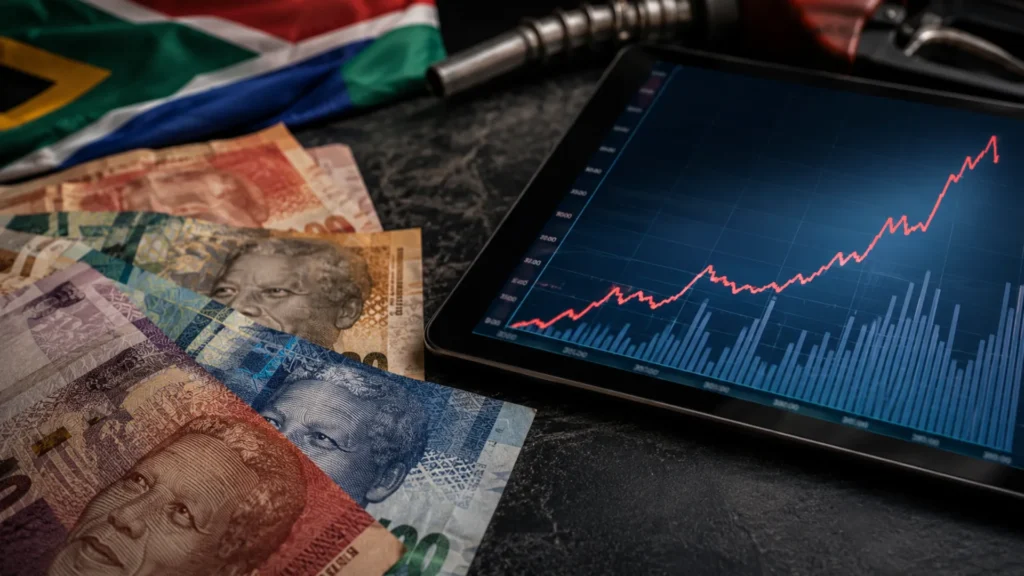
Political instability fleet fuel costs are now directly connected through a mechanism every fleet operator must understand: the rand. On 8 May, the Constitutional Court ruled that Parliament must establish an impeachment committee to examine President Ramaphosa’s conduct in the Phala Phala scandal. The DA has confirmed it will participate. The EFF demands immediate action. Ramaphosa has responded by announcing a legal challenge to the Section 89 report. The ANC NEC met this weekend and Mbalula ruled out recall or resignation. Meanwhile, the rand has weakened from R15.84 in February to R16.65 — and FX Leaders reports USD/ZAR tested R17 before retreating. South Africa imports all its fuel. Every R1 of rand weakness adds approximately R0.15 to R0.25 per litre to diesel. Political instability is not a newspaper story for fleet operators. It is a line item on their fuel bill.
This analysis explains the direct transmission mechanism from political instability to fleet fuel costs, quantifies the rand risk scenarios fleet operators face, and identifies the specific actions fleet managers should take to protect their budgets while South Africa’s most consequential political crisis in years unfolds.
The Constitutional Court Ruling That Links Political Instability Fleet Fuel Costs
Specifically, the Constitutional Court’s unanimous ruling on 8 May found that Rule 129I of the National Assembly was unconstitutional and that Parliament’s December 2022 vote to reject the Section 89 independent panel report was unlawful. Chief Justice Mandisa Maya stated that terminating the impeachment process without considering the merits “stifled informed debate and undermined the values of accountability and transparency.” The court ordered the National Assembly to refer the report to an impeachment committee.
What the panel found
The independent panel, chaired by former Chief Justice Sandile Ngcobo, found prima facie evidence that Ramaphosa had a case to answer regarding the theft of $580,000 in cash from a sofa at his Phala Phala game farm in 2020. The panel concluded that Ramaphosa’s farming business exposed him to a conflict of interest, that he may have contravened the Prevention of Corrupt Activities Act by failing to report the crime, and that state resources may have been used in off-the-books investigations to locate the suspects.
The political response
Ramaphosa responded with a late-night televised address on 11 May, announcing that he will launch a legal review of the Section 89 report. He maintains that the report’s findings rest on “hearsay allegations” and that “no evidence, let alone sufficient evidence, has been presented” to show he violated the constitution. Importantly, Semafor describes this as a strategy to shift the fight from a hostile parliament to the courts — easing pressure on the fragile Government of National Unity.
The DA’s position
DA leader Geordin Hill-Lewis told Radio 702: “We cannot turn a blind eye to any adverse findings against Ramaphosa. We have to re-establish the principle of integrity and accountability in the state.” This means the senior coalition partner will not protect Ramaphosa in the impeachment process — creating a genuine political risk that financial markets have not yet fully priced in.
The Transmission Mechanism: How Political Instability Fleet Fuel Costs Are Connected
Crucially, fleet operators do not need to understand constitutional law. They need to understand one mechanism: political uncertainty → rand weakness → higher diesel prices. Here is how each link in that chain works.
Link 1: Political uncertainty weakens the rand
Fundamentally, the rand is one of the most actively traded emerging-market currencies in the world. When investors perceive political instability in South Africa, they reduce exposure to rand-denominated assets. Capital outflows weaken the currency. SACCI’s Business Confidence Index fell 3.3 points to 131.3 in March as the rand weakened. Furthermore, South African government bond yields have edged higher as investors demand increased returns to compensate for political risk. The more uncertain the political outlook, the weaker the rand trades.
Link 2: A weaker rand makes imported fuel more expensive
Accordingly, South Africa imports all its fuel. The regulated fuel price formula converts international petroleum product costs from US dollars to rand using the Basic Fuel Price (BFP). When the rand weakens against the dollar, the same barrel of oil costs more in rand terms. EBC Financial Group confirms that a weaker currency lifts the USD import bill directly, and SARB has projected fuel inflation exceeding 18% for the second quarter of 2026. This link is formulaic — it operates automatically through the pricing mechanism, regardless of what fleet operators do.
Link 3: Higher diesel prices hit fleet budgets
Every R1 of rand weakness against the dollar adds approximately R0.15 to R0.25 per litre to the diesel price, depending on the prevailing international oil price and the lag in the monthly pricing formula. The rand has moved from R15.84 in February to approximately R16.65 currently — a depreciation of roughly R0.80. This has already added an estimated R0.12 to R0.20 per litre to diesel costs that fleet operators pay at the pump. If the rand weakens further, the addition grows proportionally.
Three Rand Scenarios and What Each Means for Political Instability Fleet Fuel Costs
Clearly, fleet operators should model three scenarios based on how the political situation develops.
Scenario A: Contained — rand holds at R16.50-R16.80
Investec’s Annabel Bishop notes that the Phala Phala ruling has not yet roiled markets significantly — partly because Ramaphosa has chosen legal challenge over resignation, and partly because the GNU coalition remains intact for now. If the rand holds its current range, the currency contribution to June diesel pricing remains modest. Diesel settles in the R33-R34 range as projected by AutoTrader. This is the base case.
Scenario B: Escalation — rand weakens to R17.00-R17.50
In contrast, if impeachment hearings begin and the process fractures the ANC-DA coalition, the rand could test R17.00 or beyond. FX Leaders confirms that USD/ZAR already tested R17 before retreating. AutoTrader flagged R17.50 as a risk scenario where the June diesel hike could exceed R3.00 per litre. Consequently, diesel would reach R35 or more rather than R33 — a difference of R600,000 per year for a 20-vehicle fleet at 300,000 litres monthly. This scenario becomes more likely if the DA actively opposes Ramaphosa in the impeachment committee.
Scenario C: GNU collapse — rand beyond R17.50
Most alarmingly, this is the worst case. If the impeachment process triggers a no-confidence motion or the DA exits the coalition, the Government of National Unity collapses. Historical precedent suggests a 10% to 15% rand drop within weeks — potentially pushing the currency past R18 or R19. At those levels, diesel could approach R38 to R40 per litre from currency effects alone, on top of international oil prices. SARB would likely respond with an emergency rate hike, increasing fleet financing costs simultaneously. While this scenario remains unlikely, it is not impossible — and fleet operators who have not modelled it will be caught unprepared if it materialises.
What Makes This Political Instability Fleet Fuel Costs Risk Different From Previous Crises
Admittedly, South Africa has experienced political crises before. However, the current environment amplifies the fleet cost impact in ways that previous crises did not.
Diesel is already at record levels
To illustrate, when the rand weakened during the Zuma era or the DA’s 2025 GNU exit, diesel sat at R15 to R20 per litre. Today it sits at R31. A R0.20 per litre currency-driven increase on R15 diesel is a 1.3% cost impact. The same R0.20 on R31 diesel is still measurable, but it arrives on top of a price that has already doubled — meaning fleet budgets have zero buffer to absorb additional pressure. Currency weakness now amplifies a crisis that has already depleted financial reserves.
The levy relief disappears regardless of politics
Moreover, the diesel levy rises from R0 to R1.97 on 3 June and to R3.93 on 1 July — irrespective of what happens with impeachment proceedings. This means fleet operators face a guaranteed R3.93 per litre increase from levy reinstatement plus a potential additional R0.15 to R0.50 from currency weakness. The two forces compound rather than substitute. A fleet operator budgeting for R33 diesel in June based on AutoTrader’s projection may actually face R35 if the rand weakens simultaneously.
Business confidence is already falling
Already, SACCI’s 3.3-point drop in March occurred before the Constitutional Court ruling. The impeachment process adds further uncertainty to an already nervous business environment. For fleet operators, falling business confidence translates into fewer transport orders, delayed investment in fleet expansion, and tighter credit conditions for vehicle financing. The political instability fleet fuel costs mechanism operates alongside — and compounds — declining demand.
Six Actions Fleet Operators Should Take to Manage Political Instability Fleet Fuel Costs
Model fuel budgets at three rand scenarios. Base case R33 (rand holds), elevated case R35 (rand at R17.50), and stress case R37+ (GNU fracture). Present all three to management and finance teams. The political situation determines which scenario materialises — but the budget models should exist before events force the decision.
Next, lock in fuel purchases before 2 June. The diesel levy sits at zero for 15 more days. Buy forward now — not because of the political crisis, but because the levy reinstatement is guaranteed regardless of what happens in Parliament. Every litre purchased at R31 before June costs R1.97 less than the same litre on 3 June. If the rand weakens simultaneously, the saving grows further.
Additionally, activate fuel surcharge clauses with currency-linked triggers. Most transport contracts include fuel surcharges triggered by pump price movements. Fleet operators should also consider adding rand-linked triggers — if the rand breaches R17.00, the surcharge escalates automatically. This protects margins against currency-driven cost increases that pump price triggers may not capture until the following month’s DMRE adjustment.
Monitor, optimise, and claim
Deploy fuel monitoring to maximise every litre’s value. At R31 per litre, saving 50 litres per week per vehicle through theft detection and efficiency gains returns R80,600 per year. At R35, the same saving returns R91,000. At R37, it reaches R96,200. DigitFMS’s D-Fuel system identifies siphoning, phantom fills, and consumption anomalies in real time — converting fuel data into financial protection that grows more valuable with every price increase.
Furthermore, claim every SARS diesel refund rand. For farming, forestry, and mining operators, the 100% diesel refund recovers approximately R5.85 per litre. At R35 diesel, that represents a 16.7% effective discount. At R37, it reaches 15.8%. In a currency-driven cost environment, the SARS refund becomes an even more critical source of cash recovery.
Finally, monitor the political timeline weekly. National Assembly Speaker Didiza has outlined a six-step process for the impeachment committee. Ramaphosa’s legal review could delay proceedings. The ANC may argue sub judice. The EFF will push for acceleration. Each development moves the rand — and therefore the diesel price. Fleet managers who track the political calendar alongside the fuel calendar make better budgeting decisions than those who treat politics as irrelevant to operations.
Outlook: Political Instability Fleet Fuel Costs Risk Extends Through 2026
Looking ahead, the impeachment process will not resolve quickly. Ramaphosa’s legal challenge could take months. Even if hearings begin, the committee must gather evidence, call witnesses, and produce a final report. Removal requires a two-thirds parliamentary majority — a threshold that currently appears difficult to reach. Meanwhile, South Africa holds local government elections on 4 November 2026, adding further political intensity to every action by every party.
In essence, for fleet operators, the practical implication is that political instability fleet fuel costs risk is not a one-week event. It is a persistent background factor that will influence the rand — and therefore diesel pricing — for the remainder of 2026. The Strait of Hormuz keeps Brent above $100. The levy relief disappears by July. The slate deficit generates additional charges. And now, the impeachment crisis adds currency risk on top of every other cost pressure.
Ultimately, fleet operators cannot control the Constitutional Court, the impeachment committee, or the rand. They can control their fuel efficiency, their monitoring systems, their surcharge clauses, their SARS claims, and their budget scenarios. The operators who build those controls now — while diesel sits at R31 and the levy sits at zero — will navigate the political storm with their margins intact. The operators who assume politics does not affect their fuel bill will discover, when the rand hits R17.50 and diesel hits R35, that the most expensive assumption a fleet manager can make is that the exchange rate is someone else’s problem.
Frequently Asked Questions
How does the Phala Phala impeachment affect fleet fuel costs?
The impeachment process creates political uncertainty that weakens the rand. South Africa imports all fuel. The regulated price formula converts international costs from dollars to rand. Every R1 of rand weakness adds R0.15-R0.25 per litre to diesel. The rand has weakened from R15.84 in February to R16.65. If proceedings trigger further weakness to R17.50, diesel could exceed R35 rather than R33 in June.
Has the rand weakened because of the ruling?
Investec’s Annabel Bishop notes the ruling has not yet roiled markets significantly because Ramaphosa chose legal challenge over resignation. However, SACCI BCI fell 3.3 points. USD/ZAR tested R17 before retreating. The actual impeachment hearings, when they begin, could trigger renewed volatility. The risk is priced as possible but not yet materialised.
How does the exchange rate affect diesel prices?
South Africa imports all fuel. The Basic Fuel Price converts international costs from dollars to rand. A weaker rand makes the same oil barrel more expensive domestically. SARB projects fuel inflation above 18% for Q2 2026. This transmission is formulaic and automatic — fleet operators cannot negotiate around a currency-driven increase.
What is the worst case for fleet fuel costs?
If the GNU coalition collapses, the rand could fall 10-15% past R18. Diesel could approach R38-R40 from currency effects alone. SARB would likely hike rates, increasing fleet financing costs. Even the moderate scenario — rand at R17.50 — pushes diesel to R35 rather than R33, costing a 20-vehicle fleet R600,000 extra per year.
What should fleet operators do to prepare?
Model budgets at R33, R35, and R37. Buy fuel before 2 June while the levy sits at zero. Activate fuel surcharges with currency-linked triggers. Deploy fuel monitoring to maximise savings per litre. Claim SARS 100% diesel refunds. Monitor the political timeline weekly — each impeachment development moves the rand and therefore the diesel price.
Could the impeachment collapse the GNU?
The DA confirmed it will participate and not protect Ramaphosa. If the process weakens the ANC-DA coalition, the GNU could fracture. Analysts at Investec, Standard Bank, and SACCI flag coalition stability as the key variable for the rand. A collapse would trigger significant depreciation, higher bond yields, and potential rate hikes — all increasing fleet costs.
How long will political uncertainty last?
Speaker Didiza outlined a six-step process for the impeachment committee. Ramaphosa’s legal review could delay proceedings for months. Local government elections on 4 November add further political intensity. Fleet operators should plan for uncertainty persisting through at least the end of 2026 rather than assuming quick resolution.
Sources
Constitutional Court — CCT 35-24 EFF and Another v Speaker of the NA and Others, 8 May 2026; Chief Justice Mandisa Maya · Daily Maverick — “What ConCourt’s Phala Phala ruling means for Ramaphosa’s future”, 8 May 2026; “Ramaphosa bets on legal review to stall impeachment”, 11 May 2026 · Bloomberg — “Why Ramaphosa faces impeachment risk as Phala Phala resurfaces”, 12 May 2026 · Semafor — “South Africa’s Ramaphosa turns to courts to stall impeachment”, 12 May 2026
Mail & Guardian — “EFF demands immediate impeachment committee”, 8 May 2026 · The Citizen — “DA leader: will not turn blind eye”, 11 May 2026; “Explainer: What happens next after Phala Phala ruling”, 8 May 2026 · FX Leaders — “USD/ZAR retreats after CPI and Ramaphosa impeachment development”, 11 May 2026; rand at R16.44, R17 tested · Investec — Annabel Bishop, Rand Note analysis, May 2026 · SACCI — Business Confidence Index March 2026, 131.3 (down 3.3 points) · Swisher Post — “SA business confidence falls as rand slides to R16.53”, April 2026 · EBC Financial Group — “Fuel relief temporary as diesel, rand, export strains”, April 2026 · Domain-b — “SA rand weakens as global risks and local concerns intensify”, 15 May 2026 · AutoTrader — June fuel price projection, R17.50 risk scenario · SARB — March 2026 MPC statement, 18% fuel inflation Q2 projection · DigitFMS — ROI of fuel monitoring client data
© 2026 DigitFMS. All rights reserved.