
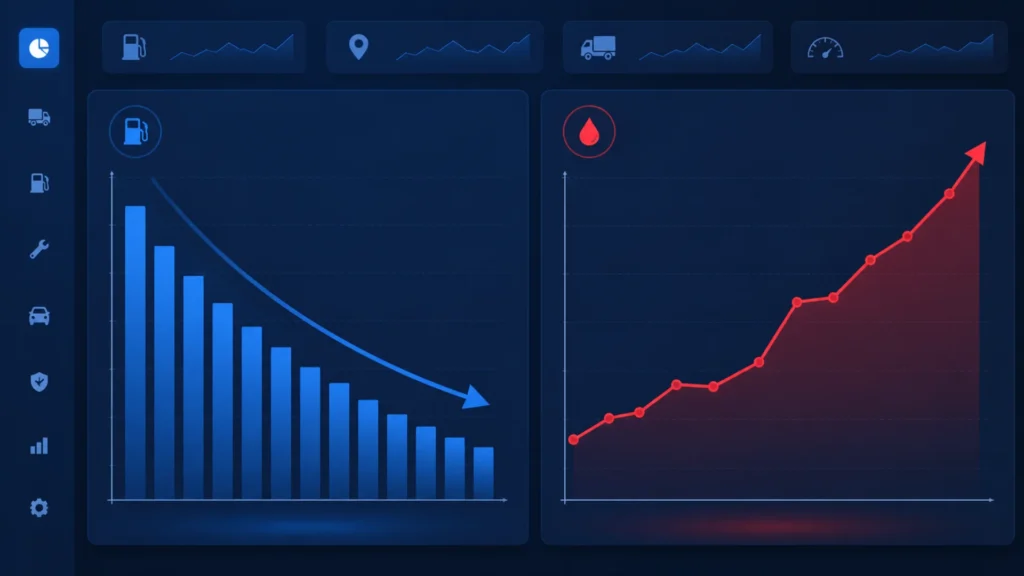
The June diesel price fleet budget planning data has arrived — and it tells two stories simultaneously. Discovery Insure reports that South Africans purchased 35% less fuel in April compared to March — the sharpest demand contraction in the insurer’s data history. Trips fell 10%. Distance dropped 9%. Meanwhile, AutoTrader projects diesel rising a further R2.50 to R3.00 per litre in June as the levy halves on 3 June. The market is simultaneously consuming less and paying more — the textbook definition of demand destruction meeting structural cost inflation.
This analysis combines the Discovery demand data, CEF mid-month recovery figures, AutoTrader price projections, and the confirmed levy phase-out calendar into a single planning document. Fleet operators have 19 days until the June adjustment. Here is exactly what the data shows and what to do with it.
The Discovery Data: Proof That the June Diesel Price Fleet Budget Crisis Is Already Here
Crucially, Discovery Insure’s analysis — based on telematics and fuel reward card swipes from over 200,000 clients — provides the most granular demand data available in South Africa. The findings confirm that the April price shock triggered an immediate and measurable behavioural change.
The headline numbers
Specifically, fuel purchases dropped 35% month-on-month. Fuel transactions declined 28%. Trips taken fell 10%. Total distance travelled dropped 9%. Even when analysts removed the Easter weekend (3-6 April) from the dataset, trips and distance remained down by 8%. These numbers are not anecdotal. They represent verified telematics data from a quarter of a million vehicles.
The pre-increase panic buy
Notably, Discovery Insure CEO Robert Attwell revealed a sharp behavioural spike before the 1 April increase. On 30 and 31 March, daily fuel transactions doubled compared to the rest of the month. Total fuel spend rose 81% in those two days as drivers filled up ahead of the price adjustment. Consequently, the April drop partly reflects a pull-forward effect — people who bought March diesel at March prices then drove through April on those tanks. However, Attwell confirmed that even after adjusting for this effect, the underlying demand reduction is genuine.
A structural behaviour change
“What we are seeing is not just a reduction in driving as petrol prices increase, but an overall change in behaviour,” Attwell stated. “People are becoming more deliberate about how they move, whether that’s driving less, combining trips, or using alternatives where it makes sense.” Additionally, Discovery Bank and Visa’s SpendTrend26 report confirmed that 58% of consumers now use ride-hailing services more than a year ago — rising to 70% among 18-to-30-year-olds. AutoTrader data shows diesel vehicle enquiries dropped 18% in April. These are not temporary reactions. They indicate a permanent shift in how South Africans relate to diesel-powered mobility.
What the Discovery Data Means for June Diesel Price Fleet Budget Planning
Clearly, for fleet operators, the Discovery data carries three direct implications.
Your clients are driving less — and ordering less
First, a 35% drop in fuel purchases translates into reduced economic activity. If consumers drive less, they shop less, order fewer deliveries, and generate less demand for the logistics services fleet operators provide. Delivery fleets, courier services, and last-mile operators should expect lower order volumes alongside higher per-delivery costs. The margin squeeze operates from both sides simultaneously.
Smaller operators are parking vehicles
Debt Rescue CEO Neil Roets describes the current environment as a “cost of survival crisis.” The Road Freight Association has warned that smaller transport operators face closure. When Discovery data shows a 10% drop in trips nationally, a significant portion of that reduction comes from operators who are simply not dispatching vehicles because the fuel cost exceeds the revenue from the trip. Fleet operators monitoring competitor exits in their market should prepare to absorb displaced demand — but only if their own cost structure supports the additional volume at current fuel prices.
The pre-June panic buy will repeat
Importantly, Discovery data showed fuel transactions doubling on 30-31 March before the 1 April increase. The same pattern will recur before 3 June, when the diesel levy rises from R0 to R1.97. Fleet operators who plan their bulk purchases for the final week of May — rather than competing with every private motorist on 1-2 June — will avoid queues, supply shortages, and the risk of arriving at a fuel station that has already run dry.
The June Projection: What CEF and AutoTrader Data Show for the June Diesel Price Fleet Budget
Essentially, the official June fuel price announcement comes from the DMRE on Wednesday 3 June, effective from midnight. Here is what the data indicates as of mid-May.
CEF mid-month tracking
BusinessTech reports that CEF mid-month data shows petrol 93 and 95 tracking a R2.34 to R2.38 per litre under-recovery. The under-recovery represents the gap between the regulated pump price and the actual cost to import, refine, and distribute fuel. If this trend holds through month-end, petrol faces a sharp increase for the second consecutive month. Notably, diesel data is more mixed: CEF shows a 51-cent over-recovery on 0.05% sulphur and a 31-cent under-recovery on 0.005% sulphur based on international price movements alone.
The levy halving dominates diesel pricing
However, the CEF recovery data tells only half the diesel story. The dominant factor for June is the levy reinstatement. The diesel general fuel levy rises from R0 to R1.97 per litre on 3 June. Even if the international diesel price stays flat or drops slightly, the levy addition pushes the total price higher. TopAuto confirms that after factoring in the levy, diesel 0.05% could see a small net reduction while diesel 0.005% faces an increase — but both grades will be significantly more expensive than the current May pricing because the zero-levy window closes.
AutoTrader’s combined projection
AutoTrader projects a total June increase of R1.80 to R2.20 per litre for petrol and R2.50 to R3.00 per litre for diesel. These projections combine the levy reinstatement with the CEF recovery data. If the projections hold, wholesale diesel could reach R33 to R34 per litre inland in June — before rising further to R35+ in July when the full levy returns. AutoTrader notes that if the rand weakens toward R17.50, the June hike could exceed R3.00 per litre.
The Broader Economic Signal: Why the June Diesel Price Fleet Budget Crisis Matters Beyond Fuel
Together, the Discovery data and AutoTrader projections together paint a picture of an economy under severe fuel-cost stress.
Agriculture faces a planting crisis
For instance, Debt Rescue CEO Roets warns that the agricultural industry, which runs almost entirely on diesel, faces devastating consequences. “The spiralling oil prices have triggered a severe economic impact, creating a ‘cost of survival’ crisis for consumers and heavily taxing the agricultural sector.” Fleet operators serving agriculture — from farm equipment transport to harvest logistics — face clients who are themselves under existential cost pressure.
Food prices will follow fuel prices
Accordingly, over 80% of South Africa’s goods move by road. AutoTrader warns that the “cost-to-shelf” for staples — maize meal, bread, milk — typically rises within 4 to 8 weeks of a fuel increase. The April and May increases have already entered the food supply chain pipeline. The June increase will compound them further. Investec chief economist Annabel Bishop projects inflation could reach 4.2% or higher — potentially forcing a SARB interest rate hike on 28 May.
Demand destruction threatens fleet viability
Most critically, when consumers buy 35% less fuel and drive 10% less, the downstream effect reaches every fleet operator. Fewer trips mean fewer deliveries requested. Lower distance means shorter average hauls. Reduced economic activity means fewer goods to transport. Meanwhile, the cost per kilometre keeps rising. This scissors effect — declining revenue and increasing costs — is the mechanism through which high fuel prices push smaller fleet operators out of business. The survivors will be operators who have already optimised their cost structure through fuel monitoring, route efficiency, and driver coaching.
19 Days: What Fleet Operators Must Do Before the June Diesel Price Fleet Budget Hit
Urgently, the 3 June adjustment is 19 days away. Here are the specific actions that separate prepared operators from those who absorb the shock unprepared.
Maximise purchases before 2 June
Above all, the diesel levy sits at zero until midnight on 2 June. Every litre purchased before that deadline costs R1.97 less than the same litre on 3 June. For a fleet with 10,000 litres of storage, filling tanks in the last week of May rather than the first week of June saves approximately R19,700. Plan the purchase for 26-28 May to avoid the consumer panic-buy spike Discovery data predicts in the final 48 hours.
Present three-scenario budgets to management
Second, build fleet fuel budget models for R31 (current May), R33 (June projection), and R35 (July projection). Calculate the monthly and annual impact for each scenario. Present all three to finance and operations leadership this week — not after the June adjustment. A 20-vehicle fleet consuming 300,000 litres monthly faces monthly fuel bills of R9.35 million (May), R9.95 million (June), and R10.53 million (July). These are not estimates. They are calculations based on published data.
Activate fuel surcharges now
Third, the combined April-May diesel increase exceeds R12.78 per litre from March levels. Every transport contract’s fuel surcharge threshold has been breached. Contact clients this week. The surcharge conversation becomes harder with every week of delay because the unrecovered cost accumulates — and clients perceive a late surcharge request as a surprise rather than a contractual trigger.
Verify fuel monitoring is capturing every litre
At R31 per litre, saving 50 litres per vehicle per week through monitoring returns R80,600 per year. The same saving at R33 returns R85,800, and at R35 it reaches R91,000. DigitFMS client data shows monitoring systems achieve ROI in as little as 6 weeks. The D-Fuel system detects siphoning, phantom fills, and consumption anomalies across both vehicle tanks and depot bulk storage on a single dashboard. Fleet operators without fuel monitoring at R33 per litre are losing money they cannot see — and the losses grow with every price increase.
Claim SARS refunds and coach drivers
For farming, forestry, and mining operators, the SARS 100% diesel refund recovers approximately R5.85 per litre on eligible diesel. At R33, that represents a 17.7% effective discount. Every month of unclaimed refund is money permanently lost. Simultaneously, intensify driver coaching — harsh driving wastes up to 30% of fuel, and at R33 per litre the financial value of a 10% behaviour improvement across 20 vehicles exceeds R3 million per year.
Outlook: The June Diesel Price Fleet Budget Reality Is the New Normal
In conclusion, the Discovery data confirms what fleet operators feel on the ground: the fuel price crisis has already changed how South Africa moves. A 35% drop in fuel purchases, 10% fewer trips, and 18% fewer diesel vehicle enquiries are not temporary responses. They represent a structural shift in demand that will persist as long as diesel remains above R30 per litre.
Nevertheless, for fleet operators, this shift creates both threat and opportunity. The threat: declining demand for transport services while costs escalate. The opportunity: operators who have optimised their cost structure — through fuel monitoring, route efficiency, driver coaching, and SARS refund claims — will absorb displaced volume from operators who cannot survive R33 diesel. Market consolidation accelerates during cost crises. The operators with the best data, the lowest per-kilometre costs, and the most resilient client relationships will emerge stronger.
Ultimately, the June diesel price fleet budget challenge is not a temporary crisis to survive. It is the new operating environment. R33 in June becomes R35 in July. The levy returns permanently. The Strait of Hormuz remains closed. Brent crude holds above $100. Every fleet that has not already deployed fuel monitoring, activated surcharge clauses, claimed SARS refunds, and coached drivers is now competing at a permanent cost disadvantage — and every week of inaction makes the gap wider.
Frequently Asked Questions
How much less fuel are South Africans buying?
Discovery Insure data from 200,000+ clients shows 35% less fuel purchased in April versus March. Transactions dropped 28%. Trips fell 10%. Distance dropped 9%. Even excluding Easter, trips and distance remained down 8%. This represents the largest single-month demand contraction in Discovery Insure’s history.
What is the projected diesel price for June?
AutoTrader projects diesel up R2.50-R3.00 per litre. CEF mid-month data shows mixed recovery: 51c cut on 0.05% sulphur, 31c increase on 0.005%. The dominant factor is the levy halving — diesel levy rises from R0 to R1.97 on 3 June. Combined, wholesale diesel could reach R33-R34 inland.
When does the DMRE announce the June price?
Wednesday 3 June, effective midnight. Fleet operators should finalise forward purchases before midnight 2 June while the zero diesel levy remains. The consumer panic-buy spike Discovery data predicts for the final 48 hours means buying earlier — 26-28 May — avoids queues and supply shortages.
Are fleet operators parking vehicles?
Discovery data confirms trips down 10% and distance down 9%. Debt Rescue CEO Roets describes a “cost of survival crisis.” The Road Freight Association warns smaller operators face closure. AutoTrader data shows diesel vehicle enquiries dropped 18%. The demand destruction is measurable and accelerating.
How does the levy halving affect fleet costs?
Diesel levy rises from R0 (May) to R1.97 (June). For a 20-vehicle fleet at 300,000 litres monthly, this adds R591,000 per month in levy costs alone. From July, when the full R3.93 levy returns, the monthly addition reaches R1.18 million compared to the current zero-levy rate.
What is the CEF under-recovery?
The Central Energy Fund tracks the gap between the regulated price and import cost. A positive under-recovery means a price increase is coming. Mid-month data shows petrol tracking R2.34-R2.38 under-recovery. If this holds through month-end, it feeds directly into the 3 June announcement.
What should fleet operators do in the next 19 days?
Buy forward before 2 June while the levy sits at zero. Present three-scenario budgets (R31/R33/R35) to management. Activate fuel surcharges in transport contracts. Deploy fuel monitoring — every litre saved returns more at R33 than at R31. Claim SARS 100% diesel refunds. Intensify driver coaching to cut the 30% fuel waste from harsh driving.
Sources
Discovery Insure — “Fuel spending drops 35% as South Africans respond to recent price hikes”, 4 May 2026; Robert Attwell CEO statements; 200,000-client telematics dataset · Discovery Bank / Visa — SpendTrend26 report; 58% increased ride-hailing; 70% among 18-30 year olds · AutoTrader South Africa — “Yet another petrol price hike coming in June”, Sean Nurse, 12 May 2026; R2.50-R3.00 diesel projection · AutoTrader — “May 2026 SA fuel price: updated forecast and survival guide”, 20 April 2026; Investec CPI projection
BusinessTech — “More bad news for petrol prices in South Africa”, May 2026; CEF mid-month data R2.34-R2.38 under-recovery · BusinessTech — “South Africans spending less on petrol amid record increases”, May 2026 · TopAuto — “Bad to worse for petrol prices in South Africa”, May 2026; diesel recovery data · Nuusflits — “Fuel price June 2026 forecast”, May 2026; CEF data and levy schedule
IOL — “The economic fallout of increased fuel prices”, Neil Roets / Debt Rescue, 10 May 2026 · TimesLive — “How motorists are adjusting to fuel price increases”, 5 May 2026 · The Citizen — “Here’s how much less fuel SA is using”, May 2026 · EWN — “Drivers hit the brakes as fuel spending drops”, 5 May 2026 · Daily Investor — “Petrol and diesel price disaster hits South Africa”, May 2026; diesel enquiries down 18% · The South African — “Cutting back? South Africans slash fuel spending by 35%”, May 2026 · DigitFMS — ROI of fuel monitoring client data
© 2026 DigitFMS. All rights reserved.