
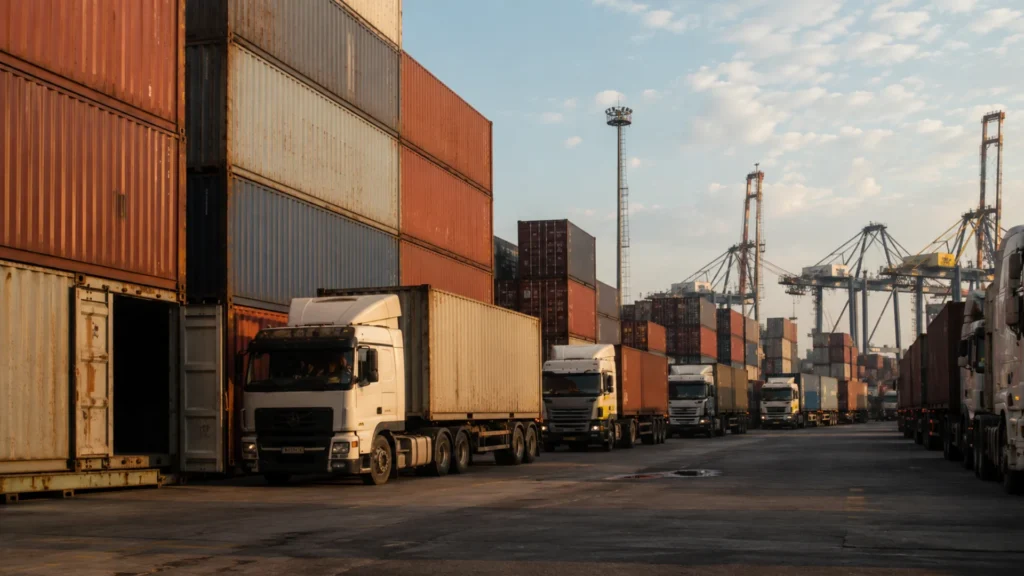
Drug cartel fleet infrastructure exploitation is no longer an abstract risk — the Madlanga Commission is documenting exactly how it works, in real time. This week, Hawks Colonel Francois Steyn testified that a Brazilian drug syndicate concealed 999 kilograms of cocaine — nearly a tonne, worth R300 million — inside shipping containers carrying legitimate vehicle body parts. The shipment travelled from the Port of Santos in Brazil to Durban Harbour, then by truck via Yellow Jersey Logistics to Scania South Africa’s warehouse in Aeroton, Johannesburg. Syndicates manufactured duplicate container seals matching shipping manifests so the container appeared untampered on arrival. R55 million of the seized cocaine subsequently disappeared from police custody.
For fleet operators, the commission testimony reveals something more disturbing than police corruption. It reveals that drug cartels use the same trucks, the same routes, the same ports, and the same logistics companies that legitimate fleet operations depend on. This analysis examines how drug cartel fleet infrastructure exploitation works, why it creates direct risk for legitimate operators, and what fleet managers must do to ensure their vehicles and drivers are not unknowingly co-opted into criminal supply chains.
How Drug Cartels Exploit Fleet Infrastructure: The Madlanga Commission Evidence
Specifically, the Madlanga Commission of Inquiry — investigating allegations that drug cartels have infiltrated South Africa’s criminal justice sector, politics, and private security — heard detailed testimony this week about a specific cocaine operation that used legitimate freight infrastructure from start to finish.
The Brazil-to-Johannesburg route
Specifically, Colonel Steyn told the Mail & Guardian that the cocaine shipment originated at the Port of Santos in Brazil. It travelled by sea to Durban Harbour concealed among legitimate vehicle body parts in a shipping container destined for Scania South Africa. From Durban Harbour, Yellow Jersey Logistics transported the container by truck to Scania’s assembly plant in Aeroton, south of Johannesburg. At every stage, the shipment used legitimate commercial infrastructure: a real shipping line, a real port, a real logistics company, and a real destination.
The duplicate seal technique
Crucially, Steyn revealed the critical method syndicates use to access drugs mid-transit without detection. They manufacture duplicate container seals that match the seal numbers on shipping manifests. After hiding narcotics inside the container alongside legitimate cargo, they reseal it with the duplicate. When the container arrives at its destination, the seal number matches the manifest — making the container appear untampered. Consequently, Scania’s warehouse staff had no reason to suspect the shipment contained anything other than vehicle parts until bags of cocaine fell out when they opened the container.
The “rip on / rip off” method
Hawks spokesperson Colonel Katlego Mogale confirmed that the operation used a “rip on / rip off” technique. Syndicates place drugs into a container at the point of origin (or during transit), then remove them clandestinely at the destination before legitimate recipients inspect the cargo. The syndicate replaces the container seal after each access. For fleet operators, this technique is particularly concerning because it can occur without the carrier’s knowledge — the truck driver transports a sealed container and has no reason to believe its contents differ from the shipping manifest.
4,000 containers daily — and most go uninspected
Commissioners asked Steyn whether all containers arriving at Durban Harbour undergo inspection. His answer was blunt: authorities cannot search every container because the port processes more than 4,000 containers daily. Searches only occur when intelligence or tip-offs flag specific shipments. The vast majority enter South Africa uninspected. For fleet operators collecting containers at ports, this means there is no guarantee that the sealed container on the back of the truck contains only what the manifest says.
What Happened at the Scene: How Police Bungling Compounds Drug Cartel Fleet Infrastructure Risk
Furthermore, the commission testimony about what occurred after the cocaine arrived in Johannesburg is equally alarming for fleet operators — because it demonstrates that even when drugs are intercepted, the police response can create additional risk.
Officers allegedly attempted to steal the cocaine
IOL reports that officers at the scene loaded bags of cocaine onto a bakkie and prepared to leave. Co-commissioner Advocate Baloyi told Warrant Officer Magane directly: “You had ulterior motives in putting them in that van, and you were going to take them where they would not be accounted for.” Magane denied the allegation, claiming he intended to transport the drugs to a police station. However, he admitted to contaminating the crime scene, handling bags with bare hands, and failing to call forensic experts before removing evidence.
Khan ordered the K9 unit to stop searching
The Mail & Guardian reports that when Crime Intelligence chief Major General Feroz Khan arrived at the scene, he ordered K9 officers to stop searching the warehouse. Next, he disarmed traffic officer Mashaba. Khan then instructed Magane to sit in his car for two hours and not move — before walking away from the scene with the truck driver. Warrant Officer Phakula testified that Khan had the investigating officers arrested to take control of the scene — “the only way for them to take over the crime scene was to get us arrested or intimidate us.”
“People say the drugs belong to him — and he laughed”
Daily Maverick reports that Phakula met Khan after being released on bail. When Phakula told Khan that “people say the drugs belong to him,” Khan laughed. The commission heard this was “corridor gossip” within SAPS — unsubstantiated but widely circulated. Phakula admitted he never reported the allegations to IPID. Meanwhile, Khan — already arrested last weekend for precious metals corruption — now faces these additional allegations at the commission. The commission chair told Phakula: “You’ve told many untruths.”
R55 million vanished from police custody
Most alarmingly, after the Aeroton seizure, police transported the cocaine to Booysens SAPS, then to SAPS College, then to the Forensic Science Laboratory. During this chain of custody, R55 million worth of cocaine disappeared. In a separate incident the previous month, thieves stole R200 million worth of cocaine from the Hawks building in Port Shepstone, KwaZulu-Natal. Combined, approximately a quarter of a billion rand in drugs vanished while in state custody. The commission’s terms of reference include investigating whether drug cartels have infiltrated law enforcement itself.
Why Drug Cartel Fleet Infrastructure Exploitation Creates Direct Risk for Legitimate Operators
Understandably, fleet operators may assume that drug trafficking is a law enforcement problem with no operational relevance to their business. The Madlanga testimony proves otherwise.
Your truck can carry contraband without your knowledge
To illustrate, the cocaine travelled from Durban to Johannesburg on a Yellow Jersey Logistics truck. Scania received what it believed to be legitimate cargo. The truck driver transported a sealed container with no reason to suspect the contents. Importantly, if the interception had occurred mid-route — on the N3 between Durban and Johannesburg — the driver and the fleet operator would have faced immediate investigation, vehicle seizure, and potential criminal charges. Fleet operators who transport containers from ports bear the risk of the “rip on / rip off” technique regardless of their own integrity.
Your routes are the same routes cartels use
Moreover, the Durban-Johannesburg freight corridor (N3) is South Africa’s busiest commercial route. It is also the primary route for drug shipments entering through Durban Harbour. The Madlanga Commission has heard that authorities also intercepted a separate R500 million cocaine shipment at Durban Harbour using the same modus operandi — Scania truck parts, same origin port in Brazil. Fleet vehicles operating on the N3 corridor share road space with vehicles carrying both legitimate and illicit cargo. Any roadblock, search, or interception on this route affects all vehicles — legitimate operators included.
Your employees can be recruited
Equally concerning, the same insider recruitment tactics that Aon identifies for hijacking syndicates apply to drug trafficking. Cartels recruit drivers, warehouse staff, and logistics personnel to facilitate the movement, loading, and unloading of containers containing drugs. A driver who makes an unauthorised stop between port collection and delivery — allowing a third party to access the container — enables the “rip off” without the fleet operator’s knowledge. Driver identification and GPS tracking with geofencing detect this deviation.
Insurance and legal exposure
Additionally, if authorities find a fleet vehicle transporting drugs, the legal consequences are severe regardless of intent. Police may seize the vehicle as evidence. The driver faces arrest. The fleet operator faces investigation. Insurance claims become complicated when a criminal case involves the vehicle. Additionally, reputational damage from a drug trafficking association — even if the operator is entirely innocent — can destroy client relationships and business credibility.
How Fleet Operators Should Protect Against Drug Cartel Fleet Infrastructure Exploitation
However, the commission testimony provides a blueprint of how cartels operate. That blueprint also reveals the specific countermeasures fleet operators should deploy.
Container seal verification
First, photograph and record every container seal number before and after transport. Compare the seal number against the shipping manifest. If the seal number does not match, or if the seal shows signs of tampering, do not proceed — report the discrepancy to the shipping line and authorities immediately. AI dashcams mounted on loading vehicles can capture seal images automatically during collection and delivery, creating a verified visual record.
GPS tracking with unauthorised-stop detection
Second, the “rip off” technique requires the truck to stop at an unauthorised location where drugs can be removed from the container. GPS tracking with geofencing detects any stop that deviates from the approved route between port and delivery point. If a truck collecting a container from Durban Harbour stops at an unauthorised location before reaching Aeroton, the fleet manager receives an immediate alert. This single capability — detecting unauthorised stops — is the most direct countermeasure against container-based drug trafficking.
Driver identification and background screening
Third, every container transport must link to a verified, authorised driver. Wireless driver ID beacons confirm the assigned driver operates the vehicle on every trip. Background screening — including repeat checks — identifies employees who may have been recruited by syndicates after their initial hiring. Route deviations attached to named drivers transform a vague alert into a specific accountability event.
AI dashcam evidence at loading and unloading
Fourth, time-stamped dashcam footage of container loading and unloading provides verified evidence of what occurred during these critical handover moments. If the fleet operator is ever investigated for a container that subsequently reveals contraband, dashcam footage showing a properly sealed container at collection — and no unauthorised stops during transit — provides the clearest possible defence of the operator’s innocence.
Report anomalies immediately
Finally, seal discrepancies, unusual cargo weight, unexplained route deviations, and suspicious contact from unknown parties should all trigger immediate reporting to the Hawks’ Serious Organised Crime Unit and the fleet’s own security team. Fleet operators who discover and report anomalies proactively demonstrate compliance and good faith. Those who fail to report — or who ignore warning signs — risk being treated as complicit rather than victimised.
The Technology That Detects Drug Cartel Fleet Infrastructure Exploitation
Notably, the same integrated fleet management technology that prevents hijacking, detects fuel theft, and supports insurance compliance also protects against drug trafficking exploitation of fleet assets.
DigitFMS integrates GPS tracking with geofencing, AI dashcams, wireless driver identification, and route management on a single platform. When a container truck deviates from its approved port-to-destination route, the geofence alert names the driver and records the location. The dashcam captures what happens at every stop. The driver ID confirms who was behind the wheel. Together, these data streams create a verified record that protects the fleet operator if the container’s contents are ever questioned. The company’s 100+ franchise branches include operators in Durban and Gauteng — the two endpoints of the N3 corridor most exposed to container-based drug trafficking.
Cartrack, Tracker, Netstar, Ctrack, and MiX by Powerfleet all offer GPS tracking and geofencing that serve the same detection purpose. The critical requirement is that the platform monitors container transport routes specifically — with tight geofencing that flags any deviation, no matter how brief, between port collection and delivery.
Outlook: Drug Cartel Fleet Infrastructure Risk Will Grow as Commission Hearings Continue
Looking ahead, the Madlanga Commission is far from finished. Testimony this week has already revealed that cocaine travels through legitimate truck infrastructure, police officers at crime scenes attempted to steal seized drugs, Crime Intelligence leadership allegedly protected suspects and halted investigations, a quarter of a billion rand in cocaine vanished from state custody, and duplicate container seal manufacturing enables undetected access to cargo mid-transit.
Accordingly, as the commission continues, more details about how cartels exploit South Africa’s logistics infrastructure will emerge. Fleet operators on the Durban-Johannesburg corridor, the Cape Town port routes, and any route handling imported containers should treat the commission testimony as an operational briefing — not a news story.
Ultimately, the Madlanga Commission has made one thing clear: drug cartel fleet infrastructure exploitation is real, it uses the same trucks and routes that legitimate operators depend on, and the police units supposed to prevent it are themselves compromised. Fleet operators cannot control what enters a container at the Port of Santos. They can control who drives their trucks, what route the truck takes, whether it stops at unauthorised locations, and whether every seal is verified before and after transport. That control — delivered through driver ID, GPS tracking, geofencing, and AI dashcams — is the difference between a fleet that moves cargo and a fleet that unknowingly moves contraband.
Frequently Asked Questions
How did cartels use truck infrastructure to smuggle cocaine?
A Brazilian syndicate concealed 999kg of cocaine in shipping containers carrying vehicle body parts for Scania. The shipment travelled from Santos to Durban Harbour to Johannesburg via Yellow Jersey Logistics. Duplicate container seals matched shipping manifests so the container appeared untampered. The same method was used in a separate R500M seizure.
What are duplicate container seals?
Syndicates manufacture fake seals matching the seal numbers on shipping manifests. After opening a container to insert or remove drugs, they reseal it with the duplicate. The seal number matches the manifest, making the container appear legitimate at its destination. Fleet operators should photograph and verify seal numbers before and after every transport.
How much cocaine went missing from police custody?
R55 million from the Aeroton consignment disappeared during the chain of custody between Booysens SAPS, SAPS College, and the Forensic Science Laboratory. In a separate incident, R200 million vanished from the Hawks building in Port Shepstone. Combined, a quarter of a billion rand in drugs disappeared while under state control.
How does drug trafficking affect legitimate fleet operators?
Fleet vehicles can unknowingly carry contraband in sealed containers. If intercepted, the driver faces arrest and the vehicle faces seizure. Insurance claims become complicated. Reputational damage from drug trafficking association destroys client relationships. Driver ID, GPS geofencing, and seal verification protect operators by detecting anomalies and documenting legitimate transport conduct.
Can all containers entering Durban Harbour be searched?
No. Hawks Colonel Steyn confirmed Durban Harbour processes over 4,000 containers daily. Authorities search only those flagged by intelligence. The vast majority enter uninspected. Fleet operators collecting containers at ports should independently verify seal integrity and monitor for unauthorised stops during transport.
What role did SAPS officers play?
Officers allegedly loaded cocaine onto a bakkie to drive away. Khan ordered the K9 unit to stop searching and had investigating officers arrested. A testifying officer admitted to lying under oath. R55M of cocaine went missing from custody. The commission chair said “you’ve told many untruths.” Khan laughed when told the drugs allegedly belonged to him.
What should fleet operators do to protect against exploitation?
Verify container seal numbers before and after transport. Use GPS tracking with geofencing to detect unauthorised stops between port and destination. Deploy driver ID on every container transport. Capture loading and unloading on AI dashcams. Report seal discrepancies or route anomalies to the Hawks immediately. These measures protect against both drug trafficking exploitation and conventional cargo theft.
Sources
Daily Maverick — “Corridor gossip named Feroz Khan as owner of R286m cocaine consignment”, 13 May 2026; “Another cocaine theft — cop confirms R55m missing”, 11 May 2026; “Feroz Khan called us tsotsi police at R286m cocaine bust”, 12 May 2026 · Mail & Guardian — “Madlanga commission hears how 999kg cocaine bust unfolded”, 11 May 2026; “Phakula accuses Khan of orchestrating arrest to derail cocaine bust”, 13 May 2026
IOL — “How cops became suspects in Hawks’ 750kg cocaine investigation”, 11 May 2026; “SAPS officer accused of drug trafficking”, 12 May 2026; “Phakula admits to lying about cocaine seizure”, 14 May 2026; “Khan’s alleged involvement in cocaine scandal”, 13 May 2026 · TimesLive — “Khan misled Mkhwanazi to clear himself”, 13 May 2026; “Scania SA cooperating with Hawks after R500m cocaine seized”, 2021 · Jacaranda FM — “Cocaine travelled from Brazil to SA undetected”, 12 May 2026; “You were clueless — Madlanga grills officer”, 12 May 2026 · The Citizen — “Cop grilled over Aeroton cocaine seizure”, 12 May 2026 · SABC News — Live commission coverage, 12-14 May 2026 · YFM — “Khan halted Aeroton drug operation”, 12 May 2026 · Aon South Africa — Insider threat data, February 2026
© 2026 DigitFMS. All rights reserved.