
Driver identification fleet security addresses the threat that no fence, camera, or GPS tracker can stop on its own: the insider. Aon South Africa’s February 2026 cargo risk analysis confirms that insider enablement — access to schedules, routes, and cargo details through compromised employees — remains a primary driver of truck hijackings and cargo theft. Arrive Alive reports that syndicates pay as little as R5,000 to recruit a driver to move a stolen vehicle to a border post. The threat is not always outside the fence. Often, it sits behind the steering wheel.
This analysis examines how the insider threat operates in South African fleet operations, why driver identification technology is the most direct countermeasure, how different ID systems compare, and what fleet managers must consider under POPIA when monitoring who drives their vehicles.
The Insider Threat That Driver Identification Fleet Security Must Address
Aon’s analysis identifies four converging tactics behind South Africa’s cargo crime surge. Advanced criminal tactics such as fake blue lights and GPS jamming get the headlines. However, it is the third trend — insider enablement — that makes the other three possible.
How syndicates recruit from inside
Organised hijacking syndicates do not rely on luck. Instead, they operate on intelligence. Consequently, they actively recruit employees from trucking companies, security firms, workshops, and even traffic departments. A compromised driver provides route times, cargo manifests, fuel stop locations, and security system details. Similarly, a compromised dispatch operator can redirect a vehicle to an interception point. A compromised workshop technician can disable tracking hardware before the vehicle leaves the yard.
The recruitment is not subtle. Syndicates approach potential insiders through informal networks, often targeting employees in financial distress. The payment for moving a stolen vehicle to a border post can be as low as R5,000 — a fraction of the vehicle’s value but significant for a driver earning entry-level wages. In addition, some insiders do not participate directly in the hijacking at all. They simply share route intelligence. A text message with a departure time and route number is enough to turn a random crime into a precision operation.
The scale of unauthorised vehicle use
Furthermore, the insider threat extends beyond hijacking facilitation. Unauthorised vehicle use — after-hours driving, weekend trips, unauthorised passengers, and route deviations — is endemic in fleets that lack driver identification. Without knowing who is behind the wheel on every trip, fleet managers cannot determine whether a vehicle is being used legitimately or has been taken by someone who should not have access. At diesel prices above R26 per litre, even unauthorised personal trips carry measurable fuel costs. Moreover, unauthorised use also voids insurance cover if an incident occurs.
How Driver Identification Fleet Security Technology Works
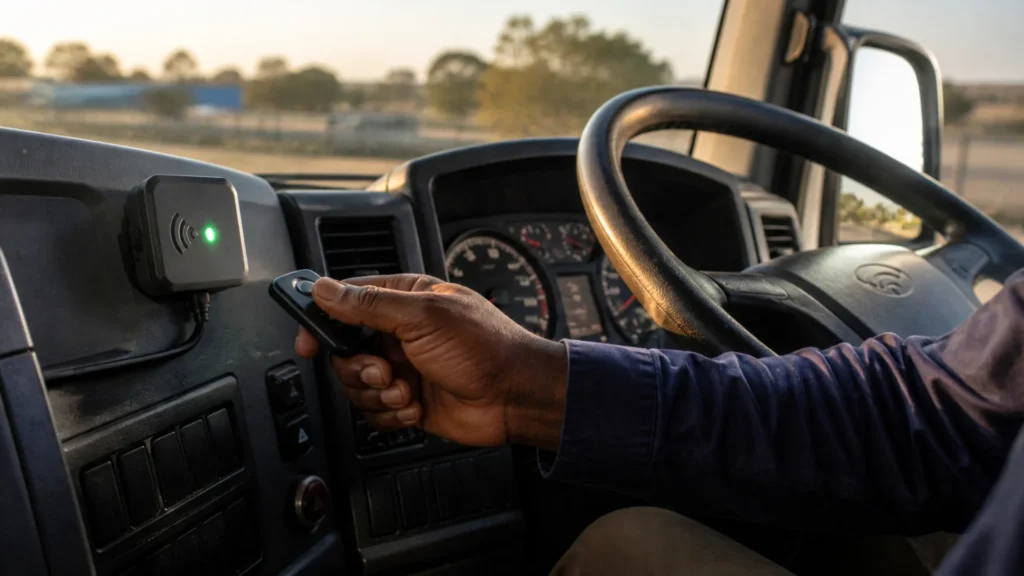
Driver identification creates a verifiable link between a specific person and every vehicle trip. Three main technologies serve the South African fleet market.
iButton contact keys
An iButton is a small metal key fob containing a unique electronic serial number. The driver touches it to a dashboard-mounted reader before starting the vehicle. As a result, the tracking system logs the driver’s identity against the trip. Each iButton is unique and cannot be duplicated without specialist equipment. This is the most cost-effective driver identification fleet security option and suits fleets where simplicity and durability matter most. However, iButtons can be shared between drivers — if driver A hands their fob to driver B, the system records driver A regardless of who actually drove.
Bluetooth Low Energy (BLE) beacons
A BLE beacon is a small wireless device — typically a key fob or card — that the driver carries. The tracking unit detects the beacon automatically within a range of 1 to 5 metres. Unlike iButton, there is no physical contact required. Instead, the driver simply enters the vehicle and the system identifies them. This is more convenient for high-frequency start-stop operations like delivery fleets. Additionally, BLE beacons are harder to share because the system detects when the beacon leaves the vehicle — if the driver steps out but the vehicle keeps moving, the alert triggers immediately.
Biometric identification
Fingerprint readers and facial recognition cameras provide the highest level of driver verification. These systems confirm biological identity rather than credential possession. A fingerprint cannot be shared. A face cannot be lent to a colleague. Nevertheless, biometric systems carry higher hardware costs, may be affected by dirt or gloves in industrial environments, and raise more complex POPIA compliance questions because biometric data is classified as special personal information under the Act.
What Driver Identification Fleet Security Detects in Practice
The value of driver ID goes far beyond knowing a name. When connected to GPS tracking, fuel monitoring, and geofencing on a single platform, driver identification turns raw alerts into actionable intelligence.
Unauthorised vehicle starts
If someone starts a vehicle without a registered ID credential, the system flags it immediately. The fleet manager receives an alert with the vehicle’s GPS position, time, and the fact that no authorised driver is present. Some configurations prevent the engine from starting entirely without a valid credential. Consequently, stolen vehicles become unusable without the corresponding ID beacon — adding a layer of defence beyond GPS tracking alone.
After-hours and weekend use
Many fleets experience significant fuel and maintenance costs from vehicles used outside of working hours. Driver ID linked to scheduling rules flags any trip that starts outside approved windows. Importantly, the alert includes who started the vehicle, where, and what route they took. Fleet managers report that after-hours usage typically drops by 80% within the first month after deploying driver identification — simply because drivers know they are identified on every trip.
Route deviations with driver accountability
Geofencing alerts become significantly more useful when they include driver identity. A vehicle deviating from its approved route triggers an alert. Without driver ID, the fleet manager knows the vehicle deviated but not who was driving. With driver ID, the alert names the specific driver. As a result, this transforms a vague operational concern into a specific accountability conversation — or, if the deviation matches a hijacking pattern, a specific recovery operation.
Driver behaviour linked to individuals
Harsh braking, speeding, excessive idling, and rapid acceleration events carry more weight when attached to a named driver. Fleet managers can identify which specific individuals need coaching, which drivers consistently perform well, and which show patterns that indicate risk. Furthermore, AI dashcam footage linked to driver ID creates verified evidence for disciplinary processes, insurance claims, and CCMA proceedings if employment disputes arise.
POPIA Compliance: The Legal Framework for Driver Identification Fleet Security
Monitoring who drives a fleet vehicle is not without legal constraints. The Protection of Personal Information Act governs how organisations collect, store, and use personal data — including driver identity information.
Establish a legitimate purpose
Fleet safety, asset protection, insurance compliance, and regulatory requirements all qualify as legitimate purposes under POPIA. Document the purpose in writing before deploying driver identification fleet security systems. Specifically, the purpose must be clear — “we monitor driver identity to prevent unauthorised vehicle use and to comply with insurance requirements” is defensible. “We monitor everything” is not.
Inform drivers before deployment
Employees must know that identification and monitoring take place. Inform drivers in writing about what data the system collects, how the data will be used, who will have access, and how long records will be retained. Include this information in employment contracts or a standalone monitoring policy. Indeed, transparency itself reduces insider risk — drivers who know they are identified on every trip are far less likely to collaborate with syndicates.
Secure the data
Trip logs, driver identities, and associated GPS and fuel data must be encrypted, stored on access-controlled platforms, and retained only for a defined period. Role-based access ensures that only fleet managers, safety officers, and authorised personnel can view driver-specific data. Leading fleet management providers build these controls into their platforms with automated data expiry and full audit trails.
Biometric data requires extra care
POPIA classifies biometric information as special personal information. Therefore, processing it requires either explicit consent from the driver or a legal basis such as employment law or public safety. Fleet operators choosing fingerprint or facial recognition systems must conduct a POPIA impact assessment, obtain informed consent, and implement stricter data protection measures than those required for iButton or BLE systems.
Who Provides Driver Identification Fleet Security in South Africa
Driver ID is available from every major fleet management provider, though implementation approaches differ.
Cartrack offers driver identification as part of its integrated fleet platform, linking ID to AI dashcam footage, behaviour scoring, and stolen vehicle recovery. Tracker includes driver identification alongside its SVR and armed response capability. Meanwhile, Ctrack, Netstar, and MiX by Powerfleet all support iButton and BLE driver ID integration within their enterprise fleet platforms.
DigitFMS deploys wireless driver ID beacons as part of its integrated platform alongside GPS tracking, AI dashcams, D-Fuel monitoring, and autonomous vehicle defence. The approach connects driver identity to every other data stream — so a fuel anomaly alert includes not just volume and location but the specific driver assigned to the vehicle at the time. This integration is the key differentiator between standalone ID systems and platform-level driver identification fleet security.
Six Steps Fleet Operators Should Take to Counter the Insider Threat
Deploy driver identification on every vehicle. Every trip must link to a named, authorised individual. Without this foundation, no other security measure can address the insider threat. Start with iButton or BLE beacons — both deliver immediate accountability.
Restrict vehicle access to authorised drivers only. Configure the system to alert or prevent engine start when no valid credential is detected. This single setting eliminates the most common form of unauthorised use within the first week of deployment.
Connect driver ID to geofencing and route management. Every route deviation alert should name the driver responsible. As a result, this transforms vague operational alerts into specific accountability events. If a deviation matches a hijacking pattern, the fleet manager and control room know exactly who was driving.
Conduct background checks on all drivers. Aon recommends thorough background screening as a foundation of personnel security. Check criminal records, verify references, and screen for existing connections to known syndicates. Additionally, repeat screening periodically — an employee who was clean at hiring may become compromised later.
Create a confidential reporting channel. Employees who are approached by syndicates need a safe way to report the approach without fear of retaliation. An anonymous tip line or reporting mechanism can surface insider recruitment attempts before they succeed. Above all, build a culture where reporting is rewarded, not punished.
Rotate routes and schedules where feasible. Predictability is the insider’s greatest asset. Syndicates study fixed routes and departure times. Varying schedules and alternating routes — even slightly — disrupts the intelligence that insiders provide. Ultimately, driver identification fleet security makes rotation auditable because every route change links to a named driver.
Outlook: Driver Identification Fleet Security Becomes Non-Negotiable
The insider threat is not new. What has changed is its scale and sophistication. Aon’s data confirms that syndicates now combine insider intelligence with GPS jamming, cyber intrusion, and law enforcement impersonation in coordinated operations. A compromised employee does not just enable one hijacking. They enable a pattern — a repeatable, low-risk method that syndicates exploit until the leak is discovered.
Driver identification fleet security closes that leak at the most fundamental level: it ensures that every vehicle trip links to a verified, authorised individual. Unauthorised use becomes visible within seconds. Route deviations attach to named drivers. Fuel anomalies connect to specific personnel. After-hours trips stop immediately because drivers know they cannot hide.
In conclusion, in an environment where 50 vehicles are hijacked daily, diesel costs R26 per litre, and SAPS leadership is in crisis, the fleet operators who survive will be those who control access to their assets at the most basic level — who is behind the wheel. Driver identification fleet security provides that control. The cost of not knowing is measured in stolen trucks, lost cargo, and compromised operations.
Frequently Asked Questions
How do syndicates recruit fleet drivers as insiders?
Aon confirms that syndicates approach drivers, warehouse staff, and dispatch operators through informal networks. Payments can be as low as R5,000 to move a stolen vehicle. Some insiders simply share route intelligence — a text message with a departure time is enough. Syndicates target employees in financial distress or those with existing criminal connections.
What is driver identification technology?
Driver identification fleet security uses electronic credentials to verify who operates each vehicle. Three technologies exist: iButton contact keys, Bluetooth Low Energy beacons, and biometric systems. The tracking system logs driver identity against every trip, creating an auditable record of who drove which vehicle, when, and where.
How does driver ID prevent unauthorised vehicle use?
When no registered credential is detected, the system triggers an immediate alert or prevents the engine from starting. Unauthorised use becomes visible within seconds. Fleet managers report that after-hours usage drops by 80% within the first month of deployment simply because drivers know they are identified on every trip.
Is driver monitoring compliant with POPIA?
It must be. Fleet operators need a documented legitimate purpose, must inform drivers before deployment, must store data securely with defined retention periods, and must limit access to authorised personnel. Biometric data requires explicit consent. Leading providers build POPIA compliance into their platforms with encryption and automated data expiry.
What is the difference between iButton and Bluetooth ID?
iButton requires physical contact with a dashboard reader. Bluetooth beacons detect the driver automatically within range. Bluetooth is more convenient but slightly more expensive. iButton is simpler but can be shared between drivers. Both create an auditable record linking identity to every trip.
How does driver ID integrate with fleet tracking?
Connected to GPS and geofencing, driver ID shows who was driving during every route deviation, fuel anomaly, or after-hours trip. A geofence alert names the specific driver. A fuel theft alert identifies who was assigned to the vehicle. This turns vague alerts into specific accountability events.
Can driver identification reduce insurance premiums?
Yes. Insurers recognise driver ID as a risk reduction measure. When every trip links to a verified driver, the fleet demonstrates accountability. Combined with AI dashcams and behaviour scoring, driver ID strengthens the risk profile. Some insurers offer preferential rates for fleets that verify identity on every trip.
Sources
Aon South Africa — “SA’s Cargo Risks and Hijacking Surge”, Natalie Cooper, February 2026 · Engineering News (Creamer Media) — Aon cargo risk analysis, 20 February 2026 · IT-Online — “SA’s cargo risks rise as hijackings surge”, 20 February 2026 · FAnews — “SA’s Cargo Risks and Hijacking Surge”, 19 February 2026 · Arrive Alive — Truck hijackings, insider recruitment, and driver safety data · Tracker South Africa — Vehicle Crime Index H1 2025; business vehicle targeting data · 234Drive — “New Car Hijacking Targets in South Africa”, November 2025 · MotorHappy — “Car Hijacking Hotspot Emerges in South Africa”, December 2025 · Cartrack — Truck hijacking prevention tactics and driver ID integration · Marshall Security — Higginson Highway syndicate disruption, February 2026 · POPIA — Protection of Personal Information Act, Republic of South Africa · SAPS — Q3 2025/26 crime statistics
© 2026 DigitFMS. All rights reserved.