
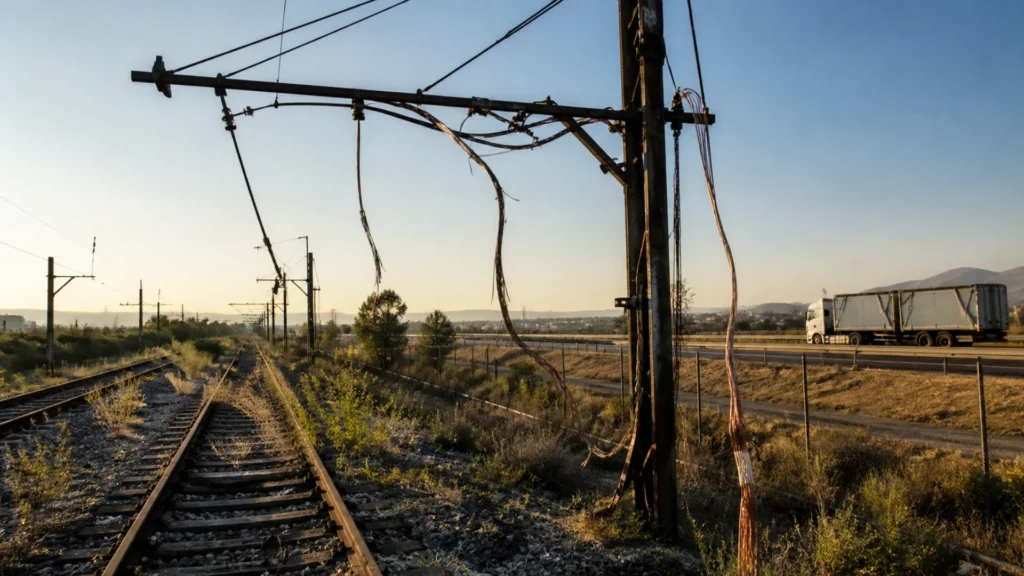
Copper theft infrastructure security has become a national emergency — and it is hitting fleet operators harder than most people realise. Genesis Analytics research, commissioned by the Department of Trade, Industry and Competition, puts the annual economic damage from copper theft at more than R45 billion. As a result, Transnet’s rail network is collapsing. One-third of South Africa’s export coal now moves by truck instead of train. More freight on the road means more vehicles for hijacking syndicates to target, more diesel burned at R26 per litre, and more accidents on highways that were never designed for this volume.
This analysis examines how copper theft is systematically dismantling the infrastructure that fleet operators depend on — from rail corridors and power grids to the security systems protecting depots and remote sites. It connects the dots between stolen cable, collapsed rail, and the escalating cost and danger of operating a fleet on South Africa’s roads in 2026.
The Scale of the Copper Theft Infrastructure Security Crisis
The numbers are staggering. Moneyweb reports that Transnet, Prasa, and Eskom collectively identified almost 11,000 copper theft incidents per year from 2018 to 2022. If municipalities were included, the total would be significantly higher. This is not petty theft. It is an industrial-scale dismantling of national infrastructure by organised syndicates.
Transnet: 1,121 km of cable stolen in one year
Transnet reported 1,121 km of cable stolen in the 2023 financial year. That is the distance from Johannesburg to Harare. It represents a nearly eight-fold increase over five years. In a single week in April 2022, thieves launched 123 attacks on South Africa’s rail infrastructure, stealing 39.4 km of copper cable. Consequently, Daily Maverick reports that Transnet and Prasa have collectively lost 30,000 km of infrastructure to theft — equivalent to three-quarters of the Earth’s circumference.
TechCentral confirms that in the year to March 2024, vandals still managed to steal 1,013 km of cable despite Transnet’s turnaround strategy. In 2022, Transnet declared force majeure on some coal transportation contracts due to copper theft. The freight rail operator has since split into two entities and is seeking private operators for some lines, requiring concession holders to take responsibility for line security.
Eskom: R5 to R7 billion per year
Eskom copper theft costs R5 to R7 billion per year, plus an additional R2 billion to replace stolen cables. That does not count the cost of power disruptions to customers. Eskom’s April 2025 statement confirmed R221 million in infrastructure vandalism and theft costs year-to-date — a decline from R271 million in the prior period, but still alarmingly high. City Power in Johannesburg reported 2,000 incidents of cable theft in one financial year, costing R380 million to repair.
Telecommunications: Telkom loses 1,321 incidents in five years
Telkom reported 1,321 instances of copper theft in the five years to November 2022. In one year alone, this cost the company R60 million and disrupted services to thousands of customers. Furthermore, thieves disguised themselves as road maintenance crews — fitting vehicles with yellow warning lights and wearing reflective jackets — to strip Telkom, Eskom, and Transnet overhead cables in broad daylight. After processing, the stolen copper was sold to scrap metal dealers in Johannesburg.
How Copper Theft Pushes Freight Onto Dangerous Roads — and Why Fleet Operators Pay the Price
The collapse of South Africa’s rail infrastructure has a direct, measurable impact on fleet operators. Here is the chain of consequences.
Rail failure forces freight onto road
According to the Minerals Council of South Africa, approximately one-third of exported coal moved by truck rather than rail in 2023. This was not a choice. It was a consequence of Transnet rail failures caused in significant part by copper theft. Transnet Freight Rail reported a pre-tax loss of R6.5 billion in the year to March 2024. The network that should carry South Africa’s bulk freight is broken.
More trucks mean more targets
Every truck that moves from rail to road becomes a potential hijacking target. SAPS data shows approximately 50 vehicles hijacked every day. Business-owned vehicles face 48% higher targeting rates than personal vehicles. The N1, N3, N12, and N17 corridors — the same highways absorbing displaced rail freight — are the country’s highest-risk hijacking zones. Consequently, copper theft infrastructure security failure does not just affect the power grid. It feeds directly into the vehicle crime crisis.
Diesel costs multiply
Road freight consumes far more diesel per tonne-kilometre than rail. At R26 per litre and potentially R35 in May, the shift from rail to road dramatically increases transport costs. Fleet operators who should be running lean, efficient logistics operations instead burn fuel compensating for infrastructure that criminals have stolen. The Road Freight Association has warned that smaller operators face closure under the current cost structure.
Power outages compromise fleet security
When Eskom substations go down due to copper theft, the consequences reach fleet depots directly. Electric fences stop working. CCTV cameras lose power. Access control gates fail. Fuel storage becomes unmonitored. In addition, fleet operators in affected areas lose workshop uptime, cannot charge vehicle batteries, and face communication blackouts that delay tracking alerts and recovery coordination. Copper theft does not just steal cable. It disables the entire security ecosystem.
Why Copper Thieves Operate With Near Impunity
The conviction rate for copper theft in South Africa is effectively zero. Corruption Watch reports that from March 2019 to March 2022, only 1,200 suspected copper cable thieves were arrested out of nearly 33,000 reported incidents. Of those arrests, 580 cases reached court. Just 40 resulted in convictions.
Several systemic failures explain this. First, SAPS does not categorise copper theft as a specific crime. Instead, it falls under the vague heading “thefts not mentioned elsewhere.” This makes accurate statistics impossible and prevents targeted policing strategies. Second, searching shipping containers for exported stolen copper is prohibitively expensive — it takes a full day to unpack a single container manually. Third, scrap metal dealers convicted of multi-million rand offences routinely receive trivial fines. One dealer received an 18-year sentence, returned to business, and was convicted again.
The Organised Crime and Corruption Reporting Project (OCCRP) confirms that this is not small-time crime. Gangs of 10 to 30 people operate with winches, mechanised cutting equipment, and vehicles fitted with yellow warning lights. They target Transnet, Eskom, and Telkom systematically. In Rustenburg, the CEO of a major platinum producer reported that “every single day there is at least one place that’s not working because of cable theft.” Indeed, the criminal enterprise is so organised that stolen copper flows through established export channels to international markets.
Copper Theft Infrastructure Security Technology: What Works
Given the scale of the threat and the near-absence of law enforcement deterrence, electronic security has become the primary defence. Here is what copper theft infrastructure security looks like in practice.
Perimeter intrusion detection
Fibre-optic sensors buried along fence lines detect vibration patterns consistent with cutting, climbing, or digging. Unlike electric fences — which copper thieves simply cut through — fibre-optic systems are passive, silent, and virtually impossible to defeat without triggering an alert. They operate without electricity at the point of detection, making them resistant to the power outages that copper theft itself causes.
Solar-powered CCTV with AI analytics
Remote infrastructure sites often lack grid power and cellular connectivity — the exact conditions copper thieves exploit. Solar-powered camera systems with onboard AI analytics address both problems. The cameras distinguish between human activity and animals, reducing false alarms. They store footage locally and transmit alerts via satellite or mesh radio when cellular coverage is unavailable. Importantly, these systems operate independently of the very infrastructure they protect.
Thermal imaging for night detection
Most copper theft occurs at night. Thermal imaging cameras detect body heat regardless of lighting conditions, fog, or smoke. They provide early warning of approaching intruders at distances exceeding 500 metres — giving response teams time to intervene before cables are cut. Unlike visible-light cameras, thermal systems cannot be defeated by cutting power to site lighting.
GPS tracking for mobile infrastructure assets
Not all infrastructure is fixed. Generator sets, transformers, solar panels, and construction equipment at remote sites are themselves high-value theft targets. GPS tracking with tamper detection and geofencing provides real-time visibility. When a generator moves outside its authorised zone, the alert triggers immediately. For fleet operators managing construction, mining, or agricultural equipment, asset tracking extends the same protection used for vehicles to every high-value item on site.
Integrated monitoring platforms
The most effective copper theft infrastructure security combines all these elements on a single monitoring platform. CCTV, perimeter detection, thermal imaging, access control, and asset tracking feed into one dashboard — whether the operator monitors a substation, a depot, a mine, or a fleet yard. Leading providers in South Africa include Fidelity ADT, Bidvest Protea Coin, G4S, DigitFMS, and specialised infrastructure security firms. DigitFMS connects fixed-site monitoring with fleet tracking, fuel management, and AI dashcams, creating unified visibility across both mobile and stationary assets.
What Fleet Operators Should Do to Address Copper Theft Infrastructure Security Risks
Assess your infrastructure dependency. Map every point where your fleet operations depend on Eskom power, Transnet rail, Telkom connectivity, or municipal water pumps. Identify which operational functions fail when each infrastructure element goes down. This exercise reveals your actual exposure to copper theft consequences.
Install backup power at critical sites. Fleet depots, fuel storage facilities, and workshop yards need uninterruptible power supply for security systems. Solar panels with battery backup ensure that CCTV, electric fences, and access control continue operating during Eskom outages — whether caused by copper theft or grid instability.
Secure your own perimeter. Do not rely solely on electric fencing. Add fibre-optic intrusion detection, thermal cameras, and AI-powered CCTV that operates independently of grid power. Copper thieves target the weakest point in the security chain — ensure your depot is not that point.
Track all high-value assets, not just vehicles. Generator sets, transformers, solar panels, and construction equipment at remote sites need GPS tracking with tamper detection. A stolen generator does not just cost money — it removes the power source that protects everything else on site.
Plan for the rail-to-road shift. If your logistics depend on Transnet rail, build contingency plans for road freight. This means additional vehicle capacity, revised route planning through lower-risk corridors, and enhanced tracking and security for road-based operations. The shift is not temporary — Transnet’s recovery will take years.
Monitor diesel consumption for route changes. When freight moves from rail to road, fuel costs spike. Use litre-level fuel monitoring to track the actual cost of displaced freight. This data supports contract renegotiation with clients and ensures that increased fuel expenditure is accounted for rather than absorbed silently.
Outlook: Copper Theft Infrastructure Security Will Define SA’s Logistics Future
The Department of Trade, Industry and Competition has implemented new scrap metal export restrictions. Transnet is privatising some rail operations. Eskom reports a decline in incident costs. However, these measures address symptoms, not the underlying dysfunction. Organised syndicates continue to operate at scale. Conviction rates remain negligible. The scrap metal export ban has pushed some stolen copper into domestic laundering channels rather than eliminating the market.
For fleet operators, the strategic reality is clear. South Africa’s rail freight network will not recover quickly. The R45 billion annual cost of copper theft will continue pushing freight onto roads. Every additional truck on the N1 or N3 increases hijacking exposure, diesel consumption, and accident risk. Meanwhile, power outages from Eskom cable theft will continue compromising depot security systems.
Ultimately, copper theft infrastructure security is not a niche concern for Eskom engineers. It is a fleet management issue. The operators who recognise this — and invest in backup power, independent security systems, comprehensive asset tracking, and contingency logistics planning — will absorb the shock. The ones who assume infrastructure will simply keep working will learn otherwise, one stolen cable at a time.
Frequently Asked Questions
How much does copper theft cost South Africa?
Genesis Analytics puts the annual economic damage above R45 billion. Eskom alone loses R5 to R7 billion per year, plus R2 billion in cable replacement. Transnet, Prasa, and Eskom combined report almost 11,000 incidents annually. The World Bank estimates that crime overall costs South Africa 10% of GDP.
How does copper theft affect fleet operators?
Rail collapse forces freight onto roads. One-third of export coal moved by truck in 2023 because of Transnet failures. More trucks on the road means more hijacking targets, higher diesel consumption, and greater accident exposure. Power outages from Eskom theft disable depot security systems including CCTV, electric fences, and access control.
How much cable has Transnet lost to theft?
Transnet reported 1,121 km of cable stolen in 2023 — the distance from Johannesburg to Harare. This was a nearly eight-fold increase over five years. Transnet and Prasa have collectively lost 30,000 km of infrastructure — three-quarters of the Earth’s circumference. In April 2022, one week saw 123 attacks and 39.4 km stolen.
How does copper theft infrastructure security work for remote sites?
Layered electronic protection includes solar-powered CCTV with AI motion detection, fibre-optic perimeter sensors, satellite-connected monitoring, thermal imaging for night detection, and integration with armed response. The key is detecting intrusion before cables are cut. These systems operate independently of the grid infrastructure they protect.
Why are so few copper thieves convicted?
From 2019 to 2022, only 1,200 arrests were made from 33,000 incidents. Just 40 ended in conviction. SAPS files copper theft under “thefts not mentioned elsewhere,” preventing targeted policing. Searching export containers costs a full day each. Convicted dealers receive trivial fines. The system fails at every step.
How does Eskom copper theft affect fleet operations?
Power outages disable depot security — electric fences, CCTV, access control, and fuel monitoring all fail. Fleet operators lose workshop uptime and face communication blackouts that delay tracking alerts. Eskom spent R221 million on theft damage year-to-date, a cost passed to commercial users through tariff increases.
What is being done to stop copper theft?
The DTIC implemented scrap metal export restrictions. Transnet is privatising rail lines, requiring concession holders to secure them. Eskom reports declining incident costs. SAPS arrested six suspects with R1.5 million in Eskom property in April 2025. However, conviction rates remain near zero and syndicates continue operating at scale.
Sources
South African Government — “Metals theft” official policy page · Genesis Analytics — Copper theft economic impact research, commissioned by DTIC · Moneyweb — “SA’s out-of-control copper theft problem”, Ciaran Ryan, January 2024 · Daily Maverick — “New report unpacks the corrosive scourge of copper cable theft in South Africa”, December 2023 · Corruption Watch — “Copper theft part two: Urgent action needed against illicit trade”, January 2024 · OCCRP — “South Africa’s Illegal Copper Trade Dismantles Critical Infrastructure”, December 2023 · TechCentral — “The crime problem crippling Eskom and Transnet”, September 2024 · Eskom — “Theft and vandalism of Eskom’s infrastructure remain a major threat”, April 2025 · The Africa Report — “Transnet Freight to allow third-party operators”, December 2024 · Transnet — Cable theft statistics 2019-2024 · Minerals Council South Africa — Coal freight transport data 2023 · World Bank — South Africa crime economic cost report · SAPS — Q3 2025/26 crime statistics
© 2026 DigitFMS. All rights reserved.