
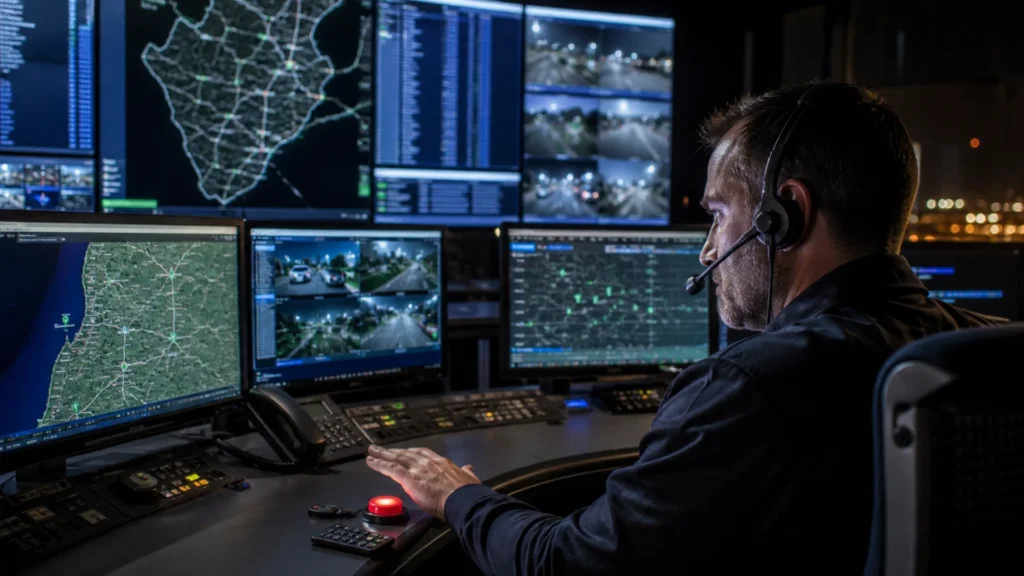
Remote immobilisation fleet security has become the most debated technology in South African vehicle recovery — and the most effective. Tracking providers now routinely shut down hijacked vehicles from control rooms hundreds of kilometres away. Cartrack recovered 1,402 vehicles in January 2025 alone, leading to 42 arrests and the confiscation of 12 jammers. Tracker assisted in 3,671 recoveries in the first half of 2025. Behind many of these recoveries sits one capability: the ability to remotely slow, stop, or prevent a stolen vehicle from restarting.
However, the legal framework governing this technology barely exists. No South African statute explicitly authorises or prohibits remote vehicle immobilisation. Fleet operators, tracking providers, insurers, and law enforcement all operate in a grey zone — one that works remarkably well in practice but remains untested in court. This analysis examines how remote immobilisation fleet security works, where the law stands, what insurers now demand, and why the distinction between basic tracking and SVR determines whether a fleet operator recovers a hijacked vehicle or writes it off.
How Remote Immobilisation Fleet Security Actually Works
Remote vehicle immobilisation is not an instant kill switch. Understanding the mechanics matters, because the safety of the process directly affects its legal defensibility.
The hardware inside the vehicle
A professionally installed immobilisation system wires a relay module into the vehicle’s ignition circuit, fuel pump, or starter motor. Essentially, this relay sits alongside the GPS tracking unit but serves a different function. The tracker reports location. The relay controls the engine. Both connect to the tracking provider’s control room via cellular network. Some advanced systems also connect via RF frequency as a fallback when cellular coverage fails or criminals deploy jammers.
Limp mode versus hard shutdown
Modern remote immobilisation fleet security systems use “limp mode” rather than an abrupt engine cut. When the control room sends an immobilisation command, the system progressively reduces engine power. As a result, the vehicle slows gradually — typically to under 5 km/h — rather than stopping suddenly on a highway. This is a critical safety distinction. An instant shutdown at 120 km/h on the N1 creates a hazard for other road users. A gradual slowdown gives the hijacker time to pull over or abandon the vehicle safely.
Alternatively, some systems use a “restart prevention” approach. Instead of cutting power while the vehicle is moving, the system waits until the ignition is turned off — at a fuel stop, a traffic light, or when the vehicle is parked — and then prevents the engine from restarting. This eliminates the highway safety concern entirely.
The control room decision chain
Importantly, immobilisation does not happen automatically. A trained control room operator follows a verification protocol. First, the system detects an anomaly: unauthorised movement, tamper alert, jam detection, panic button activation, or geofence breach. Then the operator contacts the vehicle owner or fleet manager to confirm the event. Only after confirmation — and ideally coordination with SAPS — does the operator issue the immobilisation command. This human-in-the-loop process reduces the risk of accidentally disabling an authorised vehicle.
The Legal Grey Zone: Is Remote Immobilisation Fleet Security Lawful?
In reality, this is the question nobody in the industry wants to answer directly — because the honest answer is “probably, but it has never been tested.”
What the law says
South African law does not have a specific statute governing remote vehicle immobilisation. The Private Security Industry Regulatory Authority (PSIRA) regulates the companies that perform tracking and recovery — but PSIRA’s mandate covers registration, training, and conduct standards, not the specific technical act of remotely disabling a vehicle. The National Road Traffic Act governs vehicle roadworthiness and operation but does not address remote shutdown.
Instead, the industry relies on three legal foundations. First, the common-law right to recover stolen property. The vehicle owner — or their authorised agent (the tracking company) — has a right to take reasonable steps to recover stolen property. Second, the Criminal Procedure Act allows for arrest and property seizure in certain circumstances. Third, the contractual relationship between the vehicle owner and the tracking provider, which authorises the provider to act on the owner’s behalf.
Where the risk lies
The legal vulnerability is not in the immobilisation itself. It is in the consequences. If a vehicle is immobilised on a highway and a subsequent accident injures a third party, liability questions arise. Who is responsible — the tracking provider who sent the command, the fleet operator who authorised the service, or the hijacker who created the criminal situation? South African courts have not yet ruled on this specific scenario.
Consequently, the industry has self-regulated around the limp mode standard. By gradually reducing speed rather than abruptly stopping the engine, providers minimise the risk to other road users. Furthermore, the human verification step — confirming the vehicle is stolen before issuing the command — creates a documented decision trail. If challenged, the provider can demonstrate that immobilisation was a reasonable response to a confirmed crime, not a reckless act.
SAPS coordination
In practice, most tracking providers coordinate directly with SAPS before or simultaneously with issuing an immobilisation command. This serves two purposes: it brings law enforcement into the recovery operation, and it creates a record that the immobilisation occurred in the context of a reported crime. Indeed, Cartrack reports that its recovery teams work “closely with local police” in every operation. Tracker’s recoveries regularly involve joint operations with SAPS and SANDF. This coordination provides practical — if not formal legal — cover.
SVR Versus Basic Tracking: Why the Distinction Matters for Remote Immobilisation Fleet Security
Not all tracking systems include immobilisation capability. The market divides into two tiers, and understanding the difference is critical for fleet operators.
Basic fleet tracking
A basic GPS tracker reports vehicle position at regular intervals — typically every 10 to 30 seconds while moving. It shows the vehicle on a map. The system also logs trips, speed, stops, and route history. Additionally, it may include geofencing and driver behaviour alerts. However, it does not include a relay module wired into the vehicle’s ignition. As a result, it cannot shut the vehicle down. If the vehicle is hijacked, the tracker tells you where it is going — but it cannot stop it from getting there.
Stolen Vehicle Recovery (SVR)
In contrast, an SVR system adds active intervention to basic tracking. This includes jam detection that identifies when a criminal activates a GPS jammer near the vehicle, tamper alerts when the unit’s power is disconnected or the device is physically disturbed, autonomous defence protocols that trigger automatically without driver input, remote immobilisation via limp mode or restart prevention, and 24/7 control room monitoring with armed response dispatch capability.
The recovery data tells the story. SVR-equipped vehicles achieve an 82% recovery rate. By contrast, those with basic tracking or no tracking drop to 35%. Recovery time also differs dramatically: tracked vehicles return in an average of 9.4 hours, while untracked ones take 21.7 hours. Furthermore, reporting speed matters — a vehicle reported within 15 minutes of theft has a 78% recovery rate. After 4 hours, that rate collapses to 42%.
For fleet operators, the distinction between basic tracking and SVR is the distinction between knowing where your vehicle was taken and actually getting it back. At current vehicle prices, a single unrecovered Hilux or Ranger represents a total disruption cost exceeding R500,000.
Insurance Now Drives Remote Immobilisation Fleet Security Adoption
Surprisingly, the strongest driver of immobilisation adoption is not crime statistics. Rather, it is insurance requirements.
Santam’s 2025 Insurance Barometer confirmed that enhanced tracking systems — including remote immobilisation features — in high-risk vehicles are among the most effective interventions for reducing both premiums and claim frequency. Atang Matebesi, Chief Executive of Santam Client Solutions, stated that “proactive interventions like enhanced tracking systems” are “what works.”
Most South African insurers now mandate approved tracking with SVR capability as a condition of comprehensive fleet cover. Some require dual tracking devices for high-risk vehicles such as bakkies, SUVs, and commercial vehicles. Fleets without approved SVR frequently face higher premiums, restricted cover, or outright claim rejection. Indeed, King Price and other insurers explicitly recommend immobiliser and tracking combinations that include anti-hijack modes.
The implication for fleet operators is straightforward: the insurer is now the real decision-maker. Fleet managers do not choose remote immobilisation fleet security because they want to stop hijackers. They choose it because their insurer will not cover them without it.
Autonomous Defence: Remote Immobilisation Fleet Security Without Human Delay
Notably, the newest evolution removes the human delay entirely. Autonomous vehicle defence systems detect hijacking, tampering, or jamming — and respond automatically without waiting for a control room operator to verify and act.
Under duress, drivers freeze. Panic buttons fail when a person cannot reach them or is too frightened to press. A control room operator needs 2 to 5 minutes to verify and coordinate. In a hijacking, every minute matters. Autonomous systems compress the response window to seconds.
These systems monitor multiple inputs simultaneously: GPS position, cellular connectivity, accelerometer data, ignition status, driver ID presence, and tamper sensors. When the combination of inputs matches a hijacking signature — for example, the driver ID leaves the vehicle while the engine remains running and the vehicle deviates from its route — the system triggers immobilisation protocols independently. It alerts the control room, dispatches armed response, and uploads location data, all without any driver action.
Leading providers in South Africa offering various levels of autonomous defence include Titan Secure, Cartrack, Tracker, Netstar, Ctrack, and DigitFMS. DigitFMS integrates autonomous vehicle defence with GPS tracking, AI dashcams, fuel monitoring, and driver identification on a single platform — addressing the reality that immobilisation alone is only one layer in a comprehensive remote immobilisation fleet security strategy.
What Fleet Operators Should Demand From Their Tracking Provider
Not all immobilisation systems perform equally. Fleet managers evaluating providers should assess six capabilities.
Limp mode, not hard shutdown. Confirm that the system uses progressive power reduction or restart prevention — not an abrupt engine cut. This is both a safety requirement and a legal risk mitigation. Ask for documentation of the shutdown protocol.
Jam detection with cellular fallback. If a hijacker deploys a GPS jammer, the immobilisation command must still reach the vehicle. Multi-network SIM support and RF fallback frequencies provide redundancy. Test your system against jamming before you need it in a real event.
VESA-approved installation. The Vehicle Electronic Security Association sets standards for tracking and immobiliser installation. VESA-approved fitment ensures compatibility with insurance requirements and reduces the risk of incorrect wiring that could damage the vehicle or create safety hazards.
24/7 control room with armed response. Immobilisation without recovery is incomplete. The provider must have access to armed response teams that can reach the vehicle after it has been disabled. Providers who rely entirely on SAPS for the response leg introduce delays that the SAPS leadership crisis has made worse.
Dual tracking for high-risk vehicles. A visible primary unit provides operational fleet data. A hidden secondary unit — battery-powered, operating on a different network — ensures recovery capability even if criminals find and destroy the primary device. Insurers increasingly require dual tracking for bakkies and SUVs.
Integration with fleet management. Remote immobilisation fleet security should not operate in isolation. It should connect to the same platform that manages GPS tracking, fuel monitoring, driver identification, AI dashcams, and route planning. Fragmented systems with separate logins and dashboards create operational gaps.
Outlook: Remote Immobilisation Fleet Security Moves From Optional to Mandatory
Overall, the trajectory is clear. Five years ago, remote immobilisation was a premium feature available on high-end tracking packages. Today, insurers mandate it for most commercial vehicles. Tomorrow, it will be a baseline expectation — as standard as GPS tracking itself.
Several forces are accelerating this shift. The SAPS leadership crisis means fleet operators cannot rely on police response times. Diesel prices above R26 per litre make every vehicle more valuable and every theft more costly. Hijacking syndicates grow more sophisticated, deploying jammers and fake blue lights. Meanwhile, autonomous defence technology makes immobilisation faster, safer, and less dependent on human intervention.
Inevitably, the legal grey zone will require clarity. As remote immobilisation fleet security becomes universal, a court case will eventually test the boundaries. Until then, the industry’s self-regulation around limp mode, human verification, and SAPS coordination provides a practical framework that has successfully recovered tens of thousands of vehicles without a single adverse legal ruling.
Ultimately, for fleet operators in South Africa, the question is not whether remote immobilisation is legal. The question is whether they can afford to operate without it. At 50 hijackings per day and an 82% recovery rate for vehicles that have it — versus 35% for those that do not — the answer writes itself.
Frequently Asked Questions
How does remote vehicle immobilisation work?
A relay module wired into the vehicle’s ignition or fuel system receives commands from the tracking provider’s control room via cellular network. When activated, the system gradually reduces engine power (“limp mode”) or prevents the vehicle from restarting after the ignition is turned off. The control room verifies the vehicle is stolen before sending the command. The vehicle can only restart after identity verification.
Is remote vehicle immobilisation legal in South Africa?
No specific statute authorises or prohibits it. The industry operates under the common-law right to recover stolen property, contractual authorisation from the vehicle owner, and PSIRA regulation of tracking companies. Providers use limp mode and human verification to minimise risk. The legal framework remains untested in court.
What is the difference between SVR and basic fleet tracking?
Basic tracking shows vehicle location. SVR adds jam detection, tamper alerts, autonomous defence, remote immobilisation, and 24/7 control room monitoring with armed response. SVR vehicles achieve 82% recovery rates versus 35% for untracked vehicles. Basic tracking tells you where a vehicle went. SVR gets it back.
Do insurers require remote immobilisation?
Increasingly, yes. Most SA insurers now mandate approved tracking with SVR capability for fleet cover. Santam’s 2025 Insurance Barometer confirmed that enhanced tracking reduces premiums and claim frequency. Fleets without approved SVR face higher premiums or claim rejection. Some insurers require dual tracking for high-risk vehicles.
What is limp mode?
Limp mode gradually reduces engine power so the vehicle slows to a crawl — typically under 5 km/h — rather than stopping suddenly. This avoids causing accidents on highways. Some systems prevent restart after ignition is turned off instead of cutting power while driving. Both approaches avoid the safety risk of an instant shutdown.
How fast can a vehicle be immobilised after hijacking?
Leading providers detect unauthorised movement within seconds. The control room verifies the event and can issue an immobilisation command within minutes. Vehicles reported within 15 minutes of theft have a 78% recovery rate. The full process — detection, verification, immobilisation, armed response dispatch — can complete in under 10 minutes.
What if a jammer blocks the immobilisation signal?
Advanced SVR systems use multiple fallback methods: cellular positioning when GPS fails, RF frequency switching, multi-constellation GNSS, and jam-detection alerts. Some systems include autonomous defence that triggers immobilisation locally without needing a remote signal. The jam itself becomes the alert that triggers the response.
Sources
Cartrack South Africa — Vehicle recovery data January 2025; hijacking vs theft comparison analysis · Tracker South Africa — Vehicle Crime Index H1 2025; 3,671 recoveries and 146 arrests · TrackerPrices.co.za — Vehicle theft statistics and recovery rates 2026 · Santam Insurance — 2025 Insurance Barometer; Atang Matebesi statements on tracking interventions · Moonstone Information Refinery — “Five things vehicle owners should know about hijackings and theft” · King Price Insurance — Most hijacked cars and tracking requirements 2026 · Titan Secure — “The Ultimate Buyer’s Guide to Vehicle Anti-Theft Devices in South Africa”, April 2026 · Cars.co.za — “Hijacking and making your vehicle less likely to become a statistic” · PSIRA — Private Security Industry Regulatory Authority mandate and registration data · VESA — Vehicle Electronic Security Association installation standards · Frotcom — Remote Vehicle Immobilization technical overview · SAPS — Q3 2025/26 crime statistics · AutoTrader South Africa — “SA’s most-hijacked car brands: 2026 risk report”
© 2026 DigitFMS. All rights reserved.