
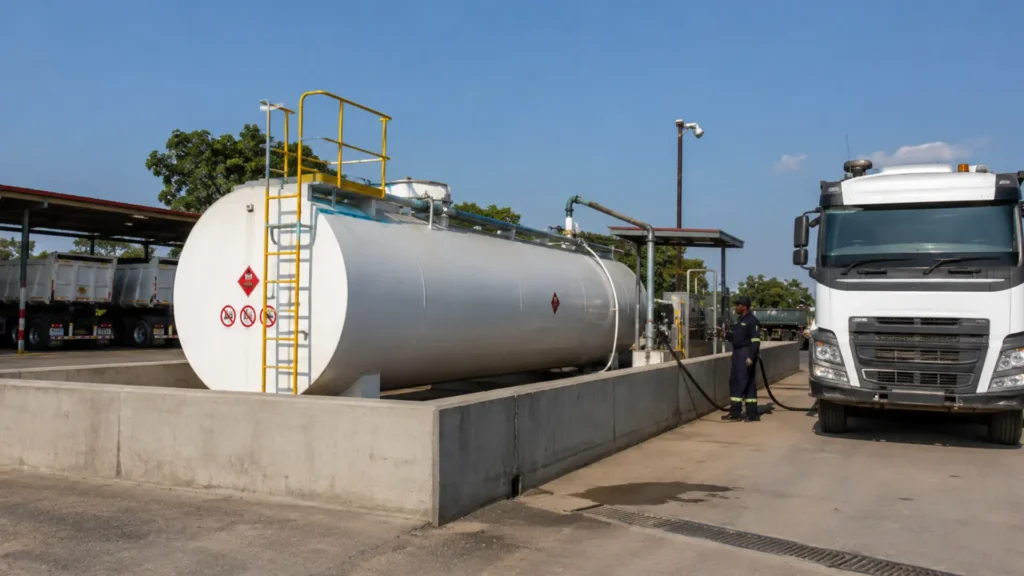
Fleet bulk fuel storage compliance has become the overlooked risk in every fleet operator’s plan to beat the July levy reinstatement. The logic is sound: with the diesel levy at zero until 2 June, buying forward saves R3.93 per litre compared to July prices. However, Clayton Ellary, Executive Head at Aon South Africa, warns that “the moment materially larger volumes of fuel are stored on site, the risk exposure fundamentally changes. Fire load increases dramatically. Vapour and handling risks increase. The potential for injury, third-party harm and environmental damage increases.” The South African Insurance Association has warned explicitly that insurers will not cover losses resulting from non-compliant fuel storage.
This analysis examines the regulatory framework governing fleet bulk fuel storage compliance in South Africa, the specific insurance risks of increasing diesel volumes at depots, the environmental and fire safety obligations fleet operators must meet, and how fuel monitoring technology protects stockpiled diesel from the theft risk that high-value stored fuel inevitably attracts.
Why Fleet Operators Are Stockpiling — and Why Fleet Bulk Fuel Storage Compliance Matters Now
Undoubtedly, the financial incentive to stockpile is clear. The diesel general fuel levy currently sits at zero — the lowest it will be for the foreseeable future. From 3 June, the levy rises to R1.97 per litre. From 1 July, the full R3.93 returns. For a fleet operator with 10,000 litres of storage capacity, filling tanks in May rather than July saves approximately R39,300 — a meaningful sum that justifies the effort.
However, the savings calculation ignores a critical question: is the storage itself compliant? Aon’s Ellary puts it directly: “This means the issue is not simply whether fuel is stored on site, but whether it is stored lawfully, safely and in compliance with all applicable requirements.” Consequently, fleet operators who rush to fill tanks without checking their compliance status may save R39,300 on diesel and lose R500,000 in a voided insurance claim, an environmental remediation order, or a fire that destroys the depot.
The Regulatory Framework for Fleet Bulk Fuel Storage Compliance in South Africa
Specifically, fuel storage in South Africa falls under multiple overlapping regulatory frameworks. Fleet operators must comply with all of them simultaneously.
SANS 10089: the national storage standard
SANS 10089 sets the technical requirements for petroleum storage in South Africa. Part 1 covers above-ground tanks — the type most fleet depots use. Part 3 covers underground tanks. Key requirements for above-ground storage include bunding that holds at least 110% of the largest tank’s volume, impermeable bund floors and walls (typically reinforced concrete or lined membranes), no drainage outlets through the bund wall (rainwater must be removed manually after contamination checks), foundations that meet structural specifications, and materials compatible with the stored fuel.
Importantly, SANS 10089-2 covers ongoing maintenance — compliance is not a one-time installation. Tanks, valves, bunding, and safety equipment require regular inspection. Fleet operators who installed compliant tanks years ago but have not maintained them may find their compliance has lapsed without anyone noticing.
Municipal fire bylaws
SAIA technical expert Mosidi Shomang confirms that municipalities set specific limits on fuel storage volumes. Many municipalities permit only 25 litres for residential use. Commercial operations face different but still defined thresholds. Once flammable liquids exceed these thresholds, municipalities may require registration, purpose-built facilities, fire department inspections, and ongoing compliance reporting. Fleet operators who increase their storage volumes without notifying the municipality risk non-compliance — and municipal fire departments have the authority to order immediate removal of non-compliant fuel.
The Occupational Health and Safety Act
Meanwhile, the OHSA (Act 85 of 1993) requires employers to provide a safe working environment. Fuel stored at a fleet depot where employees work triggers specific obligations: hazardous chemical risk assessments, employee training on fuel handling, provision of personal protective equipment, emergency procedures for spills and fires, and in some cases medical surveillance for workers exposed to fuel vapours. Furthermore, Aon notes that regulations may require exposure assessments and record-keeping — obligations that many fleet operators have never considered for their fuel storage.
NEMA environmental requirements
Equally, under the National Environmental Management Act, fleet operators have a duty to prevent pollution. Diesel spills or slow leaks contaminate soil and groundwater — sometimes going undetected for months. Inadequate bunding, poor drainage control, or damaged tanks increase the likelihood and severity of spills. For larger storage facilities or those near sensitive areas (wetlands, rivers, residential zones), NEMA may require a full Environmental Impact Assessment before storage commences. Environmental remediation for contaminated soil costs R500,000 or more depending on the extent of contamination.
The Petroleum Products Act
Additionally, the DMRE administers the Petroleum Products Act, which regulates fuel storage licensing. Depending on the volume stored, fleet operators may need either registration (for smaller volumes) or a full storage licence (for larger volumes). Applications require detailed plans, proof of SANS compliance, environmental approvals, and local authority permissions. DMRE inspectors may visit the site to verify compliance before issuing a licence. Fleet operators who store diesel above licensable thresholds without the appropriate authorisation face regulatory penalties.
The Insurance Trap: How Fleet Bulk Fuel Storage Compliance Failures Void Cover
Critically, insurance is where non-compliant fuel storage hits fleet operators hardest — and fastest.
The SAIA warning
First, the South African Insurance Association issued an explicit public warning: insurers will not cover losses resulting from illegal or non-compliant activities. Storing fuel above local limits constitutes a breach of legislation. SAIA recommends avoiding home petrol storage entirely. For fleet depots, the message translates directly: if your fuel storage does not comply with SANS 10089, municipal bylaws, and environmental regulations, your insurer may reject any claim arising from fire, explosion, spill, or theft involving that stored fuel.
What insurers assess after a fire
Christelle Colman, CEO of Ami Underwriting Managers, confirms that insurers evaluate several factors when processing claims involving stored fuel: how much fuel was present, what type of containers were used, whether the policyholder complied with municipal bylaws, and whether the fuel storage was disclosed to the insurer. A depot fire that destroys vehicles, cargo, and facilities is a multi-million rand claim. If the insurer discovers that non-compliant fuel storage contributed to the fire’s severity or spread, the entire claim may fail.
The disclosure obligation
Crucially, fleet operators must disclose any material change in fuel storage to their insurer. Installing a new tank, increasing storage volumes significantly, or beginning to stockpile diesel ahead of the July levy change all constitute material changes. Colman emphasises that the imperative to disclose includes “any decisions to store multiple containers or bulk fuel.” Failure to disclose gives the insurer grounds to reject claims — even if the fuel storage itself was technically compliant — because the insurer did not have the opportunity to assess the changed risk.
The Theft Risk: Why Stockpiled Diesel Needs Fleet Bulk Fuel Storage Compliance and Monitoring
Equally important, every fleet operator who stockpiles diesel before July creates a theft target. At R31 per litre, a full 5,000-litre tank holds R155,000 worth of diesel. A 10,000-litre tank holds R310,000. Criminals who target fleet fuel know that tanks are fullest immediately after bulk purchases — and the current zero-levy window is driving the largest bulk purchases of the year.
How thieves exploit stockpiled fuel
Typically, bulk fuel theft from depot tanks follows a predictable pattern. Thieves arrive between 22:00 and 04:00 with hoses and containers. They connect to the tank’s outlet valve or cut directly into the fuel line. A 50mm hose can drain 500 litres in under 15 minutes — R15,500 of diesel. Without monitoring, the fleet manager discovers the loss the next morning when the gauge reads lower than expected. By then, the thieves and the diesel are long gone.
Fuel monitoring closes the gap
In contrast, litre-level sensors installed in bulk storage tanks detect drainage events in real time. When the fuel level drops while no authorised dispensing is scheduled, the system sends an immediate alert with the exact volume lost, the time, and the tank location. Additionally, integration with depot CCTV triggers camera footage review at the exact moment the drainage begins — providing visual evidence for insurance claims and criminal prosecution.
ServiceLink SA documented a case study where diesel monitoring at a depot saved over R200,000 in the first year through theft detection alone. DigitFMS’s D-Fuel system extends this protection to both stationary bulk tanks and vehicle-mounted fuel tanks on a single platform. The same system that detects siphoning from a truck on the road detects drainage from the depot tank overnight — providing unified visibility across all fuel assets.
Fleet Bulk Fuel Storage Compliance Checklist: Seven Steps Before You Fill the Tank
Verify your tank meets SANS 10089-1 requirements. Check that bunding holds 110% of tank volume, bund materials are impermeable and undamaged, no drainage outlets exist through the bund wall, and the tank foundation meets structural specifications. If your tank was installed years ago, commission a compliance inspection before increasing volumes.
Next, check municipal bylaw thresholds. Contact your municipality’s fire department and confirm the maximum fuel volume permitted at your site. If your intended storage exceeds the threshold, apply for the necessary registration or approval before purchasing additional fuel.
Additionally, disclose any storage changes to your insurer immediately. Tell your broker you intend to increase diesel volumes ahead of the July levy return. Ask specifically whether your current policy covers the increased volume and whether any additional conditions or endorsements apply. Get the answer in writing.
Monitor, maintain, and protect
Install fuel monitoring on every storage tank. At R31 per litre, unmonitored stockpiled diesel is an invitation to theft. Litre-level sensors pay for themselves from a single prevented drainage event. Integrate tank monitoring with depot CCTV for visual verification of every alert.
Furthermore, ensure fire safety equipment is current. Check that fire extinguishers are rated for liquid fuel fires, are accessible, and have not expired. Verify separation distances between the tank and buildings, parking areas, and public roads. Post no-smoking signage within the defined safety zone.
Then, conduct an OHSA risk assessment. Document the hazards associated with your fuel storage, including fire risk, vapour exposure, and spill scenarios. Train depot staff on fuel handling procedures. Provide appropriate PPE. Document everything — this protects the business in any incident investigation.
Finally, assess environmental exposure. If your depot is near a watercourse, wetland, or residential area, evaluate whether NEMA requires an environmental assessment for your storage volumes. Ensure drainage from the bunded area does not connect to stormwater systems. A diesel spill that reaches a water source triggers environmental liability that dwarfs the fuel savings.
Who Helps Fleet Operators Achieve Fleet Bulk Fuel Storage Compliance
ServiceLink SA specialises in bulk diesel storage compliance, providing guidance on SANS 10089 requirements, bunding regulations, and DMRE licensing. ASP Fire provides fire safety assessments and compliance consulting for fuel storage facilities. Aon South Africa advises on the insurance implications of increased fuel storage through its mid-market and commercial broking divisions.
DigitFMS provides the monitoring layer that protects stockpiled fuel once compliance is achieved. The D-Fuel system monitors both stationary bulk tanks and vehicle fuel tanks on a single dashboard, detecting theft from either source in real time. Integration with depot CCTV, access control, and perimeter detection creates a unified security system that covers the fuel from the moment it enters the storage tank to the moment it enters a vehicle. The company’s 100+ franchise branches provide local installation and sensor calibration — ensuring the monitoring data is accurate enough to support insurance claims and SARS refund documentation.
Outlook: Fleet Bulk Fuel Storage Compliance Will Face Regulatory Scrutiny After July
Overall, the current stockpiling trend is driven by a rational financial calculation. However, insurers, municipalities, and environmental regulators are all watching. SAIA’s public warning, Aon’s explicit risk advisory, and ASP Fire’s safety caution all signal that the regulatory and insurance environment will tighten around fleet fuel storage in the coming months.
In summary, fleet operators who stockpile compliantly — with proper tanks, bunding, fire safety, insurance disclosure, environmental assessment, and fuel monitoring — will capture the R3.93 per litre saving without creating new risks. Those who stockpile carelessly — in non-compliant containers, without bunding, without disclosure, without monitoring — may discover that the money they saved on diesel disappeared into a voided insurance claim, an environmental remediation bill, or a theft they could not detect.
Ultimately, fleet bulk fuel storage compliance is not a barrier to stockpiling. It is the framework that makes stockpiling safe, insured, and defensible. The diesel levy returns in July regardless of how fleet operators prepare. The question is whether they prepare compliantly — or discover the compliance gap when a fire, a spill, or a theft turns a smart fuel purchase into the most expensive mistake of the year.
Frequently Asked Questions
Is it legal to stockpile diesel at a fleet depot?
It depends on volume and compliance. SANS 10089 governs tank standards. Municipal bylaws set volume thresholds. OHSA requires risk assessments. NEMA covers environmental obligations. The Petroleum Products Act may require licensing. Non-compliant storage can result in fines, environmental liability, and voided insurance.
What is SANS 10089?
The South African National Standard for petroleum storage. Section 1 covers above-ground tanks (bunding at 110% capacity, impermeable walls, no drainage outlets). Part 3 covers underground tanks. Section 2 covers ongoing maintenance. Fleet operators with bulk diesel tanks must comply with the relevant part and maintain compliance through regular inspections.
Can storing diesel void fleet insurance?
Yes. SAIA warned explicitly that insurers will not cover losses from non-compliant storage. Ami Underwriting’s Colman confirms insurers assess volume, container type, and bylaw compliance. Aon’s Ellary warns that increased volumes fundamentally change risk exposure. Fleet operators must disclose storage changes to their insurer or risk claim rejection.
How much diesel can fleet operators store without a licence?
Thresholds vary by municipality and regulation. SAIA notes many municipalities permit only 25 litres for residential use. Commercial thresholds differ. Volumes above 1,000 litres typically require specialist assessment. Larger storage may need DMRE registration or a full licence. Verify current thresholds with your local authority before increasing volumes.
What are the environmental risks?
Diesel spills contaminate soil and groundwater, sometimes going unnoticed for months. Inadequate bunding makes spills more likely. Environmental remediation costs R500,000 or more. NEMA may require an Environmental Impact Assessment for larger facilities. Fleet operators have a legal duty to prevent pollution under NEMA.
How does fuel monitoring protect stockpiled diesel?
Litre-level sensors detect drainage events in real time. A 5,000-litre tank at R31/litre holds R155,000 of diesel. Without monitoring, overnight theft goes undetected until the next morning. With monitoring, the alert arrives within seconds of unauthorised drainage, including volume lost, time, and GPS coordinates.
What fire safety measures does fleet fuel storage need?
Adequate separation distances from buildings and roads. Fire extinguishers rated for liquid fuel fires. No ignition sources within the safety zone. Spill containment equipment. Ventilation to prevent vapour accumulation. Documented emergency procedures. Municipal fire departments may inspect commercial storage and issue compliance orders.
Sources
Aon South Africa — Clayton Ellary, “Fuel Stockpiling: The Hidden Risk South Africans Are Overlooking”, Insurance Chat and Engineering News, April 2026 · Ami Underwriting Managers — Christelle Colman, “Stockpiling fuel at home: Understanding the hidden risks”, IOL, May 2026 · South African Insurance Association — Mosidi Shomang, “SAIA warns about risks of storing fuel at home”, EWN, April 2026
ASP Fire — Michael van Niekerk, “The risks of storing fuel at home”, IT-Online, April 2026 · ServiceLink SA — “Diesel Tank Bunding & Environmental Rules: What You Must Know”, March 2026; SANS 10089-1 and 10089-3 requirements · IOL — “The risks of fuel storage at home: What you need to know”, May 2026; “The hidden risks of fuel storage during load shedding”, May 2026 · Insurance Biz — “Fuel Stockpiling: The Hidden Risk”, April 2026 · SA Building Review — “How much petrol can you store at home in SA?”, April 2026 · SANS 10089 Parts 1, 2, and 3 · NEMA — National Environmental Management Act · OHSA — Occupational Health and Safety Act 85 of 1993 · Petroleum Products Act — DMRE licensing requirements
© 2026 DigitFMS. All rights reserved.