
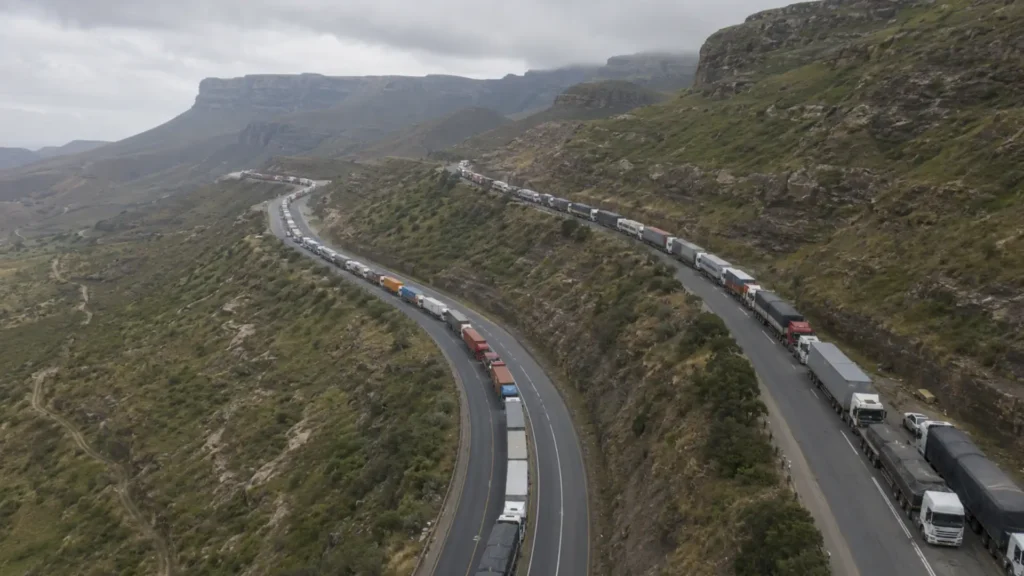
The truck driver shutdown fleet operators feared has arrived — and it is a preview of something larger. At approximately 4am on Saturday 30 May, protesting truck drivers blockaded the N3 at Van Reenen’s Pass, stranding at least 50 trucks on both carriageways. Protesters stole keys from non-participating drivers, forcibly immobilising their vehicles. The Road Traffic Inspectorate deployed tow trucks to clear the blockade. The Road Freight Association’s Gavin Kelly stated that the industry was “once again being held hostage by those who prefer to work outside of the law.” The All Truck Drivers Forum and Allied South Africa (ATDF-ASA) has confirmed a larger nationwide shutdown on 30 June — exactly 31 days from today, coinciding with the March and March immigration ultimatum and the day before the full R3.93 diesel levy returns.
In this article, this analysis reports what happened on the N3 today, explains why the truck driver shutdown fleet disruption is a rehearsal for the 30 June convergence, examines the data behind the foreign driver grievances, and updates the contingency plan every fleet operator should now accelerate from planning to execution.
What Happened Today: The Truck Driver Shutdown Fleet Routes Experienced on the N3
Specifically, KZN Acting Provincial Commissioner Major General Phumelele Makoba had warned the previous day that intelligence indicated plans for protest action involving road blockages on the N2 and N3. Despite the warning, no formal notice of the march had been filed with SAPS — making the protest illegal under the Regulation of Gatherings Act.
The N3 blockade at Van Reenen: truck driver shutdown in action
Daily Maverick confirmed that the blockade started around 4am. Road Traffic Inspectorate spokesperson Zinhle Mngomezulu confirmed at least 50 trucks were “stuck” on both carriageways. SAPS KZN confirmed that protesting drivers took keys from non-participating truckers, effectively stranding vehicles whose operators had nothing to do with the protest. The RTI brought in tow trucks to physically remove vehicles blocking the road. Importantly, it remains unclear how many of the stranded trucks belonged to protesters and how many were innocent fleet vehicles caught in the blockade.
The key-stealing tactic: a direct fleet security threat
Critically, the practice of pulling drivers from trucks to check documents — and stealing keys from those who refuse to participate — represents a direct assault on fleet operations. A fleet vehicle immobilised by key theft on the N3 cannot be dispatched, cannot deliver cargo, and cannot be recovered until the blockade clears. Furthermore, the driver faces personal safety risk from confrontation with protesters. For fleet operators, this tactic transforms a protest into an operational weapon: even neutral vehicles become tools of disruption. GPS tracking shows the fleet manager exactly which vehicles are trapped, enabling rerouting of remaining vehicles — but cannot prevent the key theft itself.
RFA’s Gavin Kelly responds: fleet industry “held hostage”
In response, the Road Freight Association issued a statement on Saturday describing the situation bluntly. Kelly stated that the country’s trucking industry was “once again being held hostage by those who prefer to work outside of the law.” He confirmed reports of “violence and looting” and noted individuals had “taken the law into their own hands to pull drivers from trucks to check their personal documents.” Crucially, the RFA called on government to “proactively intervene in chaotic protests rather than simply monitoring activities,” arguing that SA’s road transport credibility was “in rapid decline.”
Why Today’s Truck Driver Shutdown Fleet Disruption Is a Rehearsal for 30 June
Importantly, today’s N3 blockade involved one route in one province. The 30 June action is planned as a nationwide shutdown across multiple corridors.
ATDF-ASA confirms fleet-wide 30 June shutdown
In a memorandum dated 20 May 2026, ATDF-ASA secretary-general Gugu Sokhela confirmed the organisation “fully supports the planned 30 May shutdown” and announced plans for “its own nationwide shutdown on 30 June 2026.” Sokhela stated the trucking industry had reached a “breaking point” regarding the employment of foreign drivers. Consequently, what happened today on the N3 was a single-corridor preview. The 30 June action targets the N3, N1, N2, and routes linked to Durban Harbour — SA’s entire primary freight network simultaneously.
March and March convergence amplifies the threat to fleet operations
Furthermore, the ATDF-ASA’s 30 June date deliberately coincides with March and March’s immigration ultimatum. Two separate organisations — one targeting foreign truck drivers specifically, the other targeting all undocumented foreigners — have converged on the same date. Major General Makoba confirmed SAPS is monitoring both planned actions. If both mobilise on 30 June, the disruption will be broader and harder to contain than either could achieve alone. Additionally, the full R3.93 diesel levy returns on 1 July — the day after the threatened shutdown — meaning fleet operators face logistics disruption and permanent fuel cost escalation in a 48-hour window.
Today exposed the SAPS response gap for fleet security
Nevertheless, despite Makoba’s stern warnings on Friday, the blockade proceeded Saturday morning. No arrests were reported in the initial hours. The RTI — not SAPS — took the lead in clearing vehicles. The RFA’s Kelly explicitly criticised government for “monitoring” rather than “proactively intervening.” For fleet operators planning for 30 June, this response gap is the critical data point: warnings from senior police did not prevent the blockade, and the response was reactive rather than pre-emptive. With 18 senior SAPS officers suspended from the Madlanga Commission, the police capacity for 30 June will be no stronger than today.
The Data Behind the Grievances: What the Truck Driver Shutdown Fleet Protests Target
Notably, the ATDF-ASA’s demands centre on four issues. The data supports some and contradicts others.
Foreign driver employment: real but overstated
First, Road Freight Employers Association data shows 84.66% of truck drivers (37,265 of 44,021) are South African citizens. Only 15.34% are foreign nationals. However, KZN Transport MEC Siboniso Duma confirmed his department intercepted 15 abnormal load trucks carrying undeclared goods driven by undocumented foreign nationals late in 2025. Sokhela accused trucking companies of employing foreign nationals “at wages below the prescribed minimum,” undercutting local drivers. The grievance has a factual basis in specific cases — but the narrative that foreign drivers dominate the industry contradicts the aggregate data.
SAPS enforcement is happening but insufficient
Second, Makoba revealed that SAPS KZN has arrested 4,722 undocumented foreign nationals since January 2026 during joint operations. This demonstrates enforcement activity. Nevertheless, the ATDF-ASA argues enforcement is too slow, inconsistent, and undermined by corruption — a concern that the Madlanga Commission testimony about cocaine in truck containers and compromised Crime Intelligence officers substantiates. The gap between enforcement statistics and driver-level perception drives the protest momentum.
The demerit points system triggers fleet anxiety
Third, Sokhela questioned how the upcoming demerit points system would apply to undocumented foreign drivers. “It feels like this demerit system will only punish South African truck drivers. There is no clarity on how foreign nationals will be dealt with,” he said. For fleet operators, this concern is legitimate: a regulatory system that applies to documented drivers but not undocumented ones creates an uneven competitive environment. Fleet operators who employ compliant, documented drivers bear the full regulatory burden while non-compliant operators avoid it.
What Fleet Operators Must Do Now: Accelerating the 30 June Truck Driver Shutdown Fleet Contingency
Clearly, today’s events transform the 30 June contingency plan from theoretical to urgent. Fleet operators who witnessed the N3 blockade have 31 days to prepare for something larger.
Immediate actions from today’s shutdown
Check every vehicle’s position right now. If any fleet vehicles are trapped on the N3 or N2, contact those drivers directly. Do not instruct drivers to force through blockades. Reroute all remaining dispatches via the N11 through Newcastle or the R34 via Vryheid. Ensure AI dashcam footage uploads to the cloud — footage of key theft, vehicle damage, or blockade conditions supports insurance claims and criminal complaints. Importantly, document the financial impact: every hour a vehicle is stranded costs the fleet operator in missed deliveries, driver wages, and cargo depreciation.
Accelerated 30 June fleet preparation
Our 34-day contingency plan published on 28 May now has 31 days remaining. Today’s events confirm the plan must be accelerated. Geofence the N3, N2, N1, and all routes ATDF-ASA has named as targets. Pre-programme alternative routes into every driver’s GPS. Stockpile fuel before 28 June — both to capture the R28.73 June diesel price and to protect against supply disruption if the shutdown closes fuel stations. Verify insurance covers civil unrest and protest-related vehicle damage.
Protect drivers — especially foreign nationals in your fleet
Above all, protesters pulled drivers from trucks to check documents. Foreign drivers in your fleet face personal safety risk from this tactic. Brief every driver on confrontation avoidance: do not resist, do not argue, hand over keys if threatened, call the control room immediately. Similarly, ensure all foreign drivers carry valid documentation at all times. Consider temporarily reassigning foreign drivers from KZN routes until the threat period passes. No delivery is worth a driver’s safety.
Use today’s data to justify fleet security investment
Finally, the N3 blockade provides concrete, documented proof that fleet operations face direct protest disruption in 2026. Fleet operators seeking management approval for tracking upgrades, dashcam deployment, or geofencing systems can point to today’s events as the business case. The cost of a vehicle stranded on the N3 for 12 hours — missed deliveries, driver wages, cargo spoilage, alternative transport costs — exceeds the annual cost of the monitoring system that would have alerted the fleet manager to reroute before the vehicle entered the blockade zone.
Technology That Protects Fleet Operations During the Truck Driver Shutdown
In essence, today’s N3 blockade demonstrated exactly which technology capabilities matter when a freight corridor shuts down without warning.
DigitFMS integrates GPS tracking with geofencing, AI dashcams with cloud upload, wireless driver identification, panic button activation, and route management on a single dashboard. When a vehicle approaches a geofenced protest zone, both driver and control room receive instant alerts — preventing the vehicle from entering the blockade. If a vehicle is already trapped, the GPS position enables the fleet manager to coordinate with the driver and plan extraction. Cloud-uploaded dashcam footage captures any confrontation, key theft, or vehicle damage for insurance and criminal complaint purposes. The company’s 100+ franchise branches include operators in KwaZulu-Natal who understand the N3 corridor and local protest dynamics.
Similarly, Cartrack, Tracker, Netstar, Ctrack, and MiX by Powerfleet all offer real-time tracking and geofencing. The critical requirement during a truck driver shutdown fleet disruption is speed: geofences must be created and deployed within minutes of a blockade being reported, alerts must reach drivers before they enter the affected zone, and dashcam footage must upload to the cloud before the vehicle is potentially damaged or keys are stolen.
Outlook: Today’s Truck Driver Shutdown Fleet Disruption Confirms 30 June Will Be Worse
Importantly, today’s N3 blockade involved one organisation on one route in one province — and it stranded 50 trucks, triggered key theft, drew violence reports, and required the RTI to deploy tow trucks. SAPS issued stern warnings the day before and could not prevent the action. The RFA described the industry as being held hostage.
Consequently, on 30 June, two organisations — ATDF-ASA and March and March — plan simultaneous nationwide action. The N3, N1, N2, and Durban Harbour routes are all named targets. The day after, the full R3.93 diesel levy returns permanently. The SARB just hiked rates with two more warned. The SAPS leadership remains in crisis. The Phala Phala impeachment committee meets on Monday.
Ultimately, today’s truck driver shutdown fleet disruption answered the question fleet operators have been asking since the 30 June deadline was announced: “Will they actually do it?” They did it today. They will do it again — larger, broader, and on multiple corridors simultaneously — in 31 days. Fleet operators who treat today as a warning and accelerate their contingency planning will be prepared. Fleet operators who dismiss today as a minor KZN incident will be the ones with 50 trucks stranded at Van Reenen on 30 June, with stolen keys and spoiled cargo, wondering why nobody told them this would happen. Everybody told them. It happened today.
Frequently Asked Questions
What happened on the N3 during today’s truck driver shutdown?
Protesting drivers blockaded the N3 at Van Reenen’s Pass from 4am on 30 May. At least 50 trucks stranded on both carriageways. Protesters stole keys from non-participating drivers. The RTI deployed tow trucks to clear the blockade. The RFA confirmed reports of violence and looting, calling the industry “held hostage.”
Who organised the truck driver shutdown affecting fleet routes?
ATDF-ASA formally backed the shutdown in a 20 May memorandum. Secretary-general Sokhela confirmed plans to disrupt the N3 and N2. Grievances include undocumented foreign drivers, below-minimum wages, labour law enforcement, and the demerit points system. SAPS confirmed no formal notice of the march had been received.
Is a larger shutdown planned for 30 June?
Yes. ATDF-ASA confirmed a nationwide shutdown on 30 June, coinciding with March and March’s immigration ultimatum. The combined action targets the N3, N1, N2, and Durban Harbour routes. It falls one day before the full R3.93 diesel levy returns — meaning logistics disruption AND permanent fuel cost increase in the same week.
How does the truck driver shutdown affect fleet operations?
The N3 is SA’s most critical freight corridor. Blockades halt all vehicle movement. Perishable cargo faces spoilage. Delivery schedules collapse. Key theft immobilises even non-participating vehicles. GPS tracking shows which vehicles are trapped, enabling rerouting of others — but cannot prevent the physical blockade itself.
What did the Road Freight Association say?
RFA CEO Gavin Kelly said the industry was “held hostage by those who prefer to work outside of the law.” He confirmed violence and looting reports. The RFA called on government to proactively intervene rather than simply monitoring, arguing SA’s road transport credibility is “in rapid decline.”
Are foreign drivers actually taking local jobs?
RFEA data shows 84.66% of truck drivers are South African, only 15.34% are foreign nationals. However, KZN Transport MEC Duma confirmed intercepting 15 trucks with undocumented foreign drivers. SAPS KZN arrested 4,722 undocumented foreign nationals since January 2026. The issue exists in specific cases but the industry-wide narrative overstates it.
What should fleet operators do now?
Check all vehicle positions immediately. Reroute N3 dispatches via N11 or R34. Ensure dashcam footage uploads to the cloud. Brief drivers on confrontation avoidance. Verify insurance covers civil unrest. Accelerate the 30 June contingency plan: geofence all target routes, stockpile fuel before 28 June, protect foreign drivers. Today was the rehearsal — 30 June will be larger.
Sources
Daily Maverick / MSN — “Road Traffic Inspectorate brings in tow trucks to disperse illegal truck driver protest on N3 in KZN”, 30 May 2026; 50 trucks stranded, keys stolen, RTI tow trucks deployed, RFA Gavin Kelly “held hostage” statement · IOL — “KZN police issue warning over upcoming trucking protest and potential road disruptions”, 29 May 2026; Major General Makoba warning, 4,722 arrests, N2 and N3 targets · IOL / The Post — “Looming truck drivers’ strike could disrupt all major transport routes in KZN”, 29 May 2026; ATDF-ASA plans, Sokhela statements
ECR — “Truck drivers plan N2, N3 shutdown over foreign employment”, 29 May 2026; Sokhela believes foreign drivers taking SA jobs · The Herald — “KZN police warn of stern action after May 30 road shutdown threats”, 29 May 2026; Makoba SAPS statement, no formal notice received · The Witness — “KZN braces for truckers’ shutdown march on Saturday”, 29 May 2026; Sokhela below-minimum wages, demerit points, Duma 15 trucks intercepted · The Witness — “Truck drivers plan KZN shutdown over foreign employment”, 27 May 2026; Duma enforcement action
SA Trucker — “ATDF-ASA backs planned national truck drivers shutdown on 30 May 2026”, 26 May 2026; 20 May memorandum, 30 June nationwide shutdown confirmed · Zululand Observer / The Citizen — “Truck driver protest: possible highway disruptions on Saturday”, 29 May 2026 · African News Agency — “KZN police issue warning”, 29 May 2026 · RFEA — 84.66% SA drivers, 15.34% foreign nationals · DigitFMS — 30 June shutdown contingency plan (28 May), fleet budget confirmed numbers (30 May), SAPS corruption analysis (12 May), Madlanga Commission analysis (14 May)
© 2026 DigitFMS. All rights reserved.