
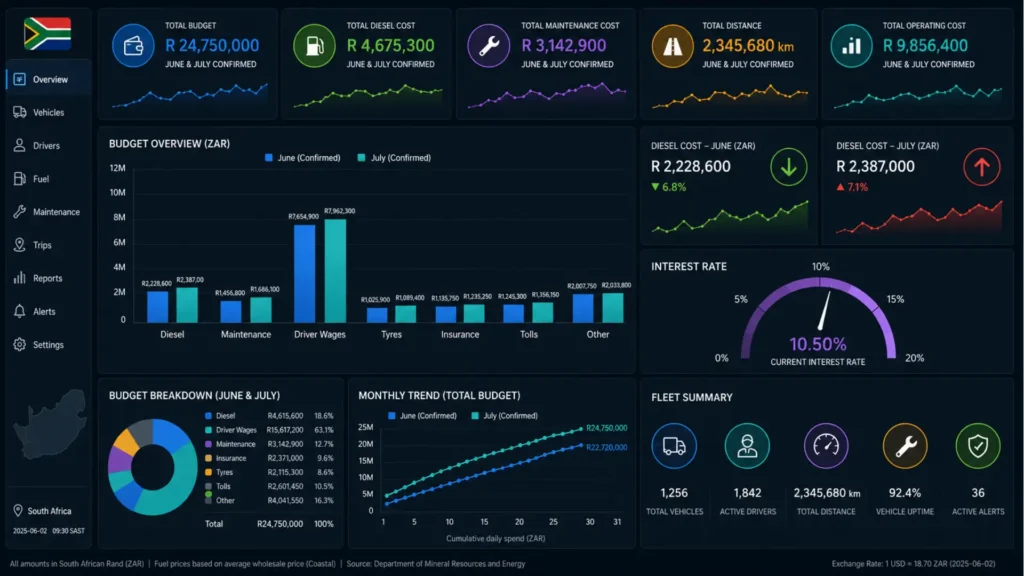
Every number in the fleet budget June July 2026 planning cycle is now confirmed — and for the first time in two months, fleet operators can build a Q3 budget with zero projections. Yesterday, the SARB hiked the repo rate to 7.00%, pushing prime to 10.50% and warning of two more increases. Today, the DMRE gazettes the official June fuel prices — confirming diesel drops R1.55 to R2.44 per litre while petrol rises R1.63 to R1.69. Treasury has confirmed no further levy relief — the full R3.93 returns 1 July. CPI stands at 4.0%. The SARB forecasts inflation at 4.4% for 2026. Nothing is projected anymore. Everything is confirmed. This is the document fleet managers should print and hand to their CFO on Monday morning.
This article consolidates every confirmed number into one planning document: the official June fuel prices, the confirmed SARB rate and forward guidance, the July levy reinstatement calendar, the Q3 cost trajectory, and the specific actions fleet operators should take during the one-month June window before July’s permanent cost increase arrives.
The Confirmed Numbers: Every Data Point in the Fleet Budget June July 2026 Plan
Specifically, here are the confirmed numbers — not projections, not estimates, not scenarios. These are gazetted, announced, and legislated figures that fleet operators can budget against with certainty.
June 2026 fleet fuel prices (DMRE gazette, 29 May)
Specifically, the DMRE confirmed that diesel 0.05% sulphur drops approximately R2.44 per litre to around R28.73 inland. Diesel 0.005% sulphur drops approximately R1.55 to around R30.33 inland. Petrol 95 rises approximately R1.69 per litre. Petrol 93 rises approximately R1.63. Prices take effect from midnight on Wednesday 3 June. The diesel decrease occurs because international over-recoveries of R3.52 to R5.02 per litre more than offset the R1.97 levy reinstatement.
SARB rate impact on fleet budget (MPC, 28 May)
Additionally, the repo rate stands at 7.00% (up 25bp). Prime stands at 10.50%. Effective since yesterday, 29 May. The MPC voted 4-2 — first hike since 2023. Crucially, Kganyago warned all three risk scenarios show additional tightening. The prolonged Hormuz scenario requires two more hikes. CPI forecast raised to 4.4% for 2026. Growth forecast lowered. The 3% inflation target pushed to 2028.
July 2026 fuel levy confirmed by Treasury
Furthermore, the full general fuel levy returns on 1 July 2026: petrol at R4.10 per litre, diesel at R3.93 per litre. Treasury has confirmed no further extensions. The R17.2 billion temporary relief programme ends permanently. If international diesel prices remain at current levels, wholesale diesel exceeds R35 per litre from July.
Inflation shaping the fleet budget (Stats SA, 20 May)
Meanwhile, April CPI at 4.0% — up from 3.1% in March. Fuel index up 18.2% in one month (steepest since 2008). Diesel up 35.4%. The SARB projects 4.4% average for 2026. Additionally, Kganyago flagged El Niño drought risk that could push food prices higher, compounding the fuel-driven inflation throughout the second half of the year.
Why June Is the Cheapest Month: The One-Month Window in the Fleet Budget June July 2026 Cycle
Crucially, the June diesel price creates an unusual and temporary opportunity that fleet operators must exploit before it closes on 30 June.
The maths behind the June 2026 diesel dip
To explain the mechanics, international diesel prices retreated from their April-May peak as global shipping routes partially adjusted to the Hormuz closure. BusinessTech confirms diesel over-recoveries of R5.02 per litre on 0.05% sulphur and R4.26 on 0.005% sulphur. The levy reinstatement adds only R1.97. The over-recovery exceeds the levy by R2 to R3 per litre — producing the net price decrease. However, from July the full R3.93 levy returns and any remaining over-recovery is overwhelmed. The June dip is a mathematical coincidence of timing, not a trend.
Fleet budget price ladder: June versus May versus July
In concrete terms, here is the confirmed price ladder for fleet planning. May diesel (0.05%): R31.18 inland (current). June diesel (0.05%): approximately R28.73 inland (confirmed — R2.45 cheaper than May). July diesel (0.05%): approximately R35+ inland (full levy return). Consequently, every litre purchased in June at R28.73 saves R2.45 versus May and approximately R6.27 versus July. For a fleet with 50,000 litres of storage capacity, filling tanks in June rather than July saves approximately R313,500 on a single fill.
Why this reverses our earlier fleet budget advice
Importantly, our earlier articles recommended buying forward in May while the levy sat at zero. The updated data changes that guidance. June diesel is cheaper than May diesel because international over-recoveries exceeded the levy reinstatement. Fleet operators who held off on bulk purchases should buy throughout June instead. Those who already filled tanks in May paid R31.18 — still significantly cheaper than July’s R35+ — but the optimal purchase window is now June, not May. We report the data as it changes, not as we wished it would be.
The Q3 Cost Trajectory: Month-by-Month Fleet Budget June July 2026 Impact
Accordingly, here is the confirmed month-by-month cost trajectory for a 20-vehicle fleet consuming 300,000 litres of diesel monthly, with vehicles financed at prime + 2%.
June 2026 fleet budget: brief relief, higher financing
First, diesel at R28.73 means the June fuel bill drops to approximately R8.62 million — down from R9.35 million in May. That is a saving of R735,000 in one month. However, the SARB rate hike adds R2,080 per month in vehicle financing costs from 29 May. Net June position: approximately R733,000 better than May. This is the only month in Q3 where costs improve.
July 2026 fleet budget: the cliff edge
Second, the full R3.93 levy returns. Diesel exceeds R35. The July fuel bill rises to approximately R10.50 million — an increase of R1.88 million versus June and R1.15 million versus May. If the SARB hikes another 25bp at the July MPC, financing costs rise a further R2,080 per month. Combined July additional cost versus May baseline: approximately R1.17 million per month. This is the month that breaks fleet operators who have not prepared.
August-September 2026: fleet budget baseline settles
Third, from August, the levy is fully reinstated and no further adjustments are scheduled. Diesel holds at R35+ unless international prices move significantly. Kganyago’s forward guidance suggests rates stay at 7.00% or rise to 7.25-7.50% depending on Hormuz and El Niño developments. Fleet operators should budget August and September at R35 diesel and 10.50-11.00% prime as the planning range. The Q3 total additional cost versus Q2: approximately R3.6 million for a 20-vehicle fleet.
The Risks That Could Make the Fleet Budget June July 2026 Numbers Worse
Nevertheless, the confirmed numbers represent the baseline. Several risks could push costs higher.
Hormuz escalation risk to fleet budget
Most critically, if the conflict escalates further and Brent crude moves from the current $107 toward $120, the international diesel price would reverse the June over-recovery. The July adjustment could then reflect both the full levy AND an international price increase — pushing diesel toward R37 or R38. The SARB’s adverse scenario shows inflation at 5% and two more hikes in this case. Fleet operators should model R37 diesel as the stress scenario for Q3.
El Niño drought risk for July fleet costs
Similarly, Kganyago explicitly flagged El Niño as a risk at Thursday’s MPC. Drought pushes up food prices, increases demand for diesel-powered irrigation and water transport, and reduces agricultural output. For fleet operators serving the agricultural sector, El Niño creates a double hit: higher fuel costs for farming operations and reduced transport volumes as harvests decline. The SARB’s combined scenario — Hormuz plus El Niño — shows rates staying “high for longer” with no relief through year-end.
The 30 June shutdown threat
March and March’s national shutdown deadline falls on 30 June — one day before the full levy returns. If the shutdown disrupts fuel supply chains, fleet operators face price escalation AND supply disruption in the same week. The July 2021 precedent cost the logistics sector R50 billion. Contingency planning for the shutdown must run alongside the fuel and financing preparations — they converge on the same date.
Rand volatility from Phala Phala
The Phala Phala impeachment committee is now constituted with 31 members. If proceedings destabilise the GNU coalition, the rand could weaken to R17.50 or beyond — adding R0.15 to R0.50 per litre to diesel on top of the levy. Political instability remains the unpriceable risk in every fleet budget.
The June Action Plan: How to Exploit the Window in the Fleet Budget June July 2026 Cycle
Clearly, June is the one-month window where costs are lower than both May and July. Here is how to maximise it.
Fleet fuel budget: buy everything in June
Fill every tank to maximum capacity throughout June. Vehicle tanks, bulk depot storage, and any additional compliant storage capacity should all reach full levels before 30 June. Every litre at R28.73 saves R6+ versus July at R35. For a fleet with 50,000 litres of storage, that is R313,500 saved on a single fill. Plan deliveries for the first two weeks of June — do not wait until the final week when the 30 June shutdown threat may disrupt fuel supply chains.
Fleet financing: lock rates before July 2026
Convert any planned vehicle acquisitions to fixed-rate financing this month. Prime stands at 10.50% today. Kganyago warned of two more hikes — potentially pushing prime to 11.00% by September. A vehicle purchased on variable rate today at prime + 2% (12.50%) could cost prime + 2% (13.00%) by Q4. Fixed-rate quotes locked in June protect against this escalation. Additionally, contact your bank about renegotiating the margin on existing fleet financing — a reduction from prime + 3% to prime + 2% saves R10,400 per month on a 20-vehicle fleet, more than offsetting the rate hike.
Surcharges: activate with a 1 July trigger
Contact every client this week. The June diesel dip gives fleet operators and their clients a brief respite. Use this month to negotiate surcharges that activate automatically on 1 July when the full levy returns. The conversation is easier now because every business experienced the SARB rate hike — they understand cost pressure is real. Having surcharges agreed in June and triggered on 1 July protects margins from day one of the permanent cost increase.
Monitoring: deploy before July makes every litre critical
Install fuel monitoring during June while diesel is cheapest. DigitFMS client data shows systems achieve ROI in 6 weeks. A system installed in the first week of June reaches ROI before the July levy hits — meaning the monitoring pays for itself while diesel is still at R28.73, then delivers amplified returns when diesel exceeds R35. At R35, saving 50 litres per vehicle per week through theft detection and efficiency gains returns R91,000 per year. At R28.73, the same saving returns R74,500. The ROI accelerates from July — but the installation window is June.
Claims and coaching: maximise every recovery
Claim every SARS refund rand immediately. Farming, forestry, and mining operators recover R5.85 per litre. At R35 diesel from July, that represents a 16.7% effective discount — the single largest cost offset available. Simultaneously, intensify driver coaching before July. Harsh driving wastes up to 30% of fuel. At R35, a 10% behaviour improvement across 20 vehicles saves over R3.1 million per year. Brief every driver before 1 July on what R35 diesel means for their driving style.
Who Provides the Platform That Turns These Confirmed Numbers Into Fleet Budget June July 2026 Protection
In essence, the confirmed numbers define the challenge. The technology response defines whether fleet operators absorb the cost increase or offset it.
DigitFMS integrates D-Fuel litre-level monitoring, GPS tracking with route optimisation, AI dashcams with driver behaviour scoring, wireless driver identification, and geofencing on a single dashboard. Client data shows 95% theft reduction, R3.2 million first-year savings, 40% reduction in idling and harsh events, and ROI in 6 weeks. The company’s 100+ franchise branches enable installation throughout June — putting the monitoring system in place during the cheapest diesel month so it delivers maximum returns when July’s R35 arrives.
Cartrack reports a 24% decrease in fuel costs through driver coaching. Tracker’s SVR network delivers 82-88% vehicle recovery. Netstar’s insurance integration reduces premium costs. Every provider’s technology delivers larger absolute savings at R35 than at R28.73 — the July cost increase amplifies the return on every efficiency tool already deployed.
Outlook: The Fleet Budget June July 2026 Document Is the Starting Point for Q3 Survival
Looking ahead, for two months, fleet operators planned around uncertainty: would the levy extend? Would the SARB cut? Would diesel keep rising? As of today, every question has an answer. The levy ends permanently. The SARB hiked and warns of more. Diesel dips in June then exceeds R35 in July. CPI stands at 4% heading to 4.4%. The 30 June shutdown threat hangs over the transition week. El Niño may compound the damage. The Phala Phala process adds political uncertainty.
Importantly, the clarity is painful but valuable. Fleet operators who act on confirmed numbers outperform those who wait for better numbers that are not coming. June is the action month: buy fuel at R28.73, lock financing at 10.50%, negotiate surcharges for 1 July, install monitoring before R35 arrives, claim SARS refunds, and coach every driver. The window between today and 30 June is the last period where fleet costs are lower than the permanent new baseline.
Ultimately, this fleet budget June July 2026 planning document exists because every number is now confirmed on the same weekend. Print it. Share it with management on Monday. Build the Q3 budget on confirmed data. The operators who enter July with tanks full of R28.73 diesel, surcharges activated, monitoring deployed, and financing locked will navigate the permanent cost increase with their margins intact. The operators who enter July unprepared will discover that R35 diesel, 10.50% prime, no government relief, and a potential national shutdown is not a temporary crisis. It is the new operating environment — and it starts in 32 days.
Frequently Asked Questions
What are the confirmed June diesel prices?
Diesel 0.05% drops ~R2.44 to ~R28.73 inland. Diesel 0.005% drops ~R1.55 to ~R30.33. International over-recoveries of R3.52-R5.02 more than offset the R1.97 levy reinstatement. June diesel is cheaper than May — the optimal month for bulk purchasing before July’s full levy return.
What did the SARB confirm?
Repo hiked 25bp to 7.00%. Prime now 10.50%. Vote split 4-2. First hike since 2023. Kganyago warns all three risk scenarios show additional tightening — prolonged Hormuz conflict requires two more hikes. Inflation forecast raised to 4.4% for 2026. Growth forecast lowered. The 3% target pushed to 2028.
What happens to diesel on 1 July?
Full R3.93 levy returns permanently. Treasury confirmed no extension. Diesel exceeds R35 inland. A 20-vehicle fleet at 300,000 litres monthly faces R1.18M/month additional versus May’s zero-levy rate. The temporary relief programme ends — this increase is permanent.
Why is June the cheapest month?
International diesel retreated from the April peak, creating R3.52-R5.02 over-recoveries. The June levy is only R1.97 (half of the full R3.93). Over-recovery exceeds the levy by R2-R3. In July, the full levy overwhelms any remaining over-recovery. June is a mathematical timing coincidence, not a trend.
Could the SARB hike again?
Yes. Three scenarios all show additional tightening. Prolonged Hormuz: two more hikes, inflation at 5%. El Niño added: rates stay high for longer. Combined adverse: inflation above 6%, significant tightening. Model prime at 10.75-11.00% for Q3. Watch May CPI (released June) for the trigger.
What is the total Q3 cost increase?
June: fuel costs drop (R735K saving) but financing rises (R2K). July: levy adds R1.88M versus June. August-September: R35+ diesel and 10.50%+ prime continue. Worst-case Q3 total: approximately R3.6M additional versus Q2 baseline for a 20-vehicle fleet. June stockpiling partially offsets this.
What should fleet operators do with this data?
Print and present to management Monday. Buy fuel throughout June at R28.73 (saves R6+/litre vs July). Lock vehicle financing at fixed rates before potential July hike. Activate surcharges with a 1 July trigger. Install fuel monitoring during June. Claim SARS refunds. Coach every driver before R35 diesel arrives. Prepare the 30 June shutdown contingency plan.
Sources
DMRE — Official June 2026 fuel price gazette, 29 May 2026 · CEF — Diesel over-recovery data: 0.05% sulphur R5.02/litre, 0.005% sulphur R4.26/litre · BusinessTech — “Great news for diesel prices in South Africa for June”, May 2026; diesel recovery data, levy reinstatement schedule · NOW in SA — “Petrol price increase June 2026 as diesel drops”, May 2026; confirmed inland projections, SAPRA statement
Mabumbe — “South Africa Fuel Price Forecast for June 2026”, May 2026; petrol 5.5c increase, diesel R4+ decrease before tax · OurPower — “June 2026 petrol price: why it goes up and what diesel drivers save”, May 2026; levy schedule, Brent at $110 · Bloomberg — “South Africa Hikes Rates, Hints at More Tightening”, 28 May 2026 · Daily Maverick — “SARB hikes to 7% as Iran war bites and El Niño looms”, 28 May 2026 · Moneyweb — “No further fuel levy relief”, 25 May 2026 · Stats SA — CPI April 2026, fuel index 18.2%, Patrick Kelly · SARB — MPC statement 28 May 2026; three risk scenarios, 4.4% CPI forecast, El Niño
DigitFMS — SARB rate hike fleet cost (29 May), fuel levy relief ending (27 May), 30 June shutdown threat (28 May), Phala Phala fleet fuel costs (18 May), bulk fuel storage compliance (13 May), Putco diesel cost analysis (21 May), fuel monitoring ROI data
© 2026 DigitFMS. All rights reserved.