
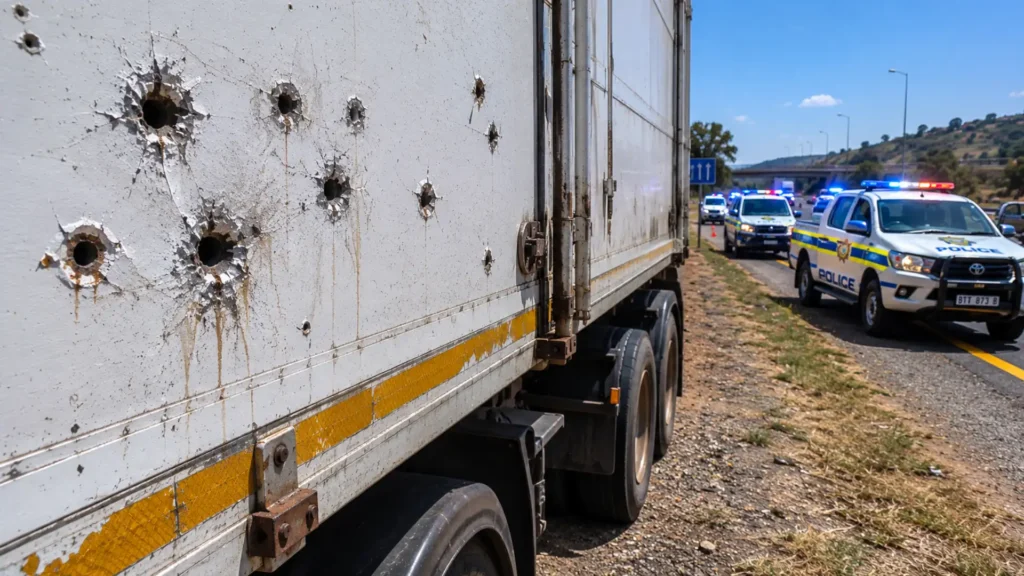
The N3 shutdown aftermath fleet operators now face has escalated from road blockade to armed confrontation. The ATDF-ASA has accused SAPS of firing live rounds during Saturday’s truck protest near Bergville, pointing to bullet holes in at least one truck container as physical evidence. Three people were arrested, including the ATDF-ASA secretary general, for alleged public violence and inciting disruption on the N3 southbound. The ATDF-ASA calls it “an unprovoked escalation of a peaceful industrial action.” SAPS Colonel Robert Netshiunda says officers found people stopping trucks and suspects fled into the bushes. Our yesterday’s report documented 50 trucks stranded and keys stolen. Today’s developments add gunfire, arrests, and a confrontation that has transformed the 30 June threat from a logistics concern into a security crisis.
This is the fourth report in our N3 shutdown aftermath fleet disruption series. It examines the competing accounts of what happened on Saturday, why the arrest of the ATDF-ASA leadership intensifies rather than defuses the 30 June threat, what bullet-damaged trucks mean for fleet insurance and vehicle safety, and what fleet operators must do immediately in response to an escalation that has introduced firearms into the freight corridor protest dynamic.
Two Accounts of What Happened: The N3 Shutdown Aftermath Fleet Operators Must Evaluate
Specifically, the ATDF-ASA interim committee and SAPS have provided sharply conflicting versions of Saturday’s events. Fleet operators cannot rely on either account alone and must plan for the worst case.
The ATDF-ASA account of the N3 shutdown aftermath
First, the ATDF-ASA interim committee issued a formal statement characterising the action as “entirely peaceful” with “absolutely no violence, destruction of property, or intimidation taking place.” They described the demonstration as a standard go-slow where regular traffic continued passing. Crucially, the committee stated that “SAPS officers used live rounds during the demonstration” and pointed to physical evidence: “The physical evidence of this excessive force can be seen directly on the trucks themselves, as one of the truck containers was left with bullet holes from the live rounds fired by SAPS.” The committee demanded a full and transparent investigation into the police’s conduct.
The SAPS account of the N3 shutdown
In contrast, however, Colonel Netshiunda stated that police were conducting routine patrols in the early hours of Saturday morning when they noticed N3 traffic slowing to a standstill near Bergville. Upon investigation, officers discovered approximately 10 people stopping trucks on the N3 southbound. Netshiunda said the suspects fled into the bushes when they noticed the police presence, abandoning a white vehicle. Three individuals were subsequently arrested for alleged public violence and inciting disruption — including a national office bearer whom the ATDF-ASA identified as their secretary general. Importantly, SAPS has not directly addressed the bullet hole allegations in its public statements.
What fleet operators should take from both accounts
Critically, regardless of which account proves accurate, the facts that matter for fleet operations are confirmed by both sides. The N3 was disrupted at 4am on Saturday. People were stopping trucks. Three arrests occurred. Furthermore, the ATDF-ASA has photographic evidence of bullet damage to at least one truck container. Whether SAPS fired the rounds or not, a freight vehicle on SA’s primary corridor now carries bullet holes. For fleet operators, the dispute over who was peaceful and who escalated is secondary to the operational reality: trucks on the N3 faced gunfire and arrests during what both sides describe as a protest about foreign drivers.
Why the Arrest Escalates Rather Than Defuses the N3 Shutdown Aftermath Fleet Threat
Fundamentally, arresting the ATDF-ASA secretary general may seem like decisive law enforcement. In practice, it risks making the 30 June shutdown more intense, not less.
Leadership arrests historically inflame fleet-related truck protests
Historically, South Africa’s history of truck driver protests shows a consistent pattern: arrests and heavy-handed police responses generate solidarity rather than deterrence. The ATDF-ASA interim committee’s statement frames the arrest as persecution of legitimate industrial action. “The arrests occurred after the initial confrontation subsided,” they stated, implying the secretary general was targeted rather than caught in the act. Consequently, this narrative positions the arrested leader as a martyr for the trucking industry’s grievances — strengthening recruitment for the 30 June action rather than weakening it.
The live rounds allegation adds a grievance multiplier
Moreover, if SAPS indeed fired live ammunition at truck drivers during a protest — with bullet holes in truck containers as evidence — the ATDF-ASA now has a new and more powerful grievance to add to their existing demands about foreign drivers. The narrative shifts from “government ignores our concerns about foreign drivers” to “government shoots at us when we protest.” This escalation in rhetoric will drive more drivers toward the 30 June action. Additionally, the combination of the secretary general’s arrest AND allegations of police brutality creates an emotional charge that rational policy engagement cannot match.
The 30 June convergence just became more dangerous for fleet operations
As a result, the ATDF-ASA’s 30 June shutdown now carries three layers of motivation: the original foreign driver grievances (ongoing since 2024), the Madlanga Commission revelations about police corruption (which undermine SAPS credibility), and now the live rounds allegation plus the secretary general’s arrest. March and March adds a fourth layer with its immigration ultimatum on the same date. For fleet operators, the 30 June threat has escalated from a logistics disruption to a potentially violent confrontation between armed police and angry truck drivers — with fleet vehicles, cargo, and drivers caught between them.
Bullet Holes in Trucks: What the N3 Shutdown Aftermath Means for Fleet Insurance and Safety
Specifically, the physical evidence of bullet damage to truck containers introduces a new risk category for fleet operations on the N3 corridor.
Ballistic damage during fleet operations is a new claim category
Traditionally, fleet insurance policies typically cover hijacking, theft, accident damage, fire, and in some cases civil unrest. Bullet damage to a freight vehicle during an industrial protest occupies uncertain territory between civil unrest and armed conflict. Fleet operators whose vehicles were on the N3 near Bergville on Saturday morning should inspect every vehicle for damage immediately. Importantly, any bullet damage must be documented with photographs, GPS route data showing the vehicle’s position at the time, and dashcam footage if available — before the vehicle returns to service and evidence is lost.
Insurance implications for N3 corridor fleet operations
Consequently, if the live rounds allegation stands and courts or investigations confirm that SAPS fired at trucks, insurers will reassess the risk profile of N3 corridor operations. Fleet operators should contact their broker this week and ask specifically: “If my vehicle sustains ballistic damage during a truck driver protest on the N3, does my current policy cover the repair, cargo damage, and business interruption?” Equally important, verify whether the policy requires GPS tracking and dashcam evidence to support such claims — because the evidence window for Saturday’s incident is closing.
Driver safety protocol must now account for firearms
Most urgently, yesterday’s driver briefing covered blockade avoidance, key theft prevention, and confrontation de-escalation. Today’s N3 shutdown aftermath adds firearms to the threat profile. Fleet operators must update driver protocols: if drivers hear gunfire, stop the vehicle immediately and take cover below the dashboard. Do not exit the vehicle under any circumstances. Contact the control room via panic button. Do not attempt to drive through an active shooting situation. This is no longer a protest avoidance protocol — it is a survival protocol.
The SAPS Credibility Gap: How the N3 Shutdown Aftermath Compounds Fleet Security Concerns
Furthermore, the live rounds allegation lands in the worst possible institutional context for SAPS.
Notably, 18 senior SAPS officers remain suspended from the Madlanga Commission. Crime Intelligence chief Khan was arrested for precious metals corruption. The Gauteng Hawks head was arrested alongside him. The Madlanga Commission heard testimony about cocaine in truck containers and police officers loading drugs onto a bakkie. SAPS spokesman Brigadier Mathe — the same spokesperson who confirmed the N3 arrests — is the same official who confirmed the Khan and Kadwa arrests.
Accordingly, for fleet operators, the credibility gap is acute. When the ATDF-ASA alleges excessive force and SAPS denies it, the Madlanga Commission evidence about police corruption, missing cocaine, and fabricated operations makes it harder to accept the police account at face value. Simultaneously, the Human Rights Watch report documented police failure to protect foreign nationals — and in some cases, police aiding attackers. The pattern of SAPS misconduct documented across our reporting creates a context in which the ATDF-ASA’s excessive force allegation is not implausible.
Updated 30 June Contingency: What Fleet Operators Must Add to Their Plans After the N3 Shutdown Aftermath
The 34-day contingency plan published on 28 May remains valid. Saturday’s events add four urgent additions.
Add firearms protocol to every fleet driver briefing
Brief every driver this week on the updated threat profile. The N3 corridor now carries a confirmed firearms risk during protests. Drivers must know: stop immediately if you hear gunfire, stay below the dashboard, do not exit the vehicle, activate the panic button, and wait for the control room to direct your next action. Furthermore, ensure all vehicles on the N3 corridor carry a first aid kit rated for traumatic injury, not just the standard kit for minor incidents.
Verify insurance covers ballistic damage from fleet protest action
Contact your broker by Wednesday. Ask the specific question: does the policy cover bullet damage to vehicles and cargo during an industrial protest? If the answer is no, request a civil unrest endorsement that explicitly includes ballistic damage. The cost of the endorsement is a fraction of the cost of a rejected claim for a bullet-damaged truck and destroyed cargo. Do not wait until after 30 June to discover the gap.
Ensure dashcam footage captures any fleet confrontation
Confirm AI dashcams upload to the cloud on every N3 vehicle. If a fleet vehicle sustains bullet damage, the dashcam footage — combined with GPS position data — proves the vehicle was not participating in the protest. This evidence distinguishes “innocent vehicle caught in crossfire” from “protest participant” in the eyes of both insurers and law enforcement. Cloud upload ensures footage survives even if the camera or vehicle is damaged.
Monitor ATDF-ASA communications weekly until 30 June
Track the organisation’s statements and social media channels. The secretary general’s arrest will generate responses — potentially escalating or moderating the 30 June plans. Every statement changes the risk assessment. Fleet operators who monitor the ATDF-ASA’s public communications in real time make better routing decisions than those who rely on mainstream news reports published hours later.
Technology Response to the N3 Shutdown Aftermath Fleet Security Escalation
Saturday’s events demonstrated that fleet technology capabilities matter more than ever on the N3 corridor — and the requirements have escalated.
DigitFMS integrates GPS tracking with geofencing, AI dashcams with cloud upload, wireless driver identification, panic button activation, and autonomous vehicle defence on a single dashboard. When a vehicle enters a geofenced protest zone, both driver and control room receive instant alerts — preventing the vehicle from entering a situation where firearms may be present. Accordingly, if a confrontation occurs, dashcam footage uploads in real time. The panic button connects the driver directly to the control room and armed response coordination. The company’s 100+ franchise branches include KZN operators who understand the N3 corridor dynamics and can provide local intelligence on protest activity.
Cartrack, Tracker, Netstar, Ctrack, and MiX by Powerfleet all offer real-time tracking and geofencing. The critical requirement after Saturday’s N3 shutdown aftermath is that the platform provides panic button capability and cloud-based dashcam storage that survives vehicle damage — including ballistic damage. A dashcam that records locally but loses footage when the vehicle is damaged provides no evidence. A cloud-connected dashcam that uploads continuously preserves the evidence regardless.
Outlook: The N3 Shutdown Aftermath Fleet Security Environment Has Permanently Changed
Looking ahead, before Saturday, the truck driver protest threat involved road blockades, key theft, and delivery delays. After Saturday, it involves alleged gunfire, bullet-damaged vehicles, and arrested leadership. The escalation is qualitative, not just quantitative. Fleet operators on the N3 corridor now face a fundamentally different risk profile than they faced on Friday.
Similarly, the 30 June nationwide shutdown — already the most serious fleet logistics threat of 2026 — has absorbed additional momentum from the arrest and the live rounds allegation. The ATDF-ASA will frame both as justification for intensified action. March and March adds the immigration ultimatum on the same date. The full R3.93 diesel levy returns the following day. Nevertheless, the SAPS leadership remains in crisis with 18 officers suspended. Fleet operators enter June facing a convergence of cost, security, and operational threats that has no precedent in South Africa’s democratic history.
Ultimately, the N3 shutdown aftermath fleet security lesson is that the threat is no longer theoretical. Trucks have bullet holes. Leaders are arrested. Both sides are escalating. In 30 days, the same confrontation plays out on a national scale. Fleet operators who upgrade their driver protocols, verify their insurance, confirm their dashcam cloud upload, and geofence every affected corridor this week will navigate whatever 30 June brings with their drivers safe, their vehicles tracked, and their evidence preserved. Fleet operators who dismiss Saturday as “just a KZN thing” will face the same surprise on 30 June — except on every major corridor simultaneously, with no time to prepare and no evidence to claim.
Frequently Asked Questions
Did SAPS fire live rounds at trucks during the N3 shutdown?
ATDF-ASA alleges SAPS used live ammunition and points to bullet holes in at least one truck container as evidence. SAPS Colonel Netshiunda says officers found people stopping trucks and suspects fled. SAPS has not directly addressed the bullet hole allegations. Fleet operators should treat the firearms risk as confirmed regardless of which account prevails.
Who was arrested during the N3 shutdown aftermath?
Three individuals were arrested for public violence and inciting disruption near Bergville. ATDF-ASA identifies one as their secretary general. The organisation claims arrests happened after the confrontation subsided and characterises them as persecution of legitimate protest. SAPS says suspects were found stopping trucks at 4am.
How does the arrest escalate the 30 June fleet threat?
Arresting the leadership of the organisation planning the 30 June shutdown risks inflaming rather than calming. ATDF-ASA frames the arrest as persecution — strengthening recruitment. The live rounds allegation adds a powerful new grievance. Historical precedent shows heavy-handed responses escalate truck protests. The 30 June action now carries three layers of motivation plus the arrest and shooting allegations.
What do ATDF-ASA and SAPS each say happened?
ATDF-ASA: “Entirely peaceful. No violence. Standard go-slow. SAPS fired live rounds. Bullet holes in containers.” SAPS: “Found 10 people stopping trucks. Suspects fled. Three arrested for public violence.” The competing accounts mean fleet operators should plan for worst case regardless. Trucks carry bullet holes — that fact is undisputed.
What evidence exists of excessive force during the N3 shutdown?
ATDF-ASA points to bullet holes in truck containers as physical evidence. No video footage has been publicly released by either side. SAPS has not addressed the bullet allegations. For fleet operators, the presence of bullet-damaged trucks on SA’s primary freight corridor represents a new vehicle damage risk regardless of who fired.
What should fleet operators do now?
Inspect any vehicles that were on the N3 near Bergville Saturday. Document damage with photos and GPS data. Verify insurance covers ballistic damage during protest. Add firearms protocol to driver briefings: stop if gunfire heard, stay below dashboard, panic button, do not exit. Ensure dashcams upload to cloud. Monitor ATDF-ASA communications weekly until 30 June.
Could the live rounds allegation affect fleet insurance?
If confirmed, insurers may reassess N3 corridor risk profiles. Bullet damage during industrial protest sits between civil unrest and armed conflict coverage. Contact your broker this week and ask whether your policy covers ballistic damage during protests. Dashcam footage and GPS data proving the vehicle was caught in crossfire — not participating — strengthens any claim.
Sources
African News Agency — “ATDF-ASA condemns police actions amid secretary general’s arrest”, 30 May 2026; bullet holes in containers, “entirely peaceful” statement, Colonel Netshiunda account, three arrested for public violence · IOL — “ATDF-ASA demands accountability from SAPS after alleging excessive force”, 31 May 2026; live rounds allegation, interim committee statement · IOL — “KZN police issue warning over upcoming trucking protest”, 29 May 2026; Major General Makoba, 4,722 arrests
Daily Maverick / MSN — “Road Traffic Inspectorate brings in tow trucks to disperse N3 protest”, 30 May 2026; 50 trucks stranded, keys stolen, RFA Gavin Kelly “held hostage” · The Herald — “KZN police warn of stern action”, 29 May 2026; Makoba SAPS statement · The Witness — “KZN braces for truckers’ shutdown”, 29 May 2026; Sokhela below-minimum wages · SA Trucker — “ATDF-ASA backs national shutdown”, 26 May 2026; 20 May memorandum, 30 June confirmed · DigitFMS — N3 shutdown report (30 May), 30 June contingency plan (28 May), SAPS corruption analysis (12 May), Madlanga Commission (14 May), HRW report (20 May)
© 2026 DigitFMS. All rights reserved.