
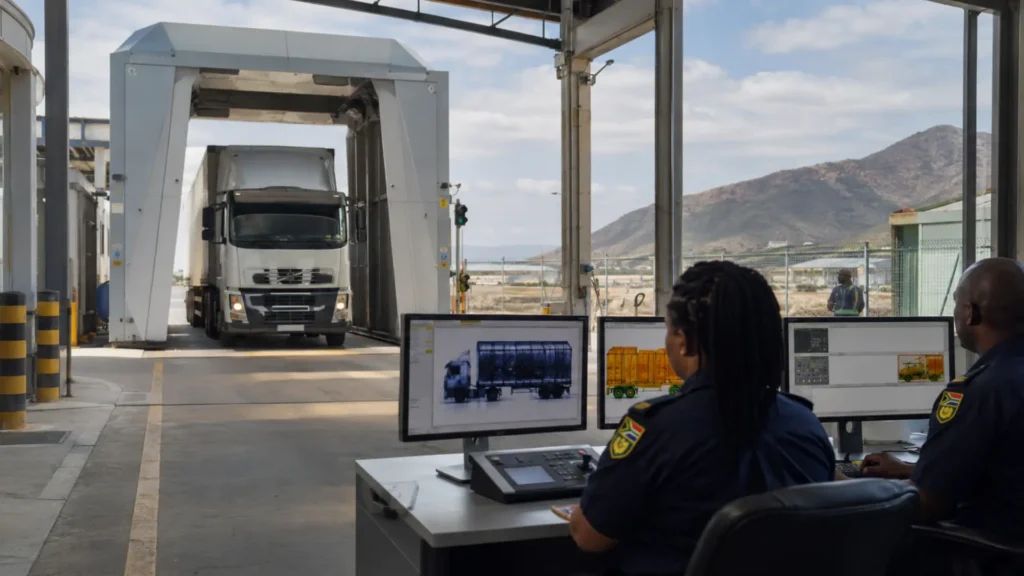
Border security fleet technology just produced South Africa’s largest drug interception in history — and the lesson for fleet operators is hiding in plain sight. On 27 May, BMA border guards spent eight hours dismantling a truck at the Beitbridge Port of Entry after intelligence systems flagged the vehicle travelling from Malawi through Zimbabwe. Inside a custom-built hidden compartment, they found 713 kilograms of methaqualone — street value R1 billion. Three Malawians arrested. Home Affairs Minister Schreiber stated: “This singular breakthrough vividly demonstrates our investment in intelligence-driven work, modern technology, digital transformation.” The cargo scanner detected what human eyes could not see. Intelligence flagged what human memory could not track. Technology caught R1 billion in drugs that would otherwise have entered South Africa inside a truck — the same type of vehicle fleet operators dispatch every day.
This analysis examines how the Beitbridge border security fleet technology operation worked, why it mirrors the same principles fleet management platforms use, how it contrasts with the Madlanga Commission failures where drugs moved through trucks undetected, and what the BMA’s new 24/7 N1 roadblocks mean for fleet operations on the northern corridors.
How It Worked: The Border Security Fleet Technology That Caught R1 Billion in Drugs
Specifically, the Beitbridge operation followed a four-stage process that reads like a textbook for intelligence-led fleet security.
Stage 1: Intelligence-led route monitoring — border security tracking the truck
IOL confirmed that intelligence officials flagged the truck as it travelled from Malawi through Zimbabwe to South Africa. The National Border Targeting Centre — a multi-agency intelligence hub — monitored the vehicle’s route before it reached the port of entry. Crucially, the detection did not begin at the border. It began hundreds of kilometres away, when the truck’s route, origin, and cargo profile triggered an alert in the intelligence system. For fleet operators, this mirrors exactly how GPS tracking with geofencing works: a vehicle’s route is monitored continuously, and deviations from expected patterns trigger alerts before the vehicle reaches its destination.
Stage 2: Cargo scanning — fleet technology detecting hidden anomalies
Subsequently, when the truck arrived at Beitbridge, officials directed it through the cargo scanner for a non-intrusive X-ray inspection. The technological arsenal included sophisticated SARS scanners that confirmed the presence of the hidden compartment. The scanner detected material inside the vehicle that the exterior inspection could not reveal. Furthermore, this parallels fleet fuel monitoring: a litre-level sensor detects fuel drainage events invisible to the driver or depot manager. A dashcam captures incidents the fleet manager cannot physically witness. Technology sees what humans miss — whether the concealed item is methaqualone in a hidden compartment or diesel being siphoned from a tank overnight.
Stage 3: Physical verification — confirming what border security technology flagged
Consequently, after the scanner detected the anomaly, border officials spent eight hours physically dismantling sections of the truck to locate the concealed cargo. They eventually uncovered a custom-built hidden compartment containing the methaqualone. The SAPS K-9 Unit and Hawks were called in to confirm the substance. Importantly, the eight-hour physical search was triggered by technology — not by a tip-off or a lucky guess. Without the scanner, the compartment would not have been found. For fleet operators, the equivalent is investigating a fuel monitoring alert: the technology detects the anomaly, the fleet manager investigates, and the investigation confirms whether the alert represents theft, a mechanical fault, or a false positive.
Stage 4: Multi-agency coordination — integrated fleet security response
BMA Commissioner Dr Michael Masiapato confirmed that the authority acts as a “multidisciplinary hub, coordinating with over 10 government departments to secure the border ecosystem.” The operation involved the BMA, SAPS, Hawks, K-9 Unit, SARS scanners, and Crime Intelligence — all coordinated through a single command structure. Accordingly, this mirrors the integrated fleet management platform philosophy: GPS tracking, dashcams, fuel monitoring, driver ID, and geofencing all coordinating through a single dashboard. Consequently, fragmented systems miss connections. Integrated systems catch them.
The Contrast: Why Border Security Fleet Technology Succeeded at Beitbridge and Failed at Durban
Importantly, the Beitbridge bust invites direct comparison with the Madlanga Commission testimony about cocaine moving through Durban Harbour — and the contrast reveals precisely why technology matters.
Beitbridge: technology and integrity produced a R1B interception
First, at Beitbridge, intelligence tracked the truck’s route. A scanner detected the hidden compartment. Officials spent eight hours searching. The Hawks confirmed the seizure. Three arrests followed. R1 billion in drugs stayed out of the country. The system worked because every component — intelligence, scanning, physical search, prosecution — functioned as designed. Minister Schreiber described it as demonstrating “a new organisational culture exemplified by BMA personnel.”
Durban: corruption defeated the border security system
In contrast, however, the Madlanga Commission heard that 999kg of cocaine worth R300 million entered South Africa through Durban Harbour in truck containers carrying Scania parts. Colonel Steyn testified that 4,000+ containers enter Durban daily and authorities cannot search them all. Moreover, duplicate container seals masked the tampering. When the cocaine was eventually discovered at Scania’s Aeroton warehouse, Crime Intelligence chief Khan allegedly ordered the K9 unit to stop searching. Shockingly, officers allegedly loaded cocaine onto a bakkie to drive away. R55 million subsequently disappeared from police custody. Detecting the drugs was technically possible. Acting on the detection required institutional integrity that did not exist.
The lesson for fleet operators: border security technology only works with integrity
Consequently, the Beitbridge-versus-Durban contrast teaches fleet operators the same lesson their own operations demonstrate daily. A GPS tracker only protects a vehicle if the control room responds to the alert. A dashcam only provides evidence if the footage is preserved and acted upon. Fuel monitoring only prevents theft if the fleet manager investigates every anomaly. The technology is necessary but not sufficient. The institutional commitment to act on what the technology reveals determines whether R1 billion in drugs is intercepted at the border or R55 million disappears from police custody.
24/7 N1 Roadblocks: What the Border Security Fleet Technology Crackdown Means for Operations
Additionally, the Beitbridge bust triggered immediate operational changes that affect every fleet vehicle on the northern corridors.
Permanent roadblocks on the N1 affect fleet routing
Cape Town Etc confirmed that the BMA deployed 24/7 roadblocks on the N1 following the seizure. Fleet vehicles travelling toward Limpopo, the Beitbridge border, or the Zimbabwean and Mozambican corridors should expect stop-and-search delays at multiple checkpoints. Additionally, the BMA announced enhanced inspections at all major ports of entry. For fleet operators, this means longer transit times, potential cargo inspections, and the need for every driver to carry complete, current documentation.
Documentation readiness determines fleet delay times
Crucially, vehicles with proper documentation — cargo manifests, delivery notes, driver identification, and vehicle registration — clear roadblock inspections in minutes. Vehicles with incomplete paperwork face extended searches. For fleet operators, the lesson is straightforward: ensure every driver carries a complete documentation pack before departing on any northern corridor route. GPS tracking data showing a consistent, legitimate route history strengthens the fleet operator’s profile with authorities — demonstrating that the vehicle operates on approved routes rather than suspicious patterns.
The Beitbridge corridor connects to the Kruger Park fleet risk
Notably, the N1 through Limpopo to Beitbridge runs through the same region where Ernst and Dina Marais were murdered in Kruger Park and their vehicle driven into Mozambique. The Beitbridge port and the Kruger border share the same geographic corridor. Drug trafficking, vehicle hijacking, and cross-border vehicle crime all converge on the same stretch of Limpopo. Fleet operators on the N1 north of Polokwane now face three simultaneous risks: drug trafficking inspection delays (new), cross-border hijacking (ongoing), and the 30 June shutdown threat that targets all major corridors including the N1.
Woolworths Store Bombings Add a New Border Security Fleet Technology Dimension
Meanwhile, in the same week as the Beitbridge bust, a separate security threat emerged that affects fleet delivery operations directly.
Two IEDs in 24 hours at delivery destinations
EWN reports that improvised explosive devices detonated at Woolworths stores in Menlyn Park (Pretoria, 28 May) and Preller Square (Bloemfontein, 29 May) — both between 1am and 2am while stores were closed. No injuries occurred. Acting Commissioner Dimpane deployed a National Forensic Task Team. ISS explosives expert Willem Els warned the incidents bore “hallmarks of a possible extortion campaign.” The U.S. Embassy issued a security alert advising citizens to avoid Menlyn Mall. In response, Woolworths has heightened security at all stores nationally.
What retail IEDs mean for fleet delivery operations
Furthermore, for fleet operators delivering to shopping centres and retail locations, the Woolworths bombings introduce a new risk at the delivery destination rather than on the road. Drivers delivering to Menlyn Park or Preller Square in the days after the explosions encountered heightened security, restricted access, and potential store closures that disrupted delivery schedules. Furthermore, if the extortion campaign targets additional retailers, fleet operators serving the retail supply chain face unpredictable delivery point closures. AI dashcam footage of delivery conditions — including any security incidents at delivery points — provides documentation for insurance and client communication if deliveries cannot be completed.
The Four Principles: How Border Security Fleet Technology Translates to Fleet Management
Clearly, the Beitbridge operation used four principles that every fleet operator should recognise — because they are the same principles driving integrated fleet management platforms.
Principle 1: Monitor routes continuously for fleet security
Notably, the BMA tracked the truck’s route from Malawi through Zimbabwe before it reached the border. Similarly, GPS tracking with geofencing monitors every fleet vehicle’s route continuously. A vehicle that deviates from its approved route — whether it is a drug truck heading for an unofficial crossing or a fleet vehicle making an unauthorised stop — triggers an alert before the deviation becomes a completed crime.
Principle 2: Detect anomalies automatically with fleet technology
The cargo scanner detected concealed material that visual inspection could not reveal. In the same way, fuel monitoring detects consumption anomalies invisible to the driver or depot manager. A tank that drains 200 litres overnight while the vehicle is parked triggers an alert. A vehicle that consumes 30% more fuel than its baseline flags for investigation. The sensor sees what human observation misses.
Principle 3: Investigate every alert — border security demands action
Third, BMA officials spent eight hours dismantling the truck after the scanner flagged the anomaly. They did not dismiss the alert or defer the investigation — instead, officials acted immediately and thoroughly. Similarly, fleet operators must apply the same discipline: every fuel anomaly, every route deviation, every unauthorised stop deserves investigation. The Madlanga testimony showed what happens when police dismiss or suppress alerts — R55 million in cocaine disappears. The Beitbridge bust showed what happens when authorities act on them — R1 billion in drugs stays out of the country.
Principle 4: Integrate systems on a single platform for fleet security
Finally, the BMA coordinated 10+ government departments through a single command structure. Intelligence, scanning, K-9, Hawks, and SARS all fed into one operation. Fragmented responses — where each agency works independently — miss the connections that integrated responses catch. For fleet operators, the same principle applies: GPS tracking, dashcams, fuel monitoring, driver ID, and geofencing coordinated through a single dashboard catch patterns that separate systems miss. A fuel anomaly combined with a route deviation combined with an unidentified driver is a theft in progress — but only an integrated platform sees all three simultaneously.
Who Provides the Integrated Border Security Fleet Technology Principles for Commercial Operations
In essence, the same intelligence-led, technology-driven, integrated approach that caught R1 billion at Beitbridge is available to every fleet operator in South Africa.
DigitFMS integrates GPS tracking with geofencing (route monitoring), D-Fuel litre-level sensors (anomaly detection), AI dashcams with cloud upload (evidence capture), wireless driver identification (personnel verification), and autonomous vehicle defence (immediate response) on a single dashboard. The philosophy is identical to the BMA’s approach: monitor continuously, detect anomalies automatically, investigate immediately, and preserve evidence for prosecution. The company’s 100+ franchise branches include operators in Limpopo and Mpumalanga — the provinces where the N1 roadblocks and Beitbridge corridor create the most direct operational impact.
Equally, Cartrack reports a 24% decrease in fuel costs through integrated monitoring. Tracker’s SVR network delivered 3,671 recoveries in H1 2025. Netstar and MiX by Powerfleet serve enterprise fleets with multi-layered security platforms. Every provider’s technology applies the same four principles the BMA demonstrated at Beitbridge: monitor, detect, investigate, coordinate. The scale differs — border posts versus fleet depots — but the principles are identical.
Outlook: Border Security Fleet Technology Sets the Standard for Every Security System
Looking ahead, the Beitbridge bust is the most positive security story in South Africa this year. R1 billion in drugs intercepted before entering the country. Technology worked. Intelligence worked. Institutional integrity worked. Three arrests followed. The system did what it was designed to do.
Nevertheless, for fleet operators, the timing is significant. This story arrives in a week where the N3 was blockaded by protesting truck drivers, SAPS allegedly fired live rounds at trucks, the ATDF-ASA secretary general was arrested, the SARB hiked rates, and the diesel levy rises tomorrow. Against this backdrop of crisis, the Beitbridge bust demonstrates that technology-led security produces results — when the people operating the technology act on what it reveals.
Ultimately, border security fleet technology at Beitbridge caught R1 billion in drugs because the system monitored a truck’s route from another country, detected a hidden compartment through scanning, spent eight hours verifying the find, and coordinated multiple agencies through a single command structure. Every fleet operator in South Africa has access to the same principles through commercial fleet management platforms: route monitoring, anomaly detection, evidence capture, and integrated response. In truth, the question is not whether the technology exists. It does. The question is whether fleet operators deploy it — and whether they act on what it reveals. Beitbridge answered that question for the border. Fleet operators must answer it for their own operations.
Frequently Asked Questions
What did the BMA find at Beitbridge using border security technology?
Officials found 713kg of methaqualone (mandrax precursor) worth R1 billion in a custom-built hidden compartment inside a truck from Malawi. Intelligence tracked the truck’s route. Cargo scanners detected the hidden material. Eight hours of physical search confirmed the find. Three Malawians arrested. SA’s largest border drug interception ever.
How did border security fleet technology detect the drugs?
Four stages: intelligence-led route monitoring flagged the truck from Malawi. Cargo scanners detected concealed material. Eight hours of physical dismantling located the compartment. K-9 Unit and Hawks confirmed the substance. The scanner detected what visual inspection could not reveal — proving technology catches what human eyes miss.
How does Beitbridge compare to the Madlanga cocaine cases?
Same method (drugs in truck compartments), opposite outcome. At Durban, 999kg of cocaine moved through undetected — Khan allegedly halted the K9 search, R55M disappeared from custody. At Beitbridge, 713kg of methaqualone was caught by technology and institutional integrity. The difference: technology that works plus officials who act on what it reveals.
How do N1 roadblocks affect fleet operations?
The BMA deployed 24/7 roadblocks on the N1 following the bust. Fleet vehicles heading north face stop-and-search delays. Complete documentation (manifests, driver ID, registration) clears inspections quickly. Incomplete paperwork triggers extended searches. GPS route history showing legitimate patterns strengthens the fleet operator’s profile with authorities.
What border security principles apply to fleet management?
Four principles translate directly: route monitoring (GPS with geofencing), anomaly detection (fuel sensors, scanners), immediate investigation (acting on alerts), and multi-agency coordination (integrated dashboards). The same philosophy that caught R1B in drugs protects fleet assets from hijacking, theft, and cargo tampering.
What happened with the Woolworths explosions?
IEDs detonated at Menlyn Park (28 May) and Preller Square Bloemfontein (29 May) between 1-2am. No injuries. National Forensic Task Team deployed. ISS expert says “hallmarks of extortion campaign.” U.S. Embassy issued security alert. Fleet operators delivering to retail locations face heightened security and potential access disruptions at delivery points.
What should fleet operators learn from the Beitbridge bust?
Technology catches what human observation misses. The BMA monitored a route, detected an anomaly, investigated thoroughly, and coordinated across agencies. Fleet operators apply the same approach through GPS tracking, fuel monitoring, dashcams, and driver ID — all on one dashboard. The principle is identical: monitor, detect, investigate, preserve evidence.
Sources
NOW in SA — “Beitbridge drug bust: BMA seizes R1bn methaqualone”, 28 May 2026; timeline, 8-hour search, custom compartment, three arrested · IOL — “BMA intercepts R1 billion drug haul at Beitbridge border”, 28 May 2026; Commissioner Masiapato quotes, intelligence-led targeting · IOL — “Explosives expert warns of potential extortion behind Woolworths bombings”, 30 May 2026; Willem Els ISS, Menlyn + Bloemfontein
African News Agency — “How a significant drug bust at Beitbridge showcases border reform achievements”, 30 May 2026; Schreiber quotes, SARS scanners, National Border Targeting Centre · Freight News — “Beitbridge bust linked to border investment”, 30 May 2026; Masiapato briefing, 10+ departments coordinating · Cape Town Etc — “24/7 roadblocks on N1 as Beitbridge crackdown intensifies”, 30 May 2026; permanent checkpoints · Politicsweb / DA — “Unprecedented R1bn drug bust”, 28 May 2026; Adrian Roos, 24% reduction in illegal crossings, 600,000 deportations
CAJ News Africa — “Border drones boost crime fight”, 29 May 2026; surveillance technology, drone deployment · Swisher Post — “SAPS investigates Woolworths explosions”, 30 May 2026; coordinated targeting pattern · EWN — “National Forensic Task Team deployed to investigate Woolworths explosions”, 30 May 2026; Dimpane, Mathe statements · U.S. Embassy Pretoria — “Security Alert: Woolworths at Menlyn Mall”, 28 May 2026 · DigitFMS — Madlanga Commission analysis (14 May), cross-border tracking (25 May), N3 shutdown aftermath (31 May)
© 2026 DigitFMS. All rights reserved.