
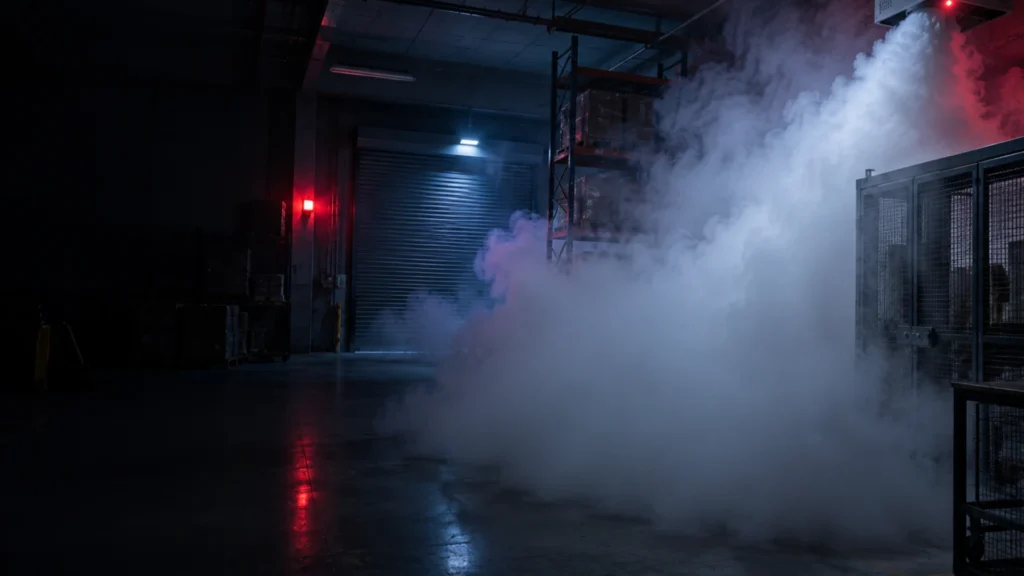
Pepper spray security system enquiries in South Africa almost always arrive with a second question attached: is it actually legal to fill a building with chilli fog when someone breaks in?
The honest answer needs more than a yes. No South African statute names fixed pepper fog systems, so their legality comes from general law instead. Four pieces matter most: the Dangerous Weapons Act, the common-law rules on private defence, the Private Security Industry Regulation Act and the Occupational Health and Safety Act.
Read together, those four draw a clear line. On one side sits a proportionate, verified deterrent. On the other sits an indiscriminate trap that exposes the owner to criminal and civil risk. This article explains where that line falls. It is general information, however, not legal advice for a specific site.
Direct Answer: Is a Pepper Spray Security System Legal in South Africa?
Yes, with conditions. No South African law prohibits a fixed pepper spray security system, and no law names one either. Legality therefore rests on private defence: the system must respond only to an unlawful intrusion, cause temporary rather than serious harm, and stay proportionate. A PSIRA-registered installer and an OHS risk assessment complete the picture.
What Does the Dangerous Weapons Act Say About Pepper Spray?
The Dangerous Weapons Act 15 of 2013 defines a dangerous weapon as any object other than a firearm that can cause death or serious bodily harm if someone uses it for an unlawful purpose. Section 3 then makes it an offence to possess such an object in circumstances that suggest an intention to use it unlawfully.
Notably, the Act never mentions pepper spray, oleoresin capsicum (OC) or irritant fog. Instead, the test turns on intent and circumstances rather than on the object itself. A court weighs the place, the time, the person’s behaviour and any explanation offered.
That is why South Africans can carry a pepper spray canister for self-defence without a licence, as PGPS Attorneys point out. Similarly, an OC canister mounted inside a monitored alarm system that protects a warehouse sits far from the conduct the Act targets. The Act is not where the real limit lies.
Private Defence Sets the Real Limit
South African common law allows a person to defend property against an unlawful attack. According to a De Rebus analysis of private defence, the attack must be unlawful and underway or imminent. The defensive act must also be directed at the attacker, necessary, and reasonably proportionate.
Automated devices test those rules hardest because nobody decides in the moment. In the 1967 case of S v Van Wyk, a shopkeeper’s shotgun trap killed an intruder. The Appellate Division held that lethal force to protect property is justifiable only in exceptional circumstances, as the Institute for Security Studies explains.
Legal commentators now warn that Van Wyk predates the Constitution. In a February 2026 IOL report, one expert described indiscriminate devices and traps as fraught with legal risk. The lesson for any active defence system is plain: lethal or indiscriminate means fail, while temporary, targeted and verified means stand on firmer ground.
What makes a pepper spray security system defensible
A defensible automated deterrent shares six traits. It:
- Responds only to a detected, unauthorised intrusion
- Causes temporary discomfort, never serious injury
- Never traps anyone inside a room or passage
- Fires on a verified trigger, not on any movement
- Stays disarmed while authorised people work on site
- Carries documented testing and clear signage
Warning signage is widely recommended in international fogging codes of practice, although no South African law requires it. In practice, signage also supports the argument that the system aims to deter rather than to injure.
Why a Pepper Spray Security System Needs a PSIRA-Registered Installer
The Private Security Industry Regulation Act 56 of 2001 defines a security service to include installing, servicing or repairing security equipment, and security equipment includes alarm systems. Section 20 then prohibits anyone from rendering a security service for reward without registering with PSIRA.
Responsibility does not stop with the installer, either. Under section 38, a client who knowingly or carelessly contracts an unregistered provider also commits an offence. For that reason, PSIRA advises clients to ask for a letter of good standing before signing anything.
What Does the OHS Act Require When Staff Work On Site?
Businesses face a second duty that homeowners do not. Section 8 of the Occupational Health and Safety Act 85 of 1993 requires every employer to keep the workplace safe and without risk to health. It also requires employers to identify hazards and to give staff information, training and supervision.
Section 9 extends that duty to people who are not employees but are directly affected. That group includes contractors, technicians and emergency crews who may enter a protected room after an activation.
South Africa already has a cautionary example. In 2009, a pepper-spray device fitted to an Absa ATM in Fish Hoek went off during maintenance, and three technicians needed paramedics, as the Mail & Guardian reported. The device did exactly what it was built to do; the procedure around it failed.
Pepper Fog vs Security Fog: Why the Difference Matters
Security fog and pepper fog are not the same product. The European standard EN 50131-8 covers security fog devices that obscure a space with non-toxic fog and must not harm people. An OC formulation adds a deliberate irritant, so it falls outside what that standard was written for.
DigitFMS supplies both options through the Digit D-Pepper range. According to DigitFMS product information, the pure fog option carries CE approval and certification to EN 50131-8, while the pepper formulation adds the irritant for higher-risk spaces. Choosing between them is therefore a risk decision, not a preference.
- Occupied shops and offices: pure fog is usually the safer default
- Cash rooms and safes after hours: pepper fog adds real deterrence
- Remote pump rooms and cell towers: pepper fog suits unmanned sites
- Warehouses with night shifts: zone the system around staff areas
- Homes with children or pets: pure fog avoids irritant exposure
How Should a Compliant Pepper Spray Security System Be Set Up?
A compliant installation starts with paperwork and ends with procedure. The checklist below reflects the legal duties above and the lessons from past incidents.
- Confirm the installer’s PSIRA registration and letter of good standing
- Complete a written risk assessment covering staff, visitors and contractors
- Keep every unit away from escape routes and fire exits
- Link activation to a verified trigger rather than a single detector
- Set clear arming schedules that match working hours
- Isolate the system before any maintenance or cleaning
- Tell your insurer in writing and keep the correspondence
- Keep the manufacturer’s safety data sheet on file
Verification deserves special attention because it answers the proportionality question directly. When the D-Pepper system links to DigitFMS off-site monitoring, AI analytics first flag the activity and a trained operator then confirms a real intrusion before deployment. As a result, a person rather than a stray movement authorises the response.
Find out if a pepper spray security system suits your site
A DigitFMS specialist will assess layout, occupancy and escape routes before recommending pepper or pure fog.
Book an Active Defence Assessment →Conclusion
A pepper spray security system is lawful in South Africa when it behaves like private defence rather than like a trap. That means a real, unlawful intrusion, a temporary and non-lethal effect, and a response that stays proportionate to the threat.
Most of the legal risk sits in design and procedure, not in the chemistry. Consequently, the questions worth asking before installation are practical ones: who can trigger it, who might be inside, how staff and contractors stay safe, and whether a registered professional installs it.
Answer those questions well and active defence becomes a defensible layer of protection. Answer them badly, and even a non-lethal device can become a liability.
Frequently Asked Questions
Yes. The Dangerous Weapons Act 15 of 2013 does not name pepper spray. It targets possession of a dangerous object in circumstances that suggest an intention to use it unlawfully. Carrying a canister for self-defence therefore does not require a licence or permit.
Liability turns on the private-defence test: an unlawful attack, and a necessary, proportionate response. A verified, non-lethal system with no trapping effect stands on much firmer ground than an indiscriminate device. Take legal advice for your specific site.
Yes. The PSIRA Act defines installing, servicing or repairing security equipment such as alarm systems as a security service. Section 20 requires registration, and a client who knowingly or carelessly uses an unregistered provider also commits an offence.
OC fog causes temporary irritation rather than lasting harm when correctly installed, but staff must never be exposed by accident. Employers should cover the system in their OHS risk assessment, train staff and isolate it before any maintenance.
Security fog obscures a space with non-toxic fog and falls under the European standard EN 50131-8. Pepper fog adds an oleoresin capsicum irritant, so intruders struggle to see and to stay. Pure fog suits occupied spaces; pepper fog suits high-risk, unmanned areas.
Yes. Disclose the system to your insurer or broker in writing before it goes live. Disclosure avoids disputes after a claim, and the insurer can confirm whether the installation affects your cover or conditions.