
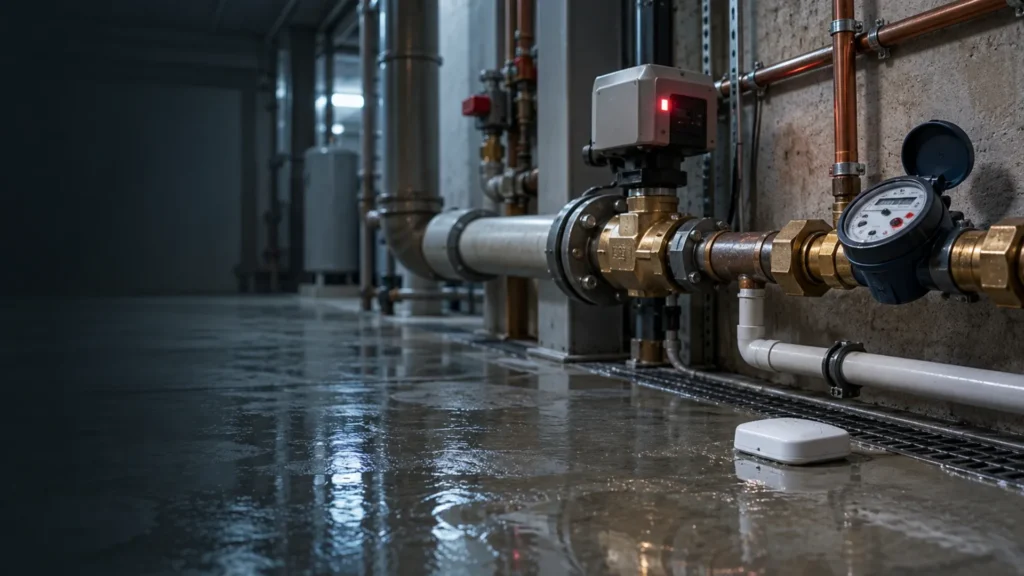
Commercial water leak detection matters more in South Africa than most property managers assume, because every litre that escapes on the private side of the meter is billed at business tariffs.
Office parks, factories, schools and retail centres rarely lose water dramatically. Instead, a urinal cistern runs all night, an irrigation line cracks under paving, or a cooling-tower float valve sticks open. The meter records every litre, yet nobody notices until the account arrives.
This guide explains who carries the cost, how to test a building for hidden leaks, and which detection technology fits which risk.
Direct Answer: What Is Commercial Water Leak Detection?
Commercial water leak detection combines meter monitoring, point-of-leak sensors and automatic shut-off valves to find water loss on a business property before it reaches the municipal account. It covers visible bursts as well as hidden leaks under floors, inside walls and underground. Crucially, it alerts the right person the moment water moves unexpectedly.
Who Pays for a Leak on a Commercial Property?
The property owner pays. The City of Cape Town’s water by-law guide states that owners must repair faulty pipes or leaks on their property as soon as they become aware of the water loss. It also advises owners to check their meter for movement regularly.
Municipal relief for businesses is thin. Cape Town’s 2026/27 tariff policy offers a rebate on hidden underground leaks for some customers. Yet the same policy states that rebates will not apply to industrial, commercial and miscellaneous categories. Schools, religious institutions and charities do qualify, provided they meet the policy’s conditions.
Elsewhere, relief depends on discretion. Ekurhuleni’s 2025/26 water tariff schedule allows a reduced rate on excess water from a private pipeline leak for up to 91 days. However, that relief sits at a divisional head’s discretion and requires proof of repair. In other words, most businesses should plan as if no rebate exists.
What a Hidden Leak Costs at Business Tariffs
Business tariffs make small leaks expensive quickly. Johannesburg’s approved 2025/26 tariffs charged industrial and commercial customers R68.26 per kilolitre for the first 200 kl a month. Above that, the rate rose to R72.01, excluding VAT. Moreover, Johannesburg Water confirmed new tariffs from 1 July 2026, so check the 2026/27 schedule for the current rate.
The US Environmental Protection Agency’s WaterSense at Work guidance gives a sense of scale. It estimates that a cooling tower with a stuck float valve wastes about 216,000 US gallons a month, roughly 818 kilolitres. At Johannesburg’s 2025/26 commercial rates, that one fault would add about R56,000 to R59,000 a month. VAT and sanitation charges come on top.
Where commercial water leak detection should look first
- Toilet and urinal cisterns with worn seals or valves
- Cooling-tower float valves that stick open
- Irrigation lines beneath paving and lawns
- Underground supply pipes between the meter and the building
- Geysers and hot-water cylinders in roof spaces
- Kitchen, canteen and wash-bay fittings
Outdoor clues often appear first. The EPA lists wet spots in parking areas and on grassed areas as signs of an underground leak, and that advice translates directly to South African office parks and industrial sites.
Why Supply Interruptions Make Leaks Harder to Spot
Gauteng businesses now plan around long water outages. Rand Water’s maintenance programme ran from 29 May to 17 July 2026 and affected Johannesburg, Tshwane, Ekurhuleni and 15 other municipalities. Even after the work ended, Daily Maverick reported that some suburbs still had unreliable supply.
Stop-start supply creates two problems for a property manager. First, taps and hoses left open during an outage start running again when pressure returns, often after hours. Second, erratic consumption patterns make a genuine leak much harder to see on a monthly bill.
The wider system is under strain too. National non-revenue water stood at 47.3% in the 2025 No Drop progress assessment, according to Engineering News. Municipalities losing close to half their water have little capacity to help individual customers find theirs.
How Do You Test a Commercial Property for a Hidden Leak?
A meter test is the simplest starting point. The City of Tshwane’s leak detection guidance tells owners to close every tap indoors and outdoors, isolate the geyser, and then check whether the meter keeps moving. If it moves with no visible leak, the leak is almost certainly underground.
For a commercial site, the same logic works best in a quiet window. Follow these steps:
- Choose a time with no production, cleaning or irrigation
- Switch off automatic equipment such as irrigation timers
- Photograph the meter reading and note the time
- Wait at least one hour with no water use
- Photograph the reading again and compare
- Repeat zone by zone using isolation valves or submeters
The EPA’s leak detection guidance for facilities recommends the same off-peak comparison. It also suggests submeters on major equipment, because a building-wide meter cannot show which system is leaking.
Plan commercial water leak detection for your building
A DigitFMS specialist will review your site layout and recommend sensor and valve positions that cover the highest-risk areas.
Speak to a Leak Detection Specialist →Which Commercial Water Leak Detection Technology Fits Which Risk?
No single device covers every leak, so commercial water leak detection works best in layers. Each layer answers a different question, from whether water is moving to exactly where it is escaping.
- Smart meters: flag continuous flow after hours
- Submeters: isolate cooling towers, kitchens and irrigation
- Point-of-leak sensors: sit under geysers, pumps and plant
- Automatic shut-off valves: close the supply when a sensor trips
- Acoustic and tracer tools: locate underground leaks precisely
The Water Research Commission’s 2018 study of smart metering found leak detection most attractive on bulk and zone meters rather than on individual household meters. For a business that pays its own bill, that finding suggests a sensible order: meter-level monitoring first, then sensors and valves wherever water causes the most damage.
How Commercial Water Leak Detection Works With Automatic Shut-Off
DigitFMS water leak detection pairs Ajax wireless leak sensors with a WaterStop valve on the main supply. When a sensor detects water, the valve closes and an alert reaches the responsible person’s phone. According to DigitFMS product specifications, shut-off happens about seven seconds after detection, and each sensor battery lasts up to five years.
Insurance Covers the Damage, Not Always the Pipe
Insurance is not a substitute for detection. In one case reported by Moonstone, the Ombudsman for Short-term Insurance upheld an insurer’s rejection because a pipe burst through wear and tear, which the policy excluded along with the resultant damage.
Policies differ, however. OUTsurance, for example, covers resultant water damage from a burst geyser, but excludes both the geyser and the damage when rust or wear and tear caused the failure. Commercial wordings vary further, so check yours with a broker. Either way, a leak caught in minutes rarely becomes a gradual-damage dispute.
Conclusion
Water that leaks on the private side of a South African meter belongs to the property owner, and business tariffs turn small faults into large bills. Rebates for commercial customers are limited at best and absent in some metros.
Effective commercial water leak detection therefore starts with the meter, moves to submeters on the biggest users, and adds sensors and shut-off valves where a leak would cause the most damage. Regular meter tests cost nothing and catch many problems early.
Above all, the goal is time. The sooner someone knows water is moving when it should not be, the smaller the bill, the claim and the disruption.
Frequently Asked Questions
The property owner is responsible for leaks on the private side of the municipal meter. Municipal by-laws, such as Cape Town’s, require owners to repair leaks as soon as they become aware of them, and the owner pays for the water lost.
Rarely. Cape Town’s 2026/27 tariff policy excludes industrial, commercial and miscellaneous customers from leak rebates. Some municipalities, such as Ekurhuleni, allow discretionary adjustments with proof of repair, so check your local tariff policy.
Close every tap and switch off automatic equipment, record the meter reading, wait an hour without using water and read it again. If the meter moved, water is leaking somewhere. Unexplained bill increases and wet patches outdoors are other warning signs.
An automatic shut-off valve sits on the main supply and closes when a leak sensor detects water or when flow looks abnormal. It limits damage and water loss even when nobody is on site.
Battery-powered wireless sensors keep detecting during an outage, and the control hub runs on a backup battery for many hours. Check the backup rating of any system before buying, especially for sites that face long outages.
Often only partly. Many South African policies cover resultant damage from a sudden burst but exclude the pipe itself, and some exclude everything when wear and tear caused the leak. Read your commercial policy wording carefully.