
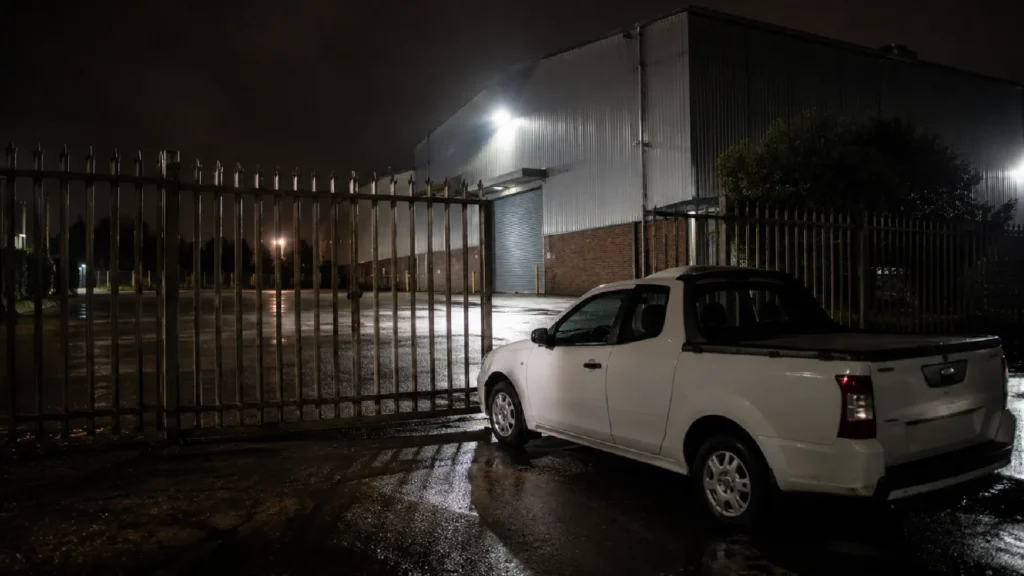
False alarm call-outs are the security cost most South African businesses never budget for, because the charge arrives one line at a time rather than as a single invoice.
A detector trips at 02:14. Yet the control room sees a signal and nothing else. A response vehicle rolls out, finds a roller door swinging in the wind or a box that has fallen off a stack, logs the attendance and drives away.
Nothing dramatic happens, which is precisely why the pattern survives. No single event costs enough to force a decision. Meanwhile the effect compounds quietly — in the contract terms, in the goodwill of the keyholder who drove out at two in the morning, and in how urgently the control room treats your next signal.
The difficulty is not detection. In fact almost every alarm on the market can report that something moved. Far fewer, however, can report what moved.
Direct Answer: What Does a False Alarm Call-Out Actually Cost?
A false alarm call-out costs a South African business three things: the wasteful call-out charge many armed response contracts allow, the staff hours somebody spends driving out to unlock a site after hours, and the urgency a control room loses once it stops treating a site with a history of unverified alarms as a priority.
The third cost is the one nobody itemises. Armed response, after all, is a triage operation, and triage runs on history. In practice, a control room that has driven out to one premises repeatedly over a quarter and found nothing every time makes a different judgement on the next signal than it made on the first.
DigitFMS installs and monitors Ajax wireless alarm systems across South Africa as an authorised Ajax partner. Because Ajax MotionCam detectors send photographs with the alarm signal, an operator sees the cause before the control room dispatches anyone.
What Triggers Most False Alarm Call-Outs
Most false alarms are not faults. Instead they are correct detections of something harmless.
A passive infrared detector reports heat and movement. It cannot form an opinion about whether that heat and movement belongs to a thief, a night guard, a stray dog or the afternoon sun on a steel roller shutter. In other words, the detector behaves exactly as its designers intended, and the site still pays for the drive-out.
Common causes of false alarm call-outs on commercial premises include:
- Detectors aimed at doors, shutters or awnings that move in wind
- Stray animals, birds and rodents inside a warehouse envelope
- Heat sources such as extractor fans, heaters and direct afternoon sun
- Stock stacked into a detection zone after a busy dispatch day
- Staff who arrive before anyone has disarmed the system
- Insects on a lens or inside a detector housing
- Flat device batteries that report as tamper events
Notice how few of these are equipment failures. Therefore replacing the alarm rarely fixes the pattern, since the pattern is a verification problem rather than a detection problem.
The Cost You Can See and the Cost You Cannot
The invoice line is the smallest part of a false alarm call-out.
Most armed response agreements in South Africa include a wasteful call-out clause, which lets the provider bill repeat attendances where the crew finds no incident. Those charges are visible, irritating and, on their own, survivable. Therefore many operations managers absorb them and move on.
The costs that never reach an invoice
Above all, the damage that matters never appears on a statement.
- Slower dispatch when verified alarms sit ahead of yours in the queue
- Keyholder fatigue and reluctance to answer the after-hours phone
- Management time spent reviewing signals that meant nothing
- Bypassing zones simply to stop the noise
- Weaker evidence when somebody finally investigates a real incident
- Loss of confidence among the staff who use the system daily
Even so, the quietest response does the most harm. On sites that trip constantly, somebody bypasses a zone here and a detector there, until a system bought to protect the whole building only covers half of it.
Find out what your alarm is actually reporting
A DigitFMS specialist will review your current detection layout and show you where verification is missing.
Book a Free Alarm Assessment →What Happens After the Fourth Unverified Alarm?
Consider a tyre warehouse on the East Rand with three loading bays and a fenced yard.
The system trips on a Friday night. A vehicle attends, finds nothing, and the provider bills the call-out. The same detector trips again on Sunday, twice on Tuesday, and again the following weekend. By the fourth week the site manager has stopped answering the after-hours phone, the control room has flagged the premises as unreliable, and the response vehicle arrives later because verified alarms elsewhere sit ahead of it.
On the fifth weekend, someone cuts through the fence line and loads stock for the better part of an hour. The alarm behaves exactly as it did on every previous occasion. The response, by contrast, does not — because nothing in the signal separates this night from the four before it.
That is the real cost of a false alarm call-out. Not the fee. The credibility.
How Does Photo Verification Change the Decision?
Photo verification replaces a question with a picture.
When an Ajax MotionCam detector triggers, it captures a short series of photographs and sends them with the alarm over the encrypted Jeweller radio protocol. The operator opens the alarm and sees an empty aisle, a bird, or a person standing between two racks. As a result, the decision to dispatch rests on evidence rather than probability.
Three things change at once. First, the operator closes off a harmless trigger without a vehicle leaving the depot, so it never becomes a chargeable false alarm call-out. Second, a genuine intrusion reaches the response team with a description of what is on site. More importantly, your premises rebuild credibility at the control room, which is what buys you speed on the night it matters.
The same logic applies after the event. A photographed sequence helps an insurer or an investigator far more than a timestamped signal with nothing attached, which is why verified alarms increasingly sit alongside night-vision cameras and continuous recording on higher-risk sites.
Which Sites Suffer Most From False Alarm Call-Outs?
False alarm call-outs cluster where the environment is busy, the perimeter is long and the building never fully seals.
The sites that gain most from verified alarm response include:
- Warehouses and distribution centres with open racking
- Fleet yards, truck depots and transport workshops
- Tyre stores and parts warehouses
- Bulk fuel and plant hire sites with outdoor assets
- Manufacturing plants running extraction and heating equipment
- Multi-site operations monitored from one central office
- Estates and complexes with shared perimeters
Small offices and retail units rarely reach the same call-out volumes. Even so, they carry a different exposure: one keyholder, no relief, and an after-hours drive-out that lands on the same person every time. Size, therefore, is not the qualifier. Trigger density is.
DigitFMS runs a national branch network, so a local branch handles installation and response rather than routing everything through one regional office.
The South African Operating Context
South African businesses run security under conditions that make verification unusually valuable.
Private security carries a share of the response burden across wide industrial areas, and a finite number of vehicles covers them. The South African Police Service publishes quarterly crime statistics covering burglary and robbery at non-residential premises, and those releases remain the clearest public picture of the pressure on commercial sites. Consequently every dispatch that chases a box in the wind is a dispatch some other site does not get.
Regulation matters here too. Monitoring and response providers work under the Private Security Industry Regulatory Authority, and a verified alarm gives a registered operator something defensible to act on rather than a signal of unknown origin.
Distance compounds all of it. A depot on the edge of a metro, a farm workshop or a yard on a haul road may sit twenty minutes from the nearest response vehicle. That journey is worth making when somebody already knows what waits at the other end.
Building a Smarter Alarm Verification Strategy
Reducing false alarm call-outs is a design exercise, not a hardware purchase.
Most of the improvement comes from decisions somebody makes before mounting the first detector: what each zone genuinely protects, what moves through it at night, and what an operator will see when it triggers. Businesses layering this into a wider plan often start from their existing electronic security across fixed and mobile assets rather than treating the alarm in isolation.
What a verification-first alarm plan covers
In short, the work happens on site and on paper long before anyone signs a monitoring contract.
- A site survey walked at night, not a plan sketched at a desk
- Photo verification on every high-traffic and high-value zone
- Detector placement away from heat, airflow and moving fabric
- Arming schedules that match real shift patterns
- A written escalation path naming every keyholder
- Monthly review of each activation and its outcome
- Treating battery and tamper reports as maintenance, not noise
Reviewing this annually matters more than replacing equipment. Operations change — new racking, a shifted dispatch schedule, an extractor fan near a detector — and a system tuned to last year’s site soon starts generating false alarm call-outs again.
Conclusion
Most South African businesses treat false alarm call-outs as an administrative annoyance. Read them instead as a slow withdrawal from an account you can only draw on once: the account of how seriously a control room takes your site at two in the morning.
The industry solved detection decades ago. Verification is the part that stayed missing, and photographic verification closes it by putting evidence in an operator’s hands at the moment they decide.
The practical test is simple. Ask how many times a vehicle attended your premises last quarter, and how many of those attendances found something. Where the second number falls well below the first, the alarm is not the problem. The absence of proof is.
An alarm that cannot show what triggered it does not protect a site. It generates traffic, and every unverified call-out slows the next real one.
Frequently Asked Questions
Any attendance where an armed response vehicle drives out to a site and finds no incident. Most South African monitoring agreements let the provider bill repeat attendances of this kind, which contracts usually describe as a wasteful or excessive call-out clause.
An Ajax MotionCam detector captures a short sequence of photographs and sends them with the alarm signal. Because the control room operator sees the cause first, they close off a bird, a moving roller door or a stray dog without ever sending a vehicle.
Coverage works best on the routes an intruder must use rather than on every wall. Entry doors, roller shutters, loading bays, corridors between racking and the approach to high-value storage all give an operator a usable image. Ajax devices run wireless, so cable runs never limit placement.
Warehouses, fleet yards, depots, tyre stores, workshops and industrial sites see the sharpest improvement, because busy environments and long perimeters generate the most harmless triggers. Offices, retail units and estates benefit too, usually by sparing a single keyholder repeated after-hours drive-outs.
Cost follows the number of detection points rather than the floor area of a building. Entry points, indoor zones, outdoor areas and the question of which detectors carry photo verification all move the figure, as does the monitoring and response level you attach to the installation.
Ajax systems carry anti-jamming and tamper detection over the encrypted Jeweller protocol, and the hub reports interference as an event rather than failing silently. Each device holds its own battery, so a power outage on site never disarms the installation.