
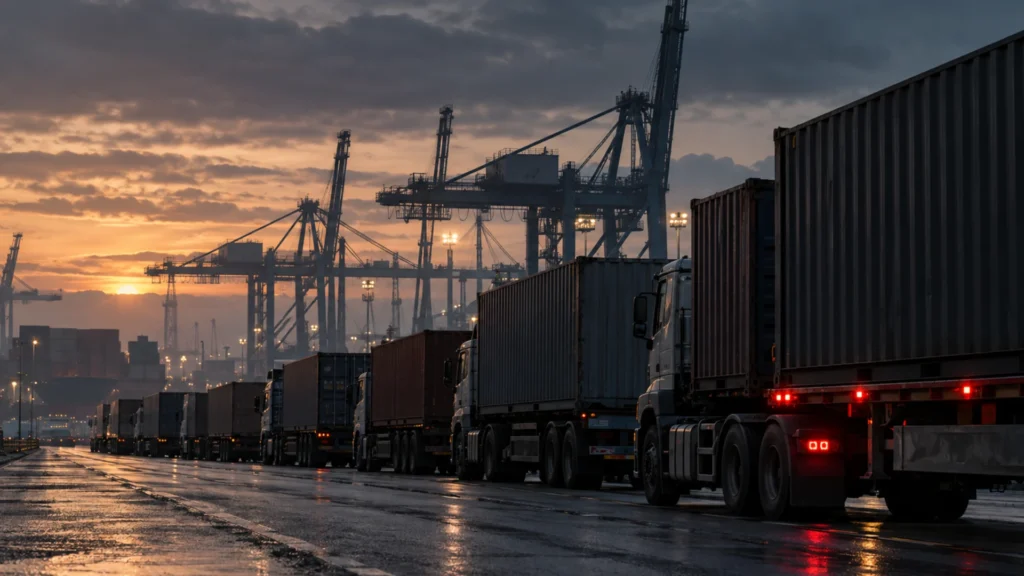
Johannesburg, 29 September 2026 — The DGT recovery 2026 is real on the quay but not yet at the gate. Durban Gateway Terminal (DGT) told Freight News on 25 September that its performance has improved. The gains followed the Navis operating system going live in August. Daily moves have reached 7,000 to 7,500 against target. In addition, yard occupancy has settled at 63% to 64%, and the anchorage queue is down to eight vessels.
“Terminal performance had improved since the implementation of the Navis system in August,” DGT chief commercial officer Grant Bahlmann said. However, the associations that represent hauliers and cargo owners describe a different picture outside the fence. Positive Freight Solutions chief executive Alex Hill said trucks with valid bookings are still “spending anything from four to 22 hours” at the terminal. Moreover, securing a booking in the first place takes one to two days.
The Southern African Association of Freight Forwarders (SAAFF) also warned that the disruption has not left the system. “The wider supply chain remains displaced: our current analysis continues to indicate an additional approximately 18–20 days through affected supply chains,” the association said. Meanwhile, Dave Logan of the South African Freight and Logistics Association (SAFLA) said “cargo owners remain heavily exposed to shipping line demurrage and detention penalties”. That exposure continues even though DGT has waived its own storage charges.
How Far The DGT Recovery 2026 Has Come
The Desk has tracked the terminal since the crisis began. At its worst, on 25 August, yard occupancy stood at 89.2%, according to SAAFF data. Two days later, it had fallen to 73.8%, while nine vessels waited at anchorage. Then, between 14 August and 10 September, daily throughput averaged 3,672 TEUs. That was 30.5% below the 5,286 of the preceding four months. By 10 September, the anchorage queue had dropped from ten ships to five. Now the yard is at 63% to 64%. On that evidence, the waterside has turned the corner.
Why Trucks Have Not Felt It Yet
The anchorage count has crept back up, from five on 10 September to eight now. So the terminal is still working through a backlog of vessels. Furthermore, DGT’s equipment problems have not gone away. Replacement equipment faces lead times of 12 to 18 months, Freight News reported. Truck booking constraints also remain, and the replacement slot system that DGT promised in mid-September has no announced go-live date. As a result, the gains so far have come from the ship side, while the truck side still queues. The Desk’s earlier report on the slot-booking admission set out that problem two weeks ago.
Analysis
What The DGT Recovery 2026 Means For Hauliers
For harbour carriers, a recovery that stops at the quay changes little. The standing time Hill describes today matches what he described on 1 September. In other words, gate hours have not improved in four weeks, even as the yard emptied. That matters because the national numbers are still catching up. As the Desk reported, August container volumes fell 7% nationally, largely because of DGT. September’s figure will show whether the yard recovery reached the trucks. Until then, the cost sits with road operators and their customers.
The Desk Calculation: Two Kinds Of Waiting
Here is the arithmetic, with the assumptions shown. First, the gate wait. On the Desk’s basis of about R320 per standing hour for a tri-axle container rig, a wait of four to 22 hours still costs roughly R1,280 to R7,040 per visit. That figure has not moved since mid-September.
Second, the booking wait. A rig with about R55,000 a month in fixed costs carries roughly R1,830 per calendar day, even when it earns nothing. So a truck that stands idle for one to two days while its operator hunts for a slot costs about R1,800 to R3,700. That cost lands before the truck even reaches the gate. Together, a single import collection can therefore carry R3,000 to R10,700 of waiting cost. None of it appears in the terminal’s recovery figures.
DGT Recovery 2026: The Scorecard
| Date | Measure | Reading |
|---|---|---|
| 25 Aug | Yard occupancy | 89.2%, the peak |
| 27 Aug | Yard occupancy / anchorage | 73.8%, with 9 vessels waiting |
| 14 Aug–10 Sep | Daily throughput | 3,672 TEU, while the baseline was 5,286 |
| 7–10 Sep | Anchorage queue | Fell from 10 vessels to 5 |
| 25 Sep | Yard occupancy / anchorage | 63–64%, although 8 vessels now wait |
| 25 Sep | Truck wait with a booking | Still 4–22 hours, unchanged since 1 Sep |
The Numbers Behind The DGT Recovery 2026
Fleet Impact
The Fleet Playbook While Durban Recovers
A recovery on the quay usually reaches the gate eventually. The question for hauliers is how much it costs them in the meantime, and who pays. That depends on evidence. A carrier that can show each truck’s arrival, gate-in and gate-out times has a basis for a standing-time charge. By contrast, a carrier that relies on driver reports has only an argument. Live vehicle tracking for fleet management records those times automatically at Bayhead Road and the terminal gate. At the same time, Digit D-Fuel shows how much diesel each queue burned. That matters more with diesel heading towards R33 a litre in October.
- First, compare your own gate times with DGT’s claims. If your trucks still wait 4 to 22 hours, the recovery has not reached you, and your data shows it.
- Second, charge for the booking wait as well as the gate wait. One to two idle days per container cost about R1,800 to R3,700, so price them into import collections.
- Third, warn cargo owners about demurrage. SAFLA says shipping lines still charge it, therefore collect early wherever a slot allows.
- Finally, watch the anchorage count. The DGT recovery 2026 will reach the gate when the queue falls back to five or fewer and stays there, so plan staffing around that signal.
Fleet Technology
Fleet Technology For A Terminal In Recovery
Terminal statistics describe the quay. Only the haulier’s own data describes the road. DigitFMS geofences time-stamp every arrival, gate-in and gate-out, so a fleet knows exactly how long each container took. Digit D-Fuel then records the litres burned while the truck waited. In effect, a queue becomes a line on an invoice. Driver identification also ties every hour to a shift. Cartrack, Netstar, Tracker, Ctrack and MiX by Powerfleet offer tracking to the same carriers. Nevertheless, DigitFMS has a Durban branch within a network of more than 100. That keeps support close to the port while the backlog clears.
Key Numbers: DGT Recovery 2026 At A Glance
Key Numbers · DGT Recovery 2026
25 September: daily moves 7,000–7,500 against target; yard occupancy 63–64%; anchorage 8 vessels (DGT, Grant Bahlmann)
Trucks: 4–22 hours with valid bookings, and 1–2 days to secure a booking (PFS, Alex Hill); supply chains +18–20 days (SAAFF); demurrage exposure (SAFLA, Dave Logan)
Series: yard 89.2% (25 Aug) → 73.8% (27 Aug) → 63–64% (25 Sep); throughput 3,672 TEU/day (14 Aug–10 Sep) vs 5,286 baseline; anchorage 10 → 5 (7–10 Sep), then 8 (25 Sep)
Constraints: equipment lead times 12–18 months; truck booking system still constrained; storage charges waived
Desk calculation: gate wait at R320/hour ≈ R1,280–R7,040 per visit; booking wait at ~R1,830 fixed cost per day ≈ R1,800–R3,700 per container; so combined ≈ R3,000–R10,700 per collection
Source: Freight News, 25 September 2026 (DGT, SAAFF, PFS, SAFLA); SAAFF data via Freight News, 27 August, 1 September and 11 September 2026.
Questions Answered
Frequently Asked Questions: DGT Recovery 2026
Is Durban Gateway Terminal Recovering?
On the waterside, yes. DGT reports 7,000 to 7,500 daily moves, yard occupancy of 63% to 64% and eight vessels at anchorage. Yard occupancy peaked at 89.2% on 25 August, so the terminal has cleared a large part of its backlog.
Why Are Trucks Still Waiting?
Truck booking constraints remain, and DGT has not announced a go-live date for its replacement slot system. As a result, Positive Freight Solutions says trucks with valid bookings still wait four to 22 hours, and securing a booking takes one to two days.
What Does The Wait Cost A Haulier?
At the Desk’s R320 per standing hour, the gate wait costs about R1,280 to R7,040 per visit. In addition, one to two idle days waiting for a booking cost about R1,800 to R3,700 per container in fixed costs. Together, that is roughly R3,000 to R10,700 per collection.
How Long Will The Supply Chain Take To Recover?
SAAFF estimates that affected supply chains still carry an extra 18 to 20 days. Moreover, replacement equipment has lead times of 12 to 18 months. So the terminal’s capacity will stay constrained well into 2027.
What Should Cargo Owners Watch For?
Demurrage and detention charges from shipping lines. SAFLA says cargo owners remain heavily exposed, even though DGT has waived its own storage fees. Therefore, collecting early and keeping records of every delay matters.
When Will The DGT Recovery 2026 Reach The Gate?
The clearest signal is the anchorage queue. When it falls back to five vessels or fewer and holds there, and the new slot system goes live, truck waits should start to shorten. Until then, hauliers should price the waiting time into their rates.
Facts checked 29 September 2026. Source: Freight News (DGT recovery), Freight News (yard data), Freight News (SAAFF update) and Freight News (throughput). Related: the DGT Competition Commission complaint and the truck stop framework.
© 2026 DigitFMS. All rights reserved.