
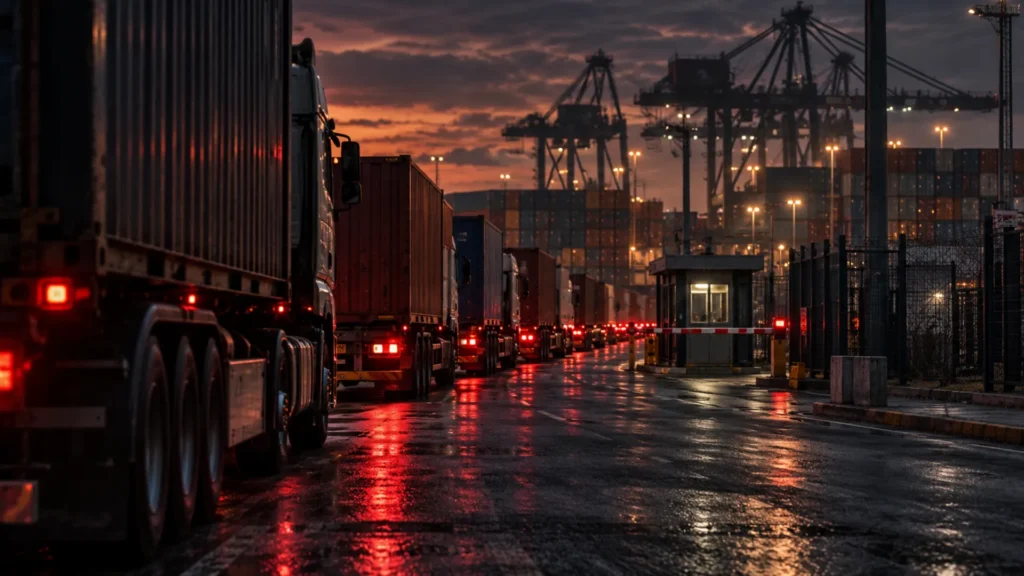
Johannesburg, 7 September 2026 — The Durban Gateway Terminal complaint has reached the regulator. The Competition Commission is conducting a preliminary assessment of a complaint against Durban Gateway Terminal, Transnet and eight shipping lines, Freight News reported on Friday. The allegations cover excessive storage charges, landside congestion and anti-competitive practices. Commission spokesperson Siyabulela Makunga confirmed receipt. The Positive Freight Solutions Container Division, which represents 140 transporters employing about 6,000 people, filed the complaint in July. The lines named are MSC, Maersk South Africa, CMA CGM and Hapag-Lloyd. Ocean Network Express, COSCO, Pacific International Lines and Evergreen complete the list.
What the Terminal Complaint Alleges
The central allegation is mechanical. Transporters say the terminal monetises avoidable delays. Demurrage, detention and storage charges accrue while hauliers physically cannot access containers. PFS Container Division chief executive Alex Hill told Freight News that DGT management was prioritising the waterside. Equipment and gangs go to loading and discharging vessels, he alleged, at the expense of the landside where trucks queue. Consequently, the transporter pays twice, first in standing time and then in the charges that standing time triggers. A preliminary assessment is not a finding, and the respondents have not been found to have done anything wrong.
How Durban Gateway Terminal Reached This Point
The terminal’s history gives the case its weight. Durban Gateway Terminal is the former Durban Container Terminal Pier 2. International Container Terminal Services Inc took operational control on 1 January under a 25-year concession. The operating vehicle is a special-purpose company in which Transnet retains 51%. However, the launch of DGT’s standalone Navis N4 system coincided with severe landside congestion. The South African Association of Freight Forwarders declared a crisis at the terminal. Additionally, the Commission referred eight shipping lines to the Competition Tribunal in December over alleged collusion on general rate increases. That is a separate matter, with overlapping names.
The Bigger Question
Why the Durban Gateway Terminal Complaint Tests Port Privatisation
The Durban Gateway Terminal complaint also lands mid-story. This desk has followed the port all year. eThekwini’s freight strategy puts truck-staging facilities first, and the industry backed that priority with conditions. Transnet’s funding requests already include R11.2 billion for Durban Container Terminal efficiency. Furthermore, the Road Freight Association complained in 2024 that terminal turnaround figures ignored staging time at the A-Check facility. The published numbers flattered the terminal. The complaint turns that grievance into a regulatory question: when a privatised terminal underperforms, who carries the cost? At present, the answer is the haulier and the importer. The assessment will decide whether that answer gets examined.
Every Party in the Durban Gateway Terminal Complaint
| Party | Role in the Complaint | Status |
|---|---|---|
| Positive Freight Solutions, Container Division | Complainant: 140 transporters, about 6,000 employees | Filed July 2026 |
| Durban Gateway Terminal (DGT) | Respondent: former DCT Pier 2, run by ICTSI under a 25-year concession | Under preliminary assessment |
| Transnet | Respondent: 51% shareholder in the DGT operating vehicle | Under preliminary assessment |
| MSC, Maersk, CMA CGM, Hapag-Lloyd | Respondents: shipping lines charging demurrage and detention | Under preliminary assessment |
| ONE, COSCO, PIL, Evergreen | Respondents: shipping lines charging demurrage and detention | Under preliminary assessment |
| Competition Commission | Confirmed receipt; preliminary assessment, not yet a formal investigation | Confirmed 4 September |
The Numbers Behind the Terminal Complaint
Fleet Impact
What Port Fleets Must Log While the Complaint Runs
For port fleets, evidence now has legal value. Every visit deserves a gate-to-gate log, including the staging time the terminal’s own metrics leave out. A disputed storage or detention charge lives or dies on time stamps. Fleets running vehicle tracking with geofencing already hold that record. It shows entry and exit at the A-Check facility, the terminal gate and the container yard, per truck and per trip. Similarly, litre-level fuel monitoring prices the queue itself. At R30 diesel, the idling burn of a four-hour wait is a cost line, not a rounding error. Grievances routed through PFS or the RFA carry more weight when they arrive with data attached.
- Log every port visit gate to gate, including A-Check staging: disputed charges live or die on time stamps
- Separate storage, demurrage and detention on every invoice: each has a different clock and a different payer
- Route grievances through PFS or the RFA with data attached: the assessment will ask for evidence
- Price standing time into port work now: at R30 diesel, a four-hour queue is a cost line, not noise
Fleet Technology
How Gate-to-Gate Records Defend Against Terminal Charges
A terminal’s clock starts at the gate it chooses. A fleet’s clock should start where the truck stops moving. DigitFMS records the whole visit. Geofencing logs every entry and exit at the port precinct, the A-Check facility and the terminal. Staging, queuing and turnaround then become numbers per trip. D-Fuel captures the idling burn. Driver identification ties each visit to a named driver, and AI dashcams document conditions at the gate. As a result, a disputed charge meets a time-stamped record, and a regulator’s request for evidence meets a file. Competing providers such as Cartrack, Tracker, Netstar, Ctrack and MiX by Powerfleet serve port fleets as well. However, the complaint shows where the port economy is heading. Delays now carry a price, and the operators who can prove their own timeline will not pay for someone else’s.
Key Numbers · The Complaint
Complainant: PFS Container Division, 140 transporters, about 6,000 employees; filed July 2026.
Respondents: Durban Gateway Terminal, Transnet and eight shipping lines.
Concession: ICTSI operating since 1 January 2026 under a 25-year agreement; Transnet holds 51% of the operating vehicle.
Status: preliminary assessment confirmed by the Competition Commission on 4 September; no finding of wrongdoing.
Source: Freight News, 25 August and 4 September 2026; Competition Commission.
Questions Answered
Frequently Asked Questions: Durban Gateway Terminal Complaint
What is the Durban Gateway Terminal complaint about?
Allegedly excessive storage charges, landside congestion and anti-competitive practices at Durban Gateway Terminal. Transporters say the terminal monetises avoidable delays, per Freight News. Demurrage, detention and storage charges accrue while their trucks cannot reach containers.
Who filed the complaint, and against whom?
The Positive Freight Solutions Container Division, representing 140 transporters employing about 6,000 people, filed in July. The respondents are Durban Gateway Terminal, Transnet and eight shipping lines. Those are MSC, Maersk South Africa, CMA CGM, Hapag-Lloyd, ONE, COSCO, Pacific International Lines and Evergreen.
What has the Competition Commission done so far?
Confirmed receipt and begun a preliminary assessment, spokesperson Siyabulela Makunga told Freight News. A preliminary assessment decides whether a formal investigation follows. Consequently, no finding of wrongdoing exists at this stage.
What is Durban Gateway Terminal?
The former Durban Container Terminal Pier 2. International Container Terminal Services Inc took operational control on 1 January 2026 under a 25-year concession. Transnet retains 51% of the operating vehicle. Its standalone Navis N4 system launched amid severe landside congestion.
What is the difference between storage, demurrage and detention?
Storage is the terminal’s charge for a container left on its premises beyond free days. Demurrage is the shipping line’s charge for a container still inside the port beyond free time. Detention is the line’s charge for a container kept outside the port beyond the allowed period. All three accrue during delays.
Why does the complaint matter beyond Durban?
Because DGT is the first major private port concession in South Africa. The complaint tests who carries the cost when a privatised terminal underperforms. Moreover, R11.2 billion of infrastructure funding already targets Durban Container Terminal efficiency.
What should port fleets do while the assessment runs?
Log every visit gate to gate, including staging time at the A-Check facility. Dispute charges with time-stamped evidence, and route grievances through PFS or the RFA. Then price standing time into port work until turnaround improves.
Facts checked 7 September 2026. Source: Freight News on the assessment and its original report on the filing, with terminal context from the South African Association of Freight Forwarders. Related: the industry’s verdict on the Durban freight strategy and the funding already aimed at the terminal.
© 2026 DigitFMS. All rights reserved.