
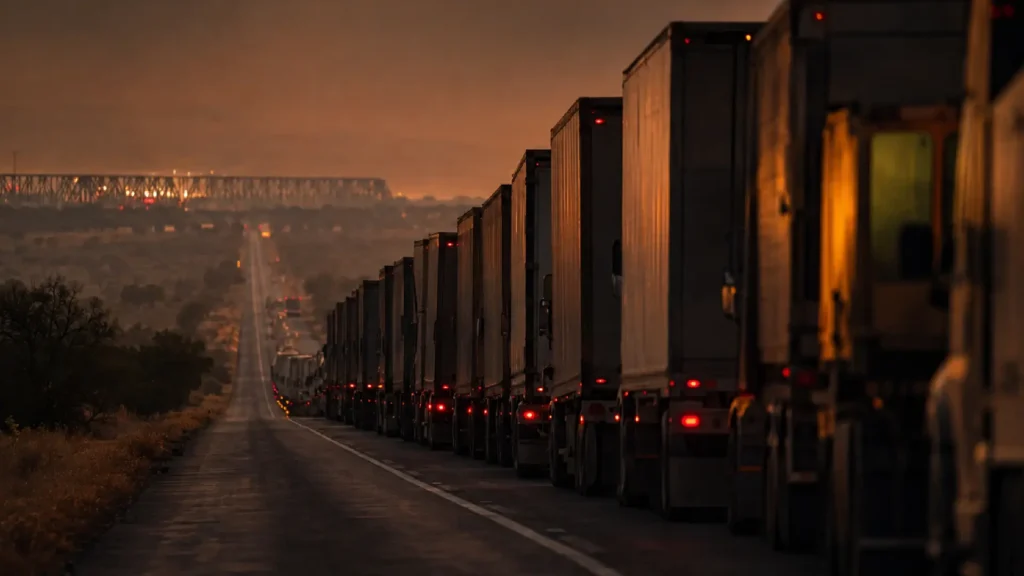
Johannesburg, 31 August 2026 — Kazungula border truck congestion has reached what the region’s driver body calls unprecedented levels. The timing matters: it is one month into Botswana’s new pre-clearance regime. The Southern Africa Truck Drivers Association of Zambia says queues at the Kazungula One-Stop Border Post now stretch deep into Botswana. Zambia Monitor reported the statement on Friday. Drivers are spending several days in line. Moreover, some wait in designated parking areas within or near game reserves, where toilets and basic amenities are scarce. Secretary-general Kaiko Salim Wamunyima described the conditions as a humanitarian concern, not merely a logistics one.
What Drivers Say Is Behind the Kazungula Congestion
The cause, in the association’s account, is not the Botswana rule everyone feared. Wamunyima attributed the delays partly to an unsupportive operational culture among border officials on both the Zambian and Botswana sides. Additionally, he pointed at recent operational and clearing measures introduced by the Zambia Revenue Authority. Documentation largely falls to clearing agents, he said. Yet ZRA processing workflows and system verification procedures remain a major source of delays. His demands followed. He wants off-site truck parks under ZRA supervision and temporary sanitation along the Botswana-side queue. He also wants professional treatment of drivers, and urgent engagement with the industry.
One Month After Botswana’s Border Pre-Clearance Rule
The timing gives the statement its weight. On 1 August, the Botswana Unified Revenue Service made pre-lodged customs declarations mandatory for all commercial road freight to, through or from Botswana. Drivers need PROCEED TO BORDER status before departure. Non-compliance carries a P10,000 fine. The 2024 Groblersbrug queues made operators brace for chaos at the entry. Notably, this desk found no published reports of pre-clearance-driven backlogs at Martin’s Drift in the rule’s first month. Instead, the crisis has surfaced at the corridor’s Zambian exit. “Trade facilitation should not come at the expense of human dignity or economic efficiency,” Wamunyima said.
The Corridor
Why Kazungula Border Truck Congestion Reprices the Copperbelt Route
For South African operators, Kazungula border truck congestion changes the corridor arithmetic. The Botswana bypass exists because the North-South Corridor through Zimbabwe carries its own costs. Zimborders charges about $213 one way at Beitbridge, per earlier Freight News reporting. In-transit checks punctuate the route, and fuel dipping at Chirundu delays tankers. Consequently, Copperbelt freight has favoured Martin’s Drift and Kazungula. The Kazungula Bridge opened in 2021 precisely to make that route flow. Now the bypass has its own multi-day hold. Operators therefore face two priced problems rather than one clean route. Furthermore, the human cost lands on the payroll. A driver parked for days near a game reserve without sanitation is a welfare obligation. He is also a fatigue risk when the queue finally moves.
The Numbers Behind the Kazungula Border Crisis
Fleet Impact
The Fleet Playbook for Kazungula Border Truck Congestion
The playbook starts before the truck leaves the yard. Standing time belongs in every Copperbelt quote now, because a corridor that holds vehicles for days reprices itself. Pre-clearance compliance is non-negotiable. That means PROCEED TO BORDER status confirmed before departure. It also means clearing agents briefed on the ZRA workflow changes, so Zambian documents clear before arrival. Fleets running vehicle tracking across the corridor can see exactly where each truck sits in the queue. They log standing time per trip. Additionally, they run welfare check-ins with drivers on a schedule rather than on hope. Similarly, litre-level fuel monitoring captures the idling burn of a multi-day hold. That is a real line in a September diesel budget.
- Price standing time into every Copperbelt quote: a corridor holding trucks for days has repriced itself
- Run a driver welfare protocol for multi-day holds: water, communication, scheduled check-ins and rest before moving
- Confirm PROCEED TO BORDER status before departure, and brief clearing agents on the ZRA workflow changes
- Review the routing arithmetic honestly: Botswana bypass delays versus Zimbabwe corridor fees and checks
Fleet Technology
How Corridor Visibility Manages a Border Truck Crisis
A border crisis two countries away is still a dispatch problem at home. DigitFMS keeps the corridor visible. GPS tracking shows every vehicle’s position and dwell time. A Kazungula hold then becomes a known number rather than a driver’s phone call. Driver identification and scheduled check-ins support welfare during multi-day waits, while AI dashcams document conditions and interactions at the border. D-Fuel measures the idling burn, and route management holds the alternative routing ready. As a result, an operator can price the standing time, protect the driver and decide the route on evidence. Competing providers such as Cartrack, Tracker, Netstar, Ctrack and MiX by Powerfleet serve cross-border fleets as well. However, Kazungula shows the stakes plainly. The corridor built to remove bottlenecks now holds trucks for days. The fleets that can see their trucks will manage it. The rest will hear about it after the fact.
Key Numbers · Kazungula, One Month In
Queue times: several days per truck, with queues stretching into Botswana, per SATDAZ on 28 August 2026.
Attributed causes: ZRA processing workflows and system verification procedures, plus operational culture on both sides; the Botswana pre-clearance rule was not cited.
Botswana rule: mandatory pre-lodged declarations since 1 August; PROCEED TO BORDER status required; P10,000 fine for non-compliance.
Alternative route cost: about $213 one way in Zimborders fees at Beitbridge, plus in-transit checks and Chirundu dipping.
Source: SATDAZ statement via Zambia Monitor, 28 August 2026; BURS public notice, 10 July 2026; Freight News.
Questions Answered
Frequently Asked Questions: Kazungula Border Truck Congestion
What has SATDAZ said about Kazungula?
The Southern Africa Truck Drivers Association of Zambia says congestion at Kazungula has reached unprecedented levels. Per its statement of 28 August, queues stretch deep into Botswana. Drivers spend several days waiting, some in parking areas near game reserves with limited sanitation.
What is causing the Kazungula congestion, according to drivers?
Two things, per secretary-general Kaiko Salim Wamunyima. First, recent operational and clearing measures introduced by the Zambia Revenue Authority. He called its processing workflows and system verification procedures a major source of delays. Second, an unsupportive operational culture among border officials on both sides.
Is Botswana’s new pre-clearance rule to blame?
Not according to the drivers’ association, which did not cite it. Notably, this desk found no published reports of pre-clearance-driven backlogs at Martin’s Drift in the rule’s first month. The crisis sits at the corridor’s Zambian exit, not its Botswana entry.
What does Botswana’s pre-clearance rule require?
Since 1 August, all commercial goods moving by road to, through or from Botswana need customs declarations lodged and approved before departure. Drivers need PROCEED TO BORDER status. Non-compliance carries a P10,000 fine, per the BURS notice of 10 July.
What has SATDAZ asked for?
Four things. Off-site truck parking under ZRA supervision to decongest the corridor, and temporary sanitation along the Botswana-side queue. Then professional treatment of drivers, and urgent engagement between ZRA, its Botswana counterparts and transport stakeholders.
What are the routing alternatives for Copperbelt freight?
The North-South Corridor through Zimbabwe, which carries its own costs. Per earlier Freight News reporting, those include Zimborders fees of about $213 one way at Beitbridge, in-transit checks, and fuel dipping at Chirundu. Consequently, operators face a choice between two priced problems, not a clean bypass.
What should fleets do right now?
Four steps. Price standing time into every Copperbelt quote, and run a driver welfare protocol for multi-day holds. Then confirm PROCEED TO BORDER status before departure. Finally, brief clearing agents on the ZRA workflow changes, so documents clear before trucks arrive.
Facts checked 31 August 2026. Source: the SATDAZ statement, reported by Zambia Monitor, the BURS pre-clearance rule per Freight News and the ZIMRA advisory via Pindula News, with corridor cost context from Freight News. Related: what border delays cost fleets and the RFA’s pre-clearance and AEO advice.
© 2026 DigitFMS. All rights reserved.