
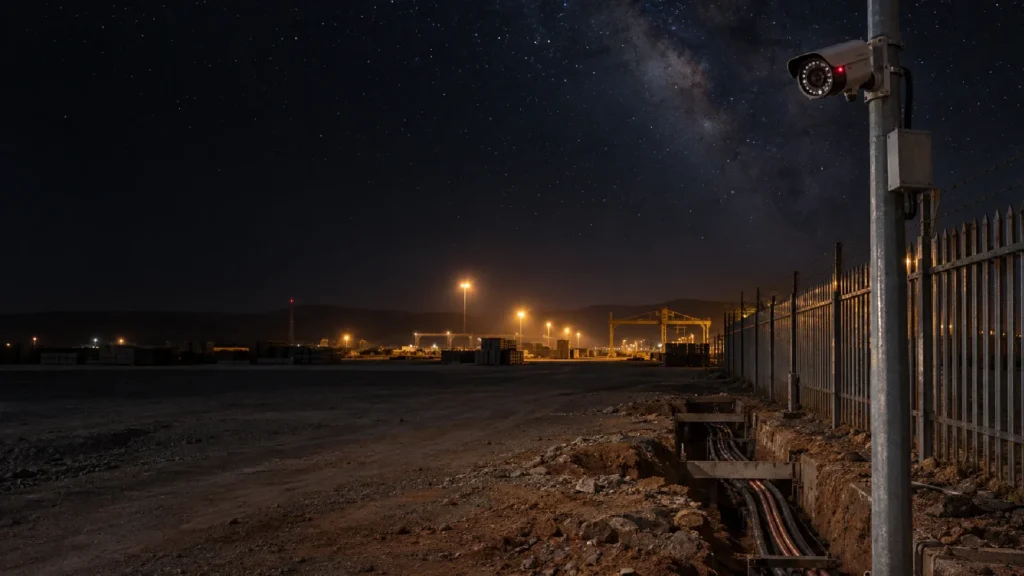
Copper cable theft prevention has become a budget line for South African businesses that never thought of themselves as infrastructure owners: farms with borehole pumps, factories with yard lighting, telecom sites, solar installations and construction projects.
The national figures explain why thieves keep coming back. In a January 2024 statement, Telkom repeated the joint estimate it shares with Eskom, Transnet and PRASA: about R7 billion a year in direct losses and R187 billion in knock-on costs to the economy.
For a single site, however, the metal is the smallest part of the bill. Downtime, replacement cable, labour and lost production usually cost far more than the scrap value thieves receive. Moreover, one stolen supply cable can stop pumps, lights and alarms at the same time.
Direct Answer: What Is the Most Effective Copper Cable Theft Prevention?
The most effective copper cable theft prevention is layered: make cable hard to reach, detect people near it early, verify the alarm on camera, and dispatch a response while the thieves are still on site. Night-capable cameras watched by an off-site control room close the gap that fences, locks and guards alone leave open.
What Does Cable Theft Cost South Africa?
The large utilities publish the clearest numbers, and together they show how widespread the problem is:
- Eskom: about R221 million lost to theft and vandalism between April 2024 and February 2025, according to Eskom
- Transnet: nearly R2 billion lost in 2025/26 across about 5,870 incidents, as Freight News reported
- Mobile networks: theft costs rose from R69.59 million in 2024 to R201.48 million in 2025, per ICASA data reported by Engineering News
- City Power: 652 cable theft incidents in Johannesburg from July 2025 to January 2026, according to Daily Maverick
Private sites rarely appear in these statistics, yet thieves use the same methods on them. DigitFMS covers the freight and fleet side of the problem in a separate Fleet Intelligence Desk report; this guide focuses on protecting fixed sites.
How Do Thieves Beat Copper Cable Theft Prevention?
Cable theft is rarely opportunistic. Instead, most incidents follow recognisable patterns that site owners can plan against:
- Planned power cuts: City Power has warned that published outage schedules help thieves plan around de-energised lines (MyBroadband)
- Fake contractors: impostors pose as utility staff changing cables (The Citizen)
- Inside help: a former thief told Daily Maverick that guards took cash bribes for access to cable tunnels
- Organised groups: research by the Global Initiative Against Transnational Organized Crime describes gangs of 10 to 30 people (Daily Maverick)
- Unguarded sites: PRASA suffered about R5.1 billion in damage across roughly 150 stations after cancelling security contracts (Mail & Guardian)
The common thread is time. Cutting, stripping and removing cable is slow work, so every minute of earlier detection reduces what thieves can take.
What Does the Law Say About Cable Theft?
The Criminal Matters Amendment Act 18 of 2015 created tougher offences for damage to essential infrastructure, whether publicly or privately owned, where the loss may interrupt a basic service to the public. Convictions carry up to 30 years in prison, and accused persons can only receive bail from a court.
That law has limits for private owners. Internal cabling in a factory or on a farm will not always qualify as essential infrastructure, so ordinary theft charges may apply instead.
Government has also targeted the scrap trade. In November 2022, the Minister of Trade, Industry and Competition announced a six-month ban on copper scrap exports (Polity), which ITAC later confirmed was extended. Nevertheless, law enforcement acts after the fact; prevention remains the site owner’s job.
Copper Cable Theft Prevention Starts With Layers
No single measure stops a determined gang, so effective copper cable theft prevention stacks four layers. Each layer buys time for the next one.
Layer 1: Make Cable Harder to Take
Physical hardening comes first. Eskom’s own measures, described by ESI Africa, include replacing copper with aluminium, marking conductors uniquely and fitting anti-theft bolts. Burying cable in sleeved trenches and locking pits and covers also adds time.
Aluminium is not a guarantee, however. City Power told EWN that switching to aluminium had not stopped theft on its network, so treat it as one layer rather than a fix.
Layer 2: Detect People Before They Reach the Cable
Perimeter detection gives the earliest warning. Beams, fence sensors and camera analytics that recognise people and vehicles can raise an alarm while intruders are still at the fence line. Eskom itself uses alarms on overhead lines that alert a control room when someone disturbs a conductor. Consequently, the response can start before any cable is cut.
Layer 3: See Clearly at Night
Remote cable routes often have little or no lighting, so camera choice matters. DigitFMS night vision cameras pair infrared and low-light sensors to record HD footage in complete darkness, which gives an operator usable detail rather than grey shapes.
Layer 4: Verify and Respond
Detection only helps when someone acts on it. In the DigitFMS off-site monitoring model, AI analytics flag unusual activity and a trained operator verifies it within seconds. A predefined response protocol then starts while the incident is still unfolding, rather than after the thieves have left.
Power resilience completes this layer. Because thieves often strike when lines are de-energised, cameras, recorders and communication links need battery or UPS backup. Otherwise, the site goes blind at exactly the moment it becomes most attractive.
Put your copper cable theft prevention to the test
A DigitFMS specialist will review your cable routes, lighting and camera coverage and show you where detection starts too late.
Book a Night-Time Risk Review →Which Sites Need Copper Cable Theft Prevention Most?
Some sites face far higher exposure than others. In general, risk rises with isolation, darkness and long unattended periods:
- Farms with borehole pumps and irrigation
- Construction sites between shifts
- Telecom masts on leased land
- Solar and backup power installations
- Industrial yards with exposed lighting circuits
- Vacant or mothballed premises
Backup power installations deserve particular attention. Many businesses have added generators, inverters and solar arrays to ride through outages, and each one brings heavy-gauge cable into yards, roofs and plant rooms. In addition, these installations often sit in corners of a site that existing cameras were never positioned to cover.
What Should You Do After a Cable Theft?
A clear response plan protects evidence and speeds recovery. Follow these steps:
- Call SAPS on 10111 and record the case number
- Report theft of Eskom infrastructure to 0800 11 27 22
- Preserve camera footage and alarm logs
- Photograph the damage before any repair
- Notify your insurer and broker in writing
- Review how the thieves entered and how long they stayed
Conclusion
Cable theft costs South Africa billions of rand a year, and the same organised methods that strip rail lines and substations reach private farms, factories and towers. Legislation raises the penalties, but it does not keep cable in the ground.
Copper cable theft prevention works when it buys time and uses it well. Harden the cable, detect people at the perimeter, see them clearly in the dark, and make sure a trained person verifies the alarm and dispatches a response.
Sites that combine those layers turn a slow, low-risk crime into a fast, high-risk one for the thieves.
Frequently Asked Questions
Telkom, Eskom, Transnet and PRASA estimate about R7 billion a year in direct losses and R187 billion in wider economic costs. Transnet alone reported nearly R2 billion in theft and vandalism losses in 2025/26.
Where the theft damages essential infrastructure, the Criminal Matters Amendment Act 18 of 2015 allows sentences of up to 30 years in prison, and only a court can grant bail. Theft of cable that does not qualify as essential infrastructure attracts ordinary theft charges.
Not on its own. Eskom uses aluminium as one of several measures, but City Power has said the switch has not stopped theft on its network. Treat it as one layer, not a complete fix.
Published outage schedules tell thieves when lines will be de-energised and how long they have. City Power has warned that criminals use these schedules to plan thefts.
Recording alone rarely prevents theft. CCTV prevents losses when night-capable cameras feed a monitored control room that verifies intruders early and dispatches a response while they are still on site.
Call SAPS on 10111 and open a case. For Eskom infrastructure, use the Eskom crime line on 0800 11 27 22. Preserve any footage before reporting.