
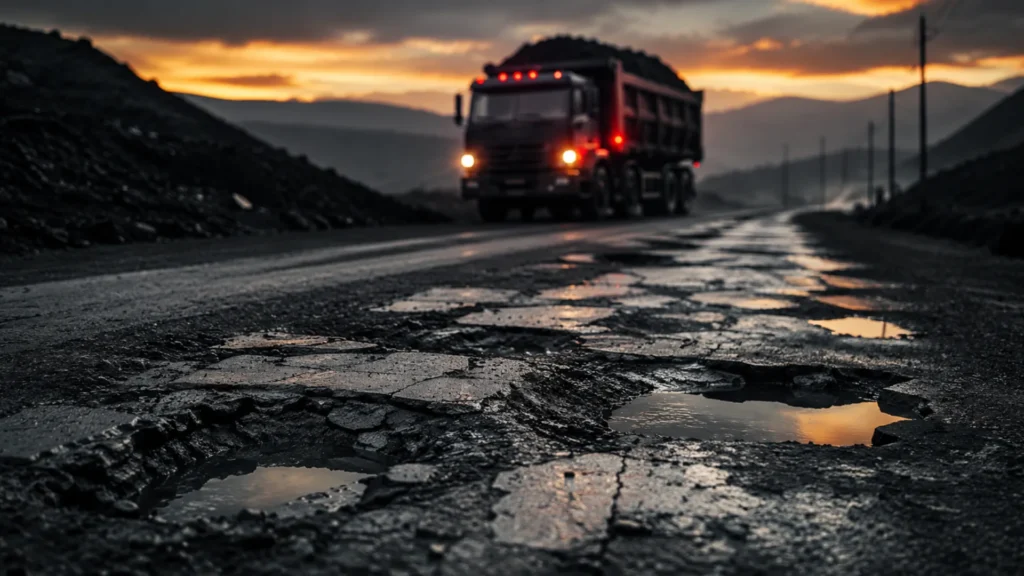
Johannesburg, 20 August 2026 — The Mpumalanga road repair backlog now has an official price: about R38 billion. The provincial Department of Public Works, Roads and Transport disclosed the figure during a National Council of Provinces oversight visit. Parliament released the statement on Wednesday. The statement names the cause as directly as the number. Heavy vehicles, including coal-haulage trucks, are responsible for much of the damage to the province’s roads. The Citizen’s report adds a sharper detail: some of those loads should not be moving by road at all.
The delegation saw the problem first-hand. It visited the badly damaged R36 in the Thaba Chweu Local Municipality during the NCOP’s Provincial Week programme. The R36 also illustrates the structural failure underneath the backlog. Several provincial roads, including the R36, moved to SANRAL because the province lacked the funding to repair them. However, the roads moved without an accompanying budget. The national agency must therefore raise the reconstruction money itself, for roads it did not break.
The timeline drew the sharpest words. R36 reconstruction targets 2028, and NCOP provincial whip Syvia Nxumalo called that too far away. “We are concerned that 2028 is a bit far for the reconstruction of the R36,” she said. The road, she added, has deteriorated severely. It poses a serious hazard to the motorists and tourists who use it daily. Meanwhile, the delegation heard the long-term relief valve plainly stated. Pressure on the network would reduce significantly if more heavy freight moved from road to rail.
The Cost Cycle
Why the Mpumalanga Road Repair Backlog Costs Fleets Twice
Operators pay the Mpumalanga road repair backlog twice. The first payment is mechanical. Broken corridors consume tyres, suspension, alignment and driver hours. They also raise accident risk. Together, that is a per-kilometre cost no rate card shows. The province’s own freight data bank describes the cycle. Mining and forestry freight shifted from rail to road, and pavements failed early. Most paved roads now sit at around thirty years old, the end of their design life. The R555 shows the local version. Trucks leave the tolled N4 to save fees, a practice called red running. The toll saving then lands on the alternative road as accelerated destruction. The second payment is political. Every R38 billion disclosure strengthens the road-to-rail case. Moreover, the rail answer is no longer theoretical. Private operators are landing locomotives now.
The Numbers Behind the Road Repair Backlog
Fleet Impact
Pricing Routes Against the Mpumalanga Road Backlog
Until the roads improve, route condition is a costing input, and fleets can price it. Fleets running vehicle tracking with route management can compare corridors on measured time, distance and vehicle wear. The toll-versus-damage question then becomes arithmetic. Additionally, AI dashcams record road hazards and incidents as they happen. Operators then hold time-stamped evidence for pothole claims, insurance disputes and hazard reports. The R36 will wait until 2028 at best. The costing discipline cannot.
- Cost corridors on measured wear, time and fuel, not habit: broken roads are a per-kilometre surcharge
- Weigh toll versus damage honestly: red running saves fees and spends suspensions, tyres and schedules
- Log hazards and incidents with footage: pothole and damage claims live or die on time-stamped evidence
- Track the R36 and SANRAL timelines: route plans through Thaba Chweu run against a 2028 horizon
Fleet Technology
How Route Data Beats a Broken Road Network
A damaged road network moves costs quietly from the state to the operator. DigitFMS makes those costs visible and manageable. Route management and GPS tracking show what each corridor actually costs in time and distance. Maintenance patterns per route surface in the vehicle data. AI dashcams document hazards and incidents, and D-Fuel captures the extra burn that rough, slow corridors add to every trip. As a result, an operator can choose routes on measured cost, not habit, and prove damage claims with footage. Competing providers such as Cartrack, Tracker, Netstar, Ctrack and MiX by Powerfleet serve Mpumalanga fleets as well. However, the province has now priced its backlog at R38 billion, and the R36 answer is years away. Fleets that measure their corridors will route around the damage. The rest will absorb it.
Key Numbers · The Backlog
Repair and maintenance backlog: about R38 billion, per the provincial Department of Public Works, Roads and Transport.
R36 reconstruction target: 2028, called too far away by the NCOP provincial whip.
Budget accompanying the roads transferred to SANRAL: none; the agency must raise reconstruction funding itself.
Named cause: heavy vehicles, including coal-haulage trucks, per Parliament’s statement.
Source: Parliament NCOP statement via Freight News and The Citizen, 19 August 2026.
Questions Answered
Frequently Asked Questions: Mpumalanga Road Repair Backlog
What did Mpumalanga disclose to Parliament?
The province requires about R38 billion to rehabilitate and maintain its damaged provincial roads. The Department of Public Works, Roads and Transport disclosed the figure to an NCOP oversight delegation, per Parliament’s statement on Wednesday.
What is damaging the province’s roads?
Heavy vehicles, including coal-haulage trucks, are responsible for much of the damage, according to the statement. The Citizen’s report adds that some of those loads should not move by road at all.
Why were roads transferred to SANRAL?
Because the province lacked the funding to repair them. Several provincial roads, including the badly damaged R36, moved to SANRAL without an accompanying budget. Consequently, the agency must raise the reconstruction funding itself.
When will the R36 be rebuilt?
The target is 2028. NCOP provincial whip Syvia Nxumalo welcomed SANRAL’s intervention but called for acceleration. The road, she said, has deteriorated severely and poses a serious hazard to daily users.
What is red running?
The practice of trucks leaving the tolled N4 to avoid fees, then hammering alternative routes such as the R555. The toll saving transfers the cost to the untolled road, and eventually to every vehicle that uses it.
How does the backlog reach fleet operating costs?
Through tyres, suspension, alignment, downtime and accident risk on damaged corridors. A broken road quietly raises the cost of every kilometre. That is why route-level costing matters.
What is the long-term answer being proposed?
Road-to-rail migration. The NCOP said pressure on the network would ease significantly once heavy freight shifts to rail. That agenda is already moving, through private rail investment and government reform.
Facts checked 20 August 2026. Source: the Parliament NCOP statement, reported by Freight News and The Citizen, with network background from the Mpumalanga Freight Data Bank. Related: the private rail investment now landing and our Q2 freight cost analysis.
© 2026 DigitFMS. All rights reserved.