
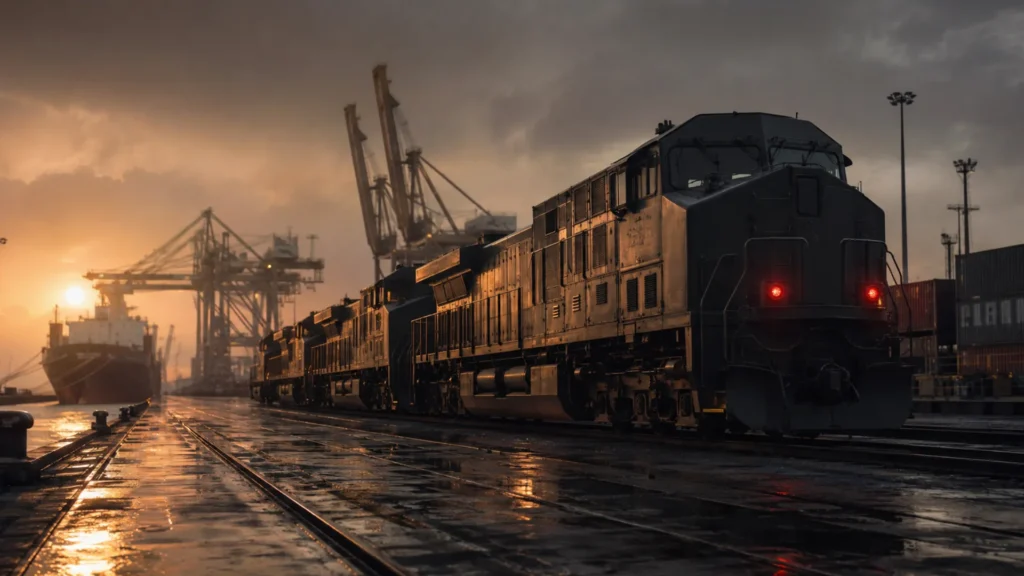
Johannesburg, 8 August 2026 — Private rail freight investment in South Africa now has hardware on the quay. On 1 August, the first eight Wabtec C28 locomotives arrived at the Port of Durban from New Zealand. Railways Africa reported the shipment on Friday. They form the opening consignment of Traxtion’s R1.8 billion rolling stock programme. In total, 46 locomotives arrive across four shipments over the next two years. Additionally, the company plans 920 wagons for a further R1.6 billion. The combined R3.4 billion commitment is the clearest signal yet of change. Rail reform has moved from access agreements to actual capacity.
The timeline is concrete. From Durban, the eight locomotives move to Traxtion’s Rail Services Hub in Pretoria. There, refurbishment and upgrades begin in September 2026. Commercial service follows. According to Traxtion, the locomotive investment alone adds capacity equivalent to approximately 4.5 million tonnes. Moreover, the programme claims 78% local procurement, 60% local content and 665 new permanent skilled jobs.
This private rail freight investment lands inside the reform this desk has tracked all year. Third-party access to the state-owned network is now operational policy. According to the Ctrack Transport and Freight Index, eleven private train operating companies have concluded access agreements. Meanwhile, government targets 250 million tonnes on the Transnet rail network by 2030. Transport Minister Barbara Creecy restated the figure at this year’s Southern African Transport Conference. Private capital arriving in locomotive form is exactly what that policy set out to produce.
The Shift
Why Private Rail Freight Investment Reaches Trucking
For road operators, the honest reading has two halves. First, road freight is not about to shrink. It carries about 87% of all freight payload in South Africa, and no rail programme changes that share quickly. Distribution, regional and time-sensitive work stays on trucks. Second, however, the pressure is selective. Rail’s recovery targets long-haul bulk and corridor container traffic first. Those are precisely the lanes where road pricing competes against rail. Consequently, the comfortable lane of today meets a stronger competitor from spring. Coal, chrome and Natcor container work face 4.5 million tonnes of new capacity.
The Numbers Behind the Rail Freight Programme
Fleet Impact
Pricing Truck Lanes Against Private Rail Freight Investment
The operators who navigate this well will treat it as a data question. Knowing which lanes earn their margin decides everything. Real per-lane costs determine whether rail competition is a threat or an exit from marginal work. Fleets using vehicle tracking across their operations can already see revenue and utilisation per lane. Similarly, litre-level fuel monitoring puts a real cost under each corridor. That is the number a rail comparison ultimately turns on. Eventually, a customer raises the rail option in a rate negotiation. The operator who knows their lane economics answers with figures.
- List your rail-competitive lanes now: long-haul bulk and Natcor corridor container work top the exposure
- Cost each exposed lane properly, fuel included: rail conversations are won and lost on real numbers
- Track September: refurbishment starts in Pretoria, and entry to service marks the clock on rate pressure
- Treat marginal long-haul work strategically: rail may be the exit that frees capacity for better lanes
Fleet Technology
How Measured Fleets Beat the Rail Freight Squeeze
Rail’s return does not threaten measured fleets. It threatens guessed ones. DigitFMS gives operators the per-lane picture. GPS tracking and route management show which corridors carry the work. Driver identification ties every trip to a named person, and D-Fuel tracks every fill, drain and burn against tank capacity and route data. As a result, clients have cut fuel theft by up to 95%. Lane costing then rests on measurements rather than averages. Competing providers such as Cartrack, Tracker, Netstar, Ctrack and MiX by Powerfleet serve road fleets as well. However, the next two years will reprice long-haul lanes one negotiation at a time. Operators holding real per-lane numbers will choose which work to defend and which to release. The rest will find out from their customers.
Key Numbers · Traxtion Programme
First shipment: 8 Wabtec C28 locomotives, arrived Port of Durban 1 August 2026.
Full programme: 46 locomotives over two years (R1.8bn) plus 920 planned wagons (R1.6bn); R3.4bn total.
Capacity: approximately 4.5 million tonnes equivalent from the locomotive investment.
Localisation: 78% local procurement, 60% local content, 665 permanent skilled jobs; refurbishment in Pretoria from September 2026.
Source: Traxtion figures as reported by Railways Africa, 7 August 2026.
Questions Answered
Frequently Asked Questions: Private Rail Freight Investment
What arrived at the Port of Durban on 1 August?
The first eight Wabtec C28 locomotives under Traxtion’s R1.8 billion rolling stock programme, shipped from New Zealand. Consequently, private rail capacity in South Africa now exists in steel rather than on paper.
How big is the full Traxtion rail investment?
R3.4 billion in total. The programme covers 46 locomotives across four shipments over two years, plus a planned 920 wagons. Traxtion estimates the locomotive investment alone adds capacity equivalent to about 4.5 million tonnes.
When do the locomotives enter service?
Refurbishment and upgrades begin at Traxtion’s Rail Services Hub in Pretoria in September 2026. Commercial service follows once that work completes.
Why does private rail investment matter for trucking?
Because rail’s recovery targets long-haul bulk and corridor container traffic first. Those are the lanes where road operators currently price against rail, so added rail capacity gradually pressures rates there.
Will rail take significant freight off the roads?
Gradually, and selectively. Road freight carries about 87% of all payload, per the Ctrack index, and keeps most of it. However, government targets 250 million tonnes on the Transnet network by 2030, and every added tonne comes from somewhere.
What local benefit does the programme claim?
According to Traxtion, the programme includes 78% local procurement, 60% local content and 665 permanent skilled jobs. Refurbishment happens in Pretoria.
What should road operators do about rail’s return?
Identify which lanes are rail-competitive, typically long-haul bulk and Natcor corridor work. Then track September’s entry to service, and price contracts on those lanes with the shift in mind.
Facts checked 8 August 2026. Source: Traxtion programme figures, reported by Railways Africa, with sector context from the Ctrack Transport and Freight Index Q2 2026. Related: our Q2 road freight analysis and Durban’s truck congestion plan.
© 2026 DigitFMS. All rights reserved.