
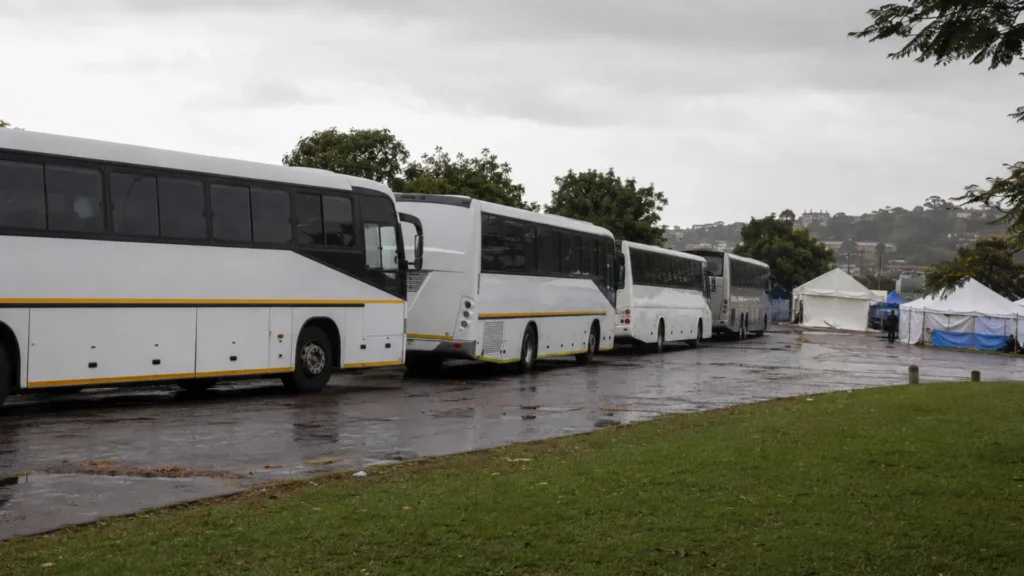
In a Durban park this week, about 4,000 people — many of them women and children — have been sheltering in the open, waiting for buses home. For fleet operators, the same scene marks the moment a forecast workforce risk became visible: the fleet driver shortage repatriation scenario is no longer a projection on a slide. IOL reports the number at Sherwood Hall Park grew from 75 on Sunday to roughly 4,000 by Friday. Home Affairs has set up a mobile unit to process voluntary repatriation, prioritising women and children. Al Jazeera reports Nigeria repatriated 260 nationals while Ghana, Mozambique and Zimbabwe moved hundreds home. This is a humanitarian situation first — and also the clearest signal yet that the cross-border driver pool is contracting, 17 days before the 30 June deadline.
Importantly, this analysis treats the displacement as the human crisis it is, then examines what the departures mean for fleet workforce planning, why cross-border routes face the sharpest exposure, and how operators can prepare responsibly while protecting the legally employed drivers who remain.
The Human Reality Behind the Fleet Driver Shortage Repatriation Story
Importantly, before any operational analysis, the facts of the situation deserve to be stated plainly. These are people, not statistics.
What is happening in the Durban field
GroundUp reports that more than 1,000 people initially fled the Burnwood informal settlement after residents demanded they leave. Subsequently, the number sheltering at the nearby Sherwood field swelled toward 4,000. Families arrived from across KwaZulu-Natal carrying what they could. Humanitarian organisations have provided blankets, mattresses, food, and baby supplies. Many of the women are heavily pregnant. Children have abandoned school exams. A representative of the Malawian embassy told reporters that most people said they were ready to leave because they no longer felt safe.
A regional movement, not an isolated event
Furthermore, the Durban field is one part of a wider movement. Al Jazeera reports five Mozambicans were killed in Mossel Bay, and more than 150 Malawians were moved out of the Western Cape over one weekend. Nigeria, Ghana, Mozambique and Zimbabwe have each repatriated hundreds of nationals this month. Additionally, about 150 people from Burundi, Ethiopia and Zimbabwe are sheltering at a government office near the Durban park. The South African government has assured neighbouring countries it will take measures to protect foreign nationals. President Ramaphosa directed that the national flag fly at half-mast on 13 and 14 June.
Why fleet operators should engage with this responsibly
Notably, fleet operators are not bystanders to this story — many employ drivers from the affected communities. Engaging with the workforce implications does not mean reducing displaced people to a labour-supply question. Instead, it means recognising that the fleet industry has both a practical interest and an ethical responsibility: to plan for operational continuity while protecting and supporting the legally employed drivers who form part of these same communities. The analysis that follows holds both truths together.
From Forecast to Field: How the Fleet Driver Shortage Repatriation Became Real
Specifically, earlier analysis in this series treated the driver shortage as a modelled risk. The Durban field converts that model into something observable.
Forecast stage: what the RFEA data predicted about fleet driver shortage
Our coverage of Ramaphosa’s immigration address cited Road Freight Employers Association data: roughly 6,756 foreign nationals among 44,021 truck drivers, about 15 percent of the workforce. At that stage, the warning was conditional — if repatriations accelerated and inspections intensified, a workforce gap could open. Similarly, the five-point crackdown analysis noted that 10,000 new inspectors would target the sector. Both were forecasts built on data, not yet visible on the ground.
Field stage: fleet driver shortage repatriation made visible in Durban
Now the forecast has a location. Thousands of people are physically leaving from Durban — the port city where fleet operators run the busiest freight corridor in the country. Crucially, the departures are concentrated in exactly the region and the communities from which many cross-border drivers are drawn. While not every person in the field is a truck driver, the same forces moving them — the threats, the 30 June pressure, the loss of safety — act on the foreign drivers in the fleet workforce too. The model predicted a contraction. The field shows it beginning.
Timing: 17 days before the convergence hits fleet operations
Consequently, the timing compounds the risk. The departures accelerate as the 30 June deadline approaches and the 1 July diesel levy looms. A fleet operator could face a thinner driver pool, a threatened corridor shutdown, and a permanent fuel cost increase within the same fortnight. The workforce dimension is the one that takes longest to fix — vehicles can be rerouted in minutes, but an experienced cross-border driver cannot be replaced in a day.
Why Cross-Border Routes Carry the Sharpest Fleet Driver Shortage Repatriation Risk
Notably, the exposure is not evenly distributed. Cross-border operations depend most heavily on the experience that is hardest to replace.
Language and border familiarity that take years to build
Specifically, a driver who has run the Beitbridge corridor for years knows the documentation rhythm, the customs timing, and the route conditions in a way no manual captures. A Mozambican driver who speaks Portuguese clears the Lebombo border faster than a colleague who does not. These capabilities took years to develop. When such drivers leave, the knowledge leaves with them, and a replacement needs structured training to rebuild even part of it.
The corridors most affected by the fleet driver shortage
Moreover, the corridors connecting South Africa to the countries now repatriating citizens face the most direct exposure. The Beitbridge route to Zimbabwe, the Lebombo route to Mozambique, and the routes serving Malawi all depend partly on drivers from those nations. As those drivers return home, the operators who serve those corridors lose both capacity and capability simultaneously. Domestic-only fleets feel the effect less; cross-border specialists feel it most.
Six Responsible Actions on the Fleet Driver Shortage Repatriation Risk
Crucially, the right response protects the business and the people in it. These actions do both.
Protect and verify the drivers you have
First, ensure every foreign driver’s documentation is current and verifiable. A legally employed driver with valid papers should be able to keep working without disruption. Verifying documentation now protects these drivers from wrongful interference and protects the fleet from losing experienced staff to avoidable confusion. Brief drivers on their rights and provide them with documentation they can present if questioned. Importantly, stability and support reduce turnover precisely when experienced drivers are hardest to replace.
Next, audit the current driver complement to map the exposure. Identify which routes depend on which drivers and where the reliance on hard-to-replace experience is concentrated. This audit is not about flagging people for removal — it is about understanding where the fleet is vulnerable so that support and contingency can be directed accurately.
Build replacement capability before any gap opens
Additionally, identify South African drivers with valid PDP licences and begin cross-training now. Cross-border competence takes time to build. Starting the training before a gap opens means the fleet has bench strength ready rather than scrambling after a driver leaves. Pair experienced cross-border drivers with trainees while that experience is still available to transfer.
Furthermore, plan staffing for both a mild and a severe scenario. A mild scenario sees a handful of drivers depart over months. A severe scenario sees a meaningful share leave before 30 June. Having both plans ready means the fleet can scale its response to whatever actually unfolds, rather than being caught between optimism and panic.
Use technology to hold the knowledge and the records
Then, use driver identification technology to maintain accurate qualification records. Knowing exactly which drivers are qualified for which routes, with which documentation, lets a fleet manager redeploy capability quickly and prove compliance during any inspection. Finally, capture route knowledge in shared systems — GPS route histories, documented border procedures, and digital checklists preserve some of the experience that would otherwise leave with a departing driver.
Technology That Eases the Fleet Driver Shortage Repatriation Pressure
Notably, the right systems both protect drivers and preserve the operational knowledge a fleet cannot afford to lose.
DigitFMS integrates wireless driver identification, GPS tracking with route history, AI dashcams, and digital documentation on a single dashboard. The driver identification system maintains a verifiable record of who is authorised and qualified for each route — protecting legally employed drivers and giving managers an accurate picture of capability. GPS route histories capture the corridor knowledge that experienced drivers carry, so a trainee can study real routes rather than learn from scratch. The company’s KZN franchise operators understand the Durban cross-border corridors directly.
Equally, Cartrack, Tracker, Netstar, Ctrack and MiX by Powerfleet provide driver management and route tracking platforms. The critical capability during a fleet driver shortage repatriation period is institutional memory: systems that hold route knowledge, qualification records, and documentation so that capability survives individual departures. Fleet operators who capture this knowledge digitally retain part of what they would otherwise lose entirely when an experienced driver goes home.
Outlook: The Fleet Driver Shortage Repatriation Risk Sits Inside a Human Crisis
Ultimately, the field in Durban is, above all, a humanitarian situation. Thousands of people, including children, are sheltering in the cold and waiting for buses home because they no longer feel safe. That reality should anchor every business decision made in response to it. Fleet operators planning for a workforce gap are planning around the lives of people who, in many cases, are their own employees, colleagues, and neighbours.
Looking ahead, the operational risk is real and worth preparing for. Cross-border capacity may tighten. Experienced drivers may leave. The convergence with the 30 June deadline and the 1 July levy could compress the pressure into a single difficult fortnight. Fleet operators who audit their exposure, protect their legal drivers, cross-train replacements, and capture route knowledge will navigate the contraction with the least disruption to their operations and their people.
Ultimately, the fleet driver shortage repatriation story asks the industry to hold two responsibilities at once. The first is operational: keep freight moving through a period of genuine workforce uncertainty. The second is human: treat the drivers affected by this crisis — those leaving and those staying — with the stability, documentation, and support they deserve. The fleets that manage both will not only survive the contraction. They will be the ones experienced drivers want to return to when the country, eventually, turns the corner.
Frequently Asked Questions
What is happening with repatriation in Durban?
About 4,000 Malawian nationals, including many children, have gathered at Sherwood Hall Park seeking voluntary repatriation after fleeing threats and attacks. Numbers grew from 75 on Sunday to roughly 4,000 by Friday. Home Affairs set up a mobile unit prioritising women and children. Nigeria, Ghana, Mozambique and Zimbabwe have also repatriated hundreds this month.
How does repatriation create a fleet driver shortage?
RFEA data shows roughly 6,756 foreign nationals among 44,021 truck drivers — about 15 percent. Many cross-border drivers come from the countries now repatriating citizens. As foreign workers leave amid the unrest and 30 June pressure, the pool of drivers familiar with regional corridors shrinks. Cross-border routes feel it most.
Why does this matter for cross-border routes specifically?
Cross-border drivers provide capabilities that take years to replace: language skills, border familiarity, documentation knowledge, and route experience. A Mozambican driver clears Lebombo in Portuguese faster than a colleague who cannot. When these drivers leave, a replacement needs structured training on procedures the experienced driver carried in their head.
Is this the workforce gap earlier analysis predicted?
Yes. Coverage of Ramaphosa’s address and the five-point crackdown modelled a driver shortage if repatriations accelerated. That was a forecast from workforce data. The Durban field makes it visible — thousands leaving from the port city where fleet operators run the N3, 17 days before 30 June. The model has become measurable.
Could the shortage affect delivery capacity before 30 June?
Potentially. If meaningful numbers of cross-border drivers leave in the next two weeks, operators on the Beitbridge, Lebombo and Maseru corridors could face capacity constraints just as the shutdown and the diesel levy arrive. Contingency staffing plans should be in place before that window, not improvised during it.
How can fleet operators support their legal drivers?
Ensure every foreign driver’s documentation is current and verifiable so legally employed drivers are protected from wrongful disruption. Brief them on their rights and provide documentation they can present if questioned. Maintain clear records linking each driver to their qualifications. Stability and support reduce turnover when experienced drivers are hard to replace.
What should fleet operators do about the shortage risk?
Audit the driver complement to map exposure. Verify all documentation. Identify South African PDP holders to cross-train now, pairing them with experienced drivers. Plan for mild and severe scenarios. Use driver ID technology for qualification records. Capture route knowledge in shared systems before it leaves with departing drivers.
Sources
IOL — “Urgent repatriation efforts for Malawians in Durban as numbers surge”, 12 June 2026; growth from 75 Sunday to 4,000 Friday, Home Affairs mobile unit, Sherwood Hall, women and children prioritised, Adam Ali Malawian embassy · GroundUp — “More than 1,000 Malawians flee Durban informal settlement”, 10 June 2026; Burnwood departure, Sherwood field, eThekwini metro police Boysie Zungu, embassy repatriation arrangements
Al Jazeera — “Malawians and Nigerians flee South Africa amid xenophobic threats”, 11 June 2026; 3,000+ in Durban field, Nigeria 260 repatriated, Mossel Bay five killed, 150 from Western Cape, 150 Burundi/Ethiopia/Zimbabwe at government office · News Central TV — “Malawians Flee Durban Amid Xenophobic Attacks”, June 2026; numbers nearly doubling in 24 hours, embassy women-first plan, June 15 landlord deadline account
SAnews / Presidency — National flag at half-mast 13-14 June 2026 · allAfrica / NewZimbabwe — ZCTU statement on migration crisis, Zimbabweans largest affected population · DigitFMS — Ramaphosa immigration fleet drivers (8 June), immigration crackdown five-point plan (8 June), June shutdown fleet risk (11 June), Hormuz escalation fleet costs (12 June), border security Beitbridge (1 June)
© 2026 DigitFMS. All rights reserved.