
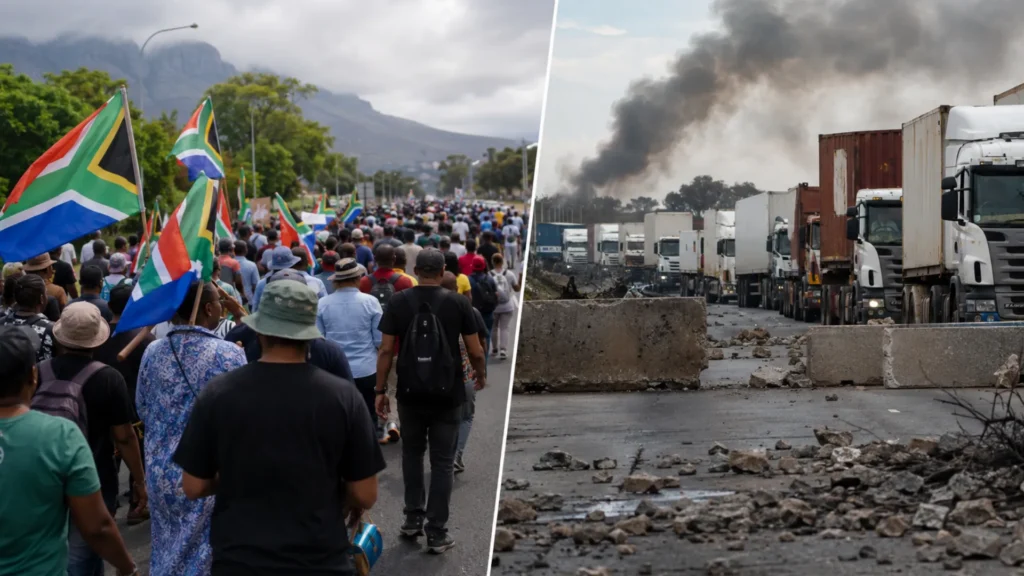
The June shutdown fleet risk just split into two — and fleet operators who only heard the “no violence” headline yesterday are dangerously underestimating what remains. March and March leader Jacinta Ngobese-Zuma told supporters at Durban City Hall yesterday: “There is no one I am asking to loot. There is no one who will come and you have to beat him or her.” SABC confirmed she distanced the movement from violence. Specifically, activist leader Ndabandaba separately stated: “There will be no riots. There will be no marches.” ANC secretary general Mbalula declared the ANC will not support the shutdown. However, the ATDF-ASA nationwide truck shutdown targeting freight corridors on the same date remains fully active — and ATDF-ASA has not called for no violence, has not stood down, and already blockaded the N3 on 30 May as a preview.
Importantly, this analysis separates the two movements targeting 30 June, assesses how Ngobese-Zuma’s directive changes the general unrest risk while leaving the freight corridor risk untouched, and provides the 19-day action plan fleet operators need to prepare for both scenarios simultaneously.
What Ngobese-Zuma Said: The June Shutdown Fleet Risk Directive From Durban City Hall
Crucially, Briefly.co.za reports Ngobese-Zuma spoke at the MK Party march in Durban on 10 June — confirming the alliance between March and March and Julius Malema’s party. Her message carried two components: an operational directive for supporters and a political warning for government.
Marching orders: no looting changes the June shutdown fleet risk profile
Specifically, Ngobese-Zuma told the crowd: “I want you to do only one thing on June 30, or even two: there is no one I am asking to loot.” She warned that violence would make South Africans look like “vigilantes” and invited international condemnation. Furthermore, she explicitly distanced March and March from recent looting in Bloemfontein, saying: “We saw the protests in Bloemfontein today, and we don’t support that looting behaviour because it feeds exactly into the narrative of us being painted as vigilantes.” Ndabandaba reinforced this: “People mustn’t expect us to say on that day people must be killed, shops must be looted, or there must be vandalism.”
Political defiance: Ngobese-Zuma’s warning does not reduce the June shutdown fleet risk entirely
Nevertheless, in the same speech, Ngobese-Zuma dismissed Ramaphosa’s five-point plan as “not implementable” and accused government of “waiting for some holocaust to happen” so it could deploy the SANDF against its own citizens. Additionally, she rejected the “Zuma stokvel” label, joking: “If it’s a Zuma stokvel, I did not care as she, too, is a Zuma.” She confirmed the 30 June deadline remains active. March and March has not surrendered its demands — it has only renounced violence as a tactic. The political pressure on government to act before 30 June remains at maximum intensity.
Two Movements, One Date: Why the June Shutdown Fleet Risk Requires Separate Assessment
Consequently, fleet operators must understand that “30 June” does not describe a single event. It describes two separate movements with different tactics, different targets, and different fleet implications — converging on the same date.
March and March: political protest with reduced June shutdown fleet risk
Specifically, March and March targets undocumented foreign nationals broadly. Its 30 June deadline demands government enforcement of immigration laws. Ngobese-Zuma now explicitly calls for peaceful engagement. The movement has MK Party backing but ANC opposition. Consequently, if supporters follow the no-violence directive, March and March’s 30 June action resembles a political demonstration — not the July 2021 supply chain catastrophe. Accordingly, the general civil unrest risk — mall shutdowns, retail looting, wholesale supply chain collapse — decreases if the no-violence directive holds.
ATDF-ASA: industrial action with unchanged June shutdown fleet risk
In contrast, ATDF-ASA targets foreign truck drivers employed at below-minimum wages. Its 30 June action involves physically blockading freight corridors. On 30 May, ATDF-ASA supporters blockaded the N3, stranded 50 trucks, and stole keys. On 31 May, SAPS allegedly fired live rounds at trucks. The secretary general faced arrest. Notably, none of these escalations prompted ATDF-ASA to stand down. Ngobese-Zuma’s no-violence call does not bind ATDF-ASA. Importantly, her directive applies to March and March supporters only. The truck shutdown — the action that directly blockades freight corridors, strands fleet vehicles, and threatens drivers — remains fully active.
The critical distinction for fleet operators assessing June shutdown risk
In summary, therefore, March and March threatens general disruption that may not materialise as violence. ATDF-ASA threatens specific corridor blockades that already materialised on 30 May. Fleet operators who read yesterday’s headlines and concluded “the 30 June risk is lower” confused the political protest with the industrial action. The political protest may indeed be less violent. The industrial action that blocks the N3, steals truck keys, and strands 50 vehicles operates under entirely different leadership, entirely different grievances, and entirely different tactics. That industrial action has not reduced, has not paused, and has not called for no violence.
The MK Party Alliance: What Political Backing Means for June Shutdown Fleet Risk
Additionally, Ngobese-Zuma spoke at the MK Party march — not independently. This alliance carries specific fleet implications.
MK Party gives March and March parliamentary legitimacy and fleet corridor influence
Notably, MK Party secretary-general Nomvalo backed the 30 June deadline and demanded undocumented foreigners leave. Similarly, Nomvalo holds a parliamentary position — elevating the demand from street activism to legislative advocacy. Furthermore, MK Party has significant support in KwaZulu-Natal — the province where the N3 runs, where ATDF-ASA blockaded trucks, and where the Comrades Marathon closes the N3 this Sunday. Political backing from a parliamentary party increases the probability that government negotiates rather than suppresses — but it also increases the political stakes if 30 June passes without visible action.
ANC opposition creates a coalition fault line affecting fleet corridor stability
Meanwhile, Mbalula’s statement that the ANC will not support the shutdown exposes the GNU coalition tension. The ANC governs alongside the DA in the GNU. MK Party opposes the GNU from outside. If the 30 June deadline destabilises the coalition — particularly with the Phala Phala impeachment committee running simultaneously — the rand weakens and diesel prices rise on top of the July levy reinstatement. Political instability compounds the operational corridor risk.
SANDF on Standby: How Military Deployment Changes the June Shutdown Fleet Risk
Furthermore, Ngobese-Zuma accused the government of preparing a military response. For fleet operators, SANDF deployment creates its own set of operational considerations.
Military checkpoints add delays to fleet corridors regardless of shutdown outcome
Critically, if SANDF deploys to support SAPS on 30 June, fleet operators should expect military checkpoints on major corridors — similar to the 24/7 N1 roadblocks after the Beitbridge bust. Vehicles with complete documentation and GPS tracking data clear checkpoints faster. Vehicles without face extended searches. Critically, military deployment may persist beyond 30 June if tensions continue — creating semi-permanent delays on corridors that already face the Comrades closure (14 June), the diesel levy (1 July), and ongoing N3 roadworks.
19-Day Countdown: The Updated June Shutdown Fleet Risk Action Plan
Clearly, the no-violence directive from March and March changes one variable. The other variables — ATDF-ASA truck shutdown, SANDF deployment, diesel levy, political instability — remain unchanged. Here is the updated action plan.
Week 1 (11-17 June): test, geofence, and brief for fleet risk
Use the Comrades Marathon on Sunday 14 June as a live N3 rerouting test. Geofence the N3 Durban-PMB corridor on Saturday. Dispatch test vehicles on alternative routes Sunday. Measure actual transit times. Verify alert systems. Simultaneously, brief every driver on the two-movement distinction: March and March says no violence; ATDF-ASA has not. Drivers encountering ATDF-ASA supporters on corridors should not engage, should contact the control room, and should document everything via dashcam.
Week 2 (18-24 June): stockpile, document, and lock for fleet operations
Subsequently, stockpile diesel at the June confirmed price of R27.93 before the 30 June disruption and 1 July levy convergence. Complete all driver documentation audits — 10,000 inspectors could arrive during or after the shutdown period. Lock vehicle financing at current rates before the July MPC. Activate fuel surcharges on transport contracts with clients. Every preparation that requires supplier or client cooperation should conclude this week — negotiations become harder during a crisis.
Week 3 (25-30 June): execute the contingency for fleet corridor protection
Finally, enter the shutdown window with full tanks, pre-programmed routes, briefed drivers, and active geofencing. Complete all non-essential N3 movements by Wednesday 25 June. Hold Thursday 26 and Friday 27 deliveries to essential-only on target corridors. Monitor ATDF-ASA social media and news channels for mobilisation signals. If ATDF-ASA confirms direct action, suspend all N3 dispatches from Friday evening. If no mobilisation signal appears by Saturday 28, cautiously resume operations with enhanced monitoring through 30 June.
Technology That Manages Both June Shutdown Fleet Risk Scenarios Simultaneously
Notably, fleet operators face a scenario where the general unrest risk decreases (March and March no-violence directive) while the corridor-specific risk remains (ATDF-ASA truck shutdown). Tracking technology manages both simultaneously.
DigitFMS integrates GPS tracking with geofencing, AI dashcams with cloud upload, wireless driver identification, panic button activation, and route management on a single dashboard. When the fleet manager geofences the N3 corridor, every vehicle approaching the zone triggers an alert — whether the threat comes from ATDF-ASA blockades or general unrest. Dashcam footage documents any confrontation for insurance, prosecution, and client communication. Panic buttons connect drivers to the control room instantly. The company’s KZN franchise operators monitor N3 conditions daily and will provide real-time intelligence throughout the 30 June period.
Similarly, Cartrack, Tracker, Netstar, Ctrack, and MiX by Powerfleet all provide geofencing and real-time tracking. The critical requirement for the June shutdown fleet risk period is the ability to manage two threat profiles simultaneously: general unrest (reduced but not eliminated) and corridor-specific industrial action (unchanged). Fleet operators whose technology distinguishes between these threats — alerting on corridor blockades while monitoring for general unrest — navigate 30 June with precision rather than fear.
Outlook: The June Shutdown Fleet Risk Has Narrowed — Not Disappeared
Looking ahead, Ngobese-Zuma’s no-violence directive is genuinely significant. If March and March supporters follow her lead — no looting, no beatings, no vandalism — the general supply chain disruption risk drops substantially compared to the July 2021 template. Malls, retail stores, and wholesale distribution may operate through 30 June without the catastrophic closures that cost R50 billion five years ago.
Nevertheless, fleet operators must resist the temptation to downgrade 30 June preparations. ATDF-ASA’s truck shutdown remains the corridor-specific threat that directly blockades freight. That threat did not receive a no-violence directive yesterday. It received nothing — because ATDF-ASA and March and March operate independently under different leadership with different tactics. ATDF-ASA organised the N3 blockade on 30 May. Its supporters stole keys from drivers. SAPS fired live rounds in response to ATDF-ASA action. None of that changed yesterday.
Ultimately, the June shutdown fleet risk has narrowed from “general unrest plus corridor blockade” to “corridor blockade with reduced general unrest.” That is an improvement. It is not a resolution. Fleet operators have 19 days. The Comrades closes the N3 in three days as a dress rehearsal. The full diesel levy returns 20 days later. ATDF-ASA has 19 days to decide whether it follows Ngobese-Zuma’s lead or follows through on the blockade it previewed on 30 May. Fleet operators who prepare for the blockade and hope for peace will navigate either outcome. Fleet operators who assume peace and skip the preparation will not.
Frequently Asked Questions
What did Ngobese-Zuma say about June shutdown fleet risk?
Ngobese-Zuma told supporters: “There is no one I am asking to loot.” Violence would undermine the movement, she warned. Her speech at the MK Party march in Durban on 10 June confirmed the alliance. SABC confirmed she distanced March and March from violence. Ndabandaba separately stated: “There will be no riots.”
Does the no-violence call reduce fleet corridor risk?
Importantly, it reduces general civil unrest risk — less likely to see July 2021-style looting and supply chain collapse. However, ATDF-ASA’s truck shutdown targeting freight corridors remains fully active. Notably, ATDF-ASA blockaded the N3 on 30 May and has not stood down. The corridor-blocking, key-stealing fleet threat is unchanged.
What is the difference between March and March and ATDF-ASA?
Specifically, March and March targets undocumented foreigners broadly through political protest. Now calls for peaceful engagement. ATDF-ASA targets foreign truck drivers through physical corridor blockades. Already demonstrated on the N3. Different leadership, different grievances, different tactics. Fleet operators face the ATDF-ASA threat directly.
Has ATDF-ASA called off the truck shutdown?
No. The nationwide truck shutdown remains confirmed for 30 June. ATDF-ASA blockaded the N3 on 30 May, stranded 50 trucks, stole keys. SAPS fired live rounds on 31 May. The secretary general faced arrest. None of this prompted ATDF-ASA to stand down. Ngobese-Zuma’s directive binds March and March only.
Is the MK Party supporting the June shutdown?
Yes. Nomvalo backed the 30 June deadline. Ngobese-Zuma spoke at the MK Party march. ANC’s Mbalula says ANC will NOT support it. The political split adds instability: MK Party backs the movement from outside the GNU while ANC opposes it from inside. Coalition tension weakens the rand and raises diesel costs.
What is the SANDF deployment for 30 June?
Military placed on standby to support SAPS. Ngobese-Zuma accused government of “waiting for some holocaust” to justify deployment. For fleet operators, SANDF means military checkpoints on corridors — similar to post-Beitbridge N1 roadblocks. Complete documentation and GPS tracking data clear checkpoints faster.
What should fleet operators do with 19 days remaining?
Distinguish between the two threats — prepare for ATDF-ASA regardless. Test N3 alternatives at the Comrades on Sunday. Geofence corridors. Stockpile diesel before 27 June. Complete documentation audits. Lock financing. Brief drivers. Enter 30 June with full tanks, pre-programmed routes, and active monitoring.
Sources
IOL — “Anti-migrant march organiser urges peaceful conduct ahead of June 30 shutdown”, 10 June 2026; Ngobese-Zuma “no one I am asking to loot,” MK Party march, Durban City Hall, Mbalula ANC opposition · Briefly.co.za — “Jacinta Ngobese-Zuma gives marching orders for 30 June”, 10 June 2026; Newzroom Afrika, no violence directive, “Zuma stokvel” response · African News Agency — “Anti-migrant march organiser urges peaceful conduct”, 10 June 2026; engagement over violence
SABC News — “Ngobese-Zuma distances March and March movement from violence”, 9 June 2026; Ramaphosa exploitation warning, Bloemfontein distancing · Inside Politic — “March and March issues 10 demands”, 28 May 2026; refugee permit suspension, Checkers/McDonald’s demands · The Mercury — “Anti-illegal immigration group reassures public”, 28 May 2026; Ndabandaba “not an event,” no riots, no marches · New Zimbabwe — “No shutdown on June 30 vows government”, 7 June 2026; government position
DigitFMS — 30 June shutdown contingency (28 May), N3 truck shutdown (30 May), N3 aftermath live rounds (31 May), Comrades Marathon fleet routes (10 June), immigration crackdown five-point plan (8 June), Ramaphosa immigration address (8 June), Madlanga verdict (6 June), confirmed diesel drop (2 June)
© 2026 DigitFMS. All rights reserved.