
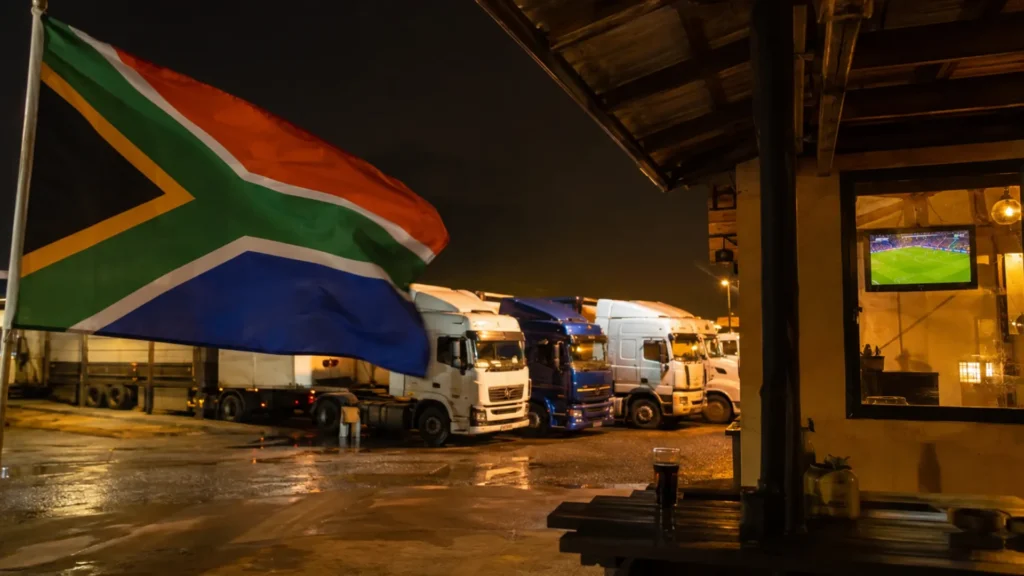
World Cup fleet operations face the most concentrated disruption window in South African logistics history — and it starts tonight at 9pm when 60 million South Africans stop what they are doing to watch Bafana Bafana play Mexico. ESPN confirms kickoff at Estadio Azteca at 9pm CAT — exactly 16 years to the day since Siphiwe Tshabalala’s thunderbolt opened the 2010 tournament. Hugo Broos sends Lyle Foster, Ronwen Williams, Teboho Mokoena, and Oswin Appollis onto the field against co-hosts ranked 46 places above Bafana. Specifically, the match falls squarely in the overnight fleet operations window. UKG estimates $17 billion in lost global productivity across the tournament. In 20 days, fleet operators face: tonight’s kickoff, Sunday’s Comrades N3 closure, the 30 June shutdown, and the 1 July diesel levy. No other period in 2026 stacks four disruptions onto the same calendar.
Importantly, this analysis maps the 20-day collision between the World Cup and every other fleet pressure, calculates the match-night productivity impact on overnight operations, and provides the actions fleet managers must take before tonight’s 9pm kickoff changes the operational rhythm for 39 days.
Tonight at 9pm: How the World Cup Opener Hits Fleet Operations Immediately
Specifically, Al Jazeera confirms the tournament opener at Estadio Azteca — the first stadium in history to host three World Cup opening matches (1970, 1986, 2026). Over 80,000 spectators fill the stands. SABC 1, SABC 3, SuperSport, and SportyTV broadcast nationally. Every truck stop with a television, every control room with a screen, and every depot break room becomes a viewing venue at 9pm.
9pm kickoff falls in the overnight World Cup fleet operations window
Crucially, the 9pm CAT start time overlaps with the fleet industry’s overnight shift changeover. Drivers depart depots between 7pm and 10pm for overnight long-haul routes. Control room operators begin night shifts at the same time. Security personnel rotate at depot facilities. A 9pm kickoff means drivers who should be departing on schedule instead delay departure to watch the first half. Furthermore, control room operators split attention between monitoring screens and match screens. Security guards watch phones instead of perimeters. The 90-minute match window — plus 30 minutes of pre-match and post-match coverage — removes approximately two hours of focused attention from fleet operations on every match night.
Driver distraction during World Cup match nights threatens fleet safety
Additionally, drivers already on the road at 9pm face a specific temptation: pulling over at truck stops to watch, or worse, streaming on phones while driving. A driver watching a phone screen at 80km/h on the N3 at night is a collision waiting to happen. Fleet operators must brief every driver before tonight’s kickoff: watching while driving violates company policy, endangers lives, and will appear on the AI dashcam footage that the control room reviews. A firm pre-match briefing prevents the post-match accident investigation.
Depot security gaps open during World Cup fleet operations match windows
Notably, depot security faces the same distraction risk. A guard watching the match on a phone at the gate is not watching the perimeter. Fuel theft, vehicle tampering, and unauthorised access all become more likely during the 90-minute window when attention shifts. For depots with D-Fuel monitoring, the system detects anomalies regardless of whether the security guard is watching. For depots without automated monitoring, the match window is a vulnerability window.
The 20-Day Collision: Four Events Hit World Cup Fleet Operations Simultaneously
Consequently, fleet operators face a concentration of disruption events that has no precedent in South African logistics.
Day 1 (tonight): World Cup opener disrupts fleet operations from 9pm
Every metric affected: driver departure times delayed, control room attention split, depot security distracted, overnight delivery schedules shifted. If Bafana score — as Tshabalala did in 2010 — celebrations extend the disruption beyond the final whistle. Vuvuzelas, street gatherings, and spontaneous celebrations could affect urban fleet routes in Johannesburg, Durban, and Cape Town late into the night.
Day 3 (Sunday 14 June): Comrades Marathon closes fleet routes for 21 hours
Three days after the opener, the Comrades Marathon shuts the N3 between Durban and Pietermaritzburg from midnight Saturday to 9:30pm Sunday. Fleet operators face a World Cup Thursday night, a recovery Friday, a Comrades closure Saturday midnight through Sunday, then resume normal operations Monday while preparing for the next Bafana match. Similarly, the same N3 corridor faces the 30 June shutdown 16 days later — making Sunday both a Comrades event and a shutdown dress rehearsal.
Day 19 (30 June): shutdown meets World Cup fleet operations pressure
The ATDF-ASA truck shutdown targets 30 June — a Monday. If Bafana advance to the round of 32, the country will be deep in World Cup euphoria. If Bafana exit, frustration compounds the shutdown tensions. Either outcome overlays national emotion onto an already volatile industrial action. Fleet operators managing the shutdown cannot separate the operational risk from the emotional context the World Cup creates.
Day 20 (1 July): the diesel levy returns during the World Cup period
The full R3.93 diesel levy returns on 1 July — the day after the shutdown. Diesel jumps from R27.93 to approximately R32 or higher. Fleet operators face permanent cost increases while simultaneously managing World Cup productivity loss, post-shutdown recovery, and the emotional state of a nation watching its team play on the global stage. No financial planning model accounts for all four variables hitting the same month.
$17 Billion in Lost Productivity: What Global Data Tells Us About World Cup Fleet Operations Impact
Challenger, Gray & Christmas calculated that if every employed American soccer fan took a single day off, US employers would lose $30 billion. UKG estimated $17 billion globally. South African figures are not separately published, but the pattern translates directly to fleet operations.
Match-night fleet productivity drops measurably on every World Cup evening
Research from previous tournaments shows productivity drops 20-35% on match days in countries with competing teams. For fleet operators, this translates to: delayed departures, extended loading times, reduced overnight kilometre coverage, and increased unplanned stops. Furthermore, the effect persists the morning after — drivers who watched late matches arrive at depots tired, reducing reaction times and increasing accident risk during the morning shift. A fleet that normally dispatches 20 vehicles by 10pm may dispatch 15 on match nights. Five vehicles delayed by two hours each represent 10 vehicle-hours of lost productivity per match night.
39 days of cumulative World Cup fleet operations disruption
The tournament runs from 11 June to 19 July — 39 days with matches nearly every day. Bafana play three group matches minimum (11, 18, 24 June). If they advance, knockout matches follow in early July. However, even when Bafana are not playing, other matches at 3pm, 6pm, and 9pm CAT attract viewership. Accordingly, fleet operators should expect reduced productivity on match days throughout the tournament — not just on Bafana nights. A fleet manager who plans for three disrupted nights underestimates a 39-day event.
The Bafana Factor: How World Cup Results Change Fleet Operations Dynamics
Bafana Bafana’s tournament trajectory directly affects fleet operational conditions — and both success and failure carry fleet implications.
If Bafana win tonight: celebration disrupts urban fleet routes
A Bafana victory at the Azteca would generate the biggest South African sporting celebration since the 2010 opener. Streets in Johannesburg, Durban, Cape Town, and Pretoria would fill with celebrating fans late into the night. Urban fleet vehicles on delivery routes face traffic congestion, road closures near fan zones, and the general unpredictability of large crowds. Crucially, the celebration is positive — but positive disruption is still disruption for a fleet vehicle attempting an 11pm delivery in Sandton.
If Bafana lose: frustration compounds the 30 June fleet tension
In contrast, a group-stage exit would leave the nation frustrated during the exact period when 30 June tensions peak. National disappointment from an early World Cup exit layered onto immigration anger, economic pressure, and the ATDF-ASA shutdown creates a volatile emotional environment. Fleet drivers operating on corridors during this period face heightened confrontation risk — not because of the World Cup itself, but because collective frustration lowers the threshold for conflict at roadblocks and checkpoints.
If Bafana advance deep: extended fleet operations disruption through July
If Bafana reach the round of 32 or beyond, match-night disruptions extend into July — overlapping with the diesel levy increase and the post-shutdown recovery period. Each advancement adds match nights with increasing emotional intensity. A quarter-final appearance would generate national fervour not seen since 2010. Fleet operators would face their most expensive diesel month (July at R32+), their post-shutdown logistics recovery, AND peak World Cup distraction simultaneously. Nonetheless, the fleet manager’s job remains the same regardless of the scoreline: vehicles must move, deliveries must arrive, and drivers must stay safe.
Five Actions Before Tonight’s 9pm Kickoff for World Cup Fleet Operations
Brief every driver before they leave the depot today. Tonight is not a normal Thursday night. The message: enjoy the World Cup, support Bafana — but not while operating a fleet vehicle. Watching on a phone while driving is a dismissible offence, a dashcam-documented violation, and a life-threatening decision. Drivers who want to watch should complete their routes before 9pm or find a safe stopping point.
Next, schedule critical overnight deliveries to depart before 8pm or after 11:30pm. Dispatching a vehicle at 9pm on a Bafana match night invites delays. Departures before 8pm clear the depot before match distraction sets in. Departures after 11:30pm avoid the match window entirely. The 90-minute gap is predictable — build the schedule around it rather than fighting it.
Furthermore, ensure control rooms maintain full staffing and attention protocols during match windows. Designate a dedicated monitor who does NOT watch the match during the 9-11pm window. Rotate the responsibility across match nights so no single operator carries every game. The control room must function at full capacity when drivers, depots, and public roads are at reduced capacity.
Deploy monitoring, manage celebrations, and plan for 39 days
Activate enhanced dashcam monitoring during match windows. AI dashcams detect phone usage, distracted driving, and unauthorised stops. Fleet managers who review match-night footage the following morning send a clear signal: the system watches even when the nation watches football. Equally important, set GPS alerts for vehicles that stop unexpectedly between 9pm and 11pm on match nights — an unplanned stop during kickoff suggests the driver is watching rather than delivering.
Finally, build the World Cup into the 30 June contingency plan as an emotional overlay. The shutdown arrives during the tournament. National mood — whether euphoric from a Bafana victory or frustrated from an exit — directly affects protest intensity, driver behaviour, and public willingness to participate in or resist the shutdown. Fleet managers who factor in the World Cup’s emotional contribution to 30 June make better risk assessments than those who treat the shutdown as an isolated industrial event.
Technology That Maintains World Cup Fleet Operations Through 39 Days of Disruption
Critically, fleet management technology provides the consistency that human attention cannot guarantee during a World Cup — monitoring every vehicle, every route, and every driver regardless of the scoreline.
DigitFMS integrates GPS tracking with geofencing, AI dashcams with phone-detection and cloud upload, D-Fuel litre-level monitoring, wireless driver identification, and real-time alerts on a single dashboard. If a driver stops unexpectedly at 9:15pm, the system flags it. Fuel draining from a depot tank during the match triggers the sensor automatically. A vehicle deviating from its route while the control room operator watches the second half fires a geofence alert without human input. The technology does not care about the score. It monitors continuously for 39 days while the nation watches football.
Similarly, Cartrack, Tracker, Netstar, Ctrack, and MiX by Powerfleet all provide AI dashcam monitoring and GPS tracking that function independently of human attention. The critical requirement during World Cup fleet operations is automated alerting that catches the incidents human operators miss during match windows. A system that depends on a control room operator watching a screen fails when that operator watches a different screen. A system that alerts automatically succeeds regardless.
Outlook: World Cup Fleet Operations Define the Most Challenging Period of 2026
At 9pm tonight, Bafana Bafana walk onto the Azteca pitch — and World Cup fleet operations challenges begin. For 39 days, every match night tests fleet productivity, driver discipline, depot security, and control room focus. The nation will celebrate or commiserate. Fleet vehicles must still move.
Looking ahead, the next 20 days compress more disruption into a shorter window than any period in South African fleet history. World Cup tonight. Comrades Sunday. Shutdown 30 June. Levy 1 July. Each event alone requires contingency planning. Together, they demand a fleet management approach that assumes disruption is the default — and builds operations around technology, automation, and pre-planned responses rather than human attention that the World Cup will inevitably capture.
Ultimately, World Cup fleet operations success over the next 39 days depends on one principle: the technology monitors while the nation watches. GPS tracking does not pause for a penalty shootout. AI dashcams do not switch off for a Bafana goal. Fuel sensors do not care about the group standings. Fleet operators who deploy these systems — and trust them to maintain vigilance when human attention drifts to the Azteca, to the fan zone, to the truck stop television — will emerge from the World Cup period with their vehicles, their cargo, and their clients intact. Ke nako. It is time. For Bafana and for fleet operators alike — the next 39 days define the year.
Frequently Asked Questions
When do Bafana play and how does it affect World Cup fleet operations?
Tonight (11 June) vs Mexico at 9pm CAT. Then Czech Republic (18 June) and South Korea (24 June). All at 9pm CAT — directly in the overnight fleet window. Hugo Broos starts Lyle Foster, Ronwen Williams, Teboho Mokoena, and Oswin Appollis. SABC 1, SABC 3, and SuperSport broadcast nationally.
How does the 9pm kickoff affect fleet operations?
Falls in the overnight shift changeover. Drivers delay departures to watch. Control rooms split attention. Depot security faces distraction. Cold chain deliveries shift by two hours. The 90-minute match window plus coverage removes approximately two hours of focused fleet attention on every match night for 39 days.
What is the 20-day collision facing fleet operators?
World Cup opener tonight (11 June). Comrades N3 closure Sunday (14 June). ATDF-ASA shutdown and March and March deadline (30 June). Full diesel levy returns (1 July). Four events in 20 days on the same corridors. No precedent exists for this concentration of disruption in SA fleet history.
How much productivity does the World Cup cost globally?
UKG estimates $17 billion globally. Challenger calculated $30 billion if every US soccer fan took one day off. Research shows 20-35% productivity drops on match days in competing nations. SA figures are not published separately, but night-shift fleet operations face measurable output reduction on every match night.
What happens to fleet operations if Bafana advance?
Success extends match-night disruptions into July — overlapping with the diesel levy and post-shutdown recovery. Celebrations affect urban fleet routes. Advancing deep generates 2010-level national fervour during the most expensive diesel month. Exit generates frustration that compounds 30 June tensions. Either outcome affects fleet dynamics.
How does the Comrades compound World Cup fleet disruption?
World Cup Thursday night. Recovery Friday. Comrades closes the N3 from midnight Saturday through Sunday 9:30pm. Resume Monday. Next Bafana match the following Wednesday. Fleet operators face continuous disruption across the same N3 corridor for the entire period between the opener and the 30 June shutdown.
What should fleet operators do before 9pm tonight?
Brief drivers: no watching while driving. Schedule critical departures before 8pm or after 11:30pm. Staff control rooms with a dedicated non-match monitor. Activate dashcam monitoring for phone detection. Set GPS alerts for unplanned stops between 9-11pm. Build the World Cup into the 30 June contingency as an emotional overlay.
Sources
ESPN — “Mexico vs South Africa: Kick-off time, team news, how to watch FIFA World Cup opener”, 10 June 2026; 9pm CAT, Azteca Stadium, Broos squad, SABC broadcast details · Al Jazeera — “Mexico v South Africa: World Cup group match”, 10 June 2026; 80,000 capacity, third Azteca World Cup opener, predicted lineups · TimesLive — “Mexico’s star players: What Bafana are up against”, 11 June 2026; Aguirre tactics, Foster lead role
UKG — World Cup 2026 productivity impact; $17 billion global estimate, $12 billion US, $1 billion UK · Challenger, Gray & Christmas — “FIFA World Cup 2026 Productivity Impact Analysis”, 10 June 2026; $30 billion single-day estimate, host metro exposure, gender wage gap in productivity cost · The National — “How World Cup 2026 will impact employee productivity”, 10 June 2026; 84% plan to watch, flexible arrangements, morning shift impacts
Yahoo Sports / RotoWire / Sports Mole — Mexico vs South Africa predicted lineups; Williams, Foster, Appollis, Mokoena confirmed starters · DigitFMS — Comrades Marathon fleet routes (10 June), June shutdown fleet risk (11 June), confirmed diesel drop (2 June), SARB rate hike (29 May), immigration crackdown (8 June)
© 2026 DigitFMS. All rights reserved.