
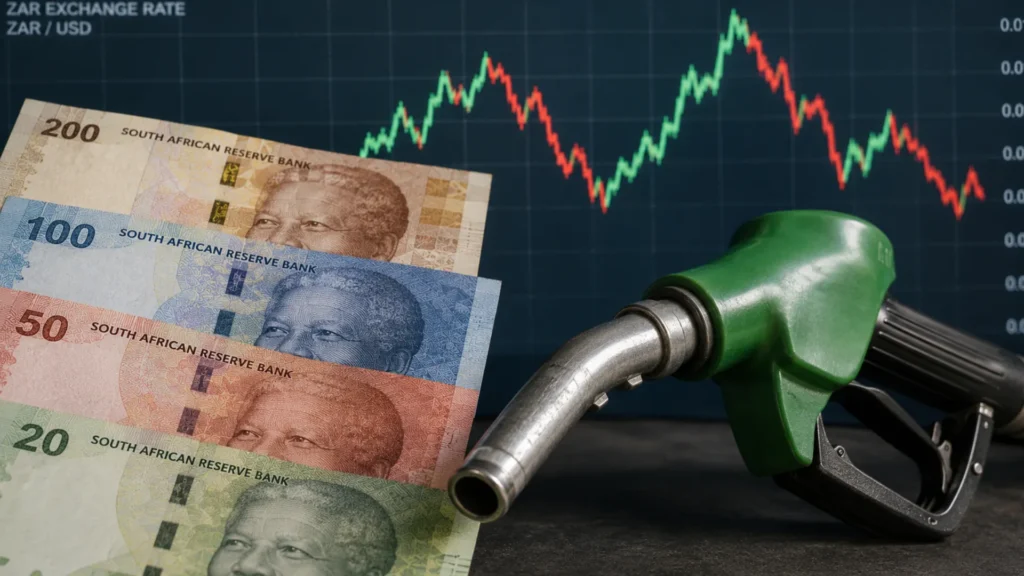
Two of the biggest South African economic stories this month point in opposite directions — and the rand volatility fleet diesel impact lands squarely on every fuel budget for July. On 5 June, Fitch upgraded South Africa from BB- to BB — the first Fitch upgrade in about 21 years, citing fiscal discipline and primary surpluses. That is a rand-supportive signal. Then on 12 June, President Ramaphosa filed an urgent court application to halt Parliament’s Phala Phala impeachment inquiry, arguing it would cause “irreparable harm” while a review of the underlying report is pending. That is a fresh dose of political uncertainty. Specifically, both forces act on the same currency — the rand that prices the imported diesel fleets buy. The Fitch upgrade pulls one way. Political uncertainty pulls the other. And the 1 July levy lands in the middle.
Importantly, this analysis explains how the rand sets fleet diesel prices, weighs the rand-supportive Fitch upgrade against the rand-pressuring political uncertainty, and provides a range-based planning approach for July rather than a single forecast nobody can honestly make.
How the Rand Sets Fleet Diesel Prices: The Mechanism Behind Rand Volatility
Crucially, the link between the currency and the pump is mechanical, not abstract. Understanding it explains why every fleet operator should watch the rand as closely as the oil price.
Dollars in, rand out: the rand volatility fleet diesel conversion
Specifically, South Africa imports both crude oil and refined products at international prices denominated in US dollars. Each month, the DMRE converts those dollar costs into rand to set the regulated fuel price. Consequently, two variables drive most of the monthly movement: the dollar oil price and the rand-dollar exchange rate. When the rand strengthens, the same barrel of oil costs fewer rand. When the rand weakens, the same barrel costs more. Local levies and margins make up roughly 35% of the pump price, but the international component carries the volatility.
Why rand volatility hits fleet diesel harder than petrol
Furthermore, diesel matters more to the broader economy than petrol because more than 70% of South African goods move by road. When diesel rises, freight costs rise, and food and goods prices follow. For fleet operators specifically, diesel is the single largest controllable operating cost. A 50-cent move in the rand-driven diesel price, across a fleet consuming hundreds of thousands of litres monthly, translates into hundreds of thousands of rand. Accordingly, rand volatility is not a financial-page abstraction for fleet managers — it is a direct line item.
The Upgrade: Why Fitch Supports the Rand and Eases Fleet Diesel Pressure
First, the Fitch decision is genuinely positive news for the rand — and therefore a potential brake on fleet diesel costs.
What Fitch actually did and why it matters for rand volatility
IOL reports Fitch lifted South Africa’s long-term foreign and local currency rating from BB- to BB on 5 June, with a stable outlook. Notably, the National Treasury said it was the first Fitch upgrade in almost 21 years, making South Africa only the second G20 country upgraded by Fitch in 2026. Fitch cited prudent fiscal management and primary budget surpluses averaging about 1% of GDP over four years. S&P upgraded South Africa in November 2025, and Moody’s holds a positive outlook — so all three major agencies now point the same direction.
How an upgrade can ease rand volatility for fleet diesel
Notably, a higher credit rating tends to support a currency through two channels. First, it can attract foreign investment into government bonds, increasing demand for rand. Second, it lowers government borrowing costs, improving the fiscal picture that underpins currency confidence. Importantly, some institutional funds have minimum rating thresholds, so moving from BB- to BB can unlock pools of capital previously off-limits. A firmer rand means cheaper imported diesel — which is why the Fitch upgrade is a quiet piece of good news on every fleet fuel budget.
The Uncertainty: Why Political Risk Pressures the Rand and Fleet Diesel
Meanwhile, pulling the other way is a fresh source of political uncertainty. This is reported here strictly as a market-relevant development — the legal merits are for the courts to decide.
What the impeachment interdict involves for rand volatility
Inside Politic reports that on 12 June, President Ramaphosa filed an urgent application in the Western Cape High Court to halt Parliament’s impeachment committee from proceeding with its Phala Phala inquiry until a separate review of the Section 89 panel report concludes in early September. He argues that proceeding on a report whose validity is being challenged would cause “irreparable harm.” Meanwhile, the committee chairperson, the Speaker, and opposition parties including the EFF are cited as respondents, and the EFF has vowed to oppose the bid. The matter is unresolved.
Why markets react to political uncertainty with rand volatility
Importantly, markets do not take sides in legal disputes, but they do price uncertainty. Specifically, prolonged uncertainty about the presidency, the stability of the governing coalition, and policy continuity can prompt investors to demand a higher risk premium — which tends to weaken the rand. A weaker rand raises the rand cost of imported diesel. This is not a comment on the merits of the Phala Phala matter, which remain for the courts; it is simply how currency markets respond to political uncertainty of any kind. The longer the uncertainty persists, the more it can offset the Fitch upgrade’s rand support.
The Tug of War: How Both Forces Shape Rand Volatility and Fleet Diesel for July
Two strong, opposing signals are active on the same currency at the same time — and a third factor sits behind both.
The third force: Hormuz keeps the oil side of the equation volatile
Crucially, behind the rand sits the oil price, and the Hormuz escalation keeps that volatile too. Even a firm rand cannot fully offset a sharp oil spike. Conversely, a weak rand combined with an oil spike compounds the cost. Therefore, fleet operators face a three-variable problem for July: the levy (certain), the rand (pulled two ways), and the oil price (volatile). Only the levy is fixed.
Why a single July forecast would be dishonest about rand volatility
Consequently, given three moving variables, any confident single-number July forecast would overstate what anyone can actually know. Instead, the honest approach is a range. If the rand holds firm on the Fitch upgrade and oil eases, July diesel could land near R32. If political uncertainty weakens the rand and oil stays elevated, it could reach R34 or higher. Accordingly, fleet operators should plan for the range — not bet the budget on the optimistic end of it.
Five Actions on Rand Volatility Fleet Diesel Before the July Price Sets
Maximise June fuel purchases while the current price holds. Whatever the rand does next, June diesel sits below where the 1 July levy return will push it. Filling tanks now hedges against both the certain levy increase and any rand-driven rise. This is the one action available to every fleet operator regardless of which way the currency moves.
Next, model July across a range rather than a single number. Build a firm-rand scenario near R32 and a weak-rand scenario at R34 or above. Present both to management with the levy, oil, and currency assumptions stated explicitly. A range-based budget survives reality better than a point forecast that the first Wednesday of July immediately disproves.
Additionally, add exchange-rate or Brent-triggered clauses to fuel surcharge contracts. Conventional surcharges adjust monthly via the gazette, lagging a fast-moving currency or oil market by up to 30 days. A clause tied to the rand-dollar rate or a Brent threshold adjusts margin closer to real time. Clients negotiating in June, before the July increase, tend to accept these clauses more readily than during a price spike.
Furthermore, lock vehicle financing before the July MPC. Rand weakness strengthens the case for the SARB to hold or hike to defend the currency. Our coverage of the May hike noted Governor Kganyago’s warning of further tightening. Fixed-rate quotes signed in June protect against a higher prime rate later in the year.
Finally, monitor the rand and the oil price daily, not monthly. The Fitch upgrade, the impeachment litigation, and the Hormuz situation can each move the rand within a single trading session. Fleet operators tracking the currency and the oil price together reprice their hedging decisions faster than those who wait for the monthly fuel gazette. The gap between daily market moves and monthly price adjustments is precisely where unmanaged margin disappears.
Technology That Protects Margin Through Rand Volatility Fleet Diesel Swings
Notably, no fleet operator can control the rand, the oil price, or the courts. What they can control is how efficiently every litre is used — and that control matters more as prices become less predictable.
DigitFMS integrates D-Fuel litre-level monitoring, GPS tracking with route optimisation, AI dashcams with driver behaviour scoring, and wireless driver identification on a single dashboard. Client data shows up to 95% theft reduction and ROI within weeks. Crucially, the value of every litre saved rises as the rand-driven diesel price rises. When the currency weakens and diesel climbs, the savings from theft detection, idling reduction, and route efficiency grow in absolute rand terms — turning currency volatility from a pure threat into a measurable efficiency incentive.
Equally, Cartrack, Tracker, Netstar, Ctrack, and MiX by Powerfleet provide comparable fuel and route management platforms. The critical capability during a period of rand volatility fleet diesel uncertainty is litre-level visibility: knowing exactly where every litre goes regardless of what it costs. Fleet operators with that visibility absorb price swings better than those who learn their consumption only when the monthly fuel invoice arrives.
Outlook: Rand Volatility Fleet Diesel Planning Means Preparing for Both Directions
Ultimately, this week handed South Africa a genuinely good economic story and a genuinely uncertain political one within days of each other. The Fitch upgrade is real and earned — a fiscal turnaround two decades in the making. The political uncertainty is also real, and markets will price it until it resolves. Both act on the rand that sets fleet diesel prices.
Looking ahead, the responsible position for a fleet operator is not to predict which force wins. It is to prepare for either. A firmer rand would soften the July levy blow; a weaker rand would sharpen it. Neither outcome is certain, and a fuel budget built on hoping for the better one is not a plan. The fleet operators who buy June fuel, model a July range, hedge their contracts, and monitor the markets daily will be ready whichever way the rand moves.
Ultimately, rand volatility fleet diesel management is about controlling the controllable. The currency, the oil price, the courts, and the levy lie beyond any fleet manager’s reach. Fuel efficiency, purchase timing, contract structure, and financing terms do not. The Fitch upgrade and the impeachment battle will pull the rand in their own directions over the coming weeks. The fleet operators who focus on what they can control — every litre, every route, every contract — will navigate the volatility regardless of which headline moves the currency next.
Frequently Asked Questions
How does rand volatility affect fleet diesel prices?
South Africa imports oil priced in dollars. The DMRE converts those dollar costs to rand monthly to set the regulated price. A stronger rand lowers imported fuel costs; a weaker rand raises them. Levies are about 35% of the pump price, but the rand-and-oil international component drives most monthly movement. Rand volatility becomes diesel cost uncertainty.
What did the Fitch upgrade mean?
On 5 June, Fitch raised SA from BB- to BB — the first Fitch upgrade in about 21 years, stable outlook. It cited fiscal discipline and primary surpluses averaging 1% of GDP over four years. SA became the second G20 country Fitch upgraded in 2026. The rating stays two notches below investment grade. A higher rating tends to support the rand.
What is the impeachment interdict about?
On 12 June, Ramaphosa filed an urgent Western Cape High Court application to halt Parliament’s Phala Phala impeachment committee until a review of the Section 89 report concludes in September. He argues proceeding on a challenged report causes “irreparable harm.” The EFF and others oppose the bid. The matter is unresolved — the legal merits are for the courts.
Why do these events pull the rand in opposite directions?
The Fitch upgrade is rand-supportive — it reflects fiscal discipline and can attract investment. Political uncertainty works the other way, as markets demand a higher risk premium amid leadership uncertainty, which can weaken the rand. Both act on the same currency simultaneously. The net effect on diesel depends on which signal dominates week to week.
How does this affect the July fuel price?
July diesel absorbs the full R3.93 levy return, June’s average international price, and the rand-dollar rate. A firmer rand from Fitch helps offset the levy; a weaker rand from uncertainty or Hormuz amplifies it. Model a range — near R32 if the rand holds, R34 or higher if it weakens — rather than a single number.
What should fleet operators do about rand volatility?
Buy June fuel before the July levy. Model July across a range. Add exchange-rate or Brent-triggered surcharge clauses. Lock financing before the July MPC. Monitor the rand and oil daily, not monthly. Focus on the controllable — efficiency, timing, contracts — rather than forecasting the currency.
Will the rand strengthen or weaken from here?
No one can reliably predict currency movements, and fleet budgets should not bet on either direction. Two strong opposing forces are active — a real fiscal upgrade and real political uncertainty — against Hormuz oil volatility. The prudent approach is preparing for a range of outcomes, not forecasting one number.
Sources
ECR / AFP — “Fitch lifts South Africa rating in first upgrade in two decades”, 6 June 2026; BB- to BB, stable outlook, prudent fiscal management, 1% GDP primary surpluses, CPI 4%, unemployment above 32% · IOL — “Major boost for SA as Fitch upgrades sovereign credit rating”, 6 June 2026; first in 21 years, second G20 country upgraded 2026, S&P November 2025, Moody’s positive outlook · National Treasury statement, 5 June 2026; fiscal anchor in 2026 MTBPS
News24 — “Ramaphosa launches urgent bid to stay Phala Phala impeachment inquiry”, 12 June 2026; irreparable harm argument, Speaker and committee chair refused to pause · Inside Politic — “Ramaphosa files urgent court bid to halt Phala Phala impeachment probe”, 12 June 2026; Western Cape High Court, Didiza and Gana cited, EFF and ATM respondents, review early September · The Citizen — “Ramaphosa argues impeachment inquiry should wait for court review”, 12 June 2026; notice of motion, Section 89 panel, Ngcobo · SABC News — “President’s latest court bid is to avoid accountability: EFF”, 12 June 2026; EFF opposition, Thambo comment
BusinessTech / FIASA — July levy R3.93 diesel, R4.10 petrol return 1 July; slate levy R1.58 · safuelprices.co.za — pump price drivers: Brent, rand-dollar, BFP, 35% levies, 70% goods by road · DigitFMS — Hormuz escalation fleet costs (12 June), confirmed diesel drop (2 June), SARB rate hike (29 May), June shutdown fleet risk (11 June)
© 2026 DigitFMS. All rights reserved.