
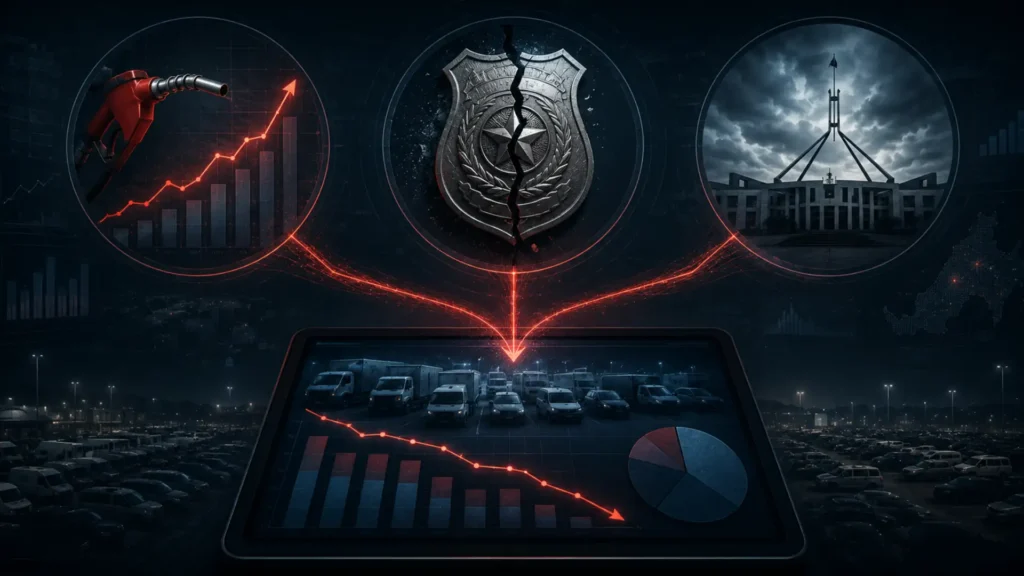
The fleet operating crisis June 2026 presents is unlike anything South African fleet operators have faced — because three separate threats are converging on the same budget at the same time. In exactly 13 days, the diesel levy rises from R0 to R1.97 per litre — adding R591,000 per month to a 20-vehicle fleet. Simultaneously, the Madlanga Commission has triggered the suspension of 18 senior SAPS officers — gutting the police leadership responsible for hijacking and cargo crime investigations. Meanwhile, the 31-member Phala Phala impeachment committee receives its nominees this Friday — with the DA already deploying its team, signalling it will not protect Ramaphosa. Each crisis has been covered separately. Nobody has connected them into one operational picture. This article does.
This analysis maps how each crisis independently threatens fleet operations, calculates the combined financial impact when all three hit simultaneously, and provides a single 13-day action plan that addresses fuel costs, security posture, and political risk in one integrated response.
Crisis 1: The Diesel Levy Returns in 13 Days — The Guaranteed Hit in the Fleet Operating Crisis June 2026
This is the one certainty. Finance Minister Godongwana confirmed the schedule. The diesel general fuel levy rises from R0 to R1.97 per litre on 3 June. From 1 July, the full R3.93 per litre returns. These dates are published. These amounts are confirmed. There are no surprises in the levy calendar — only the question of whether fleet operators prepare or absorb.
The numbers for a 20-vehicle fleet
Specifically, a fleet of 20 vehicles consuming 300,000 litres monthly faces the following escalation. May fuel bill at R31.18: R9.35 million. June fuel bill at approximately R33.15 (adding R1.97 levy): R9.95 million. July fuel bill at approximately R35.11 (full R3.93 levy): R10.53 million. The monthly increase from May to June is R591,000. From May to July it reaches R1.18 million. These figures account only for the levy reinstatement — international oil price movements and currency effects add additional pressure on top.
The zero-levy window closes in 13 days
Every litre purchased before midnight on 2 June carries zero general fuel levy. Every litre purchased from 3 June carries R1.97. For a fleet with 10,000 litres of storage capacity, filling tanks in the last week of May rather than the first week of June saves approximately R19,700. Discovery Insure data shows fuel transactions doubled on 30-31 March before the April increase. The same panic-buy pattern will repeat before 3 June. Fleet operators who purchase by 26-28 May avoid the consumer rush.
Crisis 2: 18 SAPS Officers Suspended — The Security Vacuum in the Fleet Operating Crisis June 2026
The Madlanga Commission has produced the largest senior police purge in South Africa’s democratic history. Pretoria News confirmed that 18 top SAPS officials have been suspended, including officers from the highest ranks of the service.
Who is suspended and why it matters for fleet security
National Commissioner Fannie Masemola — charged with PFMA violations related to the R360 million Medicare24 tender. Deputy Commissioner Shadrack Sibiya — accused of protecting alleged cartel figures and interfering with investigations. Major General Feroz Khan (Crime Intelligence) — arrested for illicit precious metals dealing and accused of halting a cocaine investigation. Major General Ebrahim Kadwa (Gauteng Hawks head) — arrested alongside Khan. Major General Lesetja Senona (KZN Hawks head) — linked to the R200 million cocaine theft from Hawks premises. Four Ekurhuleni EMPD officers and one Tshwane TMPD officer round out the list.
Crucially, independent crime consultant Professor Johan Burger told Pretoria News that the suspensions expose “the relationships and toxic arrangements in the police service.” ISS senior research fellow Lizette Lancaster warned that “these senior officials protected and enabled criminal networks, manipulated procurement processes, and interfered with investigations.” Furthermore, Lancaster stressed that “replacement officials must undergo rigorous vetting, including mandatory lifestyle audits.”
What this means for fleet recovery and security
The Hawks investigate hijacking syndicates and cargo theft networks. Crime Intelligence provides the intelligence-sharing infrastructure that supports vehicle recovery. The Gauteng Hawks head (Kadwa) covered the province responsible for 55% of all carjackings and 64% of truck hijackings nationally. The KZN Hawks head (Senona) covered the province with the N3 freight corridor. With both suspended, the two provinces where fleet crime is most concentrated face leadership vacuums in the units responsible for investigating it. Meanwhile, Acting Commissioner Dimpane faces a stabilisation challenge that grows more complex with every new revelation at the Madlanga Commission.
Crisis 3: Impeachment Committee Nominees Due Friday — The Rand Risk in the Fleet Operating Crisis June 2026
The 31-member Phala Phala impeachment committee receives its nominees by close of business on Friday 22 May — two days from now. Speaker Didiza confirmed the composition: ANC 9 seats, DA 5, MK Party 3, EFF 2, and 12 smaller parties with one seat each. The DA has already named its five-member team, led by parliamentary leader George Michalakis and including Glynnis Breytenbach and Baxolile Nodada.
What the DA deployment signals
Deputy chief whip Nodada stated explicitly: “Where there is a finding of wrongdoing against the president, the DA will hold him accountable.” The deployment of Michalakis — the DA’s parliamentary leader — and Breytenbach — a former senior NPA prosecutor — signals that the coalition partner intends serious engagement, not a protective exercise. For financial markets, this confirms the political risk is real. The GNU coalition’s senior partner will not shield the president from adverse findings.
The rand transmission to fleet costs
The rand has weakened from R15.84 in February to R16.65 currently. FX Leaders confirms USD/ZAR tested R17 before retreating. Every R1 of weakness adds R0.15 to R0.25 per litre to diesel. If impeachment hearings fracture the coalition and the rand reaches R17.50, AutoTrader projects the June diesel hike could exceed R3.00 per litre instead of R2.50. Consequently, diesel would reach R35 rather than R33 — a difference of R600,000 per year for a 20-vehicle fleet.
The Combined Impact: What All Three Crises Cost When They Hit Simultaneously
Each crisis is damaging individually. Together they create a compounding effect that no single-issue response can address.
The fuel cost compound
The diesel levy adds R1.97 per litre (guaranteed). Rand weakness from political instability adds R0.15 to R0.50 per litre (probable). International oil price movements add or subtract further (uncertain). At worst, a 20-vehicle fleet faces R35+ diesel from June rather than the R33 baseline. The monthly fuel bill increases by R1 million or more compared to the current May zero-levy rate. At R35, every efficiency measure — fuel monitoring, route optimisation, driver coaching — delivers proportionally larger absolute savings.
The security cost compound
With 18 senior officers suspended, the SAPS leadership responsible for fleet crime investigation is the weakest it has been since democratisation. Simultaneously, hijacking syndicates observe these same headlines and know that the institutional response capacity has degraded. An unrecovered hijacking costs R750,000 or more. Insurance premiums may rise as insurers assess reduced police effectiveness. The cost of upgrading from basic GPS to full SVR with AI dashcams and driver ID is measured in hundreds of rands per month. The cost of not upgrading is measured in hundreds of thousands of rands per incident.
The confidence cost compound
SACCI’s Business Confidence Index fell 3.3 points. Discovery Insure reports fuel purchases dropped 35% and trips fell 10%. Falling confidence means fewer transport orders and delayed fleet investment. Simultaneously, rising costs demand more investment in efficiency. Fleet operators face a scissors effect: declining revenue pressure meets escalating cost pressure. The operators who invested in fuel monitoring, route efficiency, and evidence-capture technology before the convergence will navigate it. Those who delayed investment face the worst possible timing to be unequipped.
The 13-Day Action Plan: One Integrated Response to the Fleet Operating Crisis June 2026
Here is the single plan that addresses all three crises simultaneously. Each action protects against fuel costs, security exposure, and political uncertainty.
Days 1-5 (20-24 May): Secure the budget
Model three fuel budget scenarios this week. Base case R33 (rand holds, levy adds R1.97). Elevated case R35 (rand at R17, levy plus currency). Stress case R37 (rand at R17.50, oil above $105). Present all three to management by Friday 23 May — the same day impeachment committee nominees are due. The political calendar drives the budget calendar.
Additionally, activate fuel surcharge clauses in every transport contract. The combined April-May diesel increase exceeds R12.78 per litre from March levels. Every threshold has been breached. Contact clients before the June adjustment adds further pressure. Waiting until June compounds the unrecovered cost.
Days 5-10 (24-29 May): Secure the fuel and the fleet
Maximise fuel purchases between 26-28 May. Buy before the consumer panic-buy spike that Discovery data predicts in the final 48 hours before a price change. Every litre purchased at R31 before June costs R1.97 less than the same litre on 3 June. If you have bulk storage capacity, fill it completely.
Simultaneously, verify that every vehicle has active SVR, dashcam, and driver ID. The SAPS leadership vacuum means the police response to hijacking and cargo crime will be slower, less coordinated, and less effective for months. Your tracking system and its private armed response capability — not the suspended generals — determine your recovery outcome. Confirm with your provider: “If we get hijacked tonight, does your team respond, or do you wait for SAPS?”
Days 10-13 (29 May – 2 June): Secure the evidence and the claims
Ensure AI dashcams upload to the cloud on every vehicle. With SAPS investigative capacity degraded, self-generated evidence becomes more valuable — for insurance claims, criminal prosecution, and CCMA disciplinary processes. Local SD card storage risks data loss if the vehicle is stolen or damaged. Cloud upload preserves the evidence regardless.
Furthermore, claim the full SARS 100% diesel refund before June. For farming, forestry, and mining operators, the refund recovers R5.85 per litre on eligible diesel. At R33 per litre, that is a 17.7% effective discount. Every month of unclaimed refund at this rate leaves substantial money permanently on the table. Fuel monitoring provides the verified eligible/non-eligible split SARS requires.
Finally, intensify driver coaching this week. At R33 per litre, a 10% behaviour improvement across 20 vehicles saves over R3 million per year. Driver scorecards linked to AI dashcam and GPS data identify the specific drivers and behaviours that carry the highest fuel cost. Brief every driver before the June adjustment lands.
Who Provides the Integrated Technology Response to the Fleet Operating Crisis June 2026
The convergence demands a platform that addresses fuel, security, and evidence capture on one dashboard — not three separate systems for three separate crises.
DigitFMS integrates D-Fuel litre-level monitoring (fuel crisis), GPS tracking with SVR and autonomous vehicle defence (security crisis), AI dashcams with cloud upload (evidence for insurance and prosecution), driver identification (insider threat and accountability), and geofencing with route management (efficiency optimisation). The company’s 100+ franchise branches provide local installation, calibration, and recovery coordination across all nine provinces — including the Gauteng and KZN regions where the SAPS leadership vacuum is most acute. One platform, one dashboard, one subscription addresses all three converging crises simultaneously.
Cartrack, Tracker, Netstar, Ctrack, and MiX by Powerfleet all offer integrated platforms that address multiple dimensions of the convergence. The critical evaluation criterion is platform breadth: does the system monitor fuel, track vehicles, capture dashcam evidence, identify drivers, and support recovery coordination from a single dashboard? Fleet operators managing three separate crises through three separate systems will miss the connections between them — and the connections are where the real risks hide.
Outlook: The Fleet Operating Crisis June 2026 Is the New Baseline
The levy reinstatement is permanent. The SAPS leadership crisis will take months or years to resolve. The impeachment process extends through at least November. None of these three threats is temporary. June is not a month to survive — it is the beginning of a new operating environment that will persist through the remainder of 2026 and beyond.
The fleet operators who use the next 13 days to lock in fuel, upgrade security, capture evidence, claim refunds, and coach drivers will enter June with their costs controlled, their vehicles protected, and their budgets modelled for every scenario. The operators who treat each crisis as someone else’s problem — “the levy is Treasury’s issue, SAPS is a policing issue, impeachment is a political issue” — will discover on 3 June that all three hit the same line on the same P&L statement.
Ultimately, the fleet operating crisis June 2026 presents is not three separate problems. It is one compound problem with one compound solution: an integrated fleet management platform that monitors fuel, protects vehicles, captures evidence, and generates the data that turns chaos into controllable costs. The 13 days start now.
Frequently Asked Questions
What three crises converge on fleet operators?
The diesel levy rises R1.97 on 3 June (adding R591,000/month to a 20-vehicle fleet). 18 senior SAPS officers are suspended from the Madlanga Commission (gutting hijacking and cargo crime investigation leadership). The 31-member impeachment committee receives nominees Friday 22 May (creating political uncertainty that weakens the rand and could push diesel above R35).
How much will the levy add to fleet costs?
Diesel levy goes from R0 to R1.97 on 3 June. A 20-vehicle fleet at 300,000 litres monthly faces R591,000/month additional levy cost. From July, when the full R3.93 returns, the monthly addition reaches R1.18 million compared to the current zero-levy rate.
How do the SAPS suspensions affect fleet security?
Commissioner Masemola, Deputy Commissioner Sibiya, Crime Intelligence chief Khan, Gauteng Hawks head Kadwa, and KZN Hawks head Senona are all suspended. These officers led the units investigating hijacking syndicates and cargo crime. Gauteng handles 55% of carjackings. KZN handles the N3 freight corridor. Both provinces face command-level vacuums.
How does the impeachment committee affect fleet fuel costs?
Political uncertainty weakens the rand. Every R1 weakness adds R0.15-R0.25 per litre to diesel. The DA deployed its team led by Michalakis, signalling it will not protect Ramaphosa. If the rand reaches R17.50, diesel could exceed R35 instead of R33. The difference costs a 20-vehicle fleet R600,000 per year.
What is the combined cost of all three crises?
Levy: R591,000/month guaranteed. Rand weakness: R45,000-R75,000/month if political instability pushes the currency to R17. One unrecovered hijacking during the SAPS vacuum: R750,000+. Rising insurance premiums. Combined: potentially R1 million or more in additional monthly costs versus the current May baseline.
What should fleet operators do in 13 days?
Days 1-5: Model three budget scenarios (R33/R35/R37), activate fuel surcharges. Days 5-10: Buy fuel by 26-28 May, verify SVR and dashcams on every vehicle. Days 10-13: Ensure cloud dashcam upload, claim SARS refunds, brief drivers on fuel efficiency. Monitor the impeachment timeline — each development moves the rand and the diesel price.
When does the impeachment committee begin?
Speaker Didiza confirmed 31 members from 16 parties. Nominees are due Friday 22 May. The DA named its team: Michalakis, Nodada, Breytenbach, Khakhau, Sharif. Ramaphosa launched a legal review that could delay proceedings. The timeline is uncertain but the process is irreversible — the Constitutional Court ordered it to proceed.
Sources
National Treasury — Fuel levy phase-out schedule, April 2026 · Finance Minister Godongwana — Levy extension and phase-down confirmation · Pretoria News / IOL — “SAPS in turmoil: 18 officials suspended amid Madlanga Commission”, 13 May 2026; Professor Johan Burger and Lizette Lancaster (ISS) quotes · Daily Maverick — “Top cops in the dock: full list of Madlanga-related arrests”, 12 May 2026
SAnews — “Didiza determines process for composition of Impeachment Committee”, 14 May 2026 · The Citizen — “Parliament moves to establish impeachment committee”, 14 May 2026 · News24 — “DA unveils team deployed to impeachment committee”, 15 May 2026; Michalakis, Breytenbach, Nodada named · Business Day — “Party whips agree on 31-member impeachment panel”, 13 May 2026 · EWN — “NA Speaker confirms 31-member committee”, 14 May 2026 · Joburg Etc — “Parliament forms 31-member Phala Phala impeachment committee”, 14 May 2026
AutoTrader — June fuel projection R2.50-R3.00, R17.50 risk scenario · FX Leaders — USD/ZAR tested R17, rand at R16.44-R16.65 · SACCI — BCI down 3.3 points to 131.3 · Discovery Insure — 35% fuel purchase drop, transactions doubled 30-31 March · DigitFMS — Fuel levy phase-out analysis, SAPS corruption fleet security report, political instability fleet fuel costs analysis, June diesel price fleet budget report
© 2026 DigitFMS. All rights reserved.