
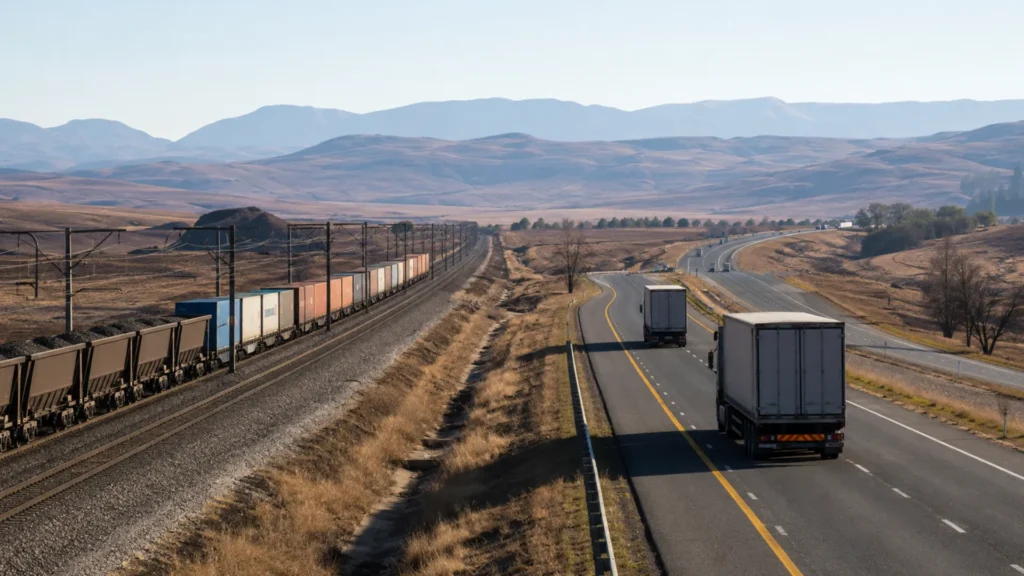
South Africa’s transport establishment is gathered in Pretoria this week. Moreover, the opening address handed road fleet operators two dates that matter. Private trains start running in April 2027. Additionally, a national weigh-in-motion enforcement network of more than 170 systems is taking shape. The Citizen reports Transport Minister Barbara Creecy’s address to the 44th Southern African Transport Conference. The event runs from 6 to 9 July at the CSIR International Convention Centre. Importantly for transport reform fleet operators, the speech moved beyond policy ambition into dates, tenders and numbers. Consequently, this briefing extracts what road freight businesses should actually note, plan for, and watch.
Specifically, this analysis covers the rail timeline and its new milestones, plus the corridor tenders heading to market. It then examines the weigh-in-motion enforcement shift, the level-crossing safety data, and the digital and green signals from the conference floor.
The Setting: Why SATC Matters to Transport Reform Fleet Operators
SATC is where South Africa’s transport policy gets said out loud, in detail, with the minister as patron. This year’s theme is blunt about the environment: Developing and Sustaining Transport Systems in an Uncertain World.
The stage where transport reform fleet operators hear policy first
The conference brings government, academia and industry into one venue for four days. Minister Creecy opened proceedings on 6 July. The programme runs plenaries alongside parallel sessions on road infrastructure, rail, public transport and freight. For operators, the value lies in specifics. Policy speeches at SATC tend to carry dates, targets and tender confirmations that shape planning horizons. Accordingly, this year’s address delivered several. The sessions around it added enforcement and safety detail that affects daily road freight operations directly.
The competitiveness warning transport reform fleet operators heard
The address opened with honesty about the starting point. Years of underinvestment in logistics infrastructure, together with the post-pandemic decline in rail and port performance, have weakened national competitiveness. Furthermore, that weakness created opportunities for neighbouring countries to capture regional cargo flows that South Africa once carried. Shipping and Freight Resource reports the minister’s acknowledgement of the stakes. Transport disruption affects passenger journeys, freight flows, supply chain efficiency, jobs, trade and the wider economy. Therefore, the reform programme is framed as competitive recovery, not routine maintenance. Every business in the sector has a direct stake in its success.
The Rail Timeline Transport Reform Fleet Operators Now Have
Our rail reform analysis last week covered the eleven approved operators. The SATC address added the milestones that turn policy into a schedule.
April 2027: the date transport reform fleet operators should diarise
Creecy confirmed the start date for the 11 private Train Operating Companies approved in March. Operations are due to commence in April 2027. The network itself stays state-owned. Additionally, the Transnet Rail Infrastructure Manager published its second Network Statement in early July. The document helps the new operators raise the capital they need for rolling stock and staff. Consequently, road operators now have a concrete date for planning trunk-corridor volumes, intermodal opportunities and contract horizons. An open-ended reform promise has become a schedule.
The volume numbers behind the transport reform fleet operators outlook
The address also quantified the gap the reform must close. Current rail freight volumes sit around 165 million tonnes a year. Meanwhile, the Draft National Rail Master Plan, approved for public comment earlier this year, puts market demand at 280 million tonnes. The government target remains 250 million tonnes on the Transnet network by 2030. Recovery work also continues on the ground. Crews have restored 35 of 40 priority rail lines over the past two years, including a section on the Midway to Lenasia route. Re-signalling and station upgrades run alongside.
Tenders on the transport reform fleet operators radar
Notably for KwaZulu-Natal readers, the minister confirmed three Private Sector Participation projects going to market this financial year. They cover the Ngqura Manganese Export Corridor, the Richards Bay Dry Bulk Terminal and the container terminal. The Richards Bay confirmation matters because that port’s congestion costs featured heavily in industry submissions earlier this year. Furthermore, Creecy cited the Ngqura Liquid Gas Terminal agreement signed in May and progress on Boegoebaai Port. That project would give the Northern Cape its first commercial port and reduce dependence on Namibian harbours for mining and agricultural exports.
The Enforcement Shift Facing Transport Reform Fleet Operators
The quieter SATC story may touch road fleets more directly than any rail date. Weigh-in-motion enforcement is moving from pilot to network.
How WIM changes the game for transport reform fleet operators
Weigh-in-motion systems weigh vehicles as they pass over road sensors at normal speed, with no weighbridge stop. Enforcement-grade WIM allows prosecution of overloading directly from sensor data. According to SATC organisers, SANRAL ran accuracy trials at the Mantsole Traffic Control Centre on the N1. Ten systems stood installed by mid-February, with trials running to the end of May. Crucially, the planned national enforcement network could include more than 170 systems. Consequently, overloading detection stops being a matter of which weighbridges are open and becomes continuous, automatic and everywhere.
Compliance readiness for transport reform fleet operators
For compliant operators, this is good news wearing a warning label. Overloaded competitors currently undercut honest businesses while damaging the roads everyone pays to use. A functioning WIM network penalises them at scale. However, readiness matters. Verify load plans against permissible axle masses for every vehicle configuration. Then train loading staff and drivers on distribution, and audit the routes and clients where overloading pressure creeps in. Operators using onboard weighing or telematics load data gain an evidence trail of their own. The prepared will welcome the network; the careless will fund it through fines.
The Safety Data Transport Reform Fleet Operators Cannot Ignore
One SATC session put a hard number on a risk every long-haul operator crosses daily, in the most literal sense.
Level crossings and transport reform fleet operators risk
South Africa has 7,665 road-rail intersections. A predictive modelling session at the conference projected that crossing accidents could rise from an average of 76 per year to 153 by 2030 without intervention. The logic is uncomfortable but sound: as rail recovery succeeds and train frequencies climb, crossing exposure climbs with them. Therefore, the same reform that promises cheaper trunk freight raises the stakes at every unguarded crossing. Fleet route planning, driver training and in-cab alerts around rail crossings deserve attention now, before the traffic returns in volume.
Digital and green signals for transport reform fleet operators
Two further threads ran through the address. First, digitalisation. The Department of Transport and its 20 entities plan a single digitised transport platform hosting online permitting through one citizen interface. That would simplify the licence and permit administration every operator battles. Second, sustainability. Creecy tied the road-to-rail shift to lower emissions, alongside the Ngqura gas terminal, green hydrogen plans and sustainable aviation fuel initiatives. Accordingly, operators should expect emissions and digital compliance to feature more prominently in future transport regulation and client requirements alike.
Technology That Positions Transport Reform Fleet Operators
Notably, every SATC theme rewards the same underlying capability. Enforcement, safety, digitalisation and emissions all come back to knowing exactly what each vehicle is doing.
DigitFMS integrates GPS tracking with geofencing, D-Fuel litre-level fuel monitoring, AI dashcams, route management and wireless driver identification. Everything runs on a single dashboard. Against the WIM enforcement era, telematics provides the operational discipline that keeps loading, routing and driving inside the rules. Around the 7,665 level crossings, geofenced alerts can warn drivers approaching high-risk intersections. Additionally, fuel monitoring quantifies the consumption and emissions picture that greener-transport requirements will increasingly demand. Client data shows up to 95% fuel theft reduction. The same visibility builds the compliance evidence a tightening regulatory environment favours.
Equally, Cartrack, Tracker, Netstar, Ctrack and MiX by Powerfleet offer comparable fleet management platforms across the industry. The direction of travel from SATC is the point, whatever the badge. Enforcement is becoming continuous, safety data predictive, and administration digital. Fleets that already run on data will slot into that world without friction. Those still running on paper and guesswork will find each of these reforms arriving as a cost. The fleet investment surge suggests most operators are choosing the first path.
Outlook: The Delivery Test for Transport Reform Fleet Operators
The conference closes on Thursday, and the policy direction it showcased is coherent. Rebuild rail, improve ports, attract private capital, enforce road compliance, digitise administration and cut emissions. Moreover, the milestones are now specific enough to hold to account. Private trains in April 2027. Three corridor tenders to market this financial year. A second Network Statement published. Thirty-five of forty priority lines recovered. The reform era finally has a calendar.
However, the honest measure was stated at the conference itself: the reset will be judged by delivery, not announcements. Freight must move more reliably, ports must perform more consistently, and the country must regain the logistics confidence it lost. South Africa’s reform record includes missed deadlines. Independent trackers flagged delays across the logistics programme as recently as the first quarter. Consequently, operators should plan against the announced dates while keeping contingency for slippage. That is simply the discipline this sector has learned to apply to every promise.
Ultimately, transport reform fleet operators came out of SATC 2026 with something more useful than optimism: a schedule. The dates, tenders and enforcement plans announced this week define the operating environment road freight will work in through 2030. Trucks keep the first mile, the last mile and everything urgent in between, while the trunk network reshapes around them. The operators who diarise April 2027, prepare for weigh-in-motion and respect the crossings will meet that environment ready. Building data discipline now completes the preparation. The conference set the test. Delivery, on both sides, decides it.
Frequently Asked Questions
What is SATC 2026?
The Southern African Transport Conference is the region’s premier annual transport gathering, now in its 44th year. SATC 2026 runs 6 to 9 July at the CSIR International Convention Centre in Pretoria. Its theme is Developing and Sustaining Transport Systems in an Uncertain World. Transport Minister Barbara Creecy, the conference patron, delivered the opening address. It set out the rail, port, road and aviation reform agenda.
When do private rail operators start running trains?
April 2027, per the minister’s address. The Department of Transport approved 11 private Train Operating Companies in March to access the state-owned network. The Transnet Rail Infrastructure Manager published its second Network Statement in early July. It helps operators raise capital for rolling stock and staff ahead of that start date.
What is the 250 million tonne rail target?
Government aims to move 250 million tonnes of freight annually on the Transnet network by 2030. Volumes currently sit around 165 million tonnes. The Draft National Rail Master Plan, out for public comment, addresses the gap. Estimated market demand runs at 280 million tonnes. Recovery of 35 of 40 priority lines supports the push.
What is weigh-in-motion enforcement?
Weigh-in-motion technology weighs vehicles at normal driving speed over road sensors, without a weighbridge stop. Enforcement-grade WIM supports prosecuting overloading directly from sensor data. SANRAL ran accuracy trials at Mantsole on the N1. Ten systems stood installed by mid-February, with trials to the end of May. The planned national network could exceed 170 systems.
How should fleet operators prepare for WIM enforcement?
Treat axle-load compliance as continuous discipline. Verify load plans against permissible axle masses per configuration. Train loading staff and drivers on distribution, and audit routes and clients where overloading pressure occurs. Onboard weighing or telematics load data adds an evidence trail. Compliant operators gain, because network-scale enforcement penalises the competitors who undercut them illegally.
What did the minister say about road-to-rail?
Creecy called the road-to-rail shift essential, re-establishing rail as the freight backbone. She cited benefits in road safety, congestion, infrastructure wear and CO2 emissions. The programme rests on the 2022 National Rail Policy and the 2023 Freight Logistics Roadmap. Road freight keeps first-mile, last-mile and time-sensitive work while trunk volumes shift over time.
Which corridor tenders are coming to market?
The minister confirmed three Private Sector Participation projects going to market this financial year. They sit at the Ngqura Manganese Export Corridor, the Richards Bay Dry Bulk Terminal and the container terminal. She also cited the Ngqura Liquid Gas Terminal agreement signed in May. Progress continues on Boegoebaai Port, the Northern Cape’s planned first commercial port.
Sources
Department of Transport — Address by Minister Barbara Creecy at the Southern African Transport Conference, 6 July 2026, official text at transport.gov.za · The Citizen — “SA places bet back on trains: It may be time for you to ditch road for rail”, 7 July 2026; 11 TOCs approved, April 2027 commencement, 250 million tonnes by 2030, second Network Statement published, Draft National Rail Master Plan and the 165 versus 280 million tonne gap, 35 of 40 priority lines recovered, Midway-Lenasia section, PSP projects to market this financial year, Ngqura and Boegoebaai remarks
Shipping and Freight Resource — “SATC 2026: South Africa’s transport reset faces the test of delivery” and “SATC 2026 opens in Pretoria”, 7 July 2026; underinvestment and competitiveness warning, regional cargo capture by neighbouring countries, delivery-not-announcements framing, single digitised transport platform across 20 entities, road-rail crossing modelling of 7,665 intersections and the 76 to 153 accident projection, SANRAL WIMe trials at Mantsole with ten systems by mid-February and a planned national network of more than 170 systems · SATC — 44th conference programme, CSIR ICC Pretoria, 6-9 July 2026, theme and plenary schedule
DigitFMS — freight rail reform fleet road operators (3 July), commercial vehicle sales surge June 2026 (6 July), port congestion fleet costs Richards Bay (26 June); the reform context and fleet investment climate. Note: dates and targets are as announced at SATC 2026 and attributed to the minister’s address and conference reporting; implementation timelines remain subject to delivery. This is general information, not legal or financial advice.
© 2026 DigitFMS. All rights reserved.