
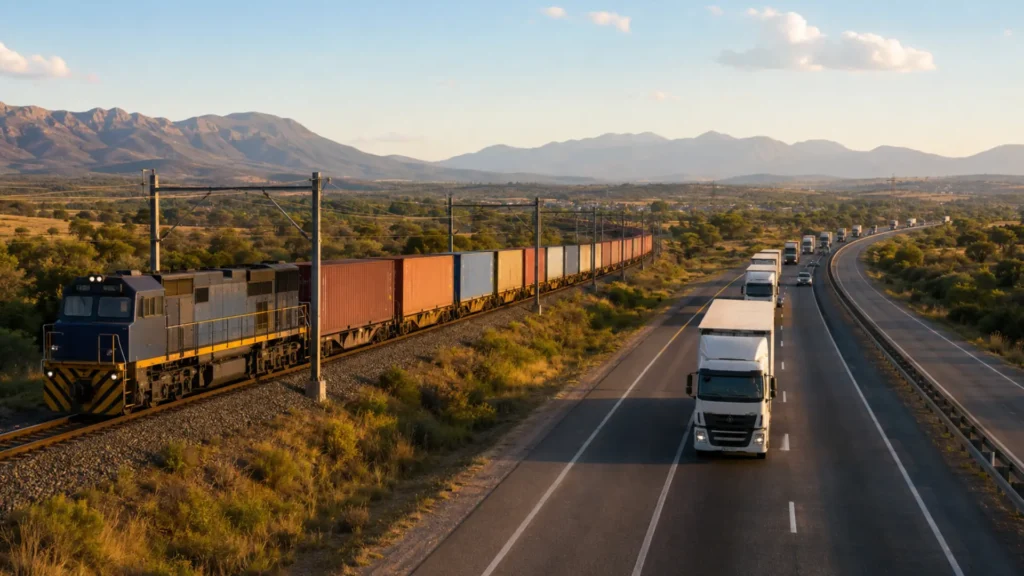
South Africa’s rail network has opened to private operators for the first time, and the freight rail reform fleet question is now unavoidable: what does the road-to-rail shift mean for every trucking operator in the country? IOL reports that the Transnet Rail Infrastructure Manager has concluded rail access agreements with 11 private train operating companies. The number of operators on the network jumps from one to twelve, across five strategic corridors. Initial slot allocations should add 24 million tonnes of rail capacity, with potential for 52 million tonnes over five years. Importantly, industry analysis says this reshapes road freight rather than sidelining it. This article explains the reform, the honest state of its progress, and how fleet operators should position for the shift.
Specifically, this analysis covers what the rail reform programme is, who the new operators are, why road freight gets reshaped rather than replaced, where the reform is genuinely behind schedule, and the practical positioning steps for road fleet operators.
The Reform Explained: Freight Rail Reform Fleet Context
Crucially, this is the biggest structural change to South African freight in decades. It deserves a clear, jargon-free explanation.
How the freight rail reform fleet landscape changed
The programme flows from the National Rail Policy of 2022 and the Freight Logistics Roadmap, which Cabinet approved in December 2023. The core idea is separation. The Transnet Rail Infrastructure Manager, known as TRIM, now manages the tracks. Private train operating companies buy access slots and run their own trains on them. Meanwhile, the infrastructure itself stays publicly owned. Consequently, rail moves from a single state operator to a competitive marketplace. President Ramaphosa framed the urgency plainly at the National Transport Conference in March: logistics inefficiencies cost the economy close to R1 billion per day.
The eleven newcomers reshaping the freight rail reform fleet picture
According to IOL and TRIM, the 11 new operators are ARC South Africa, The Railway Corporation, TLD Marine, MENAR, Sharp Logistics, Barberry, Grindrod, Minrail, IRACEMA, Motheo Logistics and Interlinks. Together they span coal, manganese, fuel, containers and general freight. TRIM chief executive Moshe Motlohi called the milestone the creation of a functional and competitive rail marketplace. Notably, the rollout is phased. Some operators should start before the end of 2026, while others follow during 2027. The Ad Hoc Slot process, introduced in December 2025, also lets operators apply for capacity outside the annual cycle.
The targets driving the freight rail reform fleet shift
The numbers frame the ambition. Rail currently moves around 160 million tonnes a year, up 5.5% year-on-year. Government wants 250 million tonnes on rail by the end of the decade. Furthermore, about 69% of South African freight moves by road today. That imbalance strains road infrastructure and worsens road safety, with more than 12,000 road deaths recorded annually. Therefore, the road-to-rail shift targets long-haul bulk cargo first. Coal, ore, fuel and containers on trunk corridors are the natural early movers. Palletised, regional and time-sensitive freight stays on trucks.
Reshaped, Not Replaced: The Freight Rail Reform Fleet Reality
The instinctive fear in the trucking industry is obvious: does rail reform take work away from trucks? The industry’s own analysis gives a more nuanced answer.
Why the freight rail reform fleet effect favours repositioning
The Southern African Association of Freight Forwarders puts it directly. Successful rail and port reform will not sideline road freight but reshape its role. Specifically, trucking concentrates where it adds the most value: first-mile and last-mile distribution, regional connectivity and time-sensitive freight. A train cannot collect from a farm gate. It cannot deliver to a retail store or a construction site. Consequently, every tonne that shifts to rail still needs trucks at both ends of the journey. The demand changes shape; it does not disappear.
The congestion dividend in the freight rail reform fleet equation
Additionally, SAAFF notes that reliable rail corridors and efficient ports should reduce congestion and improve turnaround times for the trucks that remain. Fewer long-haul bulk trucks on the N3 means faster, safer transit for everyone else. Our Richards Bay port analysis documented what congestion costs operators today. Rail reform attacks the same problem from the supply side. Moreover, a working example is already planned: a short-haul rail shuttle between Cato Ridge and Durban, enabled by the Ad Hoc Slot process, aims to cut truck congestion around the port precinct.
Lower costs and steadier demand in the freight rail reform fleet outlook
The prize extends further. SAAFF argues that well-executed reform can lower operating costs, stabilise demand and create a more predictable environment for fleet operators. Predictability matters as much as speed. Businesses plan around known constraints far better than around volatility. Equally, first-mile and last-mile work tends to be shorter and denser than long-haul routes. That profile can improve vehicle utilisation and reduce the empty return legs that drain long-distance margins. Accordingly, the reform offers road operators a real upside, provided they position for the work it creates.
The Honest Scorecard on Freight Rail Reform Fleet Progress
Balanced reporting requires the other side of the ledger. The reform is real, but it is running behind its own schedule in important places.
Where the freight rail reform fleet programme lags
The BLSA Reform Tracker recorded a 4% decline in its freight logistics index in the first quarter of 2026, to 69.16. That was the sharpest category drop of the quarter. Furthermore, reporting indicates around 60% of logistics reforms are behind schedule. Network Statement Volume 4, the document operators and financiers need for bankable investment decisions, missed its February deadline. BLSA chief executive Busisiwe Mavuso also flagged a structural concern. During the transition, Transnet remains both referee and player at the very moment the industry opens to private participation.
Reading the mixed signals in freight rail reform fleet terms
Meanwhile, the positive signals are also genuine. The Economic Regulation of Transport Amendment Act was signed in March. Port concession activity has increased, with the Durban Gateway Terminal operational and requests for qualification issued for Richards Bay and Ngqura. Vessel arrivals rose 9% year-on-year, though SAAFF cautions the improvement comes off a low base. Therefore, the honest reading is this: the direction is positive, and the milestones are real, but the pace is contested. Fleet operators should plan for a gradual, uneven shift rather than a sudden one.
Five Positioning Moves for the Freight Rail Reform Fleet Shift
The shift will take years, which is exactly why positioning should start now. These moves prepare a road fleet to benefit rather than lose.
Map your exposure to the freight rail reform fleet shift
First, identify which of your routes compete with rail and which complement it. Long-haul bulk lanes on the main corridors face rail competition first. Regional distribution, time-sensitive loads and first-mile or last-mile work face none. Next, use your fleet data to quantify that exposure. Route histories show exactly how much of your revenue sits on rail-vulnerable lanes. An operator who knows the number can plan; one who guesses cannot.
Build the intermodal side of the freight rail reform fleet opportunity
Additionally, build capability around rail terminals and ports. The growth work sits in first-mile collection, last-mile delivery and terminal shuttles. Relationships with the new train operating companies and terminal managers position a road fleet for that work early. Furthermore, watch the pilot projects closely. The Cato Ridge to Durban shuttle will change truck flows around the port. Operators serving Durban should track it and adjust route planning as it launches.
Stay efficient through the freight rail reform fleet transition
Finally, double down on efficiency, because the transition rewards the lowest-cost, most reliable road operators. Rail will win some long-haul bulk regardless. The road work that remains goes to fleets with the sharpest costs, the best on-time performance and the clearest data. Fuel discipline, route optimisation and utilisation management decide who wins the reshaped market. The reform changes what road freight does; efficiency decides who does it.
Technology That Navigates the Freight Rail Reform Fleet Shift
Notably, the positioning moves above all depend on one thing: knowing your own operation in detail. That knowledge comes from fleet data.
DigitFMS integrates GPS tracking with route history, D-Fuel litre-level monitoring, driver behaviour scoring, and utilisation reporting on a single dashboard. Route history quantifies exactly how much work sits on rail-vulnerable corridors. Fuel and utilisation data reveal the true cost per lane, which sharpens pricing for the intermodal work the reform creates. Behaviour scoring and route optimisation drive the efficiency that wins the reshaped market. For Durban-area operators, geofenced terminal data will show precisely how the Cato Ridge shuttle changes port flows once it runs. The KwaZulu-Natal franchise network understands those corridors directly.
Equally, Cartrack, Tracker, Netstar, Ctrack, and MiX by Powerfleet provide comparable fleet data platforms. The decisive capability for the freight rail reform fleet era is self-knowledge: understanding your routes, costs and utilisation well enough to reposition deliberately. Operators with that data will spot the shift early, price the new work accurately and defend the lanes worth defending. Those without it will discover the change only when a contract moves to rail — which is the most expensive way to learn.
Outlook: The Freight Rail Reform Fleet Story Rewards the Prepared
The opening of South Africa’s rail network to twelve operators is a genuine landmark. It moves the Freight Logistics Roadmap from policy documents to running trains. For a logistics system that costs the economy close to R1 billion a day in inefficiency, the direction is unambiguously right, even if the pace remains contested and parts of the programme run late.
However, road fleet operators should neither fear the shift nor ignore it. The industry’s own analysis is clear. Reform reshapes road freight toward first-mile, last-mile, regional and time-sensitive work, while easing the congestion that costs every operator money today. Consequently, the winners will be the operators who understand their exposure, build intermodal capability early and run the most efficient fleets in the reshaped market.
Ultimately, the freight rail reform fleet story is about preparation, exactly like every major shift this industry has faced. Trains are coming to the trunk corridors over the next several years. Meanwhile, trucks will still carry the first mile, the last mile and everything time-sensitive in between. Operators who map their routes, know their costs and position for the intermodal work will find more opportunity in the reform than threat. The network has opened. Its reshaping has begun. And the fleets that study it now will be the ones still winning when the shift is complete.
Frequently Asked Questions
What is South Africa’s rail reform programme?
It flows from the National Rail Policy of 2022 and the Freight Logistics Roadmap approved in December 2023. The Transnet Rail Infrastructure Manager separates infrastructure from operations and opens the state-owned network to private train operating companies. Tracks stay publicly owned, while private operators buy access slots. Ultimately, the goal is lifting rail freight from about 160 million tonnes a year to 250 million tonnes.
Who are the new private rail operators?
TRIM signed rail access agreements with 11 companies: ARC South Africa, The Railway Corporation, TLD Marine, MENAR, Sharp Logistics, Barberry, Grindrod, Minrail, IRACEMA, Motheo Logistics and Interlinks. Operators on the network rise from one to twelve across five strategic corridors, spanning coal, manganese, fuel, containers and general freight. Some start before the end of 2026, others during 2027.
How much freight will move from road to rail?
Initial slot allocations should add around 24 million tonnes of rail capacity, with potential for 52 million tonnes over five years. Government targets 250 million tonnes on rail by decade-end, against roughly 160 million tonnes now. About 69% of freight currently moves by road. The shift targets long-haul bulk first and will be gradual, with targets dependent on execution.
Does rail reform threaten road fleet operators?
Industry analysis says no — it reshapes rather than removes the role. SAAFF notes that successful reform will not sideline road freight. Trucking concentrates where it adds most value: first-mile and last-mile distribution, regional connectivity and time-sensitive freight. Rail cannot collect from a farm gate or deliver to a store. Every tonne on rail still needs trucks at both ends.
What are the benefits for road fleets if reform succeeds?
Reliable rail corridors and efficient ports should cut congestion and improve turnaround times. Lower national logistics costs benefit the whole chain, since inefficiencies cost close to R1 billion a day. A more predictable environment supports better planning. Shorter, denser first-mile and last-mile work can improve utilisation versus long empty return legs. Done well, reform creates a stabler, lower-cost environment for road operators.
Is the reform programme on track?
Progress is real but uneven. The access agreements, Ad Hoc Slot process and port concessions are genuine milestones. However, the BLSA Reform Tracker recorded a 4% drop in its freight logistics index in early 2026, about 60% of logistics reforms run behind schedule, and Network Statement Volume 4 missed its February deadline. Business leaders also flag Transnet acting as both referee and player. Direction positive; pace contested.
How should fleet operators position for the shift?
Watch which corridors and cargo types shift first — long-haul bulk moves before palletised and time-sensitive freight. Build first-mile, last-mile and intermodal capability around terminals and ports. Track pilots like the Cato Ridge to Durban shuttle. Use fleet data to see which routes compete with rail and which complement it. Operators who plan can win the new work; those who ignore it may find their long-haul lanes competing with trains.
Sources
IOL Business Report — “Transnet expands private rail access as 11 operators to add 24m tons of freight capacity”, 13 May 2026; TRIM rail access agreements, operators one to twelve, five corridors, named companies, 24m tonnes initial and 52m over five years, Motlohi competitive rail marketplace, Ad Hoc Slot December 2025, Cato Ridge-Durban shuttle · Railways Africa — “National Transport Conference Signals Rail-Led Logistics Reform Drive”, 16 March 2026; Ramaphosa R1 billion per day, 69% freight by road, 250m tonnes target, 160m tonnes current up 5.5%, 12,000 road deaths, National Rail Policy 2022 and Freight Logistics Roadmap 2023
FleetWatch / SAAFF — “2025 momentum must lead to tangible reform in 2026”, January 2026; Dr Juanita Maree, reform will not sideline road freight but reshape its role, first- and last-mile distribution, regional connectivity, time-sensitive freight, lower operating costs and stabilised demand · SA Trade Desk / BLSA Reform Tracker Q1 2026 — freight logistics index down 4% to 69.16, Network Statement Volume 4 unpublished past February deadline, Mavuso referee and player, ERT Amendment Act signed March, Durban Gateway Terminal operational, RFQs for Richards Bay and Ngqura · Freight News — “60% of logistics reforms delayed despite rail access progress”, June 2026 · IOL — SAAFF on port recovery, vessel arrivals up 9%, low-base caveat
DigitFMS — port congestion fleet costs Richards Bay Gate Zero (26 June), 30 June freight corridor disruption (30 June), fleet fuel supply continuity JRA (24 June), July fuel price confirmed (2 July); infrastructure strain, corridor economics, fleet data and positioning. Note: reform timelines and tonnage projections are reported from cited sources and remain subject to execution; this is general information, not financial or investment advice.
© 2026 DigitFMS. All rights reserved.