
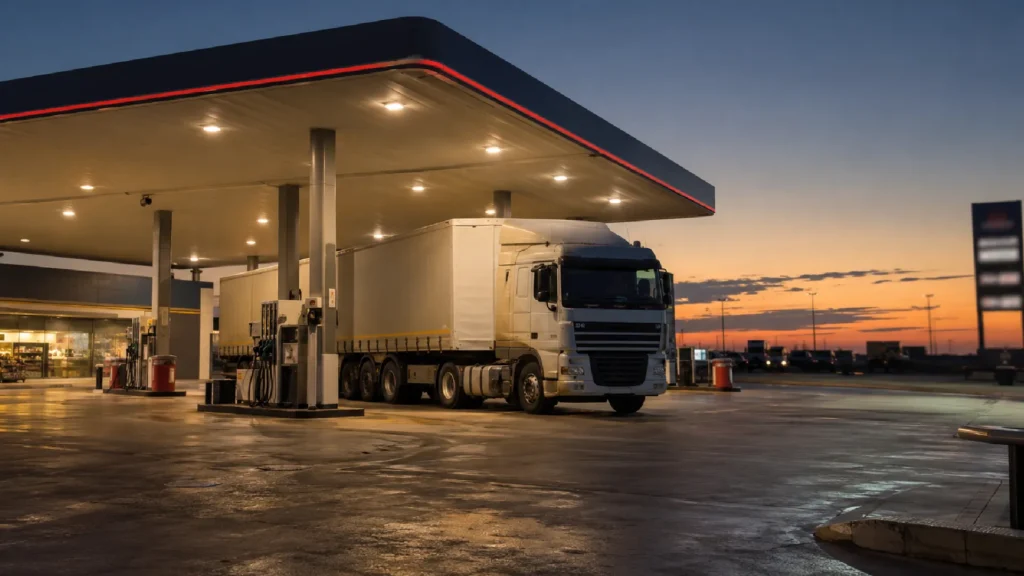
The forecourts where thousands of South African fleets fill their tanks every day are changing hands. Abu Dhabi’s ADNOC Distribution has agreed to buy Shell’s entire downstream business in the country for about $1 billion. Consequently, Shell’s 124-year run as a direct fuel retailer here is ending. CNBC Africa reports the deal covers roughly 580 fuel stations plus wholesale, aviation and lubricants operations. Together, that represents around 10% of the national retail fuel market. Importantly for fleet operators, the Shell South Africa sale changes ownership, not the pumps. The brand stays under licence, prices remain regulated, and closing is only expected in 2027. Nevertheless, the deal reshapes who controls the fuel network every fleet depends on.
Specifically, this analysis covers the deal’s verified numbers and what changes at the pump. It then examines the ownership transformation of South African fuel retail, the regulatory road ahead, and the watch items through to 2027.
The Deal: Inside the Shell South Africa Sale
The announcement came on Tuesday 7 July from Abu Dhabi and Johannesburg simultaneously, and the official terms are specific.
The numbers behind the Shell South Africa sale
ADNOC Distribution signed a definitive agreement to acquire 100% of Shell Downstream South Africa from Shell South Africa Holdings. The implied enterprise value sits at approximately $1 billion, more than R16 billion. Adjustments for net debt and working capital follow. Notably, the business being sold moved about 3.5 billion litres of fuel in 2025 and operates 360 convenience stores. Furthermore, the transaction ranks among the largest in South Africa’s downstream petroleum sector in years. It is also ADNOC Distribution’s biggest overseas acquisition ever. Completion is expected in 2027, subject to regulatory approvals.
What the Shell South Africa sale includes
The package covers the full downstream estate. It spans approximately 580 company- and dealer-owned fuel stations, the wholesale fuels business, aviation fuel operations and the lubricants business. Crucially, the Shell brand does not leave the country. ADNOC Distribution will retain Shell branding for the retail stations and lubricants under a long-term licensing agreement. Consequently, the shield on the forecourt stays, while the ownership behind it changes. After closing, a 28% stake goes to a local empowerment partner and an employee stock ownership plan. That leaves ADNOC Distribution with 72%.
The buyer driving the Shell South Africa sale
ADNOC Distribution is the fuel retail arm of the Abu Dhabi National Oil Company. It ranks as the largest fuel and convenience retailer in the United Arab Emirates. The acquisition expands its network by 55% to about 1,600 sites and lifts fuel volumes by roughly 20%. South Africa becomes its fourth market after the UAE, Saudi Arabia and Egypt. Chief executive Bader Saeed Al Lamki called the deal a significant milestone. Additionally, he said the company remains hungry for growth, naming Africa and Southeast Asia as target regions. The company projects a 6% earnings-per-share lift in the first full year after completion.
What the Shell South Africa Sale Changes at the Pump
For the fleet operator filling 40 trucks at a Shell truck stop tonight, the practical answer is reassuringly boring. Nothing changes yet.
Why drivers will not notice the Shell South Africa sale
Three buffers sit between the deal and the forecourt. First, the brand stays: the licensing agreement keeps Shell signage on stations and Shell lubricants on shelves. Second, prices stay unaffected. The Department of Mineral and Petroleum Resources regulates petrol pump prices through the monthly structure, whoever owns the network. Similarly, diesel follows the same wholesale mechanics. Third, timing: closing is only expected in 2027, so Shell Downstream South Africa operates as normal through the interim. Accordingly, the July fuel price relief and every future adjustment work exactly the same way.
Fuel cards and contracts after the Shell South Africa sale
Fleet agreements survive the change of owner. ADNOC Distribution is acquiring the legal entity whole. Consequently, existing fuel card arrangements, wholesale supply contracts and lubricant agreements continue with the same counterparty. Therefore, operators with Shell relationships should treat the transition as business as usual, while doing two sensible things. First, note the change of ultimate ownership in supplier risk registers. Second, watch renewal communications through 2026 and 2027 for any evolution in terms, loyalty structures or fleet offerings. New owners typically invest in retail and digital offerings before they change commercial fundamentals.
The Bigger Shift Behind the Shell South Africa Sale
Zoom out, and the deal completes a transformation of who owns South Africa’s fuel network. Fleet buyers should understand the new map.
From majors to traders: the era the Shell South Africa sale closes
The international oil majors that built the market have steadily exited retail. Vivo Energy, backed by commodities trader Vitol, became market leader in 2024. It acquired the majority of Engen from Malaysia’s Petronas. Glencore has stood behind the second-biggest network since the 2018 acquisition of Chevron’s Caltex stations, now trading as Astron Energy. Now ADNOC, a national oil company, takes Shell’s roughly 10% share. Consequently, trading houses and state oil producers increasingly own the forecourts fleets use daily. That structural change carries real implications for investment and supply.
Supply security and the Shell South Africa sale
The ownership shift matters most because of what South Africa has become: an importer. With most local refining capacity closed, the country depends heavily on imported refined fuel. That dependence made this year’s Gulf disruption so painful for fleet budgets. Notably, ADNOC is a producing national oil company with its own refining and trading arms. Its stated commitments include contributing to South Africa’s energy security. An owner with deep upstream and supply-chain integration could strengthen the reliability of fuel flowing into its network. That claim will be tested by delivery, but the logic favours supply resilience.
The Gulf thread running through the Shell South Africa sale
There is an irony fleet operators will appreciate. Consider the arc of this year. The Gulf region whose crisis drove South African diesel to record levels is now, through ADNOC, acquiring a tenth of the country’s pump network. The same geography that sets the price of the fuel increasingly owns the infrastructure that dispenses it. This is neither good nor bad in itself. Rather, it underlines how tightly South Africa’s fuel economics tie to the Gulf, from the Strait of Hormuz to the forecourt canopy. Operators who followed this year’s fuel cycle already understand that dependency intimately.
The Approvals Ahead for the Shell South Africa Sale
Between signature and completion stands South Africa’s regulatory process, and it is neither a formality nor a surprise.
Competition scrutiny of the Shell South Africa sale
A transaction of this size requires Competition Commission review. Moreover, large foreign acquisitions in South Africa commonly attract public-interest conditions covering jobs, local procurement and investment commitments. Additionally, the fuel retail sector sits within scope of the Commission’s newly launched franchise market inquiry, which our franchise inquiry analysis covered last week. Fuel-station convenience and dealer models fall inside its terms. Consequently, the dealer network dimension of this deal plays out against a regulator already examining franchising practices across the sector.
Empowerment commitments in the Shell South Africa sale
ADNOC Distribution has built the empowerment step into the deal structure itself. After completion, it plans to sell a 28% stake to a local broad-based black economic empowerment partner and an employee stock ownership plan. ADNOC retains 72%. The company says it will seek a partner with deep understanding of the South African sector and its regulatory environment. Furthermore, it frames its commitments around energy security, job creation and inclusive economic participation. How those commitments translate into binding conditions will emerge through the approval process. Fleet operators can watch that as a signal of the new owner’s long-term posture.
Technology and the Shell South Africa Sale Era
Notably, whoever owns the forecourt, the fleet’s fuel economics are decided by what happens between the pump and the tank.
DigitFMS integrates D-Fuel litre-level fuel monitoring, GPS tracking with geofencing, AI dashcams, driver identification and route management. Everything runs on a single dashboard. Ownership changes at the network level do not change the fundamentals of fuel control. Every litre dispensed should reconcile against distance travelled. Every fill should tie to an identified driver, and every anomaly should surface immediately. Client data shows up to 95% fuel theft reduction. Consequently, whichever brand a fleet fills at, litre-level visibility remains decisive. It separates a fuel bill that is managed from one that merely happens. The supplier landscape shifts; the discipline does not.
Equally, Cartrack, Tracker, Netstar, Ctrack and MiX by Powerfleet provide comparable fleet management platforms across the industry. New owners typically invest in retail and digital offerings. If that pattern holds, fleets with strong data foundations will be best placed to plug into evolving fuel-card, loyalty and telematics integrations. The operators who treated this year’s fuel crisis as a reason to build monitoring discipline now face the transition from a position of control. They know their consumption to the litre while the corporate landscape rearranges itself above the canopy.
Outlook: The Shell South Africa Sale Is a Watch Item, Not a Worry
For all its scale, this deal asks very little of fleet operators today. The brand stays, and prices follow the same regulated structure. Contracts continue, and completion is a 2027 event pending approvals. Meanwhile, the strategic picture is arguably positive. A producing national oil company with global supply chains is investing a billion dollars in South African fuel infrastructure. The timing matters, because the country depends on imports. Investment in the network serves everyone who fills up on it.
However, the honest watch items deserve their place. Regulatory approval will take time and may attach conditions. The empowerment partner selection will shape the local character of the business. New ownership eras eventually bring changes to loyalty programmes, dealer terms and fleet offerings. Operators should read those renewal letters when they come. Consequently, the sensible posture is attentive, not anxious. Log the ownership change, follow the approval process, and hold suppliers to the service and supply standards the fleet already expects.
Ultimately, the Shell South Africa sale closes a 124-year chapter and opens a new one. Fleet operators will judge it by a simple standard. Does the diesel flow, at the regulated price, from a well-run forecourt, when the trucks need it? Everything else is corporate weather. The operators who control their own fuel data and watch the transition with clear eyes will find little disruption. Pumps changing hands alter very little about how a well-managed fleet buys its fuel. The name on the canopy stays. And the name on the share register was never the point.
Frequently Asked Questions
Who is buying Shell South Africa?
ADNOC Distribution, the fuel retail arm of the Abu Dhabi National Oil Company, announced a definitive agreement on 7 July 2026. It acquires 100% of Shell Downstream South Africa. The implied enterprise value is about $1 billion, over R16 billion, before net debt and working capital adjustments. It is ADNOC Distribution’s largest overseas acquisition, making South Africa its fourth market after the UAE, Saudi Arabia and Egypt.
Will Shell petrol stations disappear from South Africa?
No. ADNOC Distribution will keep the Shell brand for stations and lubricants under a long-term licensing agreement, so forecourts stay Shell-branded. Ownership changes, though. The roughly 580 stations pass to ADNOC Distribution, which plans to hold 72% after selling 28% to an empowerment partner and employee ownership plan. The sale still ends Shell’s 124-year direct retail history in the country.
Does the Shell sale affect fuel prices?
Not directly. The Department of Mineral and Petroleum Resources regulates petrol pump prices through the monthly structure, whoever owns the forecourt. Diesel follows the same wholesale mechanics. The price formula fleets budget against stays unaffected by the transaction. However, the new owner’s investment choices could shape forecourt facilities and offerings over time.
What happens to fleet fuel cards and supply contracts?
Nothing changes immediately. Closing is only expected in 2027, and ADNOC Distribution is acquiring the legal entity whole. Therefore, fuel card arrangements, wholesale contracts and lubricant agreements continue with the same counterparty. Operators should note the ownership change in supplier risk registers. Additionally, read renewal communications for any evolution in terms or loyalty structures.
Why is Shell selling its South African business?
Shell signalled its intention to divest South African downstream operations in 2024. A global portfolio review favoured markets with the strongest strategic fit. The ADNOC deal concludes that process. For ADNOC, the logic is growth. The deal brings a 55% network expansion to about 1,600 sites, 20% more fuel volume, and progress toward becoming a global mobility and convenience retailer.
Who owns South Africa’s other fuel station networks?
The deal completes an ownership transformation. Vitol-backed Vivo Energy leads the market after buying the majority of Engen from Petronas in 2024. Glencore has backed the second-biggest network since the 2018 Caltex acquisition, now Astron Energy. With ADNOC taking Shell’s share, commodity traders and national oil companies have largely replaced the international majors.
When does the ADNOC-Shell deal complete?
Completion is expected in 2027, subject to regulatory and closing conditions. A deal of this size will face Competition Commission review. Furthermore, large foreign acquisitions commonly carry public-interest conditions on jobs and investment. After closing, ADNOC plans the 28% sale to a B-BBEE partner and employee ownership plan, in line with empowerment legislation.
Sources
ADNOC Distribution via PRNewswire — “ADNOC Distribution enters into Definitive Agreement to Acquire Shell Downstream South Africa”, 7 July 2026; $1 billion implied enterprise value, 580 company- and dealer-owned stations, wholesale, aviation and lubricants, 2027 completion, 28% to empowerment partner and ESOP, long-term Shell brand licensing, EPS accretion, energy security and job creation commitments · Reuters via CNBC Africa — “ADNOC Distribution to buy Shell South Africa downstream business in $1 billion deal”, 7 July 2026; largest overseas acquisition, network up 55% to about 1,600 sites, volumes up 20%, fourth market, Al Lamki quotes, Vivo Energy-Engen and Glencore-Caltex market context, 3.5 billion litres and 360 convenience stores, deal expected to close in 2027
The National (Abu Dhabi) — “Adnoc Distribution to acquire Shell Downstream South Africa to boost global portfolio”, 7 July 2026; ADX statement, entry into Africa’s largest economy, brand retention, Al Lamki significant milestone remarks · Green Building Africa — “ADNOC Distribution acquires Shell South Africa downstream fuels business for US$1 billion”, 8 July 2026; more than R16 billion equivalent, end of Shell’s 124-year direct retail history, roughly 10% of the retail fuel market · Enerdata and Economy Middle East — deal summaries, 8 July 2026; brand licensing and empowerment sell-down structure
DigitFMS — July fuel price confirmed diesel cut (2 July), franchise market inquiry impact fleet and automotive (4 July), Hormuz crisis and peace-cycle fuel coverage (May-July); the fuel cost arc and the regulatory backdrop. Note: transaction terms are as announced by ADNOC Distribution on 7 July 2026 and remain subject to regulatory approval and closing conditions expected in 2027. This is general information, not financial or investment advice.
© 2026 DigitFMS. All rights reserved.