
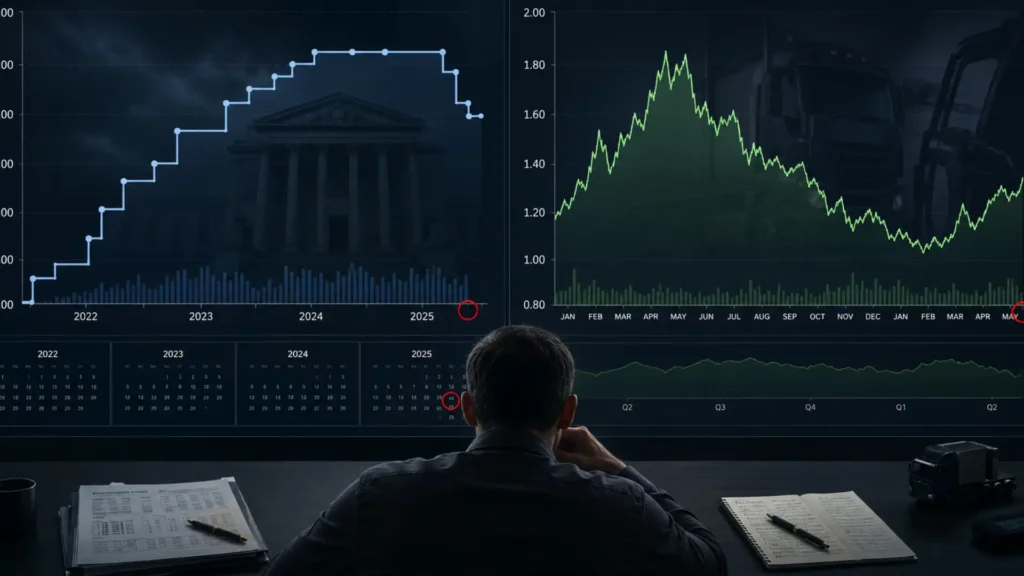
The SARB rate fleet cost impact lands in two days — and the diesel levy follows five days after that. On Wednesday 28 May, the South African Reserve Bank’s Monetary Policy Committee announces its interest rate decision. The repo rate sits at 6.75%. Prime is 10.25%. Melville Douglas expects a hold with a hawkish tone. Momentum Investments warns that if the Strait of Hormuz conflict lingers, one rate hike is possible. Then on Monday 3 June, the diesel levy rises from R0 to R1.97 per litre. Two financial events hitting the same fleet budget in the same week. Vehicle financing costs and fuel costs — the two largest line items on any fleet P&L — are both decided within seven days of each other.
This analysis is the first fleet-sector assessment of how the SARB rate decision and the diesel levy reinstatement combine to affect fleet operating costs. It models three rate scenarios, calculates the combined financial impact for a 20-vehicle fleet, and identifies the actions fleet managers should take before Wednesday’s announcement.
What the SARB Rate Decision Means for Fleet Cost: The Financing Side
Fundamentally, every fleet operator who finances vehicles pays an interest rate linked to the SARB’s repo rate. Understanding this link is essential before Wednesday’s announcement.
How vehicle financing connects to the repo rate
Specifically, the prime lending rate is calculated as the repo rate plus 3.5 percentage points. At a repo of 6.75%, prime stands at 10.25%. Commercial vehicle finance typically prices at prime plus 1% to prime plus 4%, depending on the borrower’s credit profile. A well-established fleet operator with strong financials might secure prime + 1% (11.25%). A newer or higher-risk operator might pay prime + 3% (13.25%). When the SARB moves the repo rate, every variable-rate vehicle loan in the country moves with it.
The fleet financing maths
To illustrate, for a 20-vehicle fleet with vehicles financed at R500,000 each over 60 months at prime + 2% (12.25%), the fleet carries approximately R10 million in vehicle debt. Monthly repayments across 20 vehicles total approximately R224,000. A 25-basis-point rate change moves monthly repayments by approximately R2,080 — or R25,000 per year. That amount is smaller than the diesel levy impact. However, it compounds on top of it — and unlike fuel costs, which fleet operators can partially control through monitoring and efficiency, the interest rate is imposed externally with zero ability to negotiate or optimise.
Vehicle financing is the second-largest fleet cost
Importantly, the Road Freight Association puts fuel at 35% to 55% of total operating costs. Vehicle financing and depreciation typically rank second at 15% to 25%. Together, fuel and financing account for 50% to 80% of fleet operating expenses. Crucially, both are determined by external decisions — the DMRE sets fuel prices monthly, the SARB sets rates at each MPC meeting — and both decisions land within the same seven-day window this week.
Three Rate Scenarios: What Each SARB Rate Fleet Cost Outcome Means
Accordingly, fleet operators should model three scenarios before Wednesday.
Scenario A: Hold at 6.75% (most likely)
Mzimasi Mabece of Melville Douglas expects the SARB to hold while adopting a “decisively hawkish tone.” He notes that “the policy environment has changed materially over recent months” and “markets have moved away from pricing aggressive rate cuts.” FocusEconomics projects the repo ending 2026 at 6.50% or higher — meaning easing has been pushed to the second half or later. For fleet operators, a hold means vehicle financing costs stay at current levels: no relief while fuel costs escalate. Monthly repayments remain unchanged. The combined impact is the full diesel levy increase — R591,000 per month for a 20-vehicle fleet — without any financing offset.
Scenario B: Cut 25bp to 6.50% (possible but unlikely)
The SARB’s own Quarterly Projection Model showed the repo declining to 6.31% by year-end. However, that projection preceded the oil shock and the Phala Phala political uncertainty. A split vote is possible — Mabece flags “greater divergence within the committee itself” — with some members favouring a cut amid weak household demand. If the MPC cuts by 25bp, prime drops to 10.00%. For a 20-vehicle fleet, this saves approximately R2,080 per month in financing costs — R25,000 per year. A welcome but modest offset against R591,000 per month in additional diesel levy costs.
Scenario C: Hike 25bp to 7.00% (unlikely but not impossible)
Momentum Investments warns explicitly: “We acknowledge risks for interest rate hikes. This would be more likely should the war linger or oil prices remain elevated and inflation expectations adjust upwards.” The SARB’s own adverse scenario shows inflation exceeding 4% if the Hormuz conflict continues for two more months — which it has. April CPI is expected near 4.0%. If the MPC hikes, prime rises to 10.50%. Fleet vehicle repayments increase by R2,080 per month on top of the diesel levy increase. A 20-vehicle fleet faces R616,000 per month in additional costs — R591,000 from diesel plus R25,000 annualised from financing. This is the worst-case double hit.
Why Fuel Inflation Drives the SARB Rate Fleet Cost Decision
The connection between diesel prices and interest rates is not abstract. The SARB explicitly monitors fuel costs when setting rates.
18% fuel inflation in Q2
Specifically, the SARB projects fuel inflation exceeding 18% for Q2 2026. This projection accounts for the April R7.51 and May R5.27 increases. The MPC has revised its headline inflation forecast upward twice since the Iran conflict began. Investec’s Annabel Bishop warns that the MPC will closely examine the April CPI data — released last week — which likely reflects “a substantial increase in fuel prices.” For fleet operators, the irony is acute: the diesel costs that crush fleet budgets are the same costs that prevent the SARB from cutting rates that would ease fleet financing.
Second-round effects the SARB watches
Furthermore, the SARB monitors whether fuel price increases feed through to broader inflation — food prices, transport costs, wage demands. Governor Kganyago emphasised the need to monitor these second-round effects before adjusting rates. When Putco raises fares 10% and taxi associations raise fares across Johannesburg, and Transnet hikes container charges 50%, the SARB sees exactly the kind of pass-through that delays rate cuts. Fleet operators absorbing higher diesel costs and passing them to clients through surcharges are — inadvertently — contributing to the inflation that keeps rates elevated.
The Phala Phala complication
The Phala Phala impeachment process adds a constraint the SARB cannot ignore. Political uncertainty weakens the rand. A weaker rand increases imported inflation — particularly fuel. If the SARB cuts rates, the rand weakens further, pushing fuel prices higher. If the SARB holds, rates stay restrictive but the currency stabilises. The MPC is effectively trapped between weak domestic demand (which argues for cuts) and imported inflation driven by oil prices and political risk (which argues for holding or hiking). Fleet operators bear the cost of this policy dilemma regardless of which direction the MPC moves.
The Combined Impact: SARB Rate Fleet Cost Plus Diesel Levy in One Week
Clearly, here is the combined financial picture for a 20-vehicle fleet facing both events within seven days.
If SARB holds + levy rises (base case)
In this scenario, vehicle financing stays unchanged at R224,000/month. Diesel levy adds R591,000/month. Combined additional cost versus May: R591,000 per month. The rate decision provides no offset. Every rand of the diesel increase hits the fleet budget at full force.
If SARB cuts 25bp + levy rises (best case)
Vehicle financing drops R2,080/month (R25,000/year). Diesel levy adds R591,000/month. Combined additional cost versus May: R588,920 per month. The cut provides a modest financing offset — covering approximately 0.35% of the diesel increase. Welcome but not transformative.
If SARB hikes 25bp + levy rises (worst case)
Vehicle financing rises R2,080/month (R25,000/year). Diesel levy adds R591,000/month. Combined additional cost versus May: R593,080 per month. Both costs move in the wrong direction simultaneously. A 20-vehicle fleet absorbs more than R7.1 million in additional annual costs from the two decisions combined.
Beyond the Headline: Hidden SARB Rate Fleet Cost Impacts Most Operators Miss
Notably, the repo rate affects fleet costs in ways that extend beyond monthly vehicle repayments.
New vehicle acquisition costs
First, fleet operators planning to replace or expand vehicles face higher total financing costs at current rates than 12 months ago. A Hilux or Ranger at R550,000 financed over 60 months at prime + 2% costs approximately R12,350 per month — compared to R11,980 at the lower rates of mid-2025. For a fleet replacing five vehicles annually, the rate environment adds approximately R22,200 per year to replacement costs. Importantly, if the SARB signals that rates will stay elevated through 2026 — as current projections suggest — fleet operators should factor this into every vehicle acquisition business case.
Insurance financing costs
Similarly, many fleet operators pay insurance premiums through instalment arrangements linked to prime. Higher rates increase the effective cost of insurance — on top of any premium increases driven by the SAPS capacity crisis and civil unrest risk. The rate decision compounds insurance cost pressure from two directions simultaneously.
Client payment delays
Additionally, higher rates squeeze every business in the supply chain. Fleet operators’ clients face higher borrowing costs, tighter cash flow, and slower payment cycles. If the SARB holds or hikes, debtor days typically extend — meaning fleet operators finance more working capital at higher rates while waiting longer for clients to pay. At 10.25% prime, every R100,000 in outstanding receivables costs the fleet operator approximately R855 per month in financing while waiting for payment.
Six Actions Before Wednesday’s SARB Rate Fleet Cost Decision
Model three financing scenarios this week. Hold at 10.25% prime, cut to 10.00%, hike to 10.50%. Calculate the monthly repayment impact across all financed fleet vehicles. Present the results alongside the diesel levy scenarios (R31 May, R33 June, R35 July) for a combined financial picture. Management should see the SARB decision and the levy reinstatement as one integrated cost event, not two separate ones.
Next, buy fuel before 2 June while the levy sits at zero. The diesel levy is the larger of the two cost events by a factor of 24. Every litre purchased at R31 before June costs R1.97 less than the same litre on 3 June. If you have bulk storage, fill it completely by 28 May. The rate decision on Wednesday will not change the diesel price on Thursday — but the levy change on Monday will change it permanently.
Additionally, review vehicle financing terms with your bank. If your fleet carries variable-rate financing at prime + 3% or higher, the current rate environment warrants a renegotiation conversation. Banks compete for fleet business. A strong payment history and verified tracking installation (which reduces the lender’s risk) may justify a margin reduction that saves more annually than the rate decision itself moves.
Optimise, claim, and monitor
Deploy fuel monitoring to maximise the value of every litre. The SARB rate decision changes financing costs by R25,000 per year. Fuel monitoring changes fuel costs by R80,000 to R4.2 million per year depending on fleet size and theft exposure. DigitFMS client data shows systems achieving ROI in 6 weeks. At R33 diesel in June, every percentage of consumption reduction delivers larger savings than at any previous price point. The monitoring investment is the cost item that fleet operators CAN control — unlike the repo rate and the levy, which they cannot.
Furthermore, claim every SARS diesel refund rand. For farming, forestry, and mining operators, the 100% refund recovers R5.85 per litre. At R33 diesel in June, that represents a 17.7% effective discount. In a week where the SARB provides no relief and the levy adds R1.97, the SARS refund is the single largest cost offset available to qualifying fleet operators.
Finally, watch Wednesday’s MPC statement for forward guidance. The rate number matters. The tone matters more. If the SARB signals that rates will stay elevated through 2026 — or that hikes are possible if oil remains above $100 — fleet operators should lock in fixed-rate financing on new vehicles rather than relying on variable rates that may rise further. A hawkish MPC statement changes the financing strategy for every vehicle acquisition decision in the second half of 2026.
Outlook: The SARB Rate Fleet Cost Environment Will Shape the Rest of 2026
Looking ahead, the next seven days set the financial framework for every fleet budget through year-end. The SARB decision on Wednesday determines the cost of fleet financing. The diesel levy on Monday determines the cost of fleet fuel. Together, these two numbers define 50% to 80% of total fleet operating costs. Neither is within the fleet operator’s control.
However, the response is within the operator’s control. Fuel monitoring, route optimisation, driver coaching, SARS refund claims, fuel surcharge activation, and financing renegotiation are all actions that fleet operators can take this week — regardless of what the MPC decides or what the levy adds. The operators who act on these levers before Wednesday will enter June with their costs managed across both dimensions. The operators who treat the SARB decision as irrelevant to fleet operations will discover — when the combined impact of unchanged rates plus R1.97 per litre in additional levy hits their June P&L — that monetary policy and fuel policy are not separate issues. They arrive in the same budget, in the same week, and they compound.
Ultimately, the SARB rate fleet cost reality for 2026 is clear: rates will not provide relief while oil remains above $100, the Hormuz strait remains closed, and the Phala Phala process creates political uncertainty. The diesel levy returns permanently. The two largest fleet cost drivers are both locked in the wrong direction. The only variable fleet operators control is how efficiently they convert each rand of fuel and each rand of financing into kilometres of productive transport. That efficiency — driven by technology, data, and disciplined management — is the difference between a fleet that survives the double hit and one that does not.
Frequently Asked Questions
When does the SARB announce its rate decision?
Wednesday 28 May 2026. Repo currently at 6.75%, prime at 10.25%. The March MPC held unanimously. Economists expect a hold with a hawkish tone. A split vote is possible. Momentum warns a hike is possible if the Hormuz conflict lingers and inflation expectations rise.
How does the interest rate affect fleet costs?
Vehicle finance prices at prime + 1% to prime + 4%. A 20-vehicle fleet at R500K each carries ~R10M in debt at 12.25%. A 25bp change moves repayments by R2,080/month (R25K/year). Vehicle financing is the second-largest fleet cost after fuel — both decided within the same 7-day window this week.
Will the SARB cut, hold, or hike?
Consensus expects a hold. Melville Douglas expects a hawkish tone. FocusEconomics projects the repo ending 2026 at 6.50% or higher. Momentum warns a hike is possible if the war lingers. A split vote is possible as some members weigh weak household demand against inflation risks. April CPI near 4.0% complicates the decision.
How does fuel inflation affect the rate decision?
SARB projects 18% fuel inflation for Q2 2026. April CPI near 4.0%. Putco’s 10% fare hike and Transnet’s 50% port charge increase demonstrate the second-round effects the SARB watches. Higher fuel inflation limits the MPC’s ability to cut rates — meaning the diesel costs that crush fleet budgets also prevent the rate relief that would ease fleet financing.
What is the combined cost of both events?
For a 20-vehicle fleet: diesel levy adds R591,000/month (guaranteed). If SARB holds: no financing offset. If SARB hikes 25bp: adds R2,080/month. If SARB cuts 25bp: saves R2,080/month. Best case combined: R588,920/month additional. Worst case: R593,080/month. Annual worst case: R7.1 million in additional costs.
How does Phala Phala affect the rate decision?
Political uncertainty weakens the rand. A weaker rand increases imported inflation. Cutting rates would weaken the rand further. The SARB is trapped between weak demand (argues for cuts) and imported inflation from oil and political risk (argues for holding). Fleet operators bear the cost regardless of which direction the MPC moves.
What should fleet operators do before Wednesday?
Model three financing scenarios (hold/cut/hike). Buy fuel before 2 June. Review vehicle financing terms with your bank. Deploy fuel monitoring for maximum savings per litre. Claim SARS 100% diesel refunds. Watch Wednesday’s MPC statement for forward guidance on whether to lock in fixed-rate financing for new vehicles.
Sources
FANews / Melville Douglas — Mzimasi Mabece, “Oil shock pushes inflation outlook higher as SARB expected to hold rates steady”, 20 May 2026; hawkish tone expected, split vote possible, policy environment changed materially · Momentum Investments — “SARB Interest Rate Decision March 2026” (PDF); repo held at 6.75%, hike risk if war lingers, inflation exceeding 4% in adverse scenario
FocusEconomics — “South Africa Interest Rate Outlook”, March 2026; repo ending 2026 at 6.50% or higher, easing pushed to H2 or later · Finance in Africa — “Oil shock forces SARB to hold at 6.75%”, March 2026; Governor Kganyago on second-round effects · Business Report — “MPC preview: SARB faces tough choices”, 12 May 2026; Annabel Bishop on CPI data and fuel prices · FANews — “SARB MPC: How firmly are inflation expectations anchored?”, March 2026; BER inflation expectations 3.6% in Q1 2026
Trading Economics — SA repo rate history, 6.75% since November 2025 cut · RandTools.co.za — SA prime rate 10.25% May 2026, vehicle finance calculator · EWN — “Economists believe SARB MPC next decision won’t be cut and dry”, February 2026 · Road Freight Association — Fuel at 35-55% of operating costs · DigitFMS — Diesel cost transport operators (Putco), political instability fleet fuel costs, fuel levy phase-out, ROI of fuel monitoring
© 2026 DigitFMS. All rights reserved.