
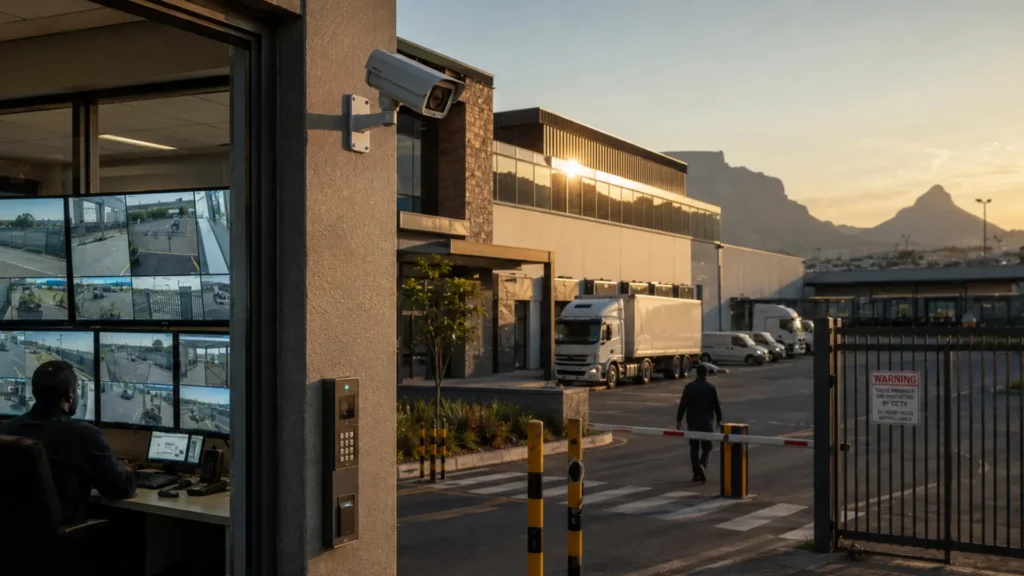
CCTV and Access Control have become essential components of modern business security. Across South Africa, organisations face increasing pressure to protect employees, visitors, assets, inventory and facilities against theft, unauthorised access and operational risk.
However, many businesses still view CCTV and access control as separate technologies. Consequently, they often miss the opportunity to create a more effective and intelligent security environment.
While CCTV provides visibility into what is happening across a facility, access control determines who is allowed to enter specific areas. Together, these technologies create a layered security strategy that helps businesses monitor activity, verify events and strengthen operational control.
Furthermore, the integration of CCTV and access control delivers significantly greater value than either solution operating independently. Therefore, organisations looking to improve security should consider how these technologies can work together.
Direct Answer: How CCTV and Access Control Work Together
CCTV and Access Control work together by combining visual monitoring with controlled entry management. CCTV records and monitors activity throughout a facility, while access control determines who can enter specific areas and when. Consequently, businesses gain both visibility and control, creating a stronger and more comprehensive security solution.
When integrated correctly, access events can be linked to video footage, providing verification, accountability and valuable operational intelligence. Furthermore, security teams can investigate incidents more efficiently because they have access to both visual evidence and access records.
DigitFMS helps South African businesses strengthen security through CCTV, Access Control, AI analytics, remote monitoring and integrated security technology solutions.
Why Businesses Need More Than Cameras
CCTV remains one of the most effective security technologies available today. Additionally, modern camera systems provide significantly better image quality, remote access and monitoring capabilities than previous generations of technology.
However, CCTV alone cannot control who enters a facility. Cameras can record events and provide evidence, but they cannot physically prevent unauthorised individuals from accessing restricted areas.
Consequently, businesses relying solely on cameras may still face security vulnerabilities. An individual may gain access to a facility, warehouse, office or depot before security personnel become aware of the situation.
Furthermore, reviewing hours of recorded footage after an incident has occurred is often time-consuming and reactive. Therefore, organisations increasingly require technologies that help prevent incidents rather than simply record them.
Why Access Control Alone Has Limitations
Access control systems provide a powerful method of managing entry into buildings, facilities and secure areas. Additionally, they create accountability by recording who entered specific locations and when.
Modern access control systems may use:
- Access cards
- Biometric readers
- Fingerprint scanners
- Facial recognition
- PIN codes
- Mobile credentials
- Vehicle access systems
However, access records alone do not always provide complete context. A log entry may show that a door was opened, but it cannot explain what happened immediately before or after the event.
Likewise, access systems cannot independently verify behaviour, identify suspicious activity or provide visual evidence of incidents. Consequently, combining access control with CCTV creates a much stronger security framework.
How Integration Creates a Complete Security Picture
When CCTV and access control are integrated, businesses gain a complete view of security events across their facilities.
For example, when an employee scans an access card at a secure door, the access control system records the event. Simultaneously, nearby CCTV cameras can capture video footage of the individual entering the area.
As a result, security teams can verify:
- Who accessed the area
- Whether access was authorised
- What occurred before entry
- What occurred after entry
- Whether multiple people entered together
- Whether suspicious behaviour was present
- Whether security protocols were followed
Furthermore, linking video evidence with access records significantly improves investigations, audits and incident response.
Reducing Internal Theft and Unauthorised Access
Many businesses focus heavily on external security threats. However, internal theft and unauthorised access can create equally significant losses.
Furthermore, internal incidents can be more difficult to identify because authorised personnel often have legitimate access to facilities, equipment and inventory.
By combining CCTV and access control, businesses gain greater accountability across their operations. Consequently, managers can verify access events and investigate suspicious activity with significantly greater accuracy.
Integrated security systems can help reduce:
- Inventory theft
- Equipment theft
- Unauthorised facility access
- After-hours access violations
- Contractor security breaches
- Employee misconduct
- Stock shrinkage
- Restricted-area violations
Additionally, visible security controls often act as a deterrent, reducing the likelihood of opportunistic incidents occurring in the first place.
Protecting Warehouses, Fleet Depots and Industrial Facilities
Warehouses, logistics facilities, fleet depots and industrial sites face unique security challenges. These environments often contain valuable inventory, expensive equipment, commercial vehicles and critical operational infrastructure.
Consequently, a single security breach can result in significant financial losses and operational disruption.
CCTV and access control help organisations secure:
- Warehouse entrances
- Loading bays
- Fleet parking areas
- Fuel storage facilities
- Server rooms
- Control rooms
- Restricted operational areas
- Visitor entry points
- Contractor access zones
- Perimeter access points
Furthermore, businesses can monitor activity across multiple facilities from a central location, improving both security oversight and operational visibility.
As a result, integrated security systems have become increasingly popular across logistics, transport, manufacturing and distribution environments.
The South African Business Security Environment
South African businesses operate in a complex security environment. Theft, vandalism, unauthorised access and criminal activity continue to create challenges across multiple industries.
Additionally, businesses must balance security requirements with operational efficiency. Employees, contractors, visitors, suppliers and service providers often require regular access to facilities.
According to the South African Police Service, property-related crime remains an ongoing concern for businesses throughout the country. Consequently, organisations are increasingly investing in integrated security technologies that improve both prevention and response.
Furthermore, security is no longer viewed purely as a compliance requirement. It has become an important component of operational resilience and business continuity.
The Role of AI-Powered Security Analytics
Modern security systems are becoming increasingly intelligent. Additionally, AI-powered analytics are transforming how businesses detect and respond to potential threats.
Rather than relying solely on human monitoring, AI can automatically identify unusual activity and generate alerts when predefined events occur.
AI-enabled CCTV systems may assist with:
- Intrusion detection
- Line-crossing alerts
- Loitering detection
- Vehicle recognition
- Facial recognition
- Perimeter monitoring
- Object removal alerts
- Behaviour analysis
Furthermore, AI analytics help security teams focus on genuine threats rather than continuously monitoring multiple camera feeds. Consequently, organisations can improve response times and reduce monitoring fatigue.
The Benefits of an Integrated Security Approach
The greatest value is achieved when CCTV and access control operate as part of a single security ecosystem.
| CCTV | Access Control | Combined Benefit |
|---|---|---|
| Visual monitoring | Entry management | Full visibility and control |
| Incident recording | Access records | Improved investigations |
| Remote viewing | User permissions | Stronger accountability |
| Evidence collection | Audit trails | Enhanced compliance |
| Security monitoring | Controlled access | Reduced risk exposure |
| Operational visibility | Facility management | Business intelligence |
Consequently, businesses gain a more complete understanding of what is happening across their facilities while improving security outcomes.
Furthermore, integrated systems often simplify administration because security teams can manage multiple technologies through a unified platform.
Building a Smarter Security Strategy
The most effective security strategies are proactive rather than reactive. Instead of relying solely on incident investigations, businesses should focus on preventing security breaches before they occur.
A modern business security strategy should consider:
- CCTV coverage requirements
- Access control policies
- Visitor management processes
- Contractor access procedures
- Remote monitoring capabilities
- AI analytics functionality
- Incident response planning
- Operational reporting requirements
Additionally, organisations should regularly review security procedures to ensure they remain aligned with operational needs and emerging risks.
Ultimately, businesses that combine visibility, control and intelligence are better positioned to protect people, assets and operations.
Questions Every Business Should Ask
Security technology should support operational objectives, not complicate them. Therefore, businesses should regularly evaluate whether their current systems provide sufficient visibility, control and intelligence.
Decision-makers should consider the following questions:
- Do we know who enters our facility and when?
- Can we verify access events visually?
- Can we quickly investigate security incidents?
- Are visitors and contractors managed effectively?
- Do we have visibility after hours?
- Can we monitor multiple facilities centrally?
- Are restricted areas adequately protected?
- Can we identify suspicious activity quickly?
- Do we have sufficient audit trails?
- Are our security systems integrated?
Consequently, answering these questions can help identify security gaps before they become operational problems.
What Businesses Should Do Next
If your organisation currently relies only on CCTV or only on access control, it may be time to evaluate how an integrated approach could improve security outcomes.
Likewise, businesses operating warehouses, logistics facilities, fleet depots, industrial sites and commercial premises should assess whether their current systems provide sufficient visibility and control.
Furthermore, organisations should consider how CCTV, access control, AI analytics and remote monitoring can work together to strengthen security while supporting operational efficiency.
A professional security assessment can help identify vulnerabilities, prioritise improvements and ensure technology investments align with business requirements.
Conclusion
CCTV and Access Control are no longer standalone security technologies. Together, they create a powerful security ecosystem that helps businesses improve visibility, manage access, investigate incidents and reduce risk.
Furthermore, South African organisations face increasingly complex security challenges that require more than cameras alone or access systems alone. Consequently, integrated security solutions are becoming an essential part of modern business operations.
By combining CCTV, access control, AI analytics and remote monitoring, businesses can create safer environments, improve operational intelligence and strengthen overall security performance.
Ultimately, the goal is not simply to record incidents after they occur. Instead, it is to create a proactive security environment that helps prevent incidents, improve accountability and protect people, assets and operations.
Frequently Asked Questions
CCTV provides visual monitoring and recording of activity, while access control manages who can enter specific areas. Together they create a more complete security solution.
Yes. Modern systems can integrate access events with video footage, allowing businesses to verify activity, improve investigations and strengthen accountability.
Yes. CCTV provides visibility into employee, visitor and contractor activity. When combined with access control, businesses can better identify and investigate suspicious behaviour.
Absolutely. Access control helps manage entry to restricted areas, loading bays, warehouses, control rooms, fuel facilities and other critical operational environments.
Logistics, transport, warehousing, manufacturing, retail, commercial property, education, healthcare and industrial businesses often benefit significantly from integrated security systems.