
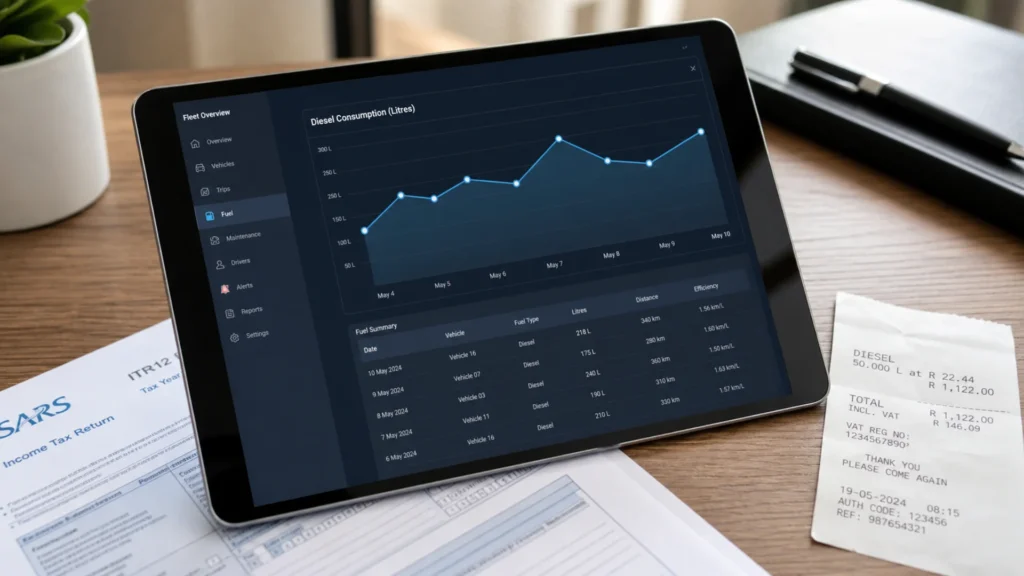
SARS diesel refund fleet compliance has become the most financially consequential data problem in South African primary-sector fleet management. On 20 April 2026, SARS confirmed that its systems are fully updated to process diesel refund claims at the new 100% rate — up from the previous 80% limit. The change, effective from 1 April 2026, applies to farming, forestry, and mining operations under rebate item 670.04. However, most qualifying fleet operators are either not claiming, still claiming at the old rate, or submitting data that will not survive an audit.
This analysis examines what changed, who qualifies, how the new standalone SARS digital platform validates claims, and why fuel monitoring technology is now the only reliable way to generate the compliant data that turns a 100% entitlement into actual money in the bank.
What Changed: SARS Diesel Refund Fleet Compliance at 100%
Essentially, the legislation is clear. A new excise provision under rebate item 670.04 of Schedule 6 to the Customs and Excise Act (Act No. 91 of 1964) came into effect on 1 April 2026. Specifically, it increases the allowable diesel consumption percentage for on-land primary sector beneficiaries from 80% to 100%. Accounting Weekly confirms Finance Minister Enoch Godongwana’s 2025 Budget Speech and aligns the Diesel Refund Scheme with its original policy intent.
The timing
Although the adjustment took effect on 1 April 2026, SARS confirmed it will reflect from the calendar month when claimants submit their April VAT return — meaning May 2026. Consequently, SARS will process the first claims at the 100% rate in May. SARS has confirmed it will not disadvantage claimants during the system upgrade period. The transition calculation uses a factor of 80/100 to adjust March litres (at the old rate) alongside April litres (at the new rate) within the same return period.
What the refund covers
The refund covers the General Fuel Levy and the Road Accident Fund (RAF) levy on eligible diesel. At current rates, this amounts to approximately R5.85 per litre. Importantly, SARS confirmed that claims will exclude the R3 per litre temporary fuel levy cut granted by National Treasury for April 2026 — or any future direct relief. The refund calculation uses the full levy structure regardless of whether the temporary relief is extended.
Who Qualifies: The SARS Diesel Refund Fleet Compliance Eligibility Rules
Notably, not every fleet operator qualifies. The 100% rate applies specifically to on-land primary sector users — and the eligibility criteria are strict.
Qualifying sectors
Specifically, three primary sectors qualify under rebate item 670.04: farming, forestry, and mining. This covers tractors, harvesters, irrigation pumps, forestry vehicles, mining haul trucks, and other diesel-powered equipment used in qualifying on-land activities. Additionally, offshore activities, harbour vessels, rail freight, and certain electricity generating plants qualify under separate provisions — but these already operated at different rates and the April change does not affect them.
Key requirements
In practice, to claim, the operator must be registered for VAT, must be both the buyer and user of the diesel (no third-party claims), and must use the diesel in qualifying activities as listed in Schedule 6 Part 3 Note 6 of the Customs and Excise Act. Furthermore, the operator must be able to distinguish between eligible and non-eligible diesel use. A tractor ploughing a field uses eligible diesel. The same tractor driving on a public road to reach the field uses non-eligible diesel. SARS requires data that separates the two — and this is precisely where most fleet operators fail.
The New SARS Digital Platform Changes the SARS Diesel Refund Fleet Compliance Game
However, SARS is not just increasing the rate. It is overhauling the entire claims infrastructure. Bizcommunity reports that SARS is moving diesel refund claims to a standalone digital platform, decoupling them from VAT returns. This means claims will no longer flow through the VAT201 declaration. Instead, they will face a dedicated customs and excise validation process.
Automated validation
In particular, the standalone platform introduces automated validation that cross-references claimed volumes against purchase records, consumption patterns, and activity data. In effect, SARS will apply algorithmic checks to identify claims where the numbers do not add up. Estimated volumes, rounded figures, and inconsistent eligible/non-eligible splits will trigger audit flags automatically — without a human reviewer needing to spot the discrepancy.
What this means for manual logbooks
Ricky Luntz, CEO of industrial fuel management specialist Refuel, puts it directly: “While the increase to a 100% rebate is a welcome relief, many companies still rely on manual logbooks and spreadsheets. Under the new SARS system, these fragmented and often estimated records are a significant audit risk.” Indeed, manual logbooks suffer from driver estimation, rounding, missing entries, and the inability to verify whether the driver actually used diesel in an eligible or non-eligible activity. When the automated platform compares a claim of 10,000 eligible litres against a total purchase of 12,000 litres, it will expect data — not guesswork — to justify the 2,000-litre non-eligible split.
The Money at Stake: Why SARS Diesel Refund Fleet Compliance Directly Affects Profitability
Overall, the financial impact of the 100% rate is substantial. At approximately R5.85 per litre in refundable levies, the difference between 80% and 100% claims adds up quickly.
Example: a 20-vehicle farming fleet
Consider a farming operation consuming 20,000 litres of eligible diesel per month. Under the old 80% rate, the monthly refund was approximately R93,600. Under the new 100% rate, the monthly refund rises to approximately R117,000. That is an additional R23,400 per month — or R280,800 per year — recovered simply by claiming at the correct rate with accurate data. For a larger mining operation consuming 100,000 eligible litres per month, the additional annual recovery exceeds R1.4 million.
The cost of not claiming — or under-claiming
Surprisingly, many qualifying operators do not claim at all. Others claim at the old 80% rate because their systems have not been updated. Others submit inaccurate data that understates eligible volumes because they cannot distinguish eligible from non-eligible use with confidence. In each case, the operator leaves money on the table. At diesel prices above R26 per litre and with the May price potentially hitting R35, every unclaimed rand compounds the cost pressure that the Road Freight Association has warned could close smaller operators.
The cost of over-claiming
On the other hand, operators who overstate eligible volumes face audit penalties. SARS applies interest on incorrectly claimed amounts and may impose additional penalties for negligent or fraudulent submissions. Operators must submit claims within two years of purchase and retain records for five years. An audit that finds inflated eligible volumes three years after the claim can result in repayment demands, penalties, and interest that far exceed the original refund value.
How Fuel Monitoring Solves the SARS Diesel Refund Fleet Compliance Problem
At its core, the compliance challenge is fundamentally a data problem. SARS needs verified, auditable records that show exactly how much diesel was purchased, how much was consumed in eligible activities, and how much was consumed in non-eligible activities. Fuel monitoring technology generates this data automatically.
Litre-level consumption measurement
First, capacitive or ultrasonic fuel sensors installed in vehicle tanks measure actual diesel volume continuously. Unlike dashboard fuel gauges — which manufacturers filter for driver convenience rather than auditing accuracy — these sensors record what is physically in the tank. Every refuelling event, every consumption interval, and every anomaly is logged with a timestamp. As a result, the fleet operator has verified data on exactly how many litres each vehicle consumed on each day.
GPS-based activity classification
Second, the critical requirement is separating eligible from non-eligible diesel use. GPS tracking linked to fuel data makes this possible. When a tractor operates within geofenced farm boundaries, the system classifies the consumption as eligible. When the same tractor drives on a public road between farms, the system classifies the consumption as non-eligible. The system generates this split automatically based on location data — not driver estimation. This is precisely the eligible/non-eligible breakdown that SARS requires.
Automated report generation
Third, modern fleet platforms generate SARS-ready reports that summarise total diesel purchased, total eligible litres, total non-eligible litres, and the refundable amount. These reports draw directly from sensor and GPS data — not from manual entries. Consequently, the data trail survives audit scrutiny because the system generates it automatically, timestamped, and independently verifiable against purchase receipts from fuel suppliers.
Theft detection protects claim accuracy
Additionally, fuel theft distorts consumption data. If 200 litres are stolen from a vehicle overnight and nobody detects the loss, the fleet’s consumption records show 200 litres more than the vehicle actually used. This inflates the eligible claim or creates a discrepancy that SARS automated validation will flag. Fuel monitoring with real-time theft alerts identifies stolen diesel and excludes it from the claim — protecting both accuracy and audit compliance.
Who Provides SARS Diesel Refund Fleet Compliance Technology in South Africa
Currently, several providers offer fuel monitoring capabilities that support diesel refund compliance, though approaches differ.
Refuel specialises in industrial fuel management with a specific focus on SARS compliance reporting for mining and agriculture. Cartrack offers fuel monitoring as part of its integrated fleet platform. Ctrack, Netstar, and MiX by Powerfleet all include fuel analytics within their enterprise fleet management systems.
DigitFMS provides SARS diesel refund fleet compliance capability through its D-Fuel litre-level monitoring system integrated with GPS tracking, driver identification, and AI dashcams on a single platform. The integration means the platform calculates the eligible/non-eligible diesel split automatically from geofenced activity zones. Reports export directly into the format SARS requires.
Importantly, the company operates more than 100 franchise branches across South Africa, providing local installation and sensor calibration. This local presence matters because inaccurate calibration undermines the data accuracy that the entire compliance framework depends on.
Six Steps Fleet Operators Should Take for SARS Diesel Refund Fleet Compliance
Confirm your registration status. Check that your operation is registered for the diesel refund under rebate item 670.04 via the DA 185 application form. If you have not registered, you are not claiming. Registration is a prerequisite — not an automatic entitlement.
Next, verify your claim rate has updated to 100%. SARS confirmed that the system update is live as of 20 April 2026. Check your April return to confirm the new rate applies. If your submission still reflects 80%, contact SARS or your tax advisor immediately — you are under-claiming by 20% on every litre.
Additionally, install litre-level fuel monitoring on every qualifying vehicle. Manual logbooks will not survive the new automated validation platform. Sensor-based monitoring generates the verified data that SARS requires. At current diesel prices, the ROI on fuel monitoring — through theft detection alone — typically pays for the system within 60 to 90 days. The compliance benefit is additional.
Data, records, and professional advice
Geofence your eligible activity zones. Create geofences around farm boundaries, mining concessions, and forestry areas in your fleet tracking platform. When vehicles operate inside these zones, the system classifies the diesel consumption as eligible automatically. This removes the guesswork that makes manual splits unreliable.
Furthermore, retain all records for five years. SARS requires purchase invoices, logbook data, claim submissions, and supporting documentation to be retained for five years from the date of the claim. Ensure your fuel monitoring platform stores historical data for this period — or export and archive reports at regular intervals.
Finally, consult a tax advisor familiar with diesel refunds. The transition from 80% to 100% involves a specific calculation factor for the crossover period. Claims for periods spanning March and April 2026 must use the 80/100 factor to adjust pre-April litres. A tax advisor can verify that your first 100% claim is correctly calculated and formatted for the new standalone platform.
Outlook: SARS Diesel Refund Fleet Compliance Moves to Automated Enforcement
Undoubtedly, the 100% rate is good news. However, the accompanying infrastructure overhaul is the real story. SARS is moving diesel refund claims from a semi-manual process buried in VAT returns to a dedicated, automated customs and excise platform with algorithmic validation. This is not a cosmetic change. It is a fundamental shift in how SARS scrutinises fuel data.
Therefore, for fleet operators in farming, forestry, and mining, the message is straightforward: the era of estimated logbooks and rounded numbers is ending. The operators who invest in verified, sensor-based fuel monitoring will claim the full 100% refund with confidence. Those who continue submitting manual data face two risks — under-claiming (leaving money on the table) and over-claiming (triggering penalties). Both are expensive.
Ultimately, SARS diesel refund fleet compliance is no longer just a tax compliance exercise. At R5.85 per litre refundable and diesel prices above R26, it is a direct contributor to operational profitability. The 100% rate is live. The systems are updated. The question is whether fleet operators have the data to claim what they are owed.
Frequently Asked Questions
What changed with the SARS diesel refund in April 2026?
SARS increased the allowable diesel consumption percentage for on-land primary sector users from 80% to 100%, effective 1 April 2026. This applies to farming, forestry, and mining under rebate item 670.04. SARS confirmed on 20 April that systems are fully updated. The first claims at the new rate process in May 2026.
Who qualifies for the 100% diesel refund?
On-land primary sector operators in farming, forestry, and mining. Claimants must be VAT-registered, must be both the buyer and user of the diesel, and must use it in qualifying activities under Schedule 6 Part 3 Note 6. Offshore activities, harbour vessels, and rail freight qualify under separate provisions.
Does the refund include the R3 temporary fuel levy relief?
No. SARS confirmed that claims exclude the R3 per litre cut granted by Treasury for April 2026. The refund uses the full levy structure. The Road Accident Fund levy remains claimable. The total refundable amount is approximately R5.85 per litre at current rates.
What records does SARS require?
Detailed logbook entries showing diesel purchased, litres used for eligible activities, and litres used for non-eligible activities. Operators must retain records for five years and submit claims within two years of purchase. SARS is moving to a standalone digital platform with automated validation. Estimated or rounded data will trigger audit flags.
Why are manual fuel logbooks a compliance risk?
Manual logbooks rely on driver self-reporting, introducing estimation and error. Refuel CEO Ricky Luntz warns that fragmented records are a significant audit risk under the new SARS system. Automated validation will cross-reference claimed volumes against purchase records. Data that does not match consumption patterns triggers audit flags automatically.
How does fuel monitoring support SARS compliance?
Litre-level sensors measure actual consumption continuously. GPS tracking classifies fuel use as eligible or non-eligible based on geofenced activity zones. The system generates SARS-ready reports automatically from verified data. Theft detection ensures stolen diesel does not distort claim accuracy.
How much can fleet operators recover at the 100% rate?
At approximately R5.85 per litre, a farming operation consuming 20,000 eligible litres monthly recovers R117,000 per month — R23,400 more than the old 80% rate. That equals R280,800 additional per year. A mining operation at 100,000 eligible litres per month recovers over R1.4 million extra annually.
Sources
SARS — “Excise: Increase in diesel refund claims from 80% to 100%”, 20 April 2026 · SARS — “Adjustment to Diesel Refund for Onland Users in Farming, Forestry, and Mining Sectors”, 13 February 2026 · SARS — “Diesel Refund Scheme” main page and policy document SE-DSL-02, updated 20 April 2026 · SARS — Manage Diesel Refund Calculation External Policy (PDF), effective 20 April 2026 · Accounting Weekly — “Diesel Refund Increased to 100% for Onland Primary Sector Users”, February 2026 · BusinessTech — “SARS has good news for big diesel users in South Africa this month”, April 2026 · Bizcommunity — “SARS diesel rebate system overhaul paves way for automated fuel monitoring”, April 2026; Ricky Luntz (Refuel CEO) · African Insider — “Godongwana hints at possible extension of fuel levy cut”, April 2026 · Customs and Excise Act, Act No. 91 of 1964, Schedule 6, Part 3, Note 6, Rebate Item 670.04 · Finance Minister Enoch Godongwana — 2025 Budget Speech
© 2026 DigitFMS. All rights reserved.