
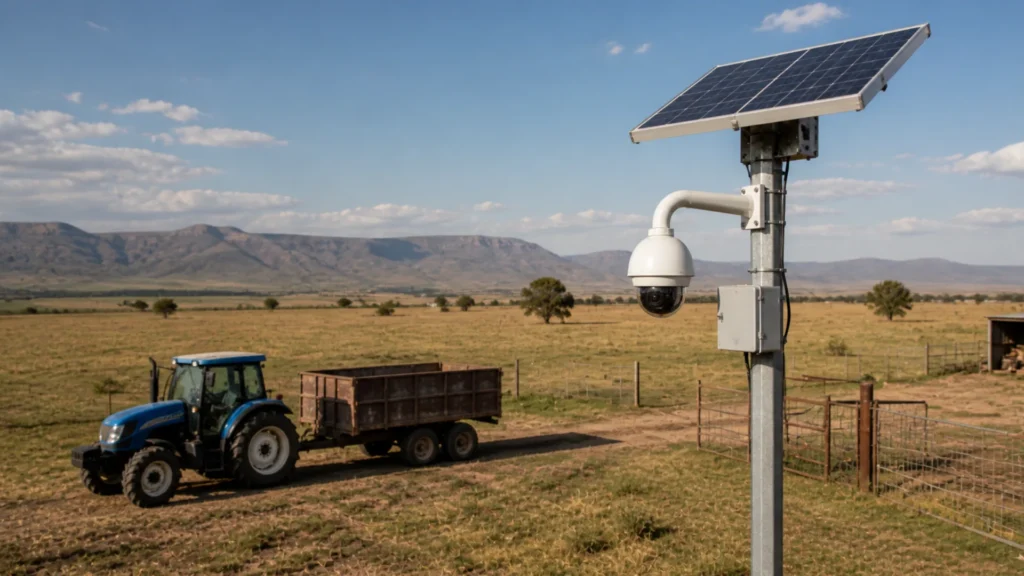
Off-grid security fleet assets face a threat that urban fleet operators rarely consider: what happens when there is no power, no signal, and no one watching. SAAI data shows farm attacks increased 18% in 2025, with 143 incidents recorded between January and October. AfriForum estimates stock theft alone costs R200 million per quarter. Meanwhile, solar panel theft has become an epidemic — criminals dress as maintenance crews and strip entire rooftop installations in daylight. For farms, mines, construction sites, and rural depots that operate beyond Eskom’s grid and cellular coverage, traditional security systems simply do not work.
This analysis examines why remote South African operations face disproportionate security risk, what off-grid security fleet assets technology now delivers, and how unified platforms connect site protection with mobile asset tracking to close the gap that criminals exploit in isolated locations.
The Crime Data Behind the Off-Grid Security Fleet Assets Crisis
Remote operations face a compounding problem: they are simultaneously the most vulnerable to crime and the least likely to report it. Understanding the scale of rural crime requires looking beyond official statistics.
Farm attacks surge 18% in 2025
The Southern African Agri Initiative (SAAI) reports that farm attacks rose from 121 incidents between January and October 2024 to 143 in the same period of 2025 — an 18% increase. Gauteng accounts for 32% of all farm attacks, followed by Mpumalanga (15%) and North West (13%). These three provinces together represent 60% of all incidents nationally. Importantly, SAAI specifically lists theft of cables, solar panels, water pumps, and tools as a growing concern alongside violent attacks.
R200 million in stock theft per quarter
AfriForum reported that stock theft cost the agricultural industry at least R200 million in direct losses from January to March 2025 alone. SAPS recorded 5,671 stock theft cases in that quarter — approximately 63 per day. Over the past year, more than 19,000 sheep, 12,000 cattle, and 12,000 goats were stolen nationwide. Furthermore, AgriSA research shows that only 25% of farmers affected by crime report it to police. The true loss — adjusted for unreported cases — exceeds R1.3 billion annually.
Solar panel theft becomes an epidemic
BusinessTech reports that solar panel theft has increased dramatically. Rodney Taylor, managing director of Guardian Eye, confirms a sharp rise fuelled by South Africa’s energy crisis. Forensic investigator Calvin Rafadi explains that criminals use a spanner to unscrew panels, often arriving dressed in work suits to appear legitimate. Fidelity Services Group notes that thieves have enough time to dismantle entire systems before leaving the property. Consequently, the very technology that protects rural sites from power outages has itself become a theft target — creating a vicious cycle where off-grid security fleet assets protection must also protect its own power source.
Construction site theft
Construction sites face equally severe exposure. Portable generators, diesel stores, copper wiring, tools, and building materials sit on unfenced, unlit sites overnight and over weekends. Additionally, the South African Federation of Civil Engineering Contractors (SAFCEC) has repeatedly flagged site theft as a major cost driver. When a generator is stolen from a remote construction site, the project loses not just the equipment but the power source for everything else on site — including any security systems that depended on it.
Why Traditional Security Fails Where Off-Grid Security Fleet Assets Operate
Standard security systems assume three things: mains electricity, fixed internet, and cellular connectivity. Remote South African operations routinely lack all three.
No power means no electric fencing
Electric fencing — the most common perimeter deterrent in South Africa — requires continuous electricity. On a farm or construction site beyond Eskom’s grid, electric fencing is either impossible or depends on a generator that criminals can disable. Even on-grid sites lose fencing capability during power outages caused by copper theft or grid instability. As a result, the perimeter stands undefended precisely when the site is most vulnerable.
No connectivity means no alerts
CCTV cameras, alarm systems, and GPS trackers all need connectivity to send alerts. ICASA coverage maps show that significant portions of Limpopo, the Eastern Cape, North West, and Mpumalanga lack reliable 4G coverage. Without connectivity, a camera records footage locally but cannot alert anyone until someone physically visits the site and checks the recording. By then, the theft happened days ago. Similarly, a GPS tracker on a tractor cannot report its position if there is no cellular signal to carry the data.
Distance defeats response time
Even when an alert does reach a monitoring centre, response times in rural areas are measured in hours rather than minutes. The nearest SAPS station may be 50 km away. Private security armed response is often unavailable outside urban zones. Consequently, the entire security model — detect, alert, respond — breaks down when the “respond” leg takes longer than the time a thief needs to load a bakkie with stolen goods.
How Off-Grid Security Fleet Assets Technology Closes the Gap
Modern off-grid security solves each of these three problems with purpose-built technology. Here is what a properly designed remote security system delivers.
Solar power with battery backup
Solar panels charge lithium-ion or lithium iron phosphate batteries that power cameras, sensors, and communication equipment 24 hours a day. A properly sized system provides 3 to 7 days of backup during overcast periods — sufficient for South African winter conditions in most regions. Importantly, the solar panels themselves must be secured with tamper-proof mounting, anti-theft bolts, and monitoring that detects removal attempts. Providers like Agri Solsec, WCCTV South Africa, and Hikvision Africa all offer solar-powered camera kits specifically designed for South African farm and remote site deployments.
Multi-network and satellite connectivity
Multi-network SIM cards automatically connect to whichever cellular provider offers the strongest signal at each location — switching between Vodacom, MTN, and Telkom as the vehicle or site changes position. Where cellular coverage fails entirely, satellite connectivity via Iridium, Globalstar, or newer LEO networks provides a fallback. For off-grid security fleet assets, the connectivity architecture must work in the worst case, not the average case. A tracker that works in Pretoria but loses contact in Limpopo is not fit for purpose.
Onboard data buffering
When connectivity drops temporarily, advanced tracking units store position data, sensor readings, and event logs on internal memory. Once the vehicle or device re-enters a coverage zone, it uploads the buffered data in bulk. This ensures that no trips, no fuel events, and no tamper alerts are lost during connectivity gaps. For fleet vehicles operating on remote mining roads or agricultural routes, this buffering capability means the fleet manager sees a complete trip record — not a trail of gaps.
AI-powered camera analytics
Processing video footage at the edge — on the camera itself rather than in a remote server — dramatically reduces the data that needs to be transmitted over limited connectivity. AI analytics running on the camera distinguish between people, vehicles, and animals. Only events classified as genuine threats trigger alerts and upload video clips. This is critical for rural deployments where wildlife, livestock, and wind-blown vegetation would otherwise generate hundreds of false alarms per day. The camera is smart enough to know the difference between a kudu and a criminal.
Thermal imaging for night detection
Most rural theft occurs at night. Thermal cameras detect body heat regardless of lighting conditions, fog, dust, or smoke. They provide early warning of approaching intruders at distances exceeding 500 metres. Unlike visible-light cameras, thermal systems work regardless of whether site lighting exists or has been cut. For off-grid security fleet assets deployment, thermal cameras eliminate the need for power-hungry floodlights while delivering superior night detection.
Protecting Mobile Off-Grid Security Fleet Assets: Tractors, Generators, and Equipment
Not all assets at remote sites are fixed. Tractors, trailers, generators, irrigation pumps, and construction equipment move between locations and sit unattended for extended periods. These mobile assets need protection that travels with them.
Battery-powered GPS trackers
Self-contained GPS trackers with internal batteries and magnetic mounting deploy in seconds without any wiring. They report position at configurable intervals and enter sleep mode to conserve battery — lasting weeks or months on a single charge. When the asset moves outside a geofenced zone, the tracker wakes immediately, increases reporting frequency, and sends a tamper alert. For farming operations with tractors and implements spread across multiple camps, magnetic trackers provide visibility that fixed CCTV cannot match.
Fuel monitoring for bulk storage and mobile tanks
At diesel prices above R26 per litre, bulk fuel storage on farms and construction sites represents an enormous theft target. Litre-level sensors installed in stationary tanks detect drainage events in real time. Similarly, mobile bowsers and vehicle-mounted fuel tanks benefit from the same monitoring. At R26 per litre, a 1,000-litre theft costs R26,000 — and can happen in under 30 minutes. The SARS diesel refund expansion to 100% for primary-sector operators makes accurate fuel records even more critical: every undetected theft distorts the data that supports the rebate claim.
Protecting the security system itself
Off-grid security systems face a unique challenge: the components themselves are theft targets. Solar panels, batteries, cameras, and cables all have resale value. Tamper-proof mounting brackets, anti-theft fasteners, enclosure locks, and tamper-detection sensors that alert when equipment is disturbed are essential. Indeed, the system must protect itself before it can protect anything else. Microdotting and hidden transmitters in solar panels provide a recovery trail if panels are stolen despite physical protections.
Unified Platforms: Connecting Off-Grid Security Fleet Assets With Site Monitoring
The greatest risk at remote sites is not the absence of individual devices. It is the absence of integration. A solar camera on a fence post, a tracker on a tractor, and a fuel sensor on a bulk tank are three separate systems generating three separate alert streams. Without a unified platform, nobody correlates the camera detecting movement at the fence with the tracker detecting a tractor leaving the geofenced zone at the same moment.
Unified off-grid security fleet assets platforms bring all data streams onto a single dashboard. The farm manager sees cameras, trackers, fuel sensors, and access logs in one view. An alert from the perimeter camera triggers alongside the geofence alert from the tractor. The control room sees both events simultaneously and dispatches a response based on the full picture — not a fragment.
Leading providers offering various levels of remote and off-grid capability include Agri Solsec (solar CCTV specialist), WCCTV South Africa (solar 4G camera systems), Hikvision Africa (solar camera kits), Fidelity ADT (guarding plus electronic), and DigitFMS. DigitFMS connects solar CCTV and perimeter detection at fixed sites with GPS tracking, AI dashcams, D-Fuel monitoring, and driver identification across mobile assets — all on a single dashboard. The company’s franchise network of 100+ branches provides local installation and support in rural areas where national-only providers have limited reach.
Six Steps to Secure Off-Grid Security Fleet Assets
Conduct a connectivity audit. Test cellular signal strength at every remote site using all three major networks. Identify dead zones where satellite fallback is required. Map the gaps before deploying any technology — the wrong assumption about connectivity is the most expensive mistake in remote security.
Next, deploy solar-powered CCTV with AI analytics. Camera systems with onboard AI reduce false alarms from wildlife and livestock to manageable levels. Choose systems rated for South African conditions: IP67 housings, operating temperatures above 45°C, and infrared night vision. Ensure local storage capacity for 30+ days of footage.
Additionally, track every high-value mobile asset. Tractors, generators, trailers, and irrigation equipment all need GPS trackers with geofencing and tamper alerts. Battery-powered magnetic units deploy in minutes without wiring. At current equipment prices, a single stolen tractor represents a loss that dwarfs the cost of tracking every asset on the farm.
Fuel, data, and response
Monitor fuel storage in real time. Install litre-level sensors on bulk diesel tanks. At R26 per litre, even small drainage events carry significant financial weight. Furthermore, accurate fuel records support SARS diesel rebate claims at the new 100% rate for primary-sector operators.
Then, unify all security data on one platform. If your cameras, trackers, and fuel sensors each send alerts to different systems, the correlation that catches criminals will not happen. Consolidate onto a single dashboard. The alert from the perimeter camera should appear alongside the alert from the tractor tracker — in one stream, on one screen.
Finally, secure the security system itself. Bolt solar panels with tamper-proof fasteners. Lock battery enclosures. Install tamper sensors on every device. Microdot panels for recovery. The system must survive the same threats it is designed to detect.
Outlook: Off-Grid Security Fleet Assets Protection Defines the Next Frontier
South Africa’s rural crime crisis is worsening. Farm attacks are up 18%. Stock theft costs R200 million per quarter. Solar panel theft creates a vicious cycle where energy independence attracts the very crime it was meant to survive. Meanwhile, SAPS response in rural areas remains slow, under-resourced, and — with the national leadership in crisis — unlikely to improve in the near term.
However, the technology has caught up. Solar power, satellite connectivity, AI analytics, and battery-powered tracking now deliver genuine 24/7 protection in locations that were impossible to secure five years ago. The cost of deploying off-grid security fleet assets systems has dropped as solar panel prices have fallen and cellular coverage has expanded. For most farming, mining, and construction operations, the payback period is measured in weeks — often from a single prevented theft.
Ultimately, off-grid security fleet assets protection is not a niche concern for farmers in the Northern Cape. It applies to every South African fleet operator with vehicles, equipment, or facilities that spend any time beyond the reach of mains power and reliable connectivity. In a country where the grid is unstable, cell towers are vandalised, and rural policing is stretched to breaking point, the ability to protect assets independently — with solar, satellite, and AI — is no longer optional. It is the baseline.
Frequently Asked Questions
What is off-grid security and why do fleet assets need it?
Off-grid security fleet assets protection operates without mains electricity or fixed internet. It uses solar power, battery backup, cellular or satellite connectivity, and onboard storage to monitor equipment in remote locations. Fleet assets at farms, mines, and construction sites often sit beyond Eskom’s grid and cellular coverage — creating blind spots criminals exploit.
How do solar CCTV cameras work for remote sites?
Solar panels charge batteries that power cameras continuously without grid electricity. AI analytics distinguish people from animals to reduce false alarms. Footage transmits via 4G or satellite. Local microSD storage retains recordings during connectivity drops. Infrared LEDs enable night vision. Providers like Hikvision, WCCTV, and Agri Solsec design systems specifically for South African conditions.
How much does farm crime cost South African agriculture?
AfriForum estimates stock theft costs R200 million per quarter in direct losses. AgriSA shows only 25% of affected farmers report crime. The adjusted annual loss exceeds R1.3 billion. SAAI data shows farm attacks increased 18% in 2025. SAPS recorded 5,671 stock theft cases in one quarter — roughly 63 per day.
Can GPS trackers work without cellular coverage?
Standard trackers need cellular connectivity. Satellite-connected trackers use Iridium or Globalstar as alternatives. Some use hybrid approaches: cellular when available, satellite as fallback. Others buffer data onboard and upload when the vehicle returns to a coverage zone. For off-grid security fleet assets, satellite fallback is essential.
What equipment is most stolen from remote sites?
High-value targets include diesel fuel, solar panels and batteries, copper cabling, livestock, water pumps, tools and generators, construction materials, and agricultural chemicals. SAAI specifically flags cable, solar panel, water pump, and tool theft as growing concerns alongside violent farm attacks.
How does off-grid security integrate with fleet management?
Unified platforms connect fixed-site monitoring with mobile asset tracking on a single dashboard. When a tractor leaves an authorised zone, the geofence alert triggers alongside the perimeter camera feed. This eliminates the gap between site security and asset security that criminals exploit at remote locations.
Is off-grid security reliable in South African conditions?
Modern systems handle harsh conditions. Solar panels operate above 45°C. Batteries provide 3 to 7 days of backup. IP67-rated housings resist dust and rain. Multi-network SIMs switch between providers automatically. Satellite fallback covers the most remote locations. The technology has matured significantly since early off-grid deployments.
Sources
SAAI — “Delayed crime statistics deepen uncertainty as farm attacks increase”, November 2025; “Farm attacks, livestock theft and illegal hunting: South Africa’s rural crime crisis”, June 2025 · AfriForum — “Stock theft robs agriculture of at least R200m in one quarter”, June 2025 · AgriSA — National agricultural sector crime survey; 25% reporting rate data · Farmer’s Weekly — “The impact of theft on farms in South Africa”, December 2024 · BusinessTech — “How criminals are stealing solar panels in South Africa”, August 2023 · SolarQuarter — “Theft fears and high costs slow solar adoption in South Africa”, April 2026 · SolarWow — “Solar panel theft South Africa: Combating the rising trend”, February 2024 · Hikvision Africa — Solar-powered security camera product range · WCCTV South Africa — Farm security solar 4G CCTV systems · Agri Solsec — Solar camera systems for South African farms · Fidelity Services Group — Solar panel security recommendations · Guardian Eye — Rodney Taylor statements on solar theft trends · SAPS — Q4 2024/25 stock theft statistics · SAFCEC — Construction site theft data · Agribook Digital — “Rural crime and farm safety” comprehensive review
© 2026 DigitFMS. All rights reserved.