
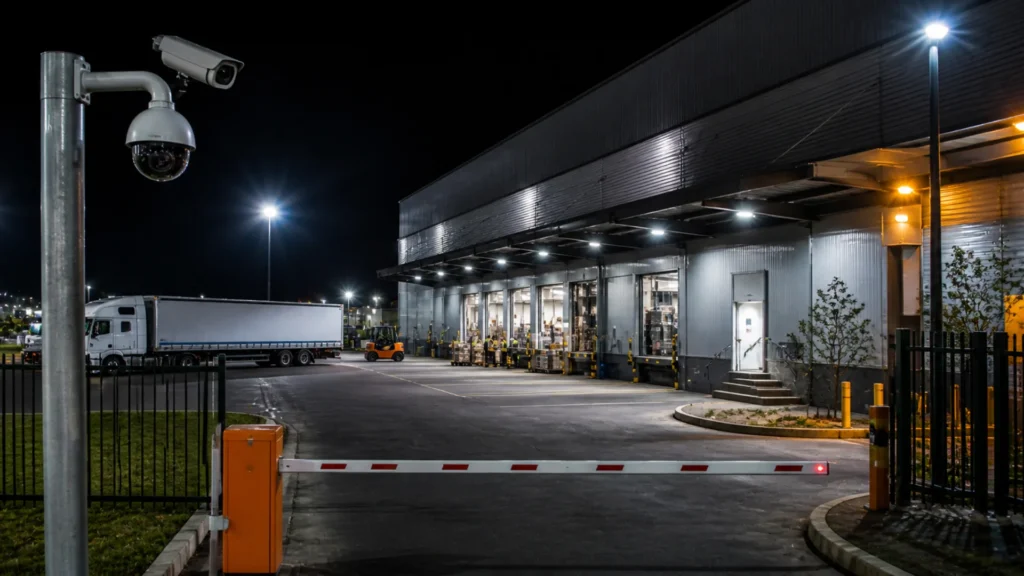
Depot security fleet monitoring addresses a blind spot that costs South African businesses billions every year: the gap between warehouse protection and vehicle protection. TAPA EMEA’s January 2025 data revealed a single theft of R200 million in precious metals from a Cape Town facility — where four offenders cut through a perimeter fence, found the vault unattended, and walked out with the goods. In Durban, R110 million in clothing disappeared from a warehouse. In Kempton Park, R41 million in trailers and goods vanished from a depot. These were not highway hijackings. They were facility failures.
This analysis examines why the gap between fixed-site security and fleet security creates exploitable blind spots, what the TAPA data reveals about facility-based cargo crime, and how unified depot security fleet monitoring platforms close the gap by putting warehouses and vehicles on the same screen.
The Facility Theft Data That Proves Depot Security Fleet Monitoring Matters
Typically, most conversations about cargo crime in South Africa focus on truck hijacking. However, TAPA EMEA’s data tells a different story. A significant proportion of the highest-value thefts target fixed facilities — warehouses, depots, distribution centres, and cargo staging areas — rather than vehicles on the road.
South Africa’s biggest facility thefts
Specifically, TAPA EMEA recorded several major facility-based incidents that dwarf typical highway hijackings in value. In January 2025, thieves stole R200 million in precious metals from a facility near Cape Town by cutting through a perimeter fence and accessing an unattended vault. In Durban, R110 million in clothing and footwear disappeared from an origin facility. A Gauteng warehouse lost R100 million in cobalt hydroxide. In Kempton Park, R41 million in trailers and goods vanished from a logistics depot. Each of these losses exceeded the value of hundreds of individual truck hijackings combined.
The global pattern confirms the local risk
Importantly, the problem is not unique to South Africa. In December 2025, a Paris warehouse lost €30 million in electronics — 50,456 devices including smartphones, laptops, and tablets — after perpetrators damaged doors and disabled the CCTV and alarm system. The facility was reportedly left unattended. Consequently, TAPA EMEA recorded €43 million in cargo losses across 557 crimes in December 2025 alone. Andre Du Venage, TAPA’s South African lead, consistently emphasises that facility security is as critical as transit security.
The Blind Spot: Why Separate Systems Create Depot Security Fleet Monitoring Gaps
In practice, most fleet operators manage their vehicles and their facilities on entirely separate systems. This fragmentation is the root cause of the blind spot.
How the gap works in practice
On one hand, the GPS tracking platform monitors vehicles on the road — location, speed, route adherence, fuel consumption. Meanwhile, a separate CCTV system monitors the depot. Access control runs on a third platform. Alarm systems operate on a fourth. Each system works independently. None of them talk to each other. As a result, the fleet manager sees the truck on the road but has no visibility into what happens when it arrives at the depot. The depot security operator sees the camera feeds but does not know which vehicle is scheduled to arrive or who should be driving it.
Where cargo disappears
Above all, the handover point — where cargo moves from vehicle to warehouse or warehouse to vehicle — is the most vulnerable moment in the supply chain. During loading and unloading, goods are physically exposed. If nobody correlates the fleet tracking data (which vehicle arrived, when, driven by whom) with the facility data (which bay door opened, who authorised it, what the camera recorded), theft at the handover point goes undetected until the next inventory count. By then, the evidence trail is cold.
Weekend and after-hours exposure
Furthermore, many fleet depots rely on crewed security during business hours and electronic systems after hours. The Cape Town precious metals theft occurred precisely because the facility was left unattended by security personnel. If the perimeter detection system, CCTV, and access control had been integrated with a 24/7 monitoring centre — and that monitoring centre also tracked the fleet — the intrusion would have triggered an immediate armed response. Instead, four men cut through a fence and found no resistance.
What Effective Depot Security Fleet Monitoring Looks Like
Closing the gap requires bringing fixed-site security and fleet management onto a single platform. Here is what each component contributes.
CCTV with AI-powered analytics
Essentially, high-resolution cameras cover all entry points, loading bays, perimeter fence lines, and fuel storage areas. AI analytics distinguish between people, vehicles, and animals — eliminating the false alarms that cause operators to ignore genuine alerts. Night vision with infrared illumination is essential because the majority of facility thefts occur after hours. Cloud-based storage with encrypted backup ensures footage survives even if on-site recording equipment is stolen or damaged during a break-in.
Access control with fleet driver integration
In addition, biometric readers, proximity cards, or PIN pads at gates and doors create an auditable entry log showing who entered the facility, when, and which areas they accessed. Critically, when access control integrates with fleet driver identification, the system links the person entering the depot to the person assigned to each vehicle. If an unregistered individual attempts entry outside business hours, the system triggers an alert and simultaneously records the event on camera. This closes the insider threat at the facility level — the same threat that Aon identifies as a primary enabler of hijacking.
Perimeter intrusion detection
Electric fences provide a basic deterrent but carry a fundamental weakness: they require power. When Eskom copper theft causes outages — or when criminals deliberately cut power — electric fences go down. Fibre-optic perimeter sensors, vibration detection systems, and ground-based radar provide detection capability that operates independently of the power grid. These systems detect cutting, climbing, and digging along fence lines before intruders reach the cargo area.
Fuel storage monitoring
Fleet depots with on-site fuel storage face a specific risk. At diesel prices above R26 per litre, bulk fuel tanks represent high-value targets. Litre-level fuel monitoring on storage tanks — separate from vehicle fuel sensors — detects drainage events in real time. When integrated with access control and CCTV, the system identifies exactly when fuel was taken, how much disappeared, and who was on site. TAPA EMEA reported 112 fuel theft incidents from trucks in January 2025 alone — depots with bulk storage face similar or greater exposure.
The unified dashboard
The defining feature of effective depot security fleet monitoring is a single dashboard that shows both fixed-site and mobile asset data simultaneously. The fleet manager sees vehicles on the road and in the yard on the same screen. Camera feeds from the depot link to specific vehicle arrivals. Access logs correlate with driver ID data. Alerts from both systems appear in one stream. This eliminates the blind spot — the handover point becomes visible, auditable, and protected.
How the Depot Security Fleet Monitoring Gap Enables Specific Crimes
Understanding how criminals exploit the gap helps fleet operators prioritise their security investment.
After-hours perimeter breach
This is the Cape Town model. Criminals study the facility, identify when crewed security leaves, and breach the perimeter using cutting tools. Without integrated detection and response, the breach goes unnoticed until the next morning. A unified platform with 24/7 monitoring detects the perimeter breach within seconds, dispatches armed response, and records the entire event on camera — regardless of whether a guard is on site.
Insider-facilitated loading bay theft
A compromised warehouse employee opens a bay door outside of scheduled loading windows and allows an unauthorised vehicle to collect goods. Without depot security fleet monitoring, this appears legitimate — the door opened, a vehicle loaded, and it left. With unified monitoring, the system flags that no scheduled delivery matches the bay door activation, the vehicle that loaded does not appear in the fleet tracking system, and the access log shows an employee who should not have been on shift. Every detail is captured, correlated, and flagged.
Fuel siphoning from depot storage
Bulk fuel tanks at fleet depots are particularly vulnerable overnight and on weekends. Thieves connect hoses and drain hundreds of litres before anyone notices. With integrated fuel tank monitoring and CCTV, a drainage event triggers an immediate alert that includes the camera feed showing who is at the tank, the exact volume being taken, and the access log showing whether the person is authorised. The alert reaches the fleet manager’s phone within seconds.
Who Provides Depot Security Fleet Monitoring in South Africa
The South African market offers two approaches to closing the depot-fleet security gap.
Traditional security companies expanding into fleet
Fidelity ADT, Bidvest Protea Coin, and G4S dominate fixed-site security — guarding, CCTV, access control, and alarm monitoring. These companies have deep expertise in physical facility protection. However, their fleet management capabilities are typically limited or outsourced. The depot is well protected but the vehicle disappears from view the moment it leaves the gate.
Fleet management companies expanding into fixed-site
Conversely, Cartrack, Tracker, Netstar, Ctrack, and MiX by Powerfleet dominate fleet tracking and vehicle recovery. Their mobile asset expertise is proven. Some now offer CCTV and access control as add-on services. DigitFMS bridges both worlds through its integrated platform — combining GPS tracking, AI dashcams, D-Fuel monitoring, driver identification, and autonomous vehicle defence with CCTV, access control, and perimeter detection for fixed sites. The company operates more than 100 franchise branches across South Africa, providing local installation for both mobile and fixed-site systems.
The integration question
The critical question for fleet operators is not which provider has the best cameras or the best tracker. It is whether both data streams — fixed-site and mobile — appear on one dashboard or require separate logins. Ultimately, separate systems recreate the blind spot that depot security fleet monitoring is designed to eliminate. A single platform that correlates vehicle arrivals with bay door activations, driver ID with access logs, and fuel tank levels with CCTV footage provides genuine unified protection.
Six Steps to Close the Depot Security Fleet Monitoring Gap
Map your handover points. Identify every location where cargo transfers between vehicle and facility. Loading bays, staging areas, fuel points, and temporary storage zones are your highest-risk locations. Ensure every handover point has camera coverage, access control, and a link to the fleet tracking system.
Next, audit your after-hours security. The Cape Town vault theft occurred because the facility was unattended. Determine what happens at your depot between 18:00 and 06:00. If the answer is “the alarm is on,” that is not enough. Integrate perimeter detection, CCTV, and monitoring centre response for continuous 24/7 coverage.
Additionally, connect access control to driver identification. When the same ID system verifies who drives the vehicle and who enters the facility, the insider threat becomes visible at both points. An unauthorised person cannot drive a fleet vehicle to the depot and then enter the warehouse without triggering alerts at both layers.
Monitor, integrate, and respond
Monitor fuel storage separately. If your depot has bulk diesel tanks, install litre-level sensors with real-time alerts. At R26 per litre, a 1,000-litre theft costs R26,000 — and it can happen in under 30 minutes. Consequently, fuel monitoring on storage tanks is as important as fuel monitoring on vehicles.
Furthermore, unify your dashboards. If your fleet tracking, CCTV, access control, and alarm systems require separate logins, you have a blind spot. Consolidate onto a single platform where depot events and vehicle events appear in one alert stream. This is the single most impactful step in closing the gap.
Finally, test your response time. Trigger a test perimeter alarm after hours and measure how long it takes for armed response to arrive. Then trigger a test vehicle tamper alert and measure the tracking provider’s response. If either takes more than 10 minutes, your coverage has a gap that criminals will find before you do.
Outlook: Depot Security Fleet Monitoring Becomes the Standard
Overall, the TAPA data is unambiguous: facility thefts produce some of the largest single losses in South African cargo crime. Meanwhile, fleet operators invest heavily in vehicle tracking while leaving depots protected by fragmented, disconnected systems. This inconsistency is exactly what criminals exploit.
Insurance tracking fleet mandates are already tightening requirements for vehicles. Expect the same trend to reach facilities. Insurers will increasingly require integrated depot monitoring — CCTV, access control, perimeter detection — as a condition of cargo and property cover. The operators who unify their security platforms now will meet these requirements before they become mandates.
In conclusion, depot security fleet monitoring is not an additional expense. It is the completion of a security architecture that most fleet operators have only built halfway. The vehicle is protected on the road. The depot must be protected with equal rigour. And both must appear on the same screen, monitored by the same team, responding through the same chain. That is how you close the gap that cost South African businesses R200 million in a single night.
Frequently Asked Questions
How much cargo is stolen from depots in South Africa?
TAPA EMEA data shows individual facility thefts reaching R200 million (Cape Town precious metals), R110 million (Durban clothing), R100 million (Gauteng cobalt), and R41 million (Kempton Park trailers). Over 60% of all cargo attacks occur in Gauteng. Facility thefts produce some of the largest single losses in SA cargo crime.
What is the gap between depot and fleet security?
Most operators manage vehicles on one platform and facilities on separate CCTV, access control, and alarm systems. These systems do not communicate. The blind spot appears at handover points — loading bays, staging areas, fuel storage — where cargo moves between vehicle and warehouse without correlated monitoring.
How does unified depot security fleet monitoring work?
A single platform integrates CCTV, access control, perimeter detection, and fleet tracking on one dashboard. Vehicle arrivals link to camera feeds. Driver ID correlates with access logs. Alerts from both systems appear in one stream. If a vehicle arrives outside scheduled hours while a perimeter sensor activates, both events flag together.
What CCTV features does depot security require?
Essentially, high-resolution cameras covering entries, loading bays, and perimeter lines. AI analytics to distinguish people from animals. Infrared night vision for after-hours detection. Cloud-based encrypted storage so footage survives even if on-site equipment is stolen. Retention periods must comply with POPIA.
How does access control protect fleet depots?
Biometric readers, cards, or PINs at gates and doors create auditable entry logs. Integration with fleet driver ID links the person entering the depot to the person assigned to each vehicle. Unregistered entry attempts trigger alerts and camera recording simultaneously.
What happened in the Cape Town vault theft?
In January 2025, four offenders cut through a perimeter fence at a cargo facility near Cape Town. TAPA EMEA reports the area was left unattended by security personnel. The thieves found vault keys and stole approximately R200 million in precious metals. The incident highlights two failures: inadequate perimeter detection and unmanned security during high-risk hours.
Can one platform monitor both depots and fleet vehicles?
Yes. Leading providers offer platforms combining fixed-site monitoring with fleet management. DigitFMS, Cartrack, Fidelity ADT, and others offer varying integration levels. The key differentiator is whether both data streams appear on one dashboard or require separate logins. Separate systems recreate the blind spot.
Sources
TAPA EMEA — “A New Year But Nothing Changes as Cargo Losses in January Surpass €37.2m”, March 2025; South Africa regional data; facility theft incident records · TAPA EMEA — “Securing South Africa” conference intelligence, Andre Du Venage · Trans.info — “Germany, Italy and UK lead cargo crime reports”, February 2026; Paris warehouse €30M theft · Shipping and Freight Resource — “Cargo theft decreased globally, South Africa new wild west”, March 2023 · Aon South Africa — “SA’s Cargo Risks and Hijacking Surge”, Natalie Cooper, February 2026 · Engineering News (Creamer Media) — Cargo theft analysis, February 2026 · Logistics Business Africa — “Raising cargo theft threatens SA’s logistics sector”, February 2026 · TT Club / BSI — “Freight Crime in South African Supply Chains” report · PSIRA — Private Security Industry Regulatory Authority guarding data · SAPS — Q3 2025/26 crime statistics
© 2026 DigitFMS. All rights reserved.