
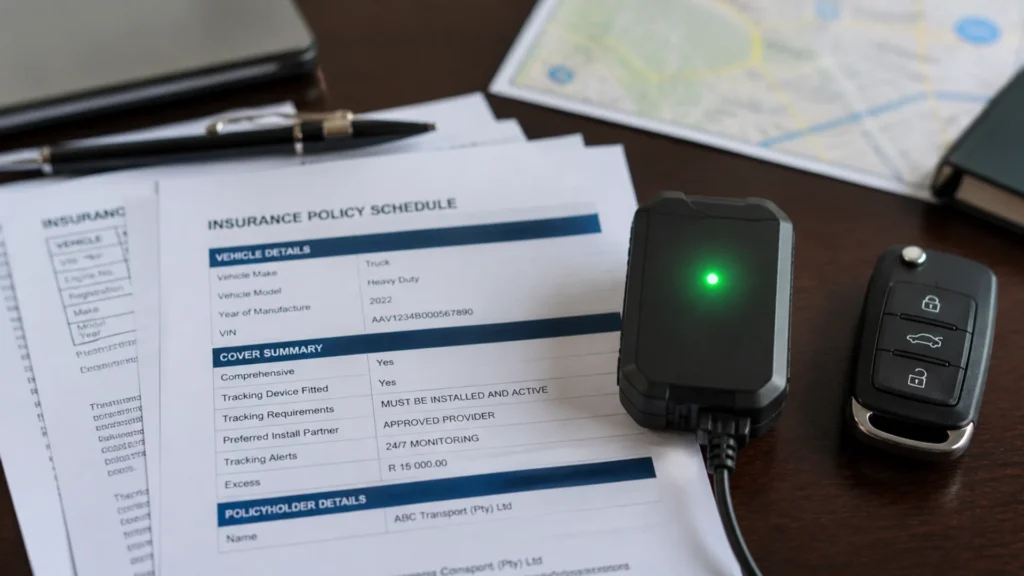
Insurance tracking fleet mandates have quietly become the most powerful force shaping technology adoption in South African fleet management. Santam now requires dual tracking devices on some high-risk vehicles. Cartrack’s founder Zak Calisto has acquired joint control of King Price Insurance, signalling that tracking and insurance are converging into a single industry. Meanwhile, Cartrack reports an 88.3% recovery rate that makes the underwriting case unanswerable. For fleet operators, the implication is clear: the insurer — not the fleet manager — now dictates which technology sits in every vehicle.
This analysis examines how insurance tracking fleet mandates work, why insurers are tightening requirements, which providers meet the approval threshold, and what the Cartrack-King Price merger signals for the future of fleet security and insurance in South Africa.
Why Insurance Tracking Fleet Mandates Now Drive Technology Decisions
Fundamentally, the business logic is straightforward. When a vehicle is hijacked without tracking, the insurer absorbs the full replacement cost. When a vehicle is hijacked with tracking, there is an 82% to 88% chance of recovery — and the insurer pays nothing. Consequently, every untracked vehicle on an insurer’s book represents a liability that tracked vehicles do not. The mandate is not a recommendation. It is risk management.
Santam’s high-risk vehicle list
Santam, South Africa’s largest short-term insurer with over 30% market share in heavy commercial vehicles, publishes an updated high-risk vehicle list that requires tracking installation as a condition of cover. For some vehicles on this list, Santam has doubled the requirement — mandating two separate tracking devices to ensure recovery capability even if criminals find and disable the primary unit. De Wet de Villiers Brokers confirmed this escalation, noting that the dual-tracker mandate targets vehicles with the highest hijacking exposure.
The approved provider system
Importantly, insurers do not accept any tracking device. They maintain approved provider lists. TrackerPrices.co.za confirms that the best tracking companies hold approvals from major insurers including Santam, Old Mutual, Discovery, and others. This approval process involves rigorous testing of tracking technology and recovery processes. It provides independent validation that the system actually works. Fleet operators who install unapproved devices may find their cover invalidated at the point of claim.
From recommendation to condition
Notably, five years ago, tracking was a recommendation that reduced premiums. Today, it is a condition without which cover does not exist. Furthermore, the minimum specification keeps rising. Basic GPS is no longer sufficient. Insurers now expect stolen vehicle recovery capability, jam detection, 24/7 control room monitoring, and — increasingly — AI dashcams and driver identification. Insurance tracking fleet mandates have effectively created a technology floor that every fleet operator must meet.
The Cartrack-King Price Merger: Insurance Tracking Fleet Mandates Reach Their Logical Conclusion
In March 2026, the South African Competition Commission approved Zak Calisto’s bid to take joint control of King Price Insurance. Calisto is the founder and majority shareholder of Karooooo, the JSE-listed group that owns Cartrack. The deal is the most significant signal yet that tracking and insurance are merging into one business.
Why the overlap matters
After all, Cartrack already sells vehicle tracking, fleet management, stolen vehicle recovery, and insurance telematics — as well as broking services and data analytics. These services sit directly adjacent to how insurers price risk and process motor claims. Indeed, Karooooo reported revenue of $139 million for the half year to August 2025, with subscription services making up 98%. A deeper relationship with a major insurer opens the door to using tracking data directly in underwriting — pricing policies based on actual vehicle behaviour rather than statistical averages.
What it means for fleet operators
In effect, the Cartrack-King Price convergence is the clearest expression of a broader trend: the company that tracks the vehicle and the company that insures it are becoming the same entity. For fleet operators, this means insurance tracking fleet mandates will become more granular. Expect insurers to require specific data feeds — real-time driver behaviour scores, fuel consumption anomalies, geofence compliance records — as conditions of cover. The tracking system will not just recover stolen vehicles. It will continuously underwrite the fleet’s risk profile.
How Telematics-Based Policies Reward Insurance Tracking Fleet Mandates Compliance
Insurance tracking fleet mandates are not only punitive. Several insurers now offer tangible rewards for fleets that generate verified safety data.
Discovery Insure: Vitality Drive
Discovery Insure’s Vitality Drive programme monitors driving behaviour through a telematics device or smartphone app. Safe drivers earn fuel cashback at participating retailers — up to 50% back on fuel purchases. The programme also rewards claim-free periods with premium reductions. For fleet operators, Discovery’s model creates a direct financial incentive for every driver to improve their behaviour. The data feeds back to the insurer, strengthening the fleet’s risk profile over time.
MiWay: MyDriveStyle
MiWay — owned by Santam and Sanlam — offers its MyDriveStyle telematics programme. A fitted device scores driving behaviour and offers premium benefits for safe driving. Additionally, MiWay’s Micashback programme returns 10% of premiums every two years for claim-free performance. These programmes demonstrate that the relationship between tracking data and insurance pricing is already live — not a future concept.
Santam: proactive risk management
The Santam 2025 Insurance Barometer confirmed that enhanced tracking systems — including remote immobilisation features — in high-risk vehicles are among the most effective interventions for reducing both premiums and claim frequency. Santam Heavy Haulage, which insures approximately 9,500 heavy commercial trucks, works directly with fleet owners on risk management programmes that integrate tracking data into insurance pricing. Fleets that demonstrate proactive security measures consistently qualify for preferential rates.
The Recovery Data That Drives Insurance Tracking Fleet Mandates
Above all, insurers make decisions based on data. The recovery statistics make the case for mandating tracking unanswerable.
Cartrack reports an 88.3% recovery rate nationally. Tracker reports recovery rates exceeding 90% for monitored vehicles. Across the industry, tracked vehicles achieve an 82% average recovery rate compared to 35% for untracked vehicles. Tracked vehicles recover in 9.4 hours on average. Untracked vehicles take 21.7 hours. Furthermore, vehicles reported within 15 minutes of theft achieve a 78% recovery rate, dropping to 42% if reported after 4 hours.
Therefore, for an insurer, these numbers translate directly to claims costs. An untracked vehicle that is hijacked and not recovered represents a total loss — vehicle replacement, cargo, business interruption, and third-party liability. A tracked vehicle that is recovered within hours represents a fraction of that cost. The maths explains why insurance tracking fleet mandates exist and why they keep tightening.
What Happens When a Fleet Does Not Meet Insurance Tracking Fleet Mandates
In practice, the consequences of non-compliance are not abstract. They are financial and immediate.
Claim rejection
Specifically, if a fleet vehicle is hijacked without the mandated tracking installation, the insurer may reject the claim entirely. The policy wording typically specifies approved tracking as a condition of cover. Failure to maintain the tracking device in working condition — including lapsed subscriptions — can also void the claim. Fleet operators who assume their device is active without verifying may discover the gap only after a loss.
Premium penalties
Similarly, fleets without approved tracking pay significantly higher premiums. In some cases, insurers refuse comprehensive cover altogether, offering only third-party or fire-and-theft policies. For high-risk vehicles on Santam’s list, the absence of the required dual-tracker installation can make the vehicle uninsurable through standard channels.
The total cost of an untracked hijacking
Consequently, a single untracked hijacking generates cascading costs: vehicle replacement (R500,000+ for a Hilux or Ranger), cargo loss, replacement vehicle hire, operational downtime, insurance excess, increased future premiums, and potential policy cancellation. At current vehicle and diesel prices, the total disruption cost of one untracked hijacking can exceed R750,000. The annual tracking subscription — typically R200 to R500 per month — is a fraction of this exposure.
What Fleet Operators Should Do to Meet Insurance Tracking Fleet Mandates
Audit your current tracking status. Confirm that every fleet vehicle has an active, approved tracking device with a current subscription. Check that the provider appears on your insurer’s approved list. Verify that lapsed subscriptions have not silently voided your cover. This audit takes one afternoon and can prevent claim rejection worth hundreds of thousands of rand.
Check the dual-tracker requirement. Review Santam’s high-risk vehicle list — and your own insurer’s equivalent — against your fleet inventory. If any vehicles require dual tracking, confirm that both devices are installed, operational, and monitored. A visible primary unit provides fleet management data. A hidden secondary unit ensures recovery even if criminals disable the first.
Upgrade from basic tracking to SVR. Basic GPS tracking shows location but cannot intervene. Insurers increasingly require SVR capability: jam detection, tamper alerts, remote immobilisation, and 24/7 control room monitoring with armed response. If your current system only shows dots on a map, it may no longer meet your insurer’s minimum standard.
Deploy AI dashcams and driver ID. Forward-thinking insurers are beginning to factor dashcam and driver identification data into premium calculations. Additionally, time-stamped video evidence protects against disputed claims and fraud. Fleet operators who deploy these systems now position themselves for the next wave of insurance tracking fleet mandates — which will require behavioural data, not just location data.
Engage your insurer proactively. Do not wait for policy renewal to discover new requirements. Contact your insurer or broker directly and ask: “What tracking specifications do you require for our fleet today? What will you require next year?” Proactive engagement demonstrates risk maturity and may unlock preferential terms.
Choose an integrated platform. Insurance tracking fleet mandates increasingly require multiple data streams — GPS, SVR, dashcam, driver ID, fuel monitoring — from a single verifiable source. Leading providers including Cartrack, Tracker, Netstar, Ctrack, and DigitFMS offer integrated platforms that satisfy these requirements. DigitFMS connects tracking, AI dashcams, D-Fuel monitoring, driver identification, and autonomous vehicle defence on a single dashboard across its 100+ franchise branches — providing the unified data feed that insurers increasingly demand.
Outlook: Insurance Tracking Fleet Mandates Will Only Tighten
Overall, the direction is unmistakable. The Cartrack-King Price merger puts tracking data at the centre of insurance underwriting. Santam’s dual-tracker requirement shows that a single device is no longer enough for high-risk vehicles. Discovery and MiWay demonstrate that behavioural telematics are already pricing policies. The minimum specification will keep rising.
Specifically, expect three developments in the next 12 to 24 months. First, insurers will require AI dashcam data as a condition of commercial fleet cover — not just tracking. Second, driver identification will become a standard mandate for vehicles carrying high-value cargo. Third, real-time data feeds from fleet platforms to insurer systems will replace periodic reporting — giving underwriters continuous visibility into fleet risk.
Ultimately, for fleet operators, insurance tracking fleet mandates are not a burden to minimise. They are a framework that, when met properly, reduces premiums, improves recovery rates, provides legal evidence, and creates a security infrastructure that protects the business regardless of whether SAPS responds. The operators who treat insurance requirements as the minimum standard — and build beyond them — will run the most resilient fleets in South Africa.
Frequently Asked Questions
Do South African insurers require tracking for fleet cover?
Yes. Most insurers now mandate approved tracking with SVR capability as a condition of comprehensive fleet cover. Santam publishes a high-risk vehicle list requiring tracking. Some vehicles need two separate tracking devices. Fleets without approved tracking face higher premiums, restricted cover, or claim rejection.
Which vehicles require dual tracking devices?
Santam’s high-risk vehicle list typically includes the Toyota Hilux, Ford Ranger, Toyota Fortuner, Volkswagen Polo, and other frequently hijacked models. De Wet de Villiers Brokers confirms that Santam has doubled safeguarding measures on some vehicles, requiring two separate devices for higher security.
How does tracking reduce insurance premiums?
Tracked vehicles achieve 82% to 88% recovery rates versus 35% for untracked vehicles. This dramatically cuts insurer claims costs. Fleet operators with verified tracking, driver monitoring, and dashcam footage typically qualify for 10% to 20% lower premiums. The Santam 2025 Insurance Barometer confirmed tracking as one of the most effective cost-reducing interventions.
Why did Cartrack’s owner acquire King Price Insurance?
The Competition Commission approved Zak Calisto’s bid in March 2026. Calisto owns Karooooo, which owns Cartrack. The acquisition signals that tracking and insurance are converging. Cartrack already sells tracking, SVR, and insurance telematics. A deeper insurer relationship allows tracking data to drive underwriting decisions directly.
What are telematics-based insurance policies?
They use tracking and driver monitoring data to price risk based on actual behaviour. Discovery Insure’s Vitality Drive rewards safe driving with fuel cashback. MiWay’s MyDriveStyle scores driving for premium benefits. These policies create a direct financial incentive for fleet operators to improve driving standards and safety compliance.
What happens if a fleet vehicle is hijacked without approved tracking?
Insurers may reject the claim entirely. The fleet faces vehicle replacement costs exceeding R500,000, cargo loss, hire costs, operational downtime, higher future premiums, and potential policy cancellation. A single untracked hijacking can cost R750,000 or more in total disruption. The annual tracking subscription is a fraction of this exposure.
How do insurance mandates affect technology choice?
Insurance tracking fleet mandates effectively dictate which technology a fleet must deploy. Insurers specify minimum capabilities: SVR, jam detection, control room monitoring, and increasingly AI dashcams and driver ID. Fleet managers choose technology to satisfy underwriter requirements, not just operational needs. The insurer has become the real buyer.
Sources
Santam — 2025 Insurance Barometer; high-risk vehicle list and dual-tracker mandate; Heavy Haulage division data (9,500 trucks insured) · De Wet de Villiers Brokers — Santam high-risk vehicle tracking requirements update · Billionaires.Africa — “Zak Calisto gets green light to take over King Price”, March 2026 · Karooooo — Half-year results to August 2025; $139M revenue, 98% subscription · TrackerPrices.co.za — Best car tracker South Africa 2026; insurer approval process; Cartrack 88.3% recovery rate · Tracker South Africa — Vehicle Crime Index H1 2025; recovery data · Discovery Insure — Vitality Drive programme; fuel cashback and premium rewards · MiWay Insurance — MyDriveStyle telematics; Micashback programme · King Price Insurance — Vehicle tracking requirements and hijacking data · SAPS — Q3 2025/26 crime statistics · AutoTrader South Africa — Most-hijacked brands 2026 risk report
© 2026 DigitFMS. All rights reserved.