
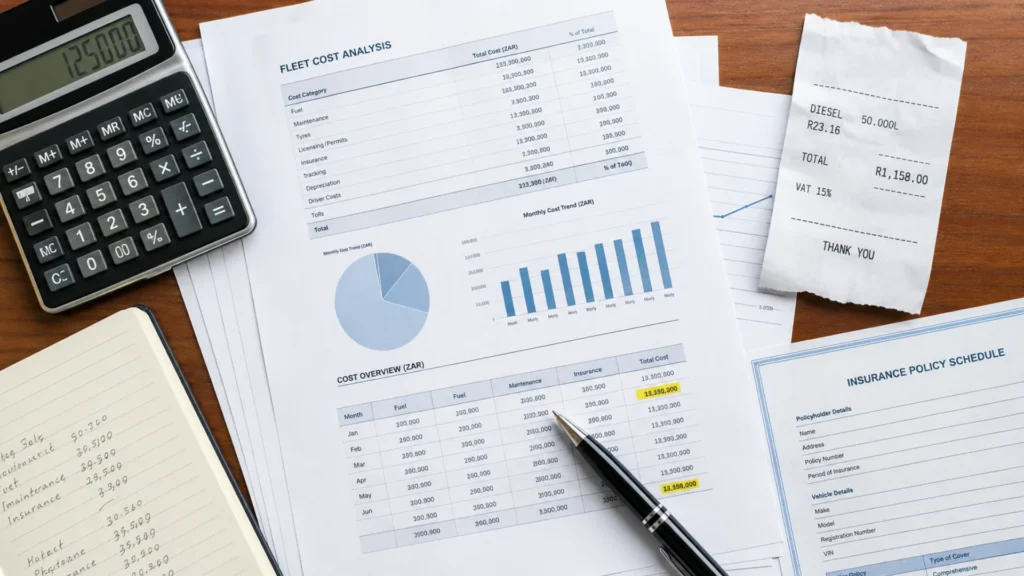
Fleet security cost analysis reveals a number that most South African fleet operators have never calculated: the true cost of NOT protecting their vehicles. At current diesel prices above R26 per litre, a single unmonitored truck losing just 50 litres per week to siphoning costs R65,000 per year in fuel theft alone. Then consider one unrecovered hijacking at R750,000 in total disruption. Factor in insurance premium penalties of R45,000 to R75,000 per year for an untracked fleet. Include missed SARS diesel refunds of R117,000 per month. Layer on driver behaviour waste consuming up to 30% of fuel unnecessarily. The annual cost of running an unprotected 20-vehicle fleet is not measured in thousands. It is measured in millions.
This analysis builds the complete fleet security cost analysis that every operator should run before deciding whether tracking and monitoring technology is “worth it.” It quantifies every cost category, uses real data from South African fleet operations, and compares the total cost of not tracking against the actual price of comprehensive monitoring. The numbers make the decision for you.
Cost Category 1: Fuel Theft — The Largest Hidden Loss in Any Fleet Security Cost Analysis
Fundamentally, fuel is the single largest operating expense for most South African fleets. The Road Freight Association puts fuel at 35% to 55% of total operating costs. However, unprotected fleets do not just pay for fuel — they pay for fuel that disappears.
The per-vehicle maths
Industry data shows 73% of commercial fleets experience fuel theft annually, with 62% of incidents caused by insiders. A driver siphoning 50 litres per week costs the fleet R1,300 per week at R26 per litre. Over a year, that single vehicle loses R65,000. Across a 20-vehicle fleet, the annual loss reaches R1.3 million — and that figure only accounts for direct siphoning. It does not include refuelling fraud (phantom fills), fuel card manipulation, or consumption increases from unauthorised after-hours use.
What monitoring prevents
Fleets that deploy litre-level fuel monitoring report a 78% average reduction in fuel theft within the first year. DigitFMS client data shows even more dramatic results: one mining client achieved a 95% theft reduction and saved R3.2 million in the first year, with ROI achieved in just 6 weeks. A Durban-based transport company recouped system costs in two months after fuel usage dropped 12%. Consequently, the monitoring system cost — typically R200 to R500 per vehicle per month — pays for itself multiple times over through fuel savings alone.
Cost Category 2: Hijacking and Vehicle Loss — The Catastrophic Line in Fleet Security Cost Analysis
By contrast, fuel theft is chronic and cumulative. Hijacking is acute and catastrophic. A single event can cost more than a year of fuel losses.
The total disruption cost
Specifically, when a fleet vehicle is hijacked and not recovered, the costs cascade. Vehicle replacement starts at R500,000 for a Hilux or Ranger. Cargo loss depends on what the vehicle carried. Replacement vehicle hire runs R15,000 to R25,000 per month. Operational downtime affects deliveries, clients, and revenue. Insurance excess typically ranges from R5,000 to R15,000. Future premiums increase — sometimes by 20% to 30% across the entire fleet. Policy cancellation is possible after multiple claims. Administrative costs for police reports, insurance claims, and vehicle procurement add up. In total, a single unrecovered hijacking costs R750,000 or more in total disruption.
The tracking difference
However, tracked vehicles achieve an 82% to 88% recovery rate. Untracked vehicles drop to 35%. Recovery time for tracked vehicles averages 9.4 hours. Untracked vehicles take 21.7 hours — if they are found at all. At 50 hijackings per day nationally, a 20-vehicle fleet operating in Gauteng faces real statistical exposure. Furthermore, one hijacking is not an abstract risk. It is a calculable probability. SAPS data shows business vehicles face 48% higher targeting rates than personal vehicles.
Cost Category 3: Insurance Premium Penalties — The Tax on Unprotected Fleets in Any Fleet Security Cost Analysis
Clearly, insurance is not optional for commercial fleets. However, the cost of insurance varies dramatically based on whether the fleet uses approved tracking.
The premium penalty
In practice, fleets without approved tracking pay 15% to 25% higher premiums than tracked fleets. For a 20-vehicle fleet with annual premiums averaging R15,000 per vehicle, the tracking penalty costs R45,000 to R75,000 per year in additional premiums. Some insurers refuse comprehensive cover entirely for untracked high-risk vehicles — leaving the fleet exposed to uninsured total loss. Santam now requires dual tracking devices on some high-risk vehicles. Non-compliance means restricted cover or outright refusal.
The premium reward
On the other hand, fleets with verified tracking, AI dashcams, and driver identification qualify for 10% to 20% premium reductions. DigitFMS’s fleet cost reduction case study shows a client receiving a 12% insurance premium reduction after video evidence helped resolve two major claims and proved driver innocence. The insurer improved the fleet’s risk rating based on verified dashcam data. In effect, tracking does not just avoid premium penalties — it actively earns premium discounts that offset the monitoring cost.
Cost Category 4: Missed SARS Diesel Refunds — The Revenue Leak in Fleet Security Cost Analysis
Notably, this cost category applies specifically to farming, forestry, and mining operators. However, for qualifying fleets, it represents the single largest revenue recovery opportunity available.
The refund opportunity
SARS now allows 100% diesel levy claims for primary-sector operators — up from 80% as of 1 April 2026. At approximately R5.85 per litre refundable, a farming operation consuming 20,000 eligible litres per month should recover R117,000 per month. Operators who do not claim leave that entire amount on the table. Operators who claim at the old 80% rate lose R23,400 per month compared to the new rate.
Why unmonitored fleets under-claim
In essence, SARS requires accurate records that split eligible from non-eligible diesel use. Without fuel monitoring and GPS-based activity classification, operators either estimate (creating audit risk), under-claim (leaving money uncollected), or do not claim at all. Importantly, undetected fuel theft further distorts the data — stolen diesel inflates apparent consumption, making the eligible/non-eligible split inaccurate. Fuel monitoring solves all three problems simultaneously.
Cost Category 5: Driver Behaviour Waste — The Invisible Drain in Fleet Security Cost Analysis
Perhaps surprisingly, driver behaviour waste is the most underestimated cost in fleet operations because it hides inside “normal” fuel consumption.
The behaviour tax
Harsh acceleration, excessive idling, speeding above optimal RPM ranges, and hard braking waste up to 30% of fuel according to telematics industry benchmarks. A vehicle idling for 30 minutes per day burns approximately 1.5 litres — R39 per day, R285,000 per year across 20 vehicles. Speeding above the engine’s efficiency band increases consumption by 15% to 20%. These costs appear on the fuel bill as “consumption” — not as “waste” — because without monitoring, the fleet manager has no way to distinguish between the two.
What coaching delivers
Fleets that implement structured driver behaviour programmes report 8% to 15% fuel improvements within the first quarter. Cartrack reports customers achieving a 24% decrease in fuel costs through GPS-linked driver coaching. DigitFMS’s case study shows a 40% reduction in idling and harsh events through driver scorecards and targeted coaching — translating directly into lower fuel consumption, reduced maintenance costs, and fewer accidents.
Cost Category 6: Hidden and Consequential Costs That Complete the Fleet Security Cost Analysis
In addition, beyond the five major categories, several hidden costs compound the total.
Unauthorised after-hours use
For instance, fleet operators report that after-hours vehicle use drops by 80% within the first month of deploying driver identification and tracking. Before monitoring, the extent of weekend personal trips, unauthorised passengers, and off-route diversions is invisible. Each unauthorised trip burns fuel, wears tyres and brakes, accumulates kilometres that accelerate service intervals, and voids insurance if an accident occurs. At R26 per litre, 200 km of personal driving costs R936 in fuel alone — multiplied across vehicles and weekends.
Accident liability without evidence
Similarly, without dashcam footage, every accident becomes a disputed claim. Insurers may reject claims where fault cannot be independently verified. Third parties make fraudulent claims against the fleet with no video evidence to refute them. Legal costs for accident disputes range from R20,000 to R100,000 per incident. Time-stamped dashcam footage resolves these disputes instantly — proving driver innocence or establishing third-party liability within minutes.
Maintenance costs from undetected issues
Likewise, a failing injector, dragging brake, or low tyre pressure increases fuel consumption by 5% to 15% before it triggers a breakdown. Without monitoring, the fleet manager discovers the problem through an expensive roadside repair — not a preventative alert. DigitFMS’s case study shows that shifting from reactive to preventative maintenance through tracking data extended vehicle lifespans and reduced emergency repair costs significantly.
CCMA risk and compliance penalties
Additionally, dismissing a driver for misconduct without verified data is a CCMA risk. Driver ID linked to GPS and dashcam footage provides the documented evidence trail that disciplinary processes require. Without it, disputed dismissals can result in reinstatement orders and compensation awards. Additionally, inadequate trip logbooks create compliance exposure for both SARS and road transport regulations.
The Complete Fleet Security Cost Analysis: Unprotected vs Protected
Accordingly, here is the full comparison for a 20-vehicle fleet operating in South Africa at current 2026 costs.
Annual cost of NOT tracking (20 vehicles)
Fuel theft at 50 litres per vehicle per week costs R1,300,000. One unrecovered hijacking over three years averages R250,000 per year. Insurance premium penalties at 20% uplift cost R60,000. Missed SARS refund (farming/mining only) costs R280,800 per year.
Furthermore, driver behaviour fuel waste at 10% of consumption costs approximately R940,000. Unauthorised after-hours use costs approximately R225,000. Idling waste across 20 vehicles costs R285,000. Total annual cost of not tracking: approximately R3.3 million — or more.
Annual cost of comprehensive tracking (20 vehicles)
Monthly subscription at R400 per vehicle for an integrated platform (GPS, fuel, dashcam, driver ID) costs R96,000 per year. Initial hardware and installation at R3,000 per vehicle costs R60,000 once-off (amortised over three years: R20,000 per year). Total annual tracking cost: approximately R116,000.
The gap
Therefore, the annual cost of not tracking (R3.3 million) exceeds the annual cost of tracking (R116,000) by a factor of 28:1. Even if monitoring prevents just 30% of the losses identified above, the fleet saves approximately R990,000 — an 8:1 return on the tracking investment. In reality, DigitFMS clients consistently report 60% to 95% reductions in specific cost categories within the first year. The ROI is not theoretical. It is documented.
Why Fleet Operators Still Resist: The Objections Fleet Security Cost Analysis Must Answer
Landmark Tracking identifies the core problem: fleet managers mistake visibility for control. Installing tracking and reviewing dashboards does not automatically reduce costs. Only structured action — coaching drivers, investigating anomalies, enforcing policies, claiming SARS refunds — turns data into savings.
“We can’t afford tracking right now”
Quite simply, this fleet security cost analysis shows you cannot afford NOT to track. After all, the tracking investment represents less than 4% of the losses it prevents. At R400 per vehicle per month, a single prevented siphoning event (50 litres, R1,300) covers more than three months of subscription cost. The system pays for itself in weeks, not years.
“Our drivers are trustworthy”
Industry data shows 62% of fuel theft is internal. Aon confirms that hijacking syndicates recruit drivers for as little as R5,000. In reality, trust is not a risk management strategy. Furthermore, monitoring protects drivers too — dashcam footage has proven driver innocence in disputed claims, resulting in insurance premium reductions rather than disciplinary action.
“We’ll look at it next quarter”
Every month of delay costs the fleet approximately R275,000 in preventable losses (R3.3 million divided by 12). That is R275,000 that cannot be recovered. After all, diesel prices are not declining. Hijacking rates are not falling. Insurance mandates are not relaxing. The cost of inaction compounds with every passing month.
Who Delivers the Best ROI in Fleet Security Cost Analysis
Naturally, ROI depends not just on the technology but on how comprehensively the platform addresses all six cost categories simultaneously.
DigitFMS delivers the broadest ROI because its integrated platform addresses every cost category in this fleet security cost analysis on a single dashboard: D-Fuel monitoring catches fuel theft and supports SARS refund compliance, AI dashcams reduce accident costs and earn insurance discounts, driver scorecards cut fuel waste by up to 40%, wireless driver ID eliminates unauthorised use, autonomous vehicle defence improves recovery rates, and GPS tracking with geofencing provides the operational intelligence that ties everything together. The company’s 100+ franchise branches ensure local installation, professional sensor calibration, and same-day support — critical factors because inaccurate data produces inaccurate savings calculations.
Other leading providers also deliver strong ROI in their areas of strength. Cartrack’s 88.3% recovery rate and 24% fuel savings benchmarks represent significant value. Tracker’s 90%+ recovery rate and 3,671 H1 2025 recoveries demonstrate SVR leadership. Netstar’s insurance integration delivers premium savings. Ctrack’s engineering-grade customisation serves specialised verticals. The right choice depends on fleet size, sector, and which cost categories represent the largest exposure.
Outlook: Fleet Security Cost Analysis Will Drive Every Procurement Decision in 2026
Overall, the operating environment has made this fleet security cost analysis unavoidable. Diesel at R26 per litre — potentially R35 in May — amplifies every efficiency gain and every preventable loss. Fifty daily hijackings make SVR non-negotiable. Insurance mandates force tracking adoption. The SARS 100% diesel refund turns fuel data into direct revenue recovery. AI dashcams create new data streams that feed both safety and underwriting.
Meanwhile, the SAPS leadership crisis means fleet operators cannot depend on police response. Private security and tracking technology are the real first responders. The 82% recovery rate for tracked vehicles versus 35% for untracked vehicles is not a marketing statistic — it is the difference between absorbing a R750,000 loss and avoiding it.
Ultimately, the question this fleet security cost analysis answers is not “can we afford tracking?” It is “can we afford to keep losing R3.3 million per year?” At a 28:1 cost-to-loss ratio, the answer writes itself. The operators who run this analysis today and act on it will build the most resilient, profitable fleets in South Africa. The ones who delay will keep paying the invisible tax — R65,000 per vehicle, R750,000 per hijacking, R275,000 per month — until the balance sheet forces the decision their analysis should have made for them.
Frequently Asked Questions
How much does fuel theft cost per vehicle per year?
A vehicle losing 50 litres weekly costs R65,000 per year at R26/litre. Across 20 vehicles, that totals R1.3 million. Industry data shows 73% of fleets experience theft, with 62% internal. Monitoring achieves 78% average reduction. DigitFMS clients report up to 95% theft reduction and R3.2 million first-year savings.
What is the total cost of an unrecovered hijacking?
R750,000 or more combining vehicle replacement, cargo loss, hire costs, downtime, insurance excess, premium increases, and administration. Tracked vehicles recover at 82-88%. Untracked vehicles at 35%. The gap determines whether the fleet absorbs or avoids the full disruption cost.
How much do insurance penalties cost untracked fleets?
Untracked fleets pay 15-25% higher premiums — R45,000 to R75,000 per year for a 20-vehicle fleet. Some insurers refuse cover entirely. Tracked fleets with dashcams and driver ID earn 10-20% discounts. DigitFMS clients received 12% premium reductions after dashcam evidence resolved disputed claims.
How much SARS refund do unmonitored fleets miss?
At R5.85/litre refundable, a farming operation consuming 20,000 eligible litres monthly leaves R117,000 unclaimed without accurate data. Operators on the old 80% rate lose R23,400/month versus the new 100% rate. Fuel monitoring provides the verified data SARS requires for full recovery.
What is the ROI timeline for fleet tracking?
Typically 60 to 90 days. DigitFMS clients achieve ROI in as little as 6 weeks. A Durban fleet recouped costs in two months after 12% fuel reduction. Monthly subscriptions of R200-R500 per vehicle represent less than 4% of the losses they prevent. The 28:1 cost-to-loss ratio makes the investment case unanswerable.
What does fleet tracking cost per vehicle?
R45 to R350 per month depending on features. Basic GPS starts around R100/month. Integrated platforms with fuel, dashcam, driver ID, and SVR range from R250 to R500. Annual cost: R2,100 to R6,000 per vehicle. Compare to R65,000/year lost to fuel theft alone — tracking costs less than 10% of the loss it prevents.
What are the hidden costs of an unprotected fleet?
After-hours vehicle use (drops 80% with monitoring), accident liability without dashcam evidence (R20,000-R100,000 per dispute), maintenance from undetected mechanical issues, CCMA risk without verified driver data, compliance penalties for inadequate logbooks, and reputational damage from unreliable delivery. These costs hide inside “operating expenses” until monitoring makes them visible.
Sources
DigitFMS — “The ROI of Fuel Monitoring in South Africa”, October 2025; 95% theft reduction, R3.2M savings, 6-week ROI · DigitFMS — “Case Study: How a South African Fleet Cut Fuel and Maintenance Costs by 25%”, November 2025; 40% reduction in harsh events, 12% insurance premium reduction · DigitFMS — “Real-Time Vehicle Tracking Benefits”, December 2025; Durban transport company 12% fuel reduction, 2-month payback · Road Freight Association — Fuel at 35-55% of operating costs · HVI App — 73% theft rate, 62% internal, 78% monitoring reduction · Cartrack — 88.3% recovery rate, 24% fuel cost decrease · Tracker — 82% tracked vs 35% untracked recovery rates, 9.4 vs 21.7 hours · Santam — 2025 Insurance Barometer, dual-tracker mandate · SARS — Diesel refund update to 100%, rebate item 670.04, April 2026 · Landmark Tracking — “One thing fleet managers are still getting wrong in 2026” · The Tracking Co — Vehicle tracking cost guide 2026, R45-R350/month · Aon South Africa — Insider threat, R5,000 driver recruitment · SAPS — Q3 2025/26 crime statistics, 50 daily hijackings
© 2026 DigitFMS. All rights reserved.