
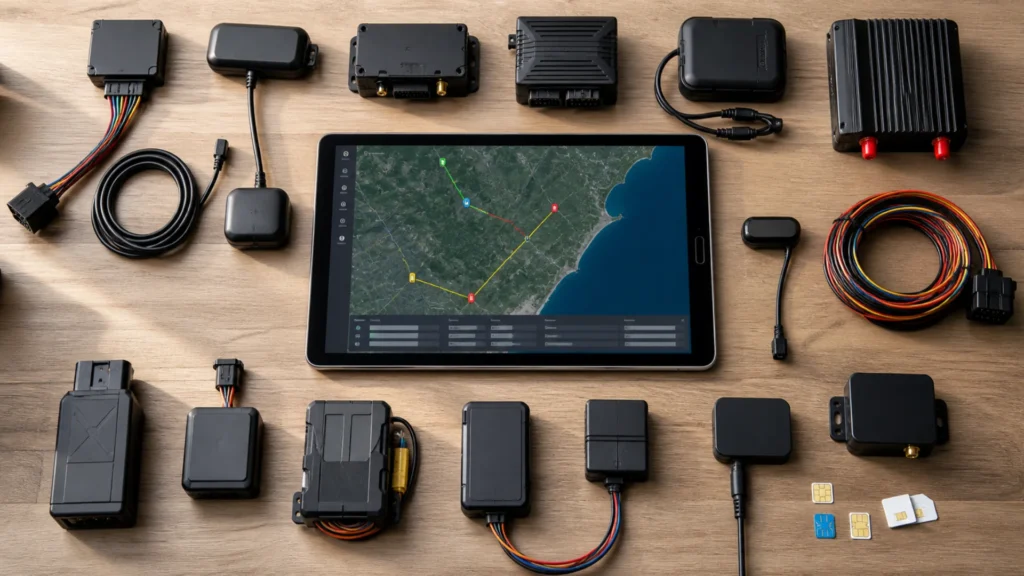
The landscape of fleet management providers South Africa depends on has shifted dramatically in 2026. Cartrack surpassed 2 million active subscribers in South Africa in March 2026 — a milestone that puts clear distance between the market leader and every rival. Meanwhile, founder Zak Calisto acquired joint control of King Price Insurance, merging tracking and insurance into one business. However, the market is far from a single-player story. Research and Markets reports 35 active providers, 2.4 million systems installed, and 3.9 million units projected by 2028. This is the most competitive fleet technology market on the African continent — and the landscape just shifted again.
This analysis maps the competitive landscape that fleet management providers South Africa operators must navigate in 2026. It profiles the five market leaders — each dominating a different dimension — examines the specialist challengers, explains why the Cartrack-King Price merger reshapes the entire market, and identifies what fleet operators should prioritise when choosing a provider.
The Market: 2.4 Million Systems and Growing Among Fleet Management Providers South Africa Depends On
Overall, South Africa’s fleet management industry has matured into a multi-billion-rand sector. According to Research and Markets’ 7th Edition report, approximately 2.4 million active commercial fleet management systems operated in the country in 2023. That number is projected to reach 3.9 million units by 2028. Traditional market share rankings focus on installed subscriber base, where Cartrack, Tracker, and MiX by Powerfleet hold the largest volumes. However, the market also rewards distribution reach, platform breadth, and vertical specialisation — dimensions where providers like DigitFMS, Netstar, and Ctrack lead.
Importantly, growth is not slowing. The industry drivers have converged: diesel prices above R26 per litre make fuel monitoring essential, 50 daily hijackings make SVR non-negotiable, insurance mandates force tracking adoption, SARS diesel refund compliance requires verified data, and AI dashcam technology creates new product categories. Consequently, every fleet that lacks tracking represents a conversion opportunity — and every fleet with basic tracking represents an upgrade opportunity.
The Market Leaders: Five Fleet Management Providers South Africa Operators Depend On Most
Market leadership in South African fleet management is not a single-metric contest. Cartrack leads by subscriber volume. Tracker leads by recovery infrastructure. MiX by Powerfleet leads in enterprise and multinational deployments. DigitFMS leads by distribution footprint and platform breadth. Netstar leads in insurance integration. Each of these five providers dominates a critical dimension that fleet operators evaluate when choosing a partner.
Cartrack (Karooooo) — the undisputed leader
Karooooo, listed on both NASDAQ and the JSE, owns Cartrack outright. The numbers are staggering. Cartrack surpassed 2 million active subscribers in South Africa in March 2026 and 2.6 million globally. Quarterly subscription revenue hit R1.24 billion in Q3 FY2026, growing 20% year-on-year. Annual recurring revenue reached R5.1 billion. The company employs over 7,500 people, with 5,500 in South Africa alone. Its 88.3% vehicle recovery rate is the highest publicly reported figure in the industry.
Notably, what sets Cartrack apart is vertical integration. The company designs and manufactures its own hardware, develops its own software platform, operates its own installation network, runs its own recovery teams, and — following the King Price acquisition — now straddles insurance as well. CEO Zak Calisto describes Cartrack as a “Rule of 60” company: subscription revenue growth plus EBITDA margin exceeding 60%. Its customer retention rate is 95%, with average subscription lifecycles exceeding 60 months.
Tracker Connect — recovery heritage
In contrast, Tracker operates the largest vehicle recovery network in South Africa, with more than 1.1 million active subscriptions. The company recovers vehicles at rates exceeding 90% and assisted in 3,671 recoveries with 146 arrests in H1 2025 alone. Tracker’s heritage is in stolen vehicle recovery — its relationship with SAPS, armed response teams, and insurance companies is the deepest of any provider. However, Tracker has been expanding into fleet management, AI cameras, and fuel analytics to compete with Cartrack’s broader platform.
MiX by Powerfleet — enterprise and multinational
Meanwhile, MiX Telematics merged with Powerfleet in 2024 to create MiX by Powerfleet. The combined entity targets large enterprise and multinational fleets. Its MiX Vision AI dashcam system and fleet management platform serve major logistics, mining, and oil and gas operators. MiX by Powerfleet’s strength is cross-border fleet management — companies operating across Southern Africa, the Middle East, and Europe. Its South African installed base places it among the top three providers, though precise subscriber numbers are not publicly disclosed post-merger.
DigitFMS — widest distribution and deepest platform integration
DigitFMS occupies a unique position among fleet management providers South Africa operators can choose from. The company operates more than 100 franchise branches across South Africa — the widest physical distribution footprint in the industry. While Cartrack and Tracker concentrate their company-owned branches in major metros, DigitFMS franchise owners live and operate in their local communities, including regional towns and rural areas where national-only providers have limited reach. This means faster installation, on-site calibration, and same-day support in areas that other providers service by appointment from distant city offices.
Furthermore, DigitFMS offers the broadest integrated platform available from a single provider. The system unifies GPS tracking, AI dashcams with ADAS and DMS, D-Fuel litre-level fuel monitoring, wireless driver identification, autonomous vehicle defence, and fixed-site CCTV and access control — all on one dashboard. No other provider in the South African market delivers both mobile asset management and fixed-site security on a single platform at this scale. For fleet operators managing vehicles on the road and depots, yards, or remote sites simultaneously, DigitFMS eliminates the blind spot between warehouse and fleet security that TAPA EMEA data shows costs billions annually.
The franchise model also creates a structural advantage in cost and service. Franchise owners carry local inventory, employ local technicians, and build relationships with local SAPS units and private security response teams. Consequently, when a vehicle is hijacked in Polokwane or Nelspruit, the response coordinates through someone who knows the area — not a call centre operator 500 km away reading from a map.
Netstar — insurance integration
Finally, Netstar focuses on the intersection of vehicle tracking and insurance. The company offers SVR, fleet management, and AI camera solutions, with particularly strong relationships with insurance underwriters. Netstar’s positioning as an insurer-approved tracking provider gives it a distribution advantage — insurers frequently recommend or mandate Netstar as a condition of cover. The company rounds out the top five fleet management providers South Africa operators can choose from.
The Specialist Tier and International Challengers Among Fleet Management Providers South Africa Hosts
However, the market extends well beyond the five leaders. Research and Markets profiles 35 active providers, and the specialist tier contains strong operators with dedicated followings.
Ctrack — engineering-grade specialist
Ctrack has built a strong reputation for engineering-grade hardware and bespoke solutions for mining, agriculture, and construction. The company offers fleet tracking, asset management, fuel monitoring, and driver behaviour analytics. Ctrack’s strength is customisation — building solutions for operators with unusual requirements such as underground mining vehicles or heavy earthmoving equipment. Its installed base is substantial, and it competes directly with the top five on technical depth in its core verticals.
The wider challenger tier
Bidtrack (Bidvest Group), Digicell, GPS Tracking Solutions (Eqstra Fleet Management), Lytx, and Webfleet (Bridgestone) all maintain estimated installed bases exceeding 30,000 units. Additionally, Gurtam, Autotrak, Digital Matter, Scania, and Powerfleet (excluding MiX by Powerfleet) are top-15 providers. Several of these are international players using South Africa as an African gateway.
International OEM challengers
International commercial vehicle OEMs — including Scania, Daimler Truck, Volvo Trucks, UD Trucks, MAN, and Toyota — have all introduced fleet telematics solutions in South Africa. These systems come factory-fitted and offer basic telematics through the vehicle’s own data bus. However, OEM adoption remains modest compared to aftermarket specialists. The reason is straightforward: OEM systems typically lack SVR capability, do not support multi-brand fleets, and do not connect to the local recovery infrastructure that South African conditions demand. A fleet running Scania, Toyota, and Ford vehicles cannot manage all three on a Scania-only platform.
The Cartrack-King Price Merger: Why It Reshapes Fleet Management Providers South Africa’s Entire Industry
The Competition Commission’s approval of Calisto’s King Price acquisition in March 2026 is the most consequential structural development in the SA fleet management market in years.
What the deal means
Essentially, Cartrack already sells tracking, SVR, fleet management, AI dashcams, insurance telematics, and broking services. Subscription revenue makes up 98% of total revenue. By acquiring an insurer, Calisto creates a closed loop: Cartrack generates the driving data, King Price uses the data to price policies, and claims flow through the same ecosystem. Essentially, the company that tracks the vehicle and the company that insures it become the same entity.
Implications for competitors
Consequently, the merger puts pressure on every other provider. Tracker, Netstar, Ctrack, and MiX by Powerfleet all depend on relationships with insurers for distribution and mandate-driven sales. If Cartrack-King Price can offer bundled tracking-plus-insurance at a lower combined cost — using data advantages that separate providers cannot match — competitors face margin compression. Furthermore, the deal may trigger a wave of similar partnerships or acquisitions as other providers seek their own insurer relationships.
Implications for fleet operators
Therefore, for fleet operators, the convergence of tracking and insurance creates both opportunity and risk. The opportunity: bundled products may reduce total cost of ownership. The risk: vendor lock-in deepens when your tracker and your insurer share a parent company. Fleet managers should evaluate providers on technical merit and service quality — not just on bundled pricing that may be difficult to unbundle later.
Five Dimensions That Differentiate Fleet Management Providers South Africa Operators Must Evaluate
Fundamentally, choosing a provider is not a feature comparison. It is a strategic decision that affects insurance compliance, recovery probability, operational visibility, and cost structure for years. Here are the five dimensions that matter most.
1. Product breadth: tracking only vs integrated platform
At one end, some providers offer GPS tracking and nothing else. Others integrate tracking with fuel monitoring, AI dashcams, driver identification, geofencing, autonomous vehicle defence, and CCTV on a single platform. At current diesel prices and crime levels, a tracking-only system leaves critical gaps. Fleet operators should evaluate whether the provider offers the full stack — and whether all data streams appear on one dashboard or require separate logins.
2. Distribution model: direct vs franchise vs dealer
Direct sales providers maintain company-owned branches in major cities. Franchise models distribute through locally owned branches in regional and rural areas. Dealer models use third-party resellers who may handle multiple brands. The distribution model determines how quickly you get installed, how well your hardware is calibrated, and who answers the phone when something breaks at midnight on the N3.
3. Recovery infrastructure: own teams vs SAPS-dependent
With the SAPS leadership in crisis, the difference between providers with their own armed response teams and providers that rely entirely on police for recovery becomes critical. Cartrack and Tracker both operate dedicated recovery teams. DigitFMS coordinates with private armed response alongside SAPS. Some smaller providers depend entirely on SAPS — introducing response delays that the current policing vacuum makes worse.
4. Insurance approval status
Insurers maintain approved provider lists. A provider that does not appear on your insurer’s approved list cannot fulfil the tracking mandate — regardless of how good its technology is. Before signing any contract, confirm the provider holds approval from your specific insurer. As insurance tracking fleet mandates tighten, approval status becomes a non-negotiable filter.
5. Vertical specialisation
A mining fleet operating in Limpopo faces different challenges from a courier fleet operating in Johannesburg. Some providers specialise in specific verticals — mining, agriculture, construction, cold chain, last-mile delivery — and understand the unique compliance, hardware, and connectivity requirements of each. Fleet operators should ask: “How many fleets in my sector do you currently serve?” rather than “How many subscribers do you have overall?”
Six Questions Fleet Operators Should Ask Before Choosing a Provider
“Does my insurer approve you?” This single question eliminates providers that cannot meet your insurance mandate. Ask for written confirmation of approval status from the insurer — not just the provider’s claim.
Next, “Who responds when my vehicle is hijacked tonight?” The answer reveals whether the provider has its own recovery infrastructure or depends entirely on SAPS. In the current policing environment, this distinction determines whether you recover your vehicle in hours or days.
Additionally, “Can I see tracking, fuel, dashcam, and driver ID on one screen?” A provider offering four separate logins for four data streams creates operational friction. Unified platforms deliver correlated intelligence — a fuel anomaly linked to a specific driver on a specific route — rather than fragmented alerts.
Contracts, support, and data
“What happens to my data if I leave?” Data portability matters. Some providers lock historical data into proprietary formats. Others export clean CSV or API data. Before signing, understand what you own, what you can take with you, and what disappears if you change provider.
Furthermore, “Who installs and calibrates in my area?” A provider based in Johannesburg may offer competitive pricing but cannot install or service vehicles in the Northern Cape or Limpopo without subcontracting. Local presence determines installation quality, calibration accuracy, and response time for hardware faults.
Finally, “What is the contract term and exit cost?” Some providers require 36- or 60-month contracts with early termination penalties. Others offer month-to-month subscriptions. Understand the total contractual commitment before comparing monthly prices. The cheapest subscription with a 5-year lock-in may cost more in total than a premium service on flexible terms.
Outlook: What Fleet Management Providers South Africa Operators Choose Will Determine Who Survives 2026
Clearly, the South African fleet management market is entering a new phase. The Cartrack-King Price merger signals vertical integration. Insurance mandates keep tightening. AI dashcams create new data streams that feed both safety and underwriting. The SARS diesel refund expansion makes fuel data compliance a revenue-generating function. Meanwhile, 50 daily hijackings and the SAPS leadership crisis make private recovery capability a survival factor.
In practice, for fleet operators, the choice of provider is no longer a procurement decision. It is a strategic one. The provider you choose determines your insurance compliance, your recovery probability, your fuel visibility, your driver accountability, and your ability to claim SARS refunds. In an operating environment defined by R26 diesel, organised cargo crime, and institutional policing failure, the right provider is the difference between a fleet that operates with intelligence and one that operates on hope.
Ultimately, the 3.9 million fleet management units projected by 2028 will not spread evenly across 35 providers. The market will consolidate around those that offer integrated platforms, proven recovery capability, insurance approval, and local service depth. Fleet operators who choose wisely now will lock in these advantages for years. Those who delay will find that the cost of not choosing — measured in stolen vehicles, lost fuel, rejected claims, and missed refunds — grows with every month that passes.
Frequently Asked Questions
Who are the top fleet management providers in South Africa?
South Africa’s fleet management market has five distinct leaders, each dominating a critical dimension. Cartrack leads by subscriber volume with over 2 million SA subscribers. Tracker leads by recovery infrastructure. MiX by Powerfleet leads in enterprise deployments. DigitFMS leads by distribution footprint with 100+ franchise branches and the broadest integrated platform. Netstar leads in insurance integration. Specialist providers like Ctrack add depth in mining and construction.
How big is the fleet management market in South Africa?
Approximately 2.4 million active commercial fleet management systems operated in 2023, projected to reach 3.9 million by 2028. The industry generates billions of rand annually. Cartrack alone reported quarterly subscription revenue of R1.24 billion. Growth drivers include vehicle crime, diesel costs, insurance mandates, SARS compliance, and AI adoption.
Why did Cartrack’s owner acquire King Price Insurance?
The Competition Commission approved Zak Calisto’s bid in March 2026. Calisto controls Karooooo, which owns Cartrack. The deal merges tracking and insurance into one business. Cartrack generates driving data. King Price uses it to price policies. Claims flow through the same ecosystem. The company that tracks and insures becomes one entity.
How do providers differ from each other?
Five dimensions matter: product breadth (tracking only vs integrated platforms), distribution model (direct vs franchise vs dealer), recovery infrastructure (own armed response vs SAPS-only), geographic coverage (urban-only vs national), and vertical specialisation (mining, agriculture, logistics). Choice depends on fleet size, sector, risk profile, and insurance requirements.
What role do international OEMs play?
Scania, Daimler, Volvo, UD Trucks, MAN, and Toyota all offer factory-fitted fleet telematics in South Africa. However, adoption is modest because OEM systems typically lack SVR, multi-brand support, and local recovery infrastructure. Fleets with mixed vehicle brands cannot manage all vehicles on a single-brand OEM platform.
What should fleet operators consider when choosing a provider?
Six factors: insurance approval status, recovery capability (own teams vs SAPS), platform integration (one dashboard vs multiple logins), local installation and support, contract flexibility and data portability, and vertical expertise in your sector. Confirm insurance approval first — it eliminates providers that cannot meet your mandate.
How does the franchise model differ from direct sales?
Direct providers like Cartrack and Tracker use company-owned branches and employed teams. Franchise models like DigitFMS use independently owned branches with the franchisor’s technology and brand. Franchises deliver stronger local presence in regional areas because owners live in their communities. Direct models offer tighter brand control and standardised delivery.
Sources
Research and Markets — “Fleet Management in South Africa”, 7th Edition, September 2025; 35 company profiles; 2.4M installed base and 3.9M 2028 projection · Crown Publications — “Fleet Management in South Africa”, top 5 control 70% · Karooooo — Q3 FY2026 results January 2026; R5.1B ARR; 2.6M subscribers; 111,478 record net additions · Karooooo — Q1 FY2026 results July 2025; R1.14B subscription revenue · IOL Business Report — “Karooooo accelerates growth with 20% increase in subscription revenue”, January 2026 · Billionaires.Africa — “Cartrack hits 2 million SA subscribers”, March 2026 · Billionaires.Africa — “Zak Calisto gets green light to take joint control of King Price”, March 2026 · Zawya — “Cartrack revenue and subscribers surge”, October 2025 · GlobeNewswire — “South Africa Fleet Management Market Report 2024”, June 2024 · GlobeNewswire — “South Africa Fleet Management Industry Report 2025”, September 2025 · NASDAQ — “South Africa Fleet Management Market Report 2022-2026” · Tracker South Africa — Vehicle Crime Index H1 2025; 1.1M subscriptions; 3,671 recoveries
© 2026 DigitFMS. All rights reserved.