
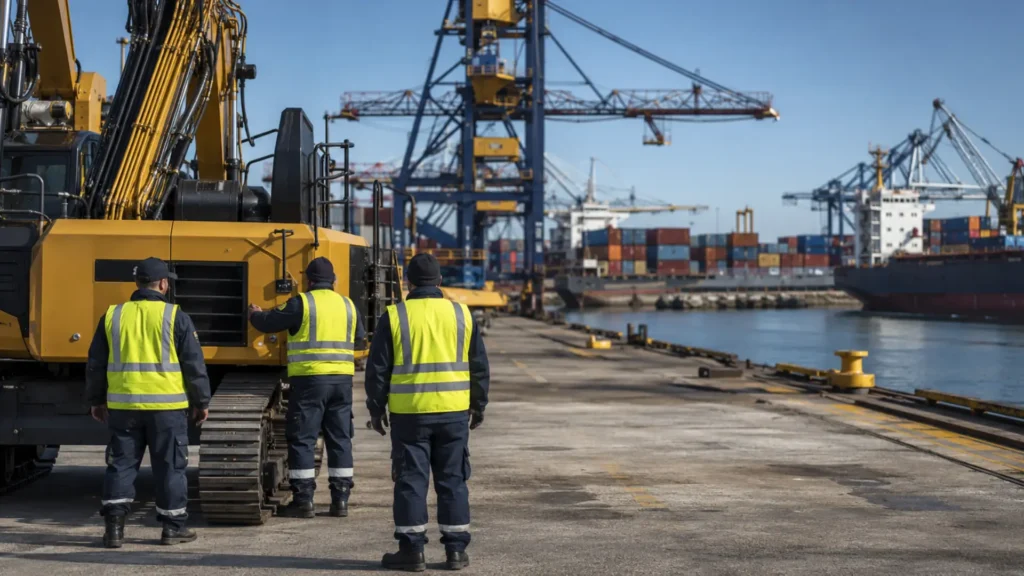
The latest Durban harbour cocaine bust confirms what the Madlanga Commission spent four weeks proving: this port is South Africa’s cocaine gateway — and the institution that catches the drugs is not the one that lost them. SARS customs officials intercepted 90 bricks of suspected cocaine worth R36 million at the Port of Durban on Saturday morning. Smugglers concealed the drugs inside two excavators on a vessel — 47 blocks in one engine compartment panel, 43 in another. Hawks acting KZN provincial head Brigadier Zenobia Mulligan confirmed the seizure at R400,000 per kilogram. This is the same Durban Harbour where 541kg of cocaine worth R200 million entered in June 2021 — and subsequently vanished from Hawks storage while the Madlanga Commission now investigates how.
This analysis examines Saturday’s Durban harbour cocaine bust, explains why SARS succeeds at the same port where the Hawks failed, connects the seizure to the Madlanga Commission testimony about the identical cocaine route, and details what three major busts in 2026 alone reveal about the scale of trafficking through South Africa’s busiest freight port.
What Happened: The Durban Harbour Cocaine Bust That Nets R36 Million
Specifically, the operation unfolded in the early hours of Saturday morning at the Port of Durban, following a targeted SARS customs intelligence protocol.
Two excavators, 90 bricks: inside the Durban harbour cocaine bust
Brigadier Mulligan stated that upon arrival at the port, the scene was handed to DPCI members by customs officials. A thorough inspection of the first excavator “revealed suspicious packages concealed within a panel leading to the engine compartment.” Officials then seized 47 blocks containing a powdered substance suspected to be cocaine. Furthermore, while the first scene was still being processed, customs officials reported discovering a second concealment on another excavator already offloaded from the same vessel. That inspection yielded an additional 43 blocks. In total, SARS recovered approximately 90 kilograms at an estimated street value of R36 million.
Why the excavator method matters for the Durban harbour cocaine route
Crucially, the choice of excavators as concealment vehicles represents a significant escalation in smuggling sophistication at Durban Harbour. Previous interceptions involved cocaine hidden in shipping containers (2021 Scania parts case), bus air conditioning units (May 2026), and truck compartments (Beitbridge). Excavators are heavy industrial machinery with complex engine compartments — making physical inspection time-consuming and concealment harder to detect visually. The fact that SARS caught both excavators suggests intelligence-led targeting rather than random inspection. Consequently, smugglers are adapting their methods while SARS adapts its detection — an arms race fought inside the same port infrastructure that fleet operators use daily.
The Madlanga Connection: Same Port, Same Route, Opposite Outcome to the Durban Harbour Cocaine Bust
Importantly, the timing of Saturday’s bust is extraordinary. The Madlanga Commission concluded its public hearings on the Durban cocaine route just three days earlier.
2021: Hawks caught R200M at Durban harbour — then lost it
First, in June 2021, the Hawks seized 541kg of cocaine worth R200 million from a container at Durban Harbour. The shipment originated from the Port of Santos in Brazil and arrived in Scania truck parts containers. However, instead of securing the drugs at a forensic laboratory, commanders transferred the cocaine to the Port Shepstone Hawks facility — a building with no CCTV and a broken alarm. The entire consignment vanished through the windows. Major-General Senona admitted he never took a polygraph about the theft. Warrant Officer Sander described the storage system as “chaos.” R200 million in drugs caught at Durban Harbour ended up back on the streets.
2026: SARS catches R36M at the same Durban harbour cocaine gateway
In contrast, on Saturday, SARS intercepted R36 million at the same port. The critical difference: SARS customs operates independently of the SAPS command structure the Madlanga Commission documented as compromised. SARS uses its own intelligence systems, its own scanning technology, and its own enforcement teams. Importantly, when SARS handed the scene to the DPCI, the drugs had already been identified, photographed, and documented under SARS custody — creating an evidence chain that began outside the compromised Hawks system. The 2021 bust and the 2026 bust share a port, a commodity, and a detection methodology. They differ in the institution that handled the evidence afterward.
EWN confirms: Durban port is South Africa’s cocaine highway
On Thursday — two days before Saturday’s Durban harbour cocaine bust — EWN published an investigation confirming that Durban port has emerged as a key route in South Africa’s cocaine trade. Journalist Nompendulo Ngubane reported that academics and experts have tracked the Santos-to-Durban trafficking route for at least two decades. Additionally, the Madlanga Commission heard testimony that 4,000+ containers enter Durban daily and authorities cannot search them all. Saturday’s 90 bricks were hidden in heavy machinery, not containers — suggesting the traffickers are diversifying beyond containers into industrial equipment.
Three Busts in 2026: The Durban Harbour Cocaine Pattern Nobody Can Ignore
Clearly, Saturday’s seizure is not an isolated event. It is the third major interception at or near Durban in 2026 — and the pattern reveals the scale of trafficking through South Africa’s busiest freight port.
5 May: R13 million cocaine bust at Durban harbour in bus compartment
Initially, SARS seized 32 blocks of cocaine hidden in the air conditioning compartment of a South American bus at Durban Harbour. Street value: R13 million. The bust demonstrated that traffickers use passenger vehicle components — not just freight containers — as concealment. Similarly, it confirmed the Santos-to-Durban route the Madlanga Commission subsequently documented.
27 May: R1 billion methaqualone bust at Beitbridge from the Durban corridor
Subsequently, BMA intercepted 713kg of methaqualone worth R1 billion at Beitbridge. Our border security analysis documented how intelligence-led technology caught the consignment. While Beitbridge is a land border, the trafficking corridor connects to the Durban port infrastructure. Intelligence tracked the truck’s route from Malawi through Zimbabwe — but the drug supply chain that feeds Durban-area distribution networks runs through the same N3 and N1 corridors fleet operators use daily.
7 June: R36 million cocaine bust at Durban harbour in excavators
Finally, Saturday’s interception brings the 2026 total value of drugs intercepted at or near Durban to over R1.05 billion. That figure counts only what authorities caught. For every consignment intercepted, trafficking experts estimate multiple shipments pass through undetected. The Madlanga Commission heard that SAPS cannot search all 4,000+ daily containers. Accordingly, the R1.05 billion intercepted in 2026 represents a fraction of what actually moves through the port — and every kilogram moves in the same cargo infrastructure that carries legitimate fleet freight.
Why SARS Succeeds at the Same Port: The Durban Harbour Cocaine Bust Institutional Lesson
Fundamentally, the contrast between SARS catching R36 million and the Hawks losing R200 million at the same port is not coincidental. It reflects fundamentally different institutional structures.
SARS operates outside the compromised SAPS command
Fundamentally, SARS Customs reports to the Commissioner of Revenue, not to the National Police Commissioner. Its intelligence systems, personnel, and chain of command are separate from the Hawks. When SARS identifies a suspicious consignment, the investigation does not pass through the SAPS hierarchy that the Madlanga Commission found riddled with corruption. Notably, SARS has conducted three major Durban Harbour operations in 2026 — each producing successful seizures. The Hawks’ most prominent Durban operation during the same period involved losing R200 million and having their provincial head admit he never took a polygraph.
The Beitbridge-Durban-Port Shepstone triangle proves the same lesson
Notably, three institutions operated along the same cocaine route in 2026. Beitbridge saw the BMA catch R1 billion using intelligence-led scanning — operating independently of SAPS. Durban Harbour saw SARS catch R36 million and R13 million — also operating independently. Port Shepstone saw the Hawks under Senona’s command lose R200 million from their own storage. The pattern is clear: agencies that operate independently of the compromised SAPS command structure produce results. The agency operating within it produced the Madlanga Commission.
What the Durban Harbour Cocaine Bust Means for Fleet Cargo Operations
Additionally, fleet operators transiting cargo through Durban Harbour face direct operational consequences from Saturday’s bust and the enhanced security environment it creates.
Enhanced SARS screening means longer port clearance for fleet cargo
Following Saturday’s Durban harbour cocaine bust, SARS will intensify cargo inspections at the port. Fleet operators should expect additional screening delays of 4 to 12 hours on shipments arriving in the coming weeks. Containers on the same vessel as intercepted cargo face particular scrutiny. Fleet operators with complete documentation — cargo manifests, GPS-tracked shipment histories, and verified chain-of-custody records — clear inspections faster. Those without comprehensive documentation face extended holds while SARS verifies legitimacy.
Guilt-by-association risk for legitimate fleet freight at Durban harbour
Similarly, when SARS identifies drug consignments on a vessel, every other cargo unit on that vessel becomes part of the investigation perimeter. Legitimate fleet cargo sharing the same ship may face inspection, documentation requests, and delayed release. Furthermore, if a freight forwarder or shipping line develops a pattern of drug interceptions, all cargo associated with that forwarder faces elevated scrutiny. Fleet operators should verify that their freight forwarding partners use reputable shipping lines with clean compliance records.
The same port infrastructure carries fleet cargo and cocaine simultaneously
Furthermore, the Madlanga Commission testimony established that 4,000+ containers enter Durban daily. Saturday’s bust involved heavy machinery, not containers — expanding the search domain beyond containerised freight. For fleet operators, this means the port’s entire cargo handling infrastructure — quays, cranes, storage yards, and clearance facilities — serves both legitimate commerce and drug trafficking simultaneously. GPS-tracked, documented, and verifiable fleet cargo distinguishes itself from suspicious shipments. Technology that provides chain-of-custody transparency is no longer optional for fleet operators using Durban Harbour.
Five Actions for Fleet Operators After the Durban Harbour Cocaine Bust
Ensure every cargo manifest is complete and current before shipments arrive at Durban. Incomplete documentation triggers extended SARS inspection. A manifest that accounts for every item — with weights, origins, and destination details — clears customs faster than one with gaps or inconsistencies. Brief your logistics team that enhanced screening is now the default at Durban Harbour.
Next, maintain GPS-tracked chain-of-custody records for every Durban shipment. Documentation showing where cargo originated, every handling point it passed through, and when it arrived at port demonstrates legitimate transit. If SARS questions a consignment, GPS data proving consistent legitimate routing resolves the inquiry faster than verbal explanations.
Additionally, verify your freight forwarder uses shipping lines with clean compliance records. A forwarder associated with a vessel that carried drug consignments faces elevated scrutiny on all future shipments. Fleet operators should ask their forwarders directly whether any vessels they use have been involved in drug interceptions. Switching to a forwarder with clean vessel history reduces inspection delays.
Report, adjust, and build the independent evidence chain
Report any suspicious cargo or unusual requests from port personnel directly to SARS. The Madlanga Commission documented police officers involved in drug movement. SARS operates independently of that compromised structure. Reporting directly to SARS rather than SAPS ensures the report reaches an institution with demonstrated integrity at Durban Harbour.
Finally, adjust delivery schedules to account for 4-12 hour enhanced screening delays at Durban. Cold chain and time-sensitive fleet cargo faces spoilage risk if port clearance takes longer than planned. Inform receiving clients that Durban clearance times may extend in the coming weeks following the bust. Build the delay into transport schedules rather than absorbing it as an unplanned cost.
Technology That Provides Fleet Cargo Transparency at Ports Like Durban Harbour
In the wake of the Durban harbour cocaine bust, fleet operators need technology that demonstrates cargo legitimacy — reducing inspection delays and protecting against guilt-by-association.
DigitFMS integrates GPS tracking with geofencing, AI dashcams with cloud upload, D-Fuel litre-level monitoring, wireless driver identification, and chain-of-custody documentation on a single dashboard. Crucially, every data point — route history, driver identity, cargo handling timestamps — provides verifiable evidence that fleet cargo is legitimate. When SARS inspects a fleet consignment at Durban, comprehensive tracking data resolves questions faster than paper manifests alone. The company’s 100+ franchise branches include KZN operators who manage Durban Harbour logistics daily.
Equally, Cartrack, Tracker, Netstar, Ctrack, and MiX by Powerfleet all provide tracking platforms that create verifiable cargo histories. The critical requirement after Saturday’s Durban harbour cocaine bust is comprehensive chain-of-custody data — proving where every consignment originated, who handled it, and how it reached the port. Fleet operators with that data clear enhanced SARS screening. Fleet operators without it join the inspection queue behind the excavators.
Outlook: The Durban Harbour Cocaine Bust Proves the Port Is a Permanent Frontline
Looking ahead, three busts in 2026. Over R1.05 billion intercepted. Cocaine hidden in containers, buses, trucks, and now excavators. The Santos-to-Durban route documented for two decades. The Madlanga Commission confirming police corruption at the same port. SARS and BMA succeeding where the Hawks fail. Durban Harbour is not experiencing a temporary spike in drug trafficking. It is a permanent frontline in an ongoing war — and fleet cargo moves through that frontline every day.
Nevertheless, for fleet operators, the Durban harbour cocaine bust creates a new operational reality. Enhanced screening is now the default. Port clearance times will extend. Documentation requirements will tighten. Cargo sharing vessels with intercepted drugs faces investigation delays. However, these inconveniences carry a positive signal: SARS is doing its job. The agency that caught R36 million on Saturday operates with the intelligence-led, technology-driven integrity that the Madlanga Commission proved the Hawks lacked.
Ultimately, the R36 million Durban harbour cocaine bust is the third chapter in a story this publication has tracked since May: drugs move through the same infrastructure fleet operators depend on. When independent agencies like SARS and the BMA apply technology with integrity, they catch billions in contraband. When compromised agencies like the Madlanga-era Hawks handle the same evidence, R200 million vanishes through a window. Fleet operators who build their own evidence chains — GPS tracking, dashcams, chain-of-custody data, cloud storage — mirror the SARS model rather than the Hawks model. The choice between those models is the Madlanga Commission’s most consequential finding for every fleet manager in South Africa.
Frequently Asked Questions
What happened in Saturday’s Durban harbour cocaine bust?
SARS customs intercepted 90 bricks of suspected cocaine worth R36 million. Smugglers hid the drugs in two excavators — 47 blocks in one, 43 in another, concealed in engine compartment panels. Hawks Brigadier Zenobia Mulligan confirmed the seizure at R400,000 per kilogram. The vessel carried both excavators into Durban Harbour.
How does this connect to the Madlanga Commission?
The same Durban Harbour handled the 541kg cocaine consignment in 2021 that the Madlanga Commission investigated. The Hawks caught that R200M shipment then lost it from storage. SARS caught this R36M shipment using independent systems. Same port, same commodity, opposite institutional outcome. EWN confirmed Thursday that Durban port has emerged as South Africa’s cocaine route.
Why did SARS catch the drugs instead of the Hawks?
SARS Customs operates independently of the SAPS command structure the Madlanga Commission found compromised. SARS uses its own intelligence, scanning, and enforcement teams. When SARS identifies suspicious cargo, the investigation does not pass through the Hawks hierarchy. Three SARS busts in 2026 all produced seizures. The Hawks’ most notable Durban result was losing R200M.
How many drug busts has Durban harbour had in 2026?
Three major interceptions: 5 May (R13M cocaine in bus), 27 May (R1B methaqualone at Beitbridge from the Durban corridor), 7 June (R36M cocaine in excavators). Total intercepted: over R1.05 billion. Trafficking experts estimate multiple shipments pass through undetected for every one caught.
How does the Durban harbour cocaine bust affect fleet cargo?
Enhanced SARS screening means 4-12 hour delays at Durban. Containers on the same vessel as intercepted cargo face additional inspection. Complete documentation and GPS-tracked histories clear inspections faster. Freight forwarders associated with flagged vessels face elevated scrutiny on all shipments. Cold chain cargo faces spoilage risk from extended clearance.
What is the Santos-to-Durban cocaine route?
Academics and law enforcement have tracked cocaine trafficking from the Port of Santos in Brazil to Durban Harbour for at least two decades. The 2021 Scania cocaine arrived via this route. The May 2026 bus cocaine followed the same path. EWN’s Nompendulo Ngubane confirmed Thursday that Durban port is now recognised as a key node in the global cocaine supply chain.
What should fleet operators with Durban cargo do now?
Complete all manifests before shipments arrive. Maintain GPS-tracked chain-of-custody records. Verify freight forwarders use clean shipping lines. Report suspicious activity to SARS directly — not SAPS. Adjust delivery schedules for 4-12 hour screening delays. Build cargo transparency through tracking technology that proves legitimacy during enhanced inspections.
Sources
The Witness — “R36 million cocaine haul seized at Durban Harbour in drug bust”, 6 June 2026; Brigadier Mulligan statement, 47+43 blocks, excavator concealment, R400K per kg · African News Agency — “SARS intercepts 90 bricks of cocaine in major drug bust at Port of Durban”, 6 June 2026; early morning operation, customs-led intelligence · The South African — “SARS intercepts suspected cocaine consignment at Durban port”, 6 June 2026; targeted customs protocol
News24 — “Hawks seize 90kg cocaine worth R36M at Durban Harbour”, 6 June 2026 · EWN — “Durban port emerges as key route in South Africa’s cocaine trade”, 5 June 2026; Nompendulo Ngubane investigation, Santos-to-Durban two-decade route · IOL — “Madlanga Commission: Hawks officer Jacob admits to failures in major cocaine bust”, 4 June 2026; Jacob conduct under fire · IOL — “Senona admits no polygraph after R200M cocaine vanished”, 5 June 2026 · SARS — Previous Durban Harbour narcotics operations October 2025, May 2026
DigitFMS — Madlanga verdict fleet security (6 June), Madlanga Commission whistleblower (4 June), border security fleet technology Beitbridge (1 June), drug cartel fleet infrastructure (14 May), SAPS corruption fleet security (12 May)
© 2026 DigitFMS. All rights reserved.