
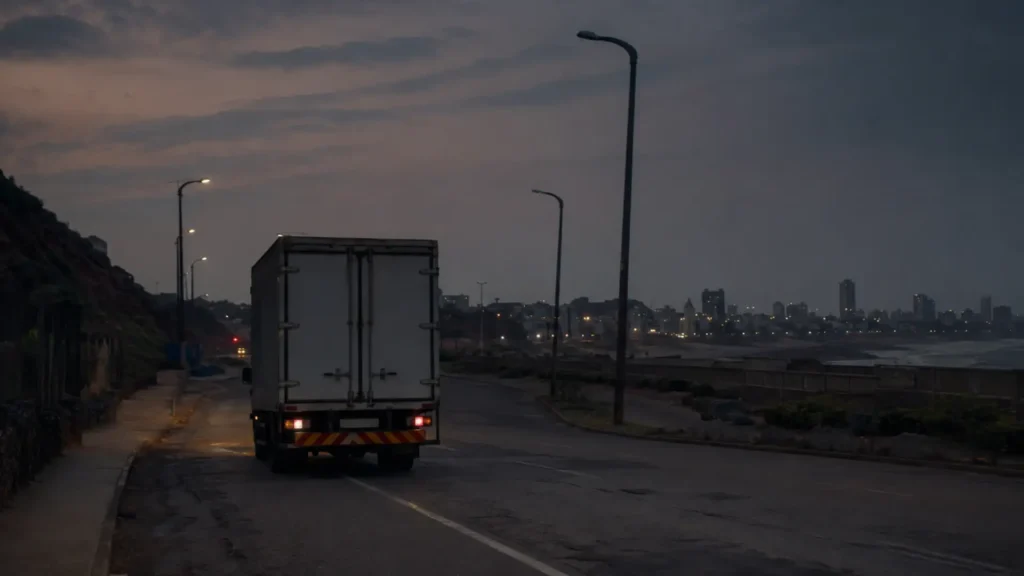
For Durban fleet road safety, the city’s own infrastructure has become a daily operating variable — as eThekwini grapples with failing street lights and stalled roadworks that affect every vehicle on the network after dark. IOL reports the municipality needed R30 million to complete the Old North Coast Road upgrade, with the road partly closed, contractors off site, and exposed excavations posing safety hazards. Separately, the city has faced persistent street-lighting faults across multiple wards. Specifically, the municipality has reprioritised capital budget toward urgent infrastructure, and an investigation into a lighting contract is on record. This article reports those governance matters factually; its focus is practical — what reduced lighting and degraded roads mean for fleet operators, and how to manage the risk.
Importantly, this analysis sets out the documented infrastructure pressures, explains how poor lighting and degraded roads raise both safety risk and vehicle costs for Durban fleets, and provides practical steps operators can take to manage a problem they cannot fix at source.
The Infrastructure Picture Behind Durban Fleet Road Safety
Crucially, the starting point is the documented state of the network. These are matters of public record, reported here factually rather than as criticism.
Roadworks delays affecting Durban fleet road safety
According to IOL, eThekwini needed R30 million to finish the Old North Coast Road upgrade and widening, a R222 million contract originally due for completion in May 2025. Reports indicated the road was partly closed with limited access, contractors had left the site, and cement pallets remained on the roadside. Furthermore, the municipality cited concern about incomplete infrastructure and exposed excavations posing safety hazards. Separately, the city sought additional funding to complete roadworks on Solomon Mahlangu Drive. These are individual projects, but together they illustrate a pattern of delayed completion that leaves road users navigating partial works.
Street-lighting faults and Durban fleet road safety after dark
On lighting, eThekwini has faced well-documented challenges. Opposition councillors have described wards where street lights were non-functional for extended periods, with one citing only about 30% of lights working in his area. Notably, the municipality itself acknowledges that vandalism and theft of infrastructure are major challenges for its streetlights division. The city has stated that functional street lighting enhances visibility for motorists and pedestrians and deters crime. For fleet operators, the practical reality is that some Durban routes carry reduced lighting after dark, whatever the underlying cause.
Budget reprioritisation shaping Durban fleet road safety conditions
The municipality has moved to address these pressures. It approved reprioritising capital budget toward urgent infrastructure, directing significant funding to water, energy, and engineering directorates, including funds to address flood-related infrastructure damage. Additionally, the city has tabled a substantial 2026/27 budget allocating money to road upgrades and bridge construction. These are constructive steps. Nevertheless, the immediate operating environment for fleets reflects the backlog that the reprioritisation aims to address — meaning the conditions on the ground change gradually, not overnight.
After Dark: How Poor Lighting Threatens Durban Fleet Road Safety
Importantly, reduced street lighting is not a cosmetic issue for a fleet. It directly affects the two things that matter most after dark: visibility and security.
Reduced visibility undermines Durban fleet road safety
Specifically, poor lighting gives drivers less time to detect and react to hazards — a pedestrian crossing, a stationary vehicle, a pothole, or debris on the road. Consequently, the safe reaction window shrinks precisely when human alertness is naturally lower. For a heavy vehicle with a longer stopping distance, that compressed window matters even more. Evening and overnight delivery routes through poorly lit areas therefore carry elevated collision risk, independent of how careful the driver is.
Security risk compounds Durban fleet road safety after dark
Additionally, poorly lit areas carry higher security risk. GroundUp has reported Durban communities where residents linked failing street lights to increased crime, and where the city even hired private security to guard electrical infrastructure against cable theft. For fleet operators, a stationary or slow-moving vehicle in an unlit area is more exposed to hijacking and theft. Accordingly, lighting is both a safety and a security variable, and the two combine to raise the overall risk profile of night operations in affected areas.
Hard Surfaces, Hard Costs: Roadworks and Durban Fleet Road Safety
Moreover, beyond lighting, the condition of the road surface itself imposes direct, measurable costs on a fleet.
Vehicle wear as a hidden Durban fleet road safety cost
Notably, degraded surfaces and potholes accelerate wear on tyres, suspension, wheel alignment, and undercarriage components. Each pothole strike risks immediate tyre or rim damage and contributes to cumulative suspension fatigue. Therefore, a fleet operating daily on deteriorated roads faces higher maintenance costs and shorter component life across every vehicle. This is the hidden cost of the infrastructure backlog: it does not appear as a single dramatic expense but as a steady upward pressure on the maintenance budget, multiplied across the fleet.
Incomplete works as a direct Durban fleet road safety hazard
Equally, incomplete roadworks create direct hazards. The municipality itself flagged exposed excavations on the Old North Coast Road as a safety concern. Furthermore, abandoned work sites often have poor or absent signage, unmarked lane changes, and materials left on the roadside. For a driver, especially at night or in Durban’s frequent coastal rain, an unexpected excavation or unmarked diversion is a serious collision risk. Consequently, partial roadworks can be more dangerous than either a finished road or a fully closed one, because they combine normal traffic flow with unexpected hazards.
Documenting damage for Durban fleet road safety claims
Importantly, road authorities can in principle be held liable for damage caused by negligently maintained roads, and motorists do sometimes recover pothole-damage costs. However, success depends on evidence — proof of the defect, its exact location, the date, and the resulting damage. Dashcam footage and GPS data that pinpoint where and when damage occurred strengthen any such claim considerably. Operators should consult their own legal and insurance advisors on the merits, but solid documentation is the foundation of any attempt to recover costs from the responsible authority.
Six Practical Steps to Protect Durban Fleet Road Safety
A fleet operator cannot repair a municipal road or fix a street light. However, the operator can manage exposure to both, turning a fixed external problem into a planned-around variable.
Map hazards and plan routes for Durban fleet road safety
First, use GPS and route data to map the worst-affected roads and plan around them. Identify which routes carry failing lighting, active roadworks, or known potholes, and favour better-lit, better-maintained alternatives for evening and overnight deliveries. Next, adjust scheduling where possible so that the most hazardous sections are travelled in daylight rather than darkness. A delivery rerouted or rescheduled costs less than a collision or a damaged vehicle.
Document defects and maintain vehicles for Durban fleet road safety
Additionally, use dashcams and telematics to document road defects and any resulting damage. This supports maintenance planning and strengthens any claim against the responsible authority. Furthermore, prioritise preventive maintenance on tyres, suspension, and alignment — the components that bear the brunt of poor roads. Catching wear early through scheduled checks is cheaper than a roadside failure and keeps vehicles roadworthy on demanding surfaces.
Brief drivers and report faults for Durban fleet road safety
Then, brief drivers on reduced-visibility driving and hazard awareness. Lower speeds in poorly lit areas, increased following distance, and heightened alertness for pedestrians and potholes all reduce risk. Finally, report faulty street lights and dangerous road defects to the municipality. eThekwini provides channels to report faults, and a documented report both supports the community and creates a record should a defect later cause damage. Reporting is a small civic act that also protects the fleet.
Technology That Manages Durban Fleet Road Safety Risk
Notably, the right technology turns failing infrastructure from an unmanageable external threat into a variable the operator can plan around and document.
DigitFMS integrates GPS tracking with route history, AI dashcams with cloud upload, driver behaviour monitoring, and route management on a single dashboard. The GPS history reveals which roads vehicles actually use, helping managers identify and avoid hazard zones. Dashcams record road conditions and document defects for maintenance and claims. Behaviour monitoring supports safe speeds in poor-visibility areas, and route management directs drivers toward better-lit, better-maintained roads at night. As a KwaZulu-Natal operation, the company’s franchise teams understand Durban’s specific corridors and conditions directly.
Equally, Cartrack, Tracker, Netstar, Ctrack, and MiX by Powerfleet provide comparable tracking and dashcam platforms. The decisive capability for Durban fleet road safety is visibility in both senses — seeing where vehicles go and documenting what they encounter. Fleet operators with that visibility plan around the worst roads, prove damage when it occurs, and keep drivers safer after dark. Those without it absorb the full cost of the infrastructure backlog blindly, discovering hazards only when a vehicle is damaged or a driver is hurt.
Outlook: Durban Fleet Road Safety Is a Managed Risk, Not a Fixed Fate
Ultimately, the eThekwini infrastructure backlog is real, and the municipality’s budget reprioritisation signals an intent to address it. Improvement, however, takes time, and fleet operators must run their businesses through the network as it is today — with some lights out, some roads degraded, and some works incomplete. That is the operating reality for the foreseeable future.
Looking ahead, the operators who treat this as a managed risk rather than an unchangeable fate will protect their vehicles, their drivers, and their margins best. Route planning around hazards, preventive maintenance against wear, evidence capture for claims, and driver briefings for night conditions are all within the operator’s control. None of them fixes a street light, but together they substantially reduce the fleet’s exposure to the consequences of one being out.
Ultimately, Durban fleet road safety in the current environment comes down to controlling what can be controlled. The roads and the lights belong to the municipality; the route choices, the maintenance discipline, the documentation, and the driver preparation belong to the operator. A fleet that plans around the backlog, records what it encounters, and prepares its drivers for dark and degraded roads will keep moving safely while the longer-term infrastructure work proceeds. The conditions are challenging, but the response is firmly in the operator’s hands.
Frequently Asked Questions
What is happening with eThekwini’s roads and street lights?
The municipality is managing significant infrastructure pressures. Street lighting has faced faults, vandalism, and supply delays across multiple wards. On roads, projects including the Old North Coast Road and Solomon Mahlangu Drive faced delays and funding shortfalls. The city has reprioritised capital budget toward urgent infrastructure. These issues affect visibility and road quality for all road users, including fleets.
How do failing street lights affect Durban fleet road safety?
Poor lighting reduces night visibility, increasing collision risk with pedestrians, vehicles, potholes, and debris. It also raises security risk, as unlit areas see more crime, including targeting of stationary vehicles. For operators on evening and overnight routes, reduced lighting means less reaction time, making route planning, vehicle lighting, and driver alertness more important.
How do stalled roadworks and potholes affect fleet costs?
Degraded surfaces accelerate wear on tyres, suspension, alignment, and undercarriage, raising maintenance costs and shortening component life. Incomplete roadworks with exposed excavations or poor signage create direct accident hazards. Across a fleet, these effects compound — turning a municipal problem into a measurable maintenance line item and a genuine safety concern.
What can fleet operators do about poor road infrastructure?
Use GPS and route data to avoid the worst roads, especially at night. Adjust schedules toward better-lit, better-maintained routes for evening work. Use telematics and dashcams to document defect damage for maintenance and claims. Prioritise preventive maintenance on tyres, suspension, and alignment. Brief drivers on reduced-visibility driving. The goal is managing a risk you cannot fix at source.
Can fleet operators claim for pothole damage?
In principle, road authorities can be liable for damage from negligently maintained roads, and motorists do sometimes claim. Success requires strong evidence — the defect, its location, the date, and the damage. Dashcam footage and GPS data that pinpoint where and when damage occurred strengthen a claim. Consult your legal and insurance advisors, but documentation is the foundation of any recovery attempt.
How does technology help with Durban fleet road safety?
GPS tracking with route history maps which roads vehicles use and identifies safer alternatives. AI dashcams record conditions, document defects, and capture incidents. Behaviour monitoring supports safe speeds in poor visibility. Route management directs drivers to better roads at night. Together these convert failing infrastructure from a fixed risk into a managed variable.
Is this only a Durban problem?
No. Maintenance backlogs, failing lights, and pothole damage affect many South African municipalities. Durban’s eThekwini situation is a current, well-documented example, but operators in Johannesburg, Tshwane, and smaller centres face similar challenges. The principles here — route planning, defect documentation, preventive maintenance, and night-driving safety — apply to any fleet on deteriorating municipal roads anywhere.
Sources
IOL — “eThekwini Municipality faces road upgrade delays, seeks R30 million funding”, 2 June 2026; Old North Coast Road R222m contract, May 2025 completion date missed, contractors left site, exposed excavations safety hazard, Solomon Mahlangu Drive R22m, ERRA Ish Prahladh · IOL / The Mercury — “Hundreds of street lights not working across eThekwini”, 2024-2026 reporting; multiple wards affected, ward at 30% functioning, vandalism and cable theft, lighting contract investigation
IOL — “Political parties demand better supply chain management in eThekwini’s budget”, 14 November 2025; capital budget reprioritisation, R314m water and sanitation, R122m smart meters, R62m flood damage engineering · Inside Metros — “R74.7bn eThekwini budget targets housing, roads, water”, 9 May 2026; 2026/27 IDP road and bridge allocations, Mayor Cyril Xaba · GroundUp — “eThekwini fixes streetlights in Bester”, 2023; community crime link, private security for infrastructure, communications head Lindiwe Khuzwayo on vandalism
eThekwini Corporate Website — “Energy Management Directorate Prioritises A Well-Lit City”, April 2026; lighting enhances visibility for motorists and pedestrians, deters crime · DigitFMS — fleet road safety technology N4 crash (17 June), Comrades N3 reopening fleet (15 June), border security fleet technology (1 June). Note: governance and liability matters are reported factually; this is general information, not legal advice.
© 2026 DigitFMS. All rights reserved.