
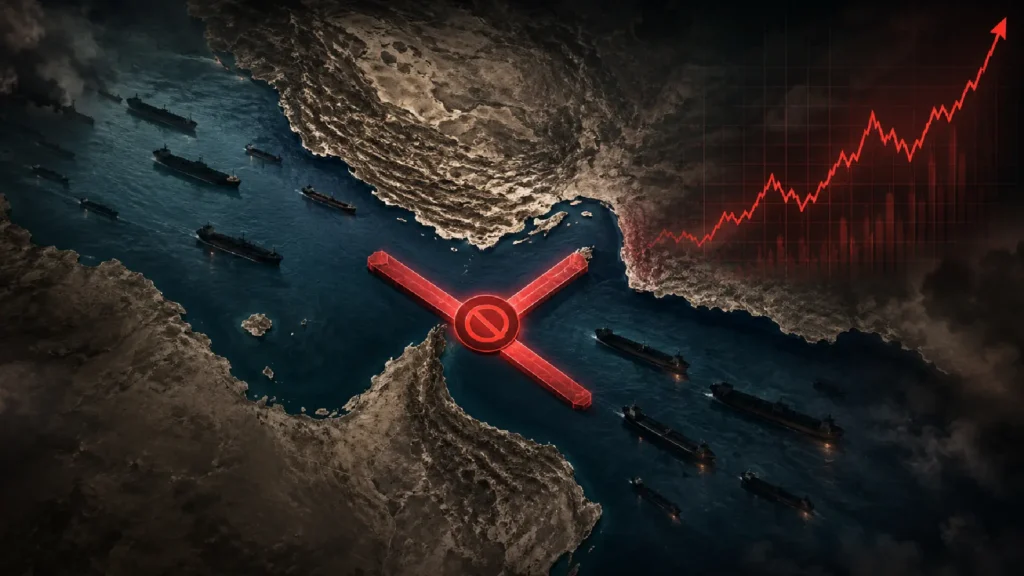
Today marks 100 days since the Hormuz crisis began — and every fleet diesel cost increase in 2026 traces directly to what happened on February 28. On that date, US and Israeli forces struck Iran. Six days later, Iran declared the Strait of Hormuz closed. Vessel traffic collapsed from 138 ships per day to fewer than 5 — according to UK Maritime Trade Operations data. Brent crude surged from $65 to above $100. South African diesel moved from R22 per litre in January to R31.18 in May. CPI hit 4.0%. The SARB hiked rates to 7%. Putco raised fares 10%. Trucks burned on the N3. Ramaphosa addressed the nation on immigration fuelled by unemployment driven by an economy contracting under fuel costs driven by Hormuz.
Specifically, Brookings published yesterday: “Once it opens, the market will take months to normalise.” Everything connects. Nothing is over.
Importantly, this analysis explains the single geopolitical event behind every fleet cost increase documented across our 48-article series, traces the chain from the Strait of Hormuz to a fleet depot in Durban, and models what fleet operators face if the closure extends through the second half of 2026.
What Happened: The Hormuz Crisis That Drove Every Fleet Diesel Price Increase
Crucially, the Strait of Hormuz normally carries approximately one-fifth of global oil supply. It is the only sea route out of the Persian Gulf for Saudi Arabian, Kuwaiti, Iraqi, Qatari, and Emirati oil exports. When Iran closed it on March 4, the world lost access to 17 to 20 million barrels per day of transit capacity.
February 28: the strikes that triggered the Hormuz crisis and fleet diesel surge
The Congressional Research Service documents that US and Israeli military operations against Iran began on February 28, 2026. Iran retaliated by using drones, ballistic missiles, and small attack boats to threaten vessels in the Strait. Furthermore, insurance became unavailable or prohibitively expensive for vessels attempting transit. Seafarers refused to make the journey. By March 8, UKMTO had recorded 10 attacks on ships, killing five crew members. The Strait did not formally “close” with a gate — it became impassable through a combination of military threat, insurance withdrawal, and crew refusal.
March to May: oil surges and fleet diesel follows
Consequently, oil prices rallied 50% in March alone — one of the steepest monthly surges on record. Brent crossed $100 on March 9 for the first time since 2022. Saudi Arabia shut its biggest domestic refinery after a drone strike. Bloomberg warned that diesel — described as “the lifeblood of the global economy” — faced scarcity pricing in Europe and Africa. Consequently, South African diesel prices absorbed the full impact: April saw R7.51 added per litre, May added R5.27, and the fuel index surged 18.2% in a single month.
The April 8 truce: fragile and now failing
Subsequently, an April 8 ceasefire produced a temporary truce that briefly eased oil prices below $105. However, IOL reports the truce has been “rattled” by fresh attacks as the war enters its 100th day. The US struggles to conclude a deal with Tehran. Iran’s Revolutionary Guards threaten further escalation. The Pentagon struck an Iranian island. Accordingly, fleet operators who hoped the truce would reverse diesel prices face the reality that the conflict has entered a protracted phase with no resolution timeline.
The Chain Reaction: How the Hormuz Crisis Drove Every Fleet Diesel Cost in South Africa
The connection between a waterway 8,000 kilometres away and a fleet depot in KwaZulu-Natal runs through a precise chain of cause and effect.
Link 1: Hormuz closes → oil surges → fleet diesel rises R9 per litre
Notably, South African fuel prices derive from international refined product costs plus taxes, levies, and margins. When Brent moved from $65 to $105 — a 62% increase — the international component of diesel rose proportionally. Diesel moved from approximately R22 in January to R31.18 in May: a R9.18 increase per litre. For a 20-vehicle fleet consuming 300,000 litres monthly, this translated to R2.75 million per month in additional fuel costs compared to January.
Link 2: diesel surges → CPI hits 4% → SARB hikes fleet financing rates
Stats SA confirmed that April CPI reached 4.0% — driven by a fuel index increase of 18.2%. Governor Kganyago cited fuel-driven inflation as the primary reason for hiking the repo rate to 7% on May 28. Prime rose to 10.50%. Furthermore, Kganyago warned that if the Hormuz crisis persists, two more hikes could follow — pushing prime to 11.00%. Fleet vehicle repayments increased immediately. The same oil price shock that raised fuel costs also raised financing costs.
Link 3: inflation rises → economy contracts → unemployment fuels unrest
Similarly, higher fuel and food prices contracted consumer spending. Putco raised fares 10%. Taxi associations raised fares across Johannesburg. Transnet hiked container charges 50%. Discovery Insure data showed fuel purchases down 35% and trips down 10%. The SARB lowered its growth forecast while raising its inflation forecast — the textbook definition of stagflation. Higher unemployment drove the anti-immigrant sentiment that triggered March and March, ATDF-ASA, the N3 shutdown, and Ramaphosa’s immigration address.
Link 4: the cascade reaches every fleet corridor and depot
The complete chain now reads: Hormuz closes → oil surges → diesel rises R9 → CPI hits 4% → SARB hikes to 7% → economy contracts → unemployment rises → immigration tensions escalate → 30 June shutdown threatened → N3 blockaded → SAPS fires live rounds → Ramaphosa addresses nation. Every link in this chain appears in our 48-article archive. Every link traces back to February 28. Fleet operators experiencing any of these pressures — fuel costs, financing costs, route disruption, driver safety, regulatory inspections — face symptoms of the same disease: the Hormuz crisis.
What Brookings Says: Why the Hormuz Crisis Fleet Diesel Impact Will Persist
The Brookings Institution analysis published yesterday delivers the assessment fleet operators need — and it is not reassuring.
Brookings: “months to normalise” even after the Hormuz crisis ends
Critically, Brookings states that oil prices will “rise further as the Strait remains closed” and that “once it opens, the market will take months to normalise.” The reasons include depleted global stockpiles that must rebuild, elevated insurance costs that persist after the military threat recedes, shipping route disruptions that take weeks to unwind, and refinery output losses that cannot restart overnight. For fleet operators, this means that even a peace deal tomorrow would not restore R22 diesel this year. The market damage is structural, not temporary.
Bloomberg’s $200 scenario and what it means for fleet diesel costs
Furthermore, in March, Bloomberg reported Macquarie Group analysis showing oil could reach $200 per barrel if the Hormuz closure extended through Q2. The closure has now extended into Q3. At $200 Brent, the international diesel component would approximately double from current levels. South African wholesale diesel could reach R45 to R50 per litre — more than double January’s R22. For a 20-vehicle fleet, monthly fuel costs at R50 diesel would exceed R15 million — compared to R6.6 million in January. This is the extreme scenario. It is no longer theoretical.
Europe faces diesel scarcity — Africa follows
Additionally, Bloomberg also warned that Europe is heading toward “scarcity pricing” for diesel, with “parts of Africa already facing supply disruptions.” Middle Eastern refineries that normally supply Europe and Africa with refined diesel face operational disruption from the conflict. Additionally, Saudi Arabia’s largest domestic refinery shut after a drone strike. If European buyers outbid African buyers for scarce diesel supply, South Africa faces both higher prices AND potential physical shortages — a scenario where fleet operators cannot buy diesel at any price.
Three Scenarios: What Fleet Operators Should Model for the Hormuz Crisis Diesel Outlook
Accordingly, fleet operators must model three scenarios for the second half of 2026 — all driven by the Hormuz crisis trajectory.
Base case: R35 fleet diesel — Hormuz conflict continues at current intensity
In this scenario, Brent holds between $100 and $110. The full R3.93 levy returns 1 July. Diesel sits at R33 to R35 per litre from July through December. The SARB holds at 7% or delivers one additional hike to 7.25%. CPI averages 4.4% as the SARB forecasts. Monthly fuel cost for a 20-vehicle fleet: approximately R10.5 million. This is the planning baseline.
Stress case: R40 fleet diesel — Hormuz escalates or truce collapses
Under these conditions, Brent rises to $120 to $130 as the truce fully collapses or military operations intensify. Diesel reaches R38 to R42 per litre. The SARB delivers two more hikes to 7.50%. Prime reaches 11.00%. Monthly fuel cost: approximately R12.6 million. This scenario aligns with Bernstein’s raised Brent assumption and the SARB’s own adverse projection.
Extreme case: R50 fleet diesel — Hormuz closure becomes protracted
In the worst case, Brent reaches $150 to $200 as global stockpiles deplete and scarcity pricing takes hold. Diesel reaches R45 to R50 per litre. Physical diesel shortages emerge in Africa. The SARB tightens aggressively. Monthly fuel cost: approximately R15 million. Bloomberg and Macquarie flagged this scenario in March. The closure has now outlasted their Q2 timeframe. This scenario is no longer an academic exercise.
Five Actions for Fleet Operators at 100 Days of the Hormuz Crisis Diesel Impact
Model all three scenarios and present them to management this week. Base (R35), stress (R40), and extreme (R50) diesel prices for H2 2026. Calculate the monthly fuel cost for each. Add the financing cost at 10.50%, 10.75%, and 11.00% prime. Show the combined P&L impact. Management must see the full range of what the Hormuz crisis could deliver — not just the base case.
Next, maximise fuel purchases during June while diesel sits at R27.93. The confirmed June price is the lowest fleet operators will see in 2026. Every litre at R27.93 saves R7 or more versus July at R35. If the Hormuz crisis escalates and diesel reaches R40, June purchases save R12 per litre. Fill every tank to capacity before 30 June.
Additionally, deploy fuel monitoring to capture maximum value from every litre. Saving 50 litres per week per vehicle returns R91,000 annually at R35 diesel, R104,000 at R40, and R130,000 at R50. DigitFMS client data shows monitoring systems achieve ROI in 6 weeks regardless of the price. The higher diesel rises, the larger the absolute return on every litre saved through theft detection and efficiency gains.
Lock rates, activate surcharges, and watch Hormuz daily
Lock vehicle financing at fixed rates before the July MPC. Kganyago warned of two more hikes. If Hormuz escalates, those hikes become certain. Variable-rate fleet financing at prime + 2% could move from 12.50% to 13.00% or 13.50% by year-end. Fixed-rate quotes locked in June protect against this trajectory.
Furthermore, activate fuel surcharges on every transport contract with a Hormuz escalation clause. Conventional surcharges adjust monthly based on the DMRE gazette. A Hormuz clause adjusts immediately if Brent crosses predefined thresholds — $110, $120, $150. Fleet operators who negotiate these clauses now protect margins before the next price spike. Those who rely on monthly gazette adjustments absorb 30 days of unrecovered cost every time oil surges.
Finally, monitor Hormuz developments daily — not monthly. A ceasefire announcement can crash oil prices 10% in hours. An escalation can surge them 15% overnight. Fleet operators who track Brent crude, UKMTO shipping reports, and diplomatic developments make faster hedging decisions than those who wait for the DMRE gazette. Hormuz moves in hours. Gazette adjustments happen monthly. That gap is where margins disappear.
Technology That Protects Fleet Operations Regardless of How the Hormuz Crisis Diesel Price Moves
Notably, the Hormuz crisis makes fleet management technology more valuable at every price point — because the return on every litre saved scales directly with the price.
DigitFMS integrates D-Fuel litre-level monitoring, GPS tracking with route optimisation, AI dashcams with driver behaviour scoring, wireless driver identification, and geofencing on a single dashboard. Client data shows 95% theft reduction, R3.2 million first-year savings at current prices, 40% reduction in idling and harsh events, and ROI in 6 weeks. At R35 diesel, those savings translate to R4.1 million — rising to R5.8 million at R50. Yet the technology does not change. Instead, the diesel price amplifies its value.
Equally, Cartrack reports a 24% fuel cost decrease through driver coaching. Tracker delivers 82-88% vehicle recovery rates. Netstar streamlines insurance claims. Every provider’s ROI accelerates as diesel prices rise because the same percentage saving returns a larger absolute amount. A 10% fuel reduction saved R2.20 per litre at R22. It saves R3.50 at R35 and R5.00 at R50. This makes the Hormuz crisis the most powerful business case for fleet management technology in South African history.
Outlook: The Hormuz Crisis Fleet Diesel Reality Has No Expiry Date
Looking back, one hundred days ago, a military decision 8,000 kilometres away redefined fleet economics in South Africa. Diesel doubled in cost trajectory. Financing costs rose. Inflation surged. The economy contracted. Immigration tensions exploded. Trucks burned on the N3. The president addressed the nation.
Looking ahead, Brookings says months to normalise even after reopening. Bloomberg flags $200 oil as possible. The April truce is failing. Iran’s Revolutionary Guards threaten more. The US has not concluded a deal. No analyst, no government, and no institution can tell fleet operators when the Hormuz crisis ends. Consequently, fleet operators must build their operations around the assumption that it continues — and welcome the relief if it doesn’t.
Ultimately, the Hormuz crisis fleet diesel reality is that the war behind every cost increase in 2026 has no expiry date. Fleet operators who accept this — and deploy the fuel monitoring, route optimisation, driver coaching, financing locks, and surcharge clauses that reduce cost per kilometre regardless of the diesel price — will survive R35, navigate R40, and endure R50 if it comes. Fleet operators who continue planning as if R22 diesel will return are planning for a world that the Hormuz closure ended 100 days ago.
Frequently Asked Questions
What is the Strait of Hormuz crisis affecting fleet diesel?
US-Israeli strikes on Iran (Feb 28) triggered Iranian closure of the Strait of Hormuz (Mar 4). Traffic collapsed from 138 ships/day to under 5. Oil surged from $65 to $105. SA diesel moved from R22 to R31. Today marks 100 days. Brookings says months to normalise even after reopening.
How did Hormuz drive SA diesel from R22 to R31?
SA fuel prices derive from international refined product costs. When Brent surged 62% ($65→$105), diesel rose proportionally. April added R7.51/litre. May added R5.27. The fuel index surged 18.2% in one month — steepest since 2008. Diesel specifically jumped 35.4%. Every rand traces to Hormuz.
Why did the SARB hike because of Hormuz?
Fuel-driven inflation pushed CPI to 4% — the tolerance band limit. Kganyago cited this as the primary reason for hiking to 7%. He warned prolonged Hormuz conflict could push inflation to 5% with two more hikes. Fleet financing costs rose immediately from the same crisis that raised fuel costs.
Could oil reach $200 per barrel?
Bloomberg/Macquarie flagged $200 if the closure extended through Q2. It has now extended into Q3. At $200, SA diesel could reach R45-R50. Monthly fleet fuel costs would exceed R15M for a 20-vehicle fleet. Brookings confirms prices will “rise further” while the Strait stays closed.
When will the Hormuz crisis end?
No resolution timeline exists. The April 8 truce is failing. Iran threatens escalation. The US hasn’t concluded a deal. Brookings: months to normalise after reopening. Fleet operators should plan for continuation through 2026 and welcome relief if it comes.
How does Hormuz connect to the 30 June shutdown?
Hormuz→fuel costs→inflation→economic contraction→unemployment→anti-immigrant sentiment→March and March + ATDF-ASA→30 June deadline→Ramaphosa address. Every domestic crisis traces back to the same geopolitical origin. Fleet operators face symptoms of one disease.
What should fleet operators plan for?
Model three scenarios: R35 (base), R40 (stress), R50 (extreme). Buy fuel in June at R27.93. Deploy monitoring for maximum litre savings. Lock financing before July MPC. Add Hormuz escalation clauses to surcharge contracts. Monitor Brent daily, not monthly. Plan for continuation — hope for resolution.
Sources
Brookings Institution — “From chokepoint to crisis: The Strait of Hormuz and global oil markets”, 8 June 2026; “months to normalise,” “prices will rise further,” depleted stockpiles, insurance costs · Congressional Research Service — “Iran Conflict and the Strait of Hormuz: Impacts on Oil, Gas, and Other Commodities”, R45281; February 28 strikes, March 4 closure, 10 attacks, 5 crew killed, insurance withdrawn
Bloomberg — “How High Could Oil Prices Get with Strait of Hormuz Closure?”, March 2026; $200 scenario, Macquarie analysis, diesel scarcity pricing, Europe and Africa supply disruptions · Al Jazeera — “Oil stays above $100 amid Iran’s stranglehold on Hormuz”, March 2026; 138 ships/day to under 5, Khamenei “lever” statement, UKMTO data · Reuters / Yahoo Finance — “Oil rises as expanding US-Israeli conflict elevates supply risks”, March 2026; Bernstein $120-$150 extreme, Saudi refinery shut
Stats SA — CPI April 2026, fuel index 18.2%, diesel 35.4% · SARB — MPC statement 28 May 2026, repo 7%, CPI forecast 4.4%, two more hikes warned · IOL — “Iran war enters 100th day, April 8 truce rattled”, June 2026 · DigitFMS — SARB rate hike (29 May), confirmed diesel drop (2 June), Putco fare hike (21 May), N3 shutdown (30 May), Ramaphosa immigration (8 June), 30 June shutdown (28 May), fuel monitoring ROI
© 2026 DigitFMS. All rights reserved.