
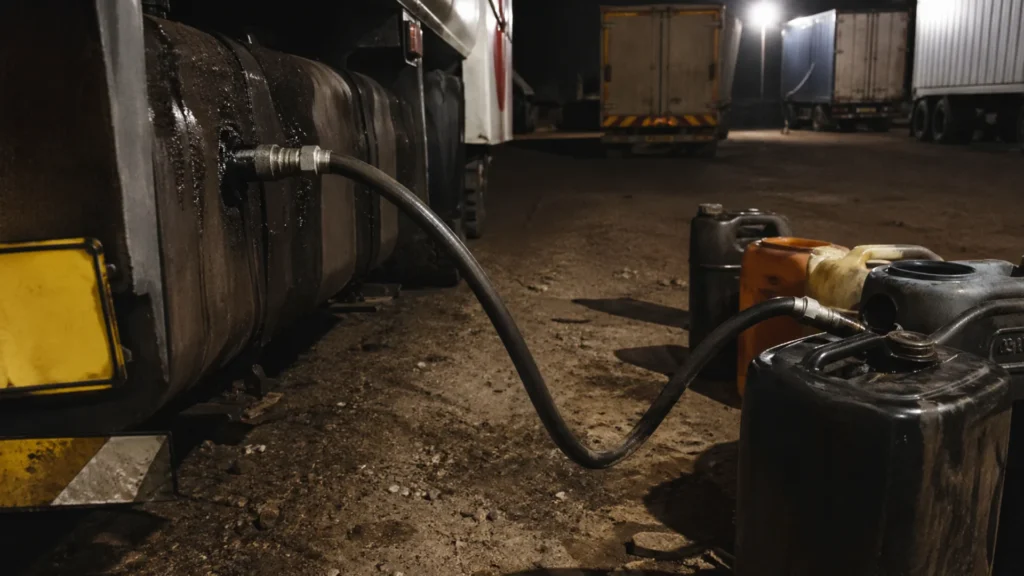
Diesel theft fleet monitoring has moved from optional to urgent as South Africa’s fuel theft crisis deepens. Industry estimates put annual diesel theft losses at R1.5 billion across South African fleets. At the same time, diesel prices have surged past R26 per litre following the April 2026 adjustment. As a result, every stolen litre now costs significantly more — and the incentive to steal has never been higher. A single commercial truck losing just 50 litres per week to siphoning now bleeds approximately R65,000 per year in fuel alone.
This analysis examines the full scale of South Africa’s diesel theft problem, where and how it happens, why the April 2026 price shock has made it worse, and what fleet operators need from a monitoring system that actually stops the bleeding.
The R1.5 Billion Problem: Why Diesel Theft Fleet Monitoring Is Now Urgent
Diesel theft in South Africa is pervasive, underreported, and growing. Industry sources estimate that 15% to 20% of all diesel sold in the country is redistributed through illegal channels. That includes siphoning from vehicle tanks, refuelling fraud, fuel card manipulation, and organised pipeline theft. However, because most incidents go unreported, the true scale almost certainly exceeds estimates.
The April 2026 diesel price shock has amplified the problem. When diesel sat at R18 per litre, a 50-litre weekly theft cost a fleet roughly R47,000 per year per vehicle. At R26 per litre, that same theft costs R65,000. Across a fleet of 20 trucks, the annual loss exceeds R1.3 million — and that is only the direct fuel cost. It does not include the engine damage caused by contaminated replacement fuel, the operational downtime, or the distorted consumption data that undermines SARS rebate claims.
The Road Freight Association has warned that smaller operators face closure within weeks under the current cost structure. For these operators, undiscovered fuel theft can be the difference between survival and shutdown. Consequently, diesel theft fleet monitoring is no longer about optimisation. It is about commercial survival.
How Diesel Gets Stolen: The Methods Fleet Operators Must Understand
Understanding how theft happens is the first step toward stopping it. Diesel theft in South Africa operates across a spectrum — from casual skimming by employees to industrial-scale organised crime.
Driver Skimming and Internal Theft
Surprisingly, most fuel theft does not come from criminals. It comes from employees. Cartrack confirms that the majority of fuel theft occurs from the inside. Drivers siphon small amounts — typically 20 to 50 litres — from the vehicle tank for personal use or resale. This is called skimming. Because the amounts are small per event, they often go unnoticed in monthly reconciliation. However, across a fleet and over months, the cumulative loss is substantial.
In addition, some drivers collude with filling station attendants. The driver presents a fuel card for a full tank, but the attendant only fills partially. The difference is either pocketed as cash or drained into separate containers. Without litre-level monitoring, the fleet manager sees a fuel card transaction for 400 litres but has no way to verify that 400 litres actually entered the tank.
Siphoning at Border Posts and Overnight Stops
Border posts are the highest-risk locations for diesel theft. Trucks sometimes queue for days to cross into or out of South Africa. During this time, organised thieves drain tanks systematically. Digit GP reports thefts of up to 600 litres in a single incident at the Mozambique border. Some trucks are left with so little fuel that another fleet vehicle must bring a refill before they can move — adding hours of operational downtime.
Similarly, overnight rest stops along the N1, N2, and N3 corridors are hotspots. Trucks parked at makeshift yards near construction projects regularly lose their entire fuel load over weekends. Consequently, operators spend the first hours of Monday morning refuelling vehicles that should have been ready to work.
Organised Crime and the Black Market
At the industrial end, organised syndicates steal diesel at scale and redistribute it through illegal channels. Diesel Guard estimates that illegal redistribution accounts for 15% to 20% of all diesel sold in South Africa. The distribution network includes roadside “water carriers,” spaza shops, and even dedicated diesel dispensaries in townships where drivers drive through and have fuel drained while they wait.
Furthermore, the Global Initiative Against Transnational Organised Crime reports that pipeline fuel theft in South Africa exploded from just 2 incidents in the 2018/19 financial year to 143 incidents in 2019/20 — with 10 million litres stolen from the Transnet pipeline network alone. Thieves drill into pipelines, fill industrial-sized tankers, and often leave punctures unsealed — creating fire and environmental hazards on top of the financial loss.
Adulteration and Contamination
Theft does not always mean empty tanks. In some cases, stolen fuel is replaced with diluted product — a mix of paraffin, petrol, or water — to disguise the volume loss. This is particularly common at border crossings where Mozambique, eSwatini, and South Africa converge. The adulterated fuel damages injectors, fuel pumps, and engine components, leading to expensive repairs. As a result, the fleet operator suffers twice: once from the theft, and again from the mechanical damage.
Why the April 2026 Price Shock Makes Diesel Theft Fleet Monitoring Essential
The Department of Mineral and Petroleum Resources confirmed that diesel (0.005% sulphur) increased by R7.51 per litre on 1 April 2026. Wholesale diesel now sits at R25.35 on the coast and R26.11 in Gauteng. Central Energy Fund data suggests a further increase to R35 per litre or more in May if the R3 levy relief expires.
This price environment changes the maths of fuel theft fundamentally. Before April, a 5% fuel loss across a 20-vehicle fleet was a nuisance. After April, that same 5% loss represents tens of thousands of rand per month. Moreover, higher diesel prices increase the incentive for thieves — the street value of stolen diesel has climbed in lockstep with the pump price.
At the same time, SARS has expanded the diesel refund for primary-sector operators to 100% of eligible levies, up from 80%. However, claiming this refund requires accurate fuel records. If diesel is stolen and the loss is not detected, the consumption data submitted to SARS is inaccurate. Therefore, the fleet either under-claims (leaving money on the table) or over-claims (creating audit risk). Diesel theft fleet monitoring solves both problems by providing verified, auditable data.
How Diesel Theft Fleet Monitoring Technology Actually Works
Modern fuel monitoring goes far beyond checking odometer readings against fuel receipts. Here is what a properly deployed system delivers.
Continuous Fuel-Level Measurement
A capacitive or ultrasonic fuel sensor is installed directly inside the vehicle’s tank. It measures actual fuel volume continuously — often every few seconds. This is fundamentally different from vehicle ECU fuel data, which manufacturers filter for driver convenience rather than auditing accuracy. The sensor measures what is physically in the tank, not what the dashboard gauge suggests.
Real-Time Theft Detection
When the engine is off and the vehicle is stationary, any downward movement in fuel level triggers an immediate alert. The alert includes the exact GPS position, time, and volume lost. As a result, siphoning events become visible within seconds — not weeks later during manual reconciliation. The fleet manager receives an SMS or app notification and can see exactly where the vehicle is and how much fuel has disappeared.
Refuelling Verification
The system also detects refuelling events and logs the exact volume added. This allows fleet managers to cross-reference fuel card transactions against actual litres entering the tank. If the card shows 400 litres but only 320 entered the tank, the discrepancy is flagged immediately. Consequently, refuelling fraud — one of the most common forms of internal fuel theft — becomes detectable from the first occurrence.
Consumption Baseline and Anomaly Detection
Over time, the system builds a consumption profile for each vehicle on each route. It knows how many litres per 100 kilometres a vehicle should consume under normal conditions. When actual consumption deviates significantly, the system flags the anomaly. This catches not just theft but also mechanical issues — a failing injector, a dragging brake, or a tyre pressure problem — that silently increase fuel consumption.
Contamination Alerts
Advanced sensors can detect when foreign substances are added to the tank. If water, paraffin, or petrol contaminates the diesel, the system alerts the fleet manager immediately. This protects the engine from damage and identifies tampering events that might otherwise go unnoticed until an expensive repair is needed.
What Diesel Theft Fleet Monitoring Providers Offer in South Africa
The South African market offers several approaches to fuel monitoring, from standalone sensor systems to fully integrated fleet platforms.
Cartrack integrates fuel monitoring into its fleet management platform with driver behaviour reports and fuel-efficient driving coaching. TankSafe specialises in anti-siphon hardware that physically blocks access to the filler neck and drain plug. Diesel Guard offers physical fuel tank protection devices designed for the South African market. Ctrack, Netstar, and MiX by Powerfleet all offer fuel analytics as part of their enterprise fleet platforms.
DigitFMS takes an integrated approach through its D-Fuel system. The platform combines litre-level fuel sensors with GPS tracking, driver identification, and AI dashcams on a single dashboard. This means a fuel theft alert includes not just volume and location, but also which driver was assigned to the vehicle, whether the vehicle deviated from its route, and — if dashcam footage is available — visual evidence of what happened. The company operates more than 100 franchise branches across South Africa, providing local installation and calibration.
In addition, physical anti-theft devices complement monitoring systems. Anti-siphon caps block access to the filler neck. Drain plug locks prevent drainage from underneath. However, physical devices alone do not detect insider fraud, refuelling discrepancies, or consumption anomalies. The strongest protection combines physical barriers with electronic diesel theft fleet monitoring — making theft both harder to commit and impossible to hide.
Six Steps Fleet Operators Should Take This Week
Establish a fuel baseline immediately. Before you can detect theft, you need to know what normal consumption looks like. Record per-vehicle, per-route fuel data for April. This baseline becomes your reference point for identifying anomalies in May.
Cross-reference fuel cards against actual delivery. Compare every fuel card transaction against the vehicle’s odometer and — if available — fuel sensor data. Look for patterns: the same vehicle consistently using more fuel than similar vehicles on similar routes is a red flag.
Secure high-risk parking locations. If your vehicles park overnight at border posts, rest stops, or unsecured yards, these are your highest-risk points. Install anti-siphon devices on all vehicles that regularly park in exposed locations.
Monitor, Report, and Claim
Deploy litre-level fuel monitoring. Fuel card reconciliation catches some theft, but only after the fact. Real-time sensor-based monitoring catches theft as it happens. At current diesel prices, the ROI is measured in weeks, not months.
Brief drivers and set expectations. Make it clear that fuel monitoring is active. Transparency reduces opportunistic theft immediately. Drivers who know every litre is tracked behave differently from drivers who believe no one is watching.
Maximise your SARS diesel refund. If you operate in farming, forestry, or mining, ensure your fuel data is accurate enough to support a full 100% rebate claim. Diesel theft fleet monitoring provides the verified records SARS requires — and ensures you are not leaving money on the table because of undetected fuel losses.
Outlook: Diesel Theft Fleet Monitoring Separates Survivors From Casualties
The economics are unambiguous. At R26 per litre and rising, diesel theft is no longer a background loss that fleets can absorb. It is a visible, quantifiable drain that determines whether an operation remains profitable. The fleets that deploy real-time monitoring will identify and stop losses within the first billing cycle. The fleets that rely on trust and monthly reconciliation will continue losing money they cannot afford to lose.
Indeed, the RFA’s warning is not hypothetical. Smaller operators are already under severe cost pressure. Undiscovered fuel theft — at volumes that seem small per incident but compound over months — can push a marginal operation into the red. At R65,000 per vehicle per year, a fleet of 20 trucks could be losing R1.3 million annually without knowing it.
Ultimately, diesel theft fleet monitoring is the simplest, fastest-returning investment a fleet operator can make in 2026. Every litre accounted for is a litre that stays on the balance sheet. In the current environment, that is the difference between operating and closing.
Frequently Asked Questions
How much diesel is stolen from South African fleets each year?
South African fleets lose an estimated R1.5 billion in diesel to theft annually. Industry sources suggest that 15% to 20% of all diesel sold is redistributed illegally. At current prices above R26 per litre, a single truck losing 50 litres per week costs approximately R65,000 per year.
How do thieves steal diesel from fleet vehicles?
Common methods include siphoning through the filler neck using electric pumps, draining through the drain plug underneath the tank, intercepting fuel lines, refuelling fraud where drivers divert fuel during stops, and fuel card fraud. At border posts, organised thieves can drain up to 600 litres from a single truck while it waits.
How does diesel theft fleet monitoring work?
Capacitive or ultrasonic sensors installed inside the tank measure fuel volume continuously. When fuel drops without engine activity or distance travelled, the system sends an instant alert with GPS position, time, and volume lost. This detects siphoning within seconds rather than at month-end reconciliation.
Where does most diesel theft happen in South Africa?
Hotspots include border posts where trucks queue for days, overnight rest stops along the N1, N2, and N3, unlit truck yards and depots, remote construction and mining sites, and filling stations where drivers collude with attendants. The Mozambique and Lesotho borders are particularly high-risk.
What is the ROI for diesel theft fleet monitoring?
Operators typically recover the cost within 60 to 90 days. A single truck losing 50 litres weekly costs R65,000 per year at current prices. A fleet of 20 vehicles could lose R1.3 million annually. The monitoring system pays for itself by making theft visible and stoppable from day one.
Can fuel monitoring detect contamination?
Yes. Advanced sensors detect water, paraffin, or petrol added to diesel tanks. This is common at border crossings where stolen fuel is replaced with diluted product. Real-time contamination alerts let fleet managers pull the vehicle before engine damage occurs, avoiding expensive injector and fuel pump repairs.
How does diesel theft affect SARS fuel rebate claims?
SARS now allows 100% diesel levy claims for farming, forestry, and mining. However, claims need accurate records of diesel purchased versus consumed. Stolen fuel creates inaccurate data — leading to under-claims or audit risk. Diesel theft fleet monitoring provides the verified records SARS requires for maximum rebate recovery.
Sources
Road Freight Association (RFA) — Operating cost impact statements, April 2026 · Department of Mineral and Petroleum Resources (DMPR) — Official April 2026 fuel price announcement · Central Energy Fund (CEF) — Under-recovery data and May projections · SARS — Diesel refund rate update, April 2026 · Diesel Guard — “The scale of the diesel theft problem in South Africa” · Global Initiative Against Transnational Organised Crime — “Pipeline fuel thefts skyrocket in South Africa”, Risk Bulletin · Cartrack — “How to Prevent Fuel Theft: 7 Instant Tips to Protect Your Fleet”, January 2026 · TankSafe South Africa — Anti-siphon device manufacturer data · Digit GP — Fuel management system theft detection case studies · SourceFin — “Transport fleet fuel cost management South Africa”, 2026 · Truck and Freight — Diesel theft incident reports · Transnet — Pipeline theft statistics 2018–2021
© 2026 DigitFMS. All rights reserved.