
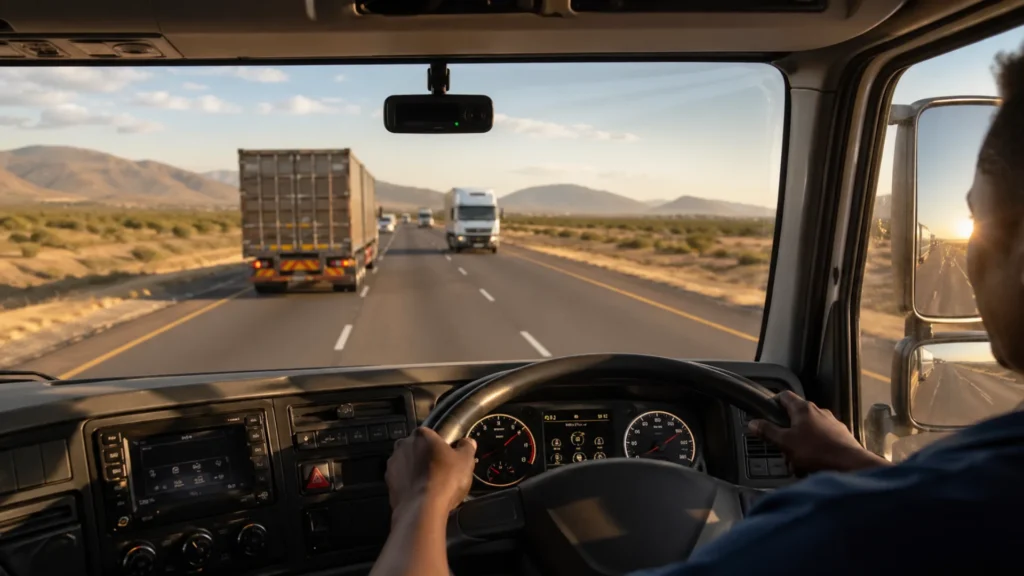
AI dashcam fleet safety technology is gaining ground in South Africa as new government data confirms the country’s road deaths have dropped to a six-year low. Transport Minister Barbara Creecy announced that road fatalities fell 10% in the first quarter of 2026 compared with the same period last year. Crashes dropped 11%. Six of nine provinces recorded decreases. But the minister’s own data carries a stark warning: over 80% of those crashes were still caused by human behaviour. That is the gap AI dashcams are designed to close.
This analysis examines South Africa’s road death crisis through the lens of fleet operations. It breaks down why commercial vehicles are disproportionately deadly, how AI dashcam and ADAS technology targets the specific behaviours that cause crashes, and what fleet managers should demand from a driver monitoring system in 2026.
The Numbers Behind AI Dashcam Fleet Safety Adoption in 2026
South Africa’s road death toll remains one of the highest in the world. The country records approximately 14,000 road fatalities per year. That is a death rate of 20.7 per 100,000 people — more than four times the rate of countries like the UK and Sweden. The Automobile Association of South Africa calls it “a national crisis.”
Minister Creecy’s Q1 2026 data offers cautious hope. Road deaths fell to the lowest level in six years between January and March. The Easter weekend confirmed the trend, with fatalities tracking below 2025 levels. Authorities set up 321 roadblocks and stopped more than 374,000 vehicles. They arrested 500 drivers for drunk driving and 93 pedestrians for jaywalking on freeways.
But enforcement alone cannot solve a behavioural crisis. Creecy herself said it plainly: “Over 80% of road crashes are the direct result of human behaviour.” During the 2024/25 festive season, the RTMC put the figure at 87%. The causes: speeding, drunk driving, fatigue, distraction, loss of control, reckless overtaking, and hit-and-runs. Every one of these behaviours is detectable by AI dashcam fleet safety systems — in real time, before the crash happens.
Why Fleet Vehicles Are Disproportionately Deadly on SA Roads
Commercial vehicles account for a far greater share of fatal crashes than their numbers on the road would suggest. The Road Traffic Management Corporation found that heavy vehicles with a gross mass above 3,500 kilograms cause 9.4% of all fatal crashes. They make up just 3.3% of registered vehicles. That is nearly a three-to-one overrepresentation.
On the N3 toll route — South Africa’s busiest freight corridor between Gauteng and Durban — trucks were involved in 57.3% of all crashes. Of those, 85% were caused by human error. Not mechanical failure. Not road conditions. Driver behaviour.
Fatigue is the dominant factor. According to Arrive Alive, 39% of the main problems truck drivers report are fatigue-related. Research shows 41% of road accidents involve fatigue as a contributing factor. Long-haul drivers covering the N1, N2, and N3 corridors face 10- to 14-hour shifts, often at night, through monotonous stretches with limited rest facilities. The RTMC’s festive season data confirms that 41% of fatal crashes occur on Saturdays and Sundays between 16:00 and 23:00 — the hours when fatigue, alcohol, and reduced visibility combine.
This is the environment where AI dashcam fleet safety technology delivers its greatest impact. Not by replacing enforcement. By reaching inside the cab and intervening before the driver’s lapse becomes a collision.
How AI Dashcam Fleet Safety Systems Actually Work
Modern AI dashcam systems combine two distinct technologies in one device. Understanding the difference matters for fleet managers evaluating providers.
ADAS — Advanced Driver Assistance System. This uses the road-facing camera. It analyses the view ahead in real time and detects forward collision risk when the vehicle approaches another too quickly, lane departure when the vehicle drifts without indicating, unsafe following distance measured in seconds, pedestrians in the vehicle’s path, and speed limit violations. ADAS turns the windscreen into an active safety sensor. It warns the driver with an audible alert before a collision becomes unavoidable.
DMS — Driver Monitoring System. This uses the driver-facing camera. It watches the person behind the wheel and detects fatigue through yawning, head nodding, and prolonged eye closure, distraction through gaze direction and lack of attention, mobile phone use, smoking, seatbelt neglect, and other unsafe cabin behaviours. DMS works with infrared LEDs for night vision. It monitors the driver regardless of lighting conditions.
The critical distinction from a traditional dashcam: AI dashcam fleet safety systems do not just record. They intervene. A standard dashcam captures footage for review after an incident. An AI system detects the risk, alerts the driver in the moment with voice or audio warnings, and uploads the event to the fleet management platform for the manager to review. Prevention, not documentation.
What the Data Shows About AI Dashcam Fleet Safety Results
The business case for AI dashcams rests on measurable outcomes, not theory. Industry data from South African fleet deployments shows consistent patterns across providers.
Crash reduction. Fleets that implement structured AI dashcam and ADAS programmes report significant drops in collision frequency. MiX by Powerfleet cites a 10:1 return on investment when AI dashcams are combined with vehicle telematics. Cartrack’s AI camera system processes event-based footage to target coaching at the specific drivers and behaviours that carry the highest risk.
Fuel savings. Driver behaviour directly affects fuel consumption. Harsh acceleration, hard braking, and speeding waste fuel at every event. Fleets using driver scoring systems — fed by AI dashcam behaviour data — typically see fuel improvements of 8% to 15% within the first quarter. At current diesel prices above R26 per litre, that saving is substantial.
Insurance premium reduction. South African insurers increasingly recognise fleets equipped with AI dashcam technology as lower risk. Fleet operators report premium reductions of 10% to 20% when they provide verified safe-driving data, lower claim frequencies, and time-stamped video evidence for disputed incidents. The dashcam investment often pays for itself through insurance savings before any operational benefit is counted.
False claims defence. Time-stamped video footage from both road-facing and cabin-facing cameras provides verified evidence for insurance claims, third-party disputes, and legal proceedings. In a country where hijacking claims and accident disputes are rising, video evidence has become a financial asset. It protects the driver, the fleet operator, and the insurer.
The South African AI Dashcam Fleet Safety Market in 2026
The driver monitoring market in South Africa has matured rapidly. Five years ago, dashcams were passive recording devices bolted to windscreens. Today, AI-powered dual-facing cameras with real-time analytics are available from every major fleet management provider.
Cartrack offers up to eight internal and external AI cameras per vehicle, with ADAS, DMS, and event-based footage upload. MiX by Powerfleet deploys its MiX Vision AI system with dual-facing cameras and a dedicated fatigue detection camera. Netstar integrates AI camera solutions with GPS tracking and fleet management. Ctrack and Smarttrack SA both offer integrated video telematics platforms for the local market.
DigitFMS integrates AI dashcams and ADAS into its broader fleet intelligence platform alongside GPS tracking, fuel monitoring, and driver identification. The company’s approach connects video telematics data with fuel consumption, route adherence, and maintenance records on a single dashboard. This lets fleet managers correlate a harsh-braking event with its fuel cost, its location, and the driver responsible — rather than reviewing video in isolation.
The common thread across all providers: AI dashcam fleet safety has shifted from a premium add-on to a baseline expectation. Fleet operators who do not deploy driver monitoring in 2026 are operating with a safety gap that insurers, regulators, and clients are increasingly unwilling to accept.
POPIA Compliance: What Fleet Operators Must Get Right
Driver-facing cameras raise legitimate privacy questions under the Protection of Personal Information Act. Fleet operators who deploy AI dashcam systems must get four things right.
First, establish a legitimate purpose. Fleet safety, regulatory compliance, and insurance requirements all qualify. Document the purpose in writing before deployment. Second, inform drivers. Employees must know that in-cab monitoring takes place, what data is collected, how it is used, and who has access. Third, secure the data. Video footage must be encrypted, stored on access-controlled platforms, and retained only for a defined period. Fourth, limit access. Only authorised personnel — fleet managers, safety officers, insurers processing claims — should view footage. Casual browsing or surveillance beyond the stated purpose violates POPIA.
Leading AI dashcam providers build these controls into their platforms. Automated data expiry, role-based access, encrypted cloud storage, and audit trails are standard. Fleet operators who buy cheap standalone dashcams without these protections carry both legal and regulatory risk.
What Fleet Managers Should Demand From an AI Dashcam Provider
Not all AI dashcam systems deliver equal results. Fleet managers evaluating providers in 2026 should assess six capabilities.
Dual-facing cameras with real-time alerts. Both ADAS and DMS must operate simultaneously. The system must alert the driver in the cab — not just upload footage for later review. Passive recording is not prevention.
Platform integration. AI dashcam fleet safety data must connect to your GPS tracking, fuel monitoring, and maintenance systems. Standalone cameras that require a separate login and dashboard create data silos. The value is in correlation: linking a harsh-braking event to its fuel cost, location, and driver identity.
Infrared night vision. South African long-haul drivers work through the night on the N1, N3, and N4. A DMS camera that cannot see the driver after dark is useless during the highest-risk hours. Infrared LED illumination to at least 3 metres is the minimum standard.
Multi-network connectivity. Fleet vehicles travel through remote areas with patchy cellular coverage — Limpopo mining corridors, Eastern Cape passes, Northern Cape stretches. The dashcam must support multiple SIM networks and buffer data on-device for upload when connectivity returns.
Hardware built for local conditions. South African cabs experience extreme heat, dust, and vibration. Consumer-grade dashcams fail within months. Fleet-grade hardware must handle operating temperatures above 60°C, continuous vibration, and dust ingress without degraded performance.
Local installation and support. Professional installation, sensor calibration, and ongoing support from technicians who understand South African fleet conditions are essential. Remote-only support from overseas providers leaves fleet operators exposed when hardware fails on the N3 at midnight.
The Outlook: AI Dashcam Fleet Safety Becomes the Baseline
Minister Creecy’s Q1 data shows that enforcement works. But 321 roadblocks and 374,000 vehicle stops cannot scale to cover every route, every shift, every driver, every night. The 80% human-behaviour gap demands technology that operates inside the cab — continuously, in real time, without fatigue.
The regulatory direction is clear. Creecy is pushing for a zero-alcohol driving limit. She has called for drunk drivers who cause deaths to face premeditated murder charges. The NATIS system shows 342,048 unroadworthy vehicles and 338,659 expired professional driving permits. The regulatory environment is tightening. Fleet operators who cannot demonstrate proactive safety measures will face increasing scrutiny from insurers, clients, and authorities.
The technology is proven. The data is unambiguous. The cost of inaction — measured in lives, in rand, in insurance claims, in reputational damage — grows with every crash that an AI dashcam could have prevented. For South African fleet operators in 2026, AI dashcam fleet safety is no longer an upgrade. It is the baseline.
Frequently Asked Questions
How do AI dashcams improve fleet safety?
AI dashcams use computer vision to monitor road and driver simultaneously. Road-facing cameras detect collision risk, lane departure, and unsafe following distance. Driver-facing cameras detect fatigue, distraction, phone use, and seatbelt violations. The system alerts the driver with in-cab audio warnings within milliseconds. This corrects dangerous behaviour before a crash occurs — prevention, not documentation.
What percentage of SA road crashes are caused by human error?
Transport Minister Barbara Creecy confirmed that over 80% of road crashes result from human behaviour. The RTMC put the festive season figure at 87%. Causes include speeding, drunk driving, fatigue, distraction, and reckless overtaking. AI dashcam fleet safety systems target exactly these behaviours with real-time detection and alerts.
What is the difference between ADAS and DMS?
ADAS uses a road-facing camera to detect external hazards: forward collision risk, lane departure, unsafe following distance, and pedestrians. DMS uses a driver-facing camera to detect internal risks: fatigue, distraction, phone use, smoking, and seatbelt neglect. Together they give fleet operators 360-degree safety coverage of both the road and the driver.
Do AI dashcams reduce insurance premiums?
Yes. South African insurers recognise fleets with AI dashcam and ADAS systems as lower risk. Operators report premium reductions of 10% to 20% with verified driving data, fewer claims, and documented safety performance. The dashcam investment often pays for itself through insurance savings alone.
Are AI dashcams compliant with POPIA?
They must be. Fleet operators need a documented legitimate purpose, must inform drivers about monitoring, must store footage securely with defined retention periods, and must limit access to authorised personnel. Leading providers build POPIA compliance into their platforms with encryption, role-based access, and automated data expiry.
How much do fleet accidents cost South African operators?
A single serious truck accident can cost R1 million or more. That includes vehicle repair, cargo loss, third-party liability, legal fees, insurance excess, driver medical costs, and operational downtime. Heavy vehicles cause 9.4% of fatal crashes despite being only 3.3% of vehicles on the road. The financial exposure is disproportionate to fleet size.
What should fleet managers look for in an AI dashcam provider?
Prioritise dual-facing cameras with both ADAS and DMS, real-time in-cab alerts, integration with GPS and fleet management platforms, infrared night vision, multi-network SIM support for remote areas, POPIA-compliant data handling, and local installation teams who know South African conditions. Avoid standalone cameras that do not connect to your fleet platform.
Sources
Transport Minister Barbara Creecy — 2026 Easter Road Safety Campaign launch, 20 March 2026 · Transport Minister Barbara Creecy — 2024/25 Festive Season Statistics announcement, January 2026 · Road Traffic Management Corporation (RTMC) — Festive season crash reports 2022/23 to 2024/25 · TimesLive — “Barbara Creecy hails drop in road deaths ahead of high-risk Easter travel”, 20 March 2026 · IOL — “What killed over 1,400 people on SA roads this festive season”, 16 January 2026 · IOL — “Why Creecy wants drunk drivers charged with murder”, 28 March 2026 · Swisher Post — “Easter road deaths South Africa 2026”, 4 April 2026 · Xinhua — “7 killed in road accident in South Africa’s Eastern Cape”, 6 April 2026 · Engineering News — “The number of fatal truck crashes on South Africa’s major roads is unacceptable”, 2023 · DSC Attorneys — “Truck Accident Statistics in South Africa”, 2024 · Statistics South Africa — “Road Transport Accident Deaths in South Africa, 2007–2019” · Automobile Association of South Africa — Road death crisis statements · Inside Metros — “Festive season road stats for 2025/26 period” · Berg Insight — Fleet Management in South Africa, 7th Edition
© 2026 DigitFMS. All rights reserved.